
OptiMask: extracting the largest (non-contiguous) submatrix without NaN

Project description






OptiMask: Efficient NaN Data Removal in Python
OptiMask is a Python package designed for efficiently handling NaN values in matrices, specifically focusing on computing the largest non-contiguous submatrix without NaN. OptiMask employs a heuristic method, relying on numpy and numba for speed and efficiency. In machine learning applications, OptiMask surpasses traditional methods like pandas dropna by maximizing the amount of valid data available for model fitting. It strategically identifies the optimal set of columns (features) and rows (samples) to retain or remove, ensuring that the largest (non-contiguous) submatrix without NaN is utilized for training models.
The problem differs from the computation of the largest rectangles of 1s in a binary matrix (which can be tackled with dynamic programming) and requires a novel approach. The problem also differs from this algorithmic challenge in that it requires rearranging both columns and rows, rather than just columns.
Key Features
- Largest Submatrix without NaN: OptiMask calculates the largest submatrix without NaN, enhancing data analysis accuracy.
- Efficient Computation: With optimized computation, OptiMask provides rapid results without undue delays.
- Numpy, Pandas and Polars Compatibility: OptiMask adapts to
numpy,pandasandpolarsdata structures.
Utilization
To employ OptiMask, install the optimask package via pip:
pip install optimask
OptiMask is also available on the conda-forge channel:
conda install -c conda-forge optimask
mamba install optimask
Usage Example
Import the OptiMask class from the optimask package and utilize its methods for efficient data masking:
from optimask import OptiMask
import numpy as np

# Create a matrix with NaN values
m = 120
n = 7
data = np.zeros(shape=(m, n))
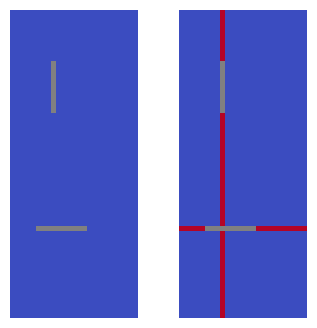
data[24:72, 3] = np.nan
data[95, :5] = np.nan

# Solve for the largest submatrix without NaN values
rows, cols = OptiMask().solve(data)

# Calculate the ratio of non-NaN values in the result
coverage_ratio = len(rows) * len(cols) / data.size

# Check if there are any NaN values in the selected submatrix
has_nan_values = np.isnan(data[rows][:, cols]).any()

# Print or display the results
print(f"Coverage Ratio: {coverage_ratio:.2f}, Has NaN Values: {has_nan_values}")
# Output: Coverage Ratio: 0.85, Has NaN Values: False
The grey cells represent the NaN locations, the blue ones represent the valid data, and the red ones represent the rows and columns removed by the algorithm:
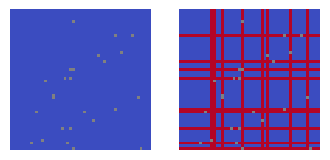
OptiMask’s algorithm is useful for handling unstructured NaN patterns, as shown in the following example:
Performances
OptiMask efficiently handles large matrices, delivering results within reasonable computation times:
from optimask import OptiMask
from optimask.utils import generate_mar

x = generate_mar(m=100_000, n=1_000, ratio=0.02)
%time rows, cols = OptiMask(verbose=True).solve(x)
# CPU times: total: 484 ms
# Wall time: 178 ms

# 	Trial 1 : submatrix of size 37190x49 (1822310 elements) found.
# 	Trial 2 : submatrix of size 37147x49 (1820203 elements) found.
# 	Trial 3 : submatrix of size 37733x48 (1811184 elements) found.
# 	Trial 4 : submatrix of size 37163x49 (1820987 elements) found.
# 	Trial 5 : submatrix of size 35611x51 (1816161 elements) found.
# Result: the largest submatrix found is of size 37190x49 (1822310 elements) found.
Documentation
For detailed documentation,API usage, examples and insights on the algorithm, visit OptiMask Documentation.
Related Project: datafiller
If you're working on data imputation, check out datafiller, another Python package I developed. datafiller is designed for general data imputation, includes a wrapper for time series workflows, and relies heavily on optimask.
Citation
If you use OptiMask in your research or work, please cite it:
@INPROCEEDINGS{Joly2025-vq,
title = "{OptiMask}: Efficiently finding the largest {NaN-free}
submatrix",
booktitle = "Proceedings of the Python in Science Conference",
author = "Joly, Cyril",
abstract = "OptiMask is a heuristic designed to compute the largest, not
necessarily contiguous, submatrix of a matrix with missing
data. It identifies the optimal set of columns and rows to
remove to maximize the number of retained elements.",
publisher = "SciPy",
pages = "67--74",
month = jul,
year = 2025,
copyright = "https://creativecommons.org/licenses/by/4.0/",
conference = "Python in Science Conference, 2025",
location = "Tacoma, Washington"
}
This paper is available at https://doi.org/10.25080/uaha7744.
Release history Release notifications | RSS feed


Download files
Download the file for your platform. If you're not sure which to choose, learn more about installing packages.
Source Distribution
Built Distribution
Filter files by name, interpreter, ABI, and platform.
If you're not sure about the file name format, learn more about wheel file names.
Copy a direct link to the current filters
File details
Details for the file optimask-1.3.12.tar.gz.
File metadata
- Download URL: optimask-1.3.12.tar.gz
- Upload date:
- Size: 14.0 kB
- Tags: Source
- Uploaded using Trusted Publishing? No
- Uploaded via: twine/6.2.0 CPython/3.14.3
File hashes
| Algorithm | Hash digest | |
|---|---|---|
| SHA256 |
620334cf50bf118880faab32e07faa50c1cd5c017e473ff192b4887730377376
|
|
| MD5 |
3b8e08c79731fcff39c9ad2eef3aac9a
|
|
| BLAKE2b-256 |
9ad20502d0c66165d1a5cad0e5d2a4849f1b4a5ba7fb527f2ccd23d68bad7441
|
File details
Details for the file optimask-1.3.12-py3-none-any.whl.
File metadata
- Download URL: optimask-1.3.12-py3-none-any.whl
- Upload date:
- Size: 13.1 kB
- Tags: Python 3
- Uploaded using Trusted Publishing? No
- Uploaded via: twine/6.2.0 CPython/3.14.3
File hashes
| Algorithm | Hash digest | |
|---|---|---|
| SHA256 |
aa465eede398d4b45b039335a4bee95d5d34ca1c91712a40859cecb03a2b3349
|
|
| MD5 |
6f7c7f8cf5162894c3eab9c4e87e1b3f
|
|
| BLAKE2b-256 |
21c0621958503f67b03682809241224c4e56720ff9209f548bfc3d68b70078ae
|






