
opyratorfront
Generate opyrator UIs and webservices and docker containers from python functions
To install: pip install opyratorfront
What it's about
opyrator
(From the readme of opyrator):
opyrator allows us to write code like this:
from pydantic import BaseModel


class Input(BaseModel):
    message: str


class Output(BaseModel):
    message: str


def hello_world(input: Input) -> Output:
    """Returns the `message` of the input data."""
    return Output(message=input.message)
Putting this in a file named my_opyrator.py and running
opyrator launch-ui my_opyrator:hello_world
from the command-line, we can get a web UI that looks like this:
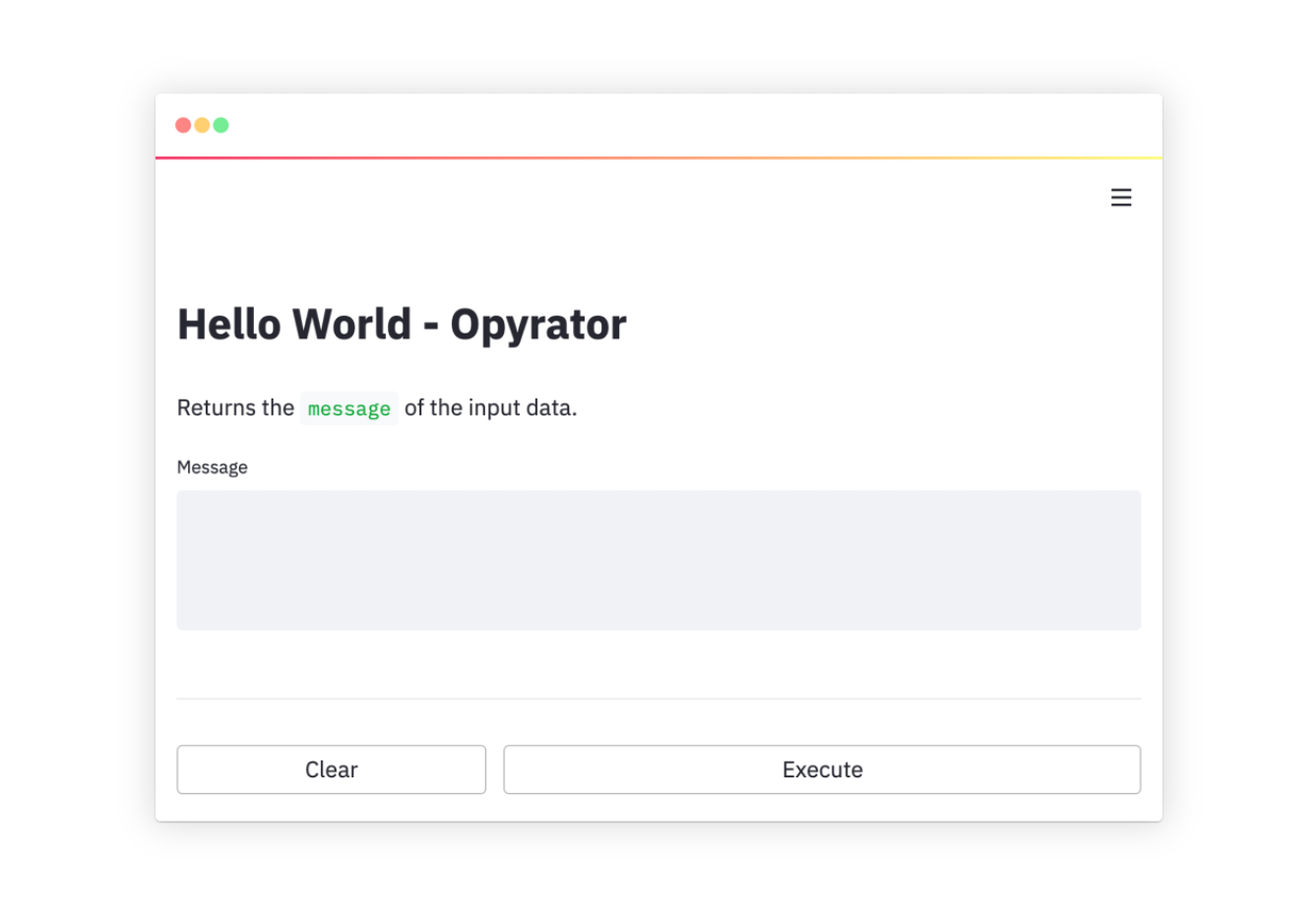
Not only that, we can also get the underlying webservice, along with an openAPI specification of the latter, by doing this:
opyrator launch-api my_opyrator:hello_world
opyratorfront
We have tools (namely py2dash and streamlitfront ) to get from a set of functions to a web UI.
Now streamlitfront, like opyrator, uses streamlit to make a UI from
python, but streamlit doesn't provide a way to remove the UI concern and
only use the underlying web-service independently.
(Though there's interest in this.)
opyrator not only offers that possibility, but also
many other desirable "dispatches".
That said, opyrator doesn't come with all the boilerplate minimized
multi-function get-from-python-functions-to-a-ui-wrapper stuff we'd want.
So we made opyratorfront to try to get the best of both worlds.
1 maintainer

Metadata
1 maintainer
Release files for opyratorfront 0.1.3
For a detailed explanation of source distributions (sdists) and built distributions (wheels), please see the package formats documentation.
Source distribution (sdist)
| File | Size | Uploaded | Provenance | Actions |
|---|---|---|---|---|
| opyratorfront-0.1.3.tar.gz | 11.2 kB | Without provenance | Details for opyratorfront-0.1.3.tar.gz |
Built distribution (wheel)
| File | Interpreter | ABI | Platform | Actions Reset |
|---|---|---|---|---|
| opyratorfront-0.1.3-py3-none-any.whl | Python 3 | none | any | Details for opyratorfront-0.1.3-py3-none-any.whl |
Total release size: 18.6 kB
Release files / opyratorfront-0.1.3.tar.gz
| Download URL | opyratorfront-0.1.3.tar.gz |
|---|---|
| Size | 11.2 kB |
| Tags | Source |
|
SHA-256 checksum How to use checksums |
b6545e20039a7cac5cf60b6b27aa836579f51ce07ea4b564045e6256b4357b49
|
|
BLAKE2b-256 checksum How to use checksums |
26c347f4b351603d11780c257438aa7d335755d583ff1db72120341bc377e73d
|
| Upload date | |
|
Uploaded using Trusted Publishing? What is trusted publishing? |
No |
| Uploaded via |
uv/0.13.6 {"installer":{"name":"uv","version":"0.13.6","subcommand":["publish"]},"python":null,"implementation":{"name":null,"version":null},"distro":{"name":"Ubuntu","version":"24.04","id":"noble","libc":null},"system":{"name":null,"release":null},"cpu":null,"openssl_version":null,"setuptools_version":null,"rustc_version":null,"ci":true}
|
Release files / opyratorfront-0.1.3-py3-none-any.whl
| Download URL | opyratorfront-0.1.3-py3-none-any.whl |
|---|---|
| Size | 7.4 kB |
| Tags | Python 3 |
|
SHA-256 checksum How to use checksums |
c58b4777b603852ef9ec2980fd3d12ed507fad1f6bdc210c14254960b742e348
|
|
BLAKE2b-256 checksum How to use checksums |
e1827b716aef8b7e5b388c98f19d1a8d611ff289a4416bba1f024247dbd0e6fe
|
| Upload date | |
|
Uploaded using Trusted Publishing? What is trusted publishing? |
No |
| Uploaded via |
uv/0.13.6 {"installer":{"name":"uv","version":"0.13.6","subcommand":["publish"]},"python":null,"implementation":{"name":null,"version":null},"distro":{"name":"Ubuntu","version":"24.04","id":"noble","libc":null},"system":{"name":null,"release":null},"cpu":null,"openssl_version":null,"setuptools_version":null,"rustc_version":null,"ci":true}
|
Security for opyratorfront 0.1.3
Provenance
Provenance describes where a file came from. On PyPI, provenance is shared via attestations, which provide a verifiable record of the build or publishing details. View details, limitations and caveats.
No provenance found
None of the files in this release were uploaded with provenance metadata.
A note on package security
PyPI is a repository for distributing packages, not a service for auditing them. While third-party security researchers and our staff do their best to detect and remove malicious packages, PyPI cannot guarantee the quality, security or suitability of any given package.
To learn more about protecting yourself from malicious actors, visit our package security documentation.














