
oracle






Scan a repository for leaked secrets, vulnerable dependencies, risky code patterns, and the repository-hygiene mistakes that make the first three inevitable.
argus scans the outside of a system and lattice maps what is exposed. This
one takes whatever repository code you point it at - local checkout or GitHub
clone - and answers four questions at once:
| question | detection |
|---|---|
| is a credential sitting in the tree? | provider formats (AWS, GitHub, Stripe, OpenAI, Slack...) plus a high-entropy backstop, user-defined regex rules from a TOML file, and a generic rule for sensitively-named assignments |
| did a credential used to sit there? | the same secret rules re-run over git log -p added lines |
| are the pinned dependencies known-vulnerable? | exact pins matched against a bundled advisory set, optionally live via osv.dev |
| is the code doing something structurally unsafe? | SAST-lite rules for eval, shell=True, HTML injection sinks, disabled TLS verification, SQL concatenation ... |
| would a real attacker shrug? | committed .env/keys, pull_request_target, write-all workflows, secret baked into a Dockerfile layer, no SECURITY policy ... |
Why it is shaped this way
Four decisions do most of the work.
The same line can be scanned twice. Secrets in the working tree are
transient: someone deletes settings.py after the leak gets noticed, and the
incident writes itself off as fixed. But the commit still exists, and it has
already been harvested by every scanner in orbit. When a repository has git
history, oracle streams git log -p --all and re-runs the secret rules
against every added line, tagging each finding with the commit that
introduced it. Tree findings and history findings share one detection engine
and one fingerprint space, so a secret that is still in the tree and also in
history is one finding, not two.
Deposits are pinned, or not asserted. A manifest range like >=1.0,<2.0
does not say what is installed; claiming a vulnerability for one would be a
confident lie. Only exact pins are matched. Ranges are recorded and left
alone. The bundled advisory database is a curated, deterministic set so a scan
works offline; --osv adds a live batch query against osv.dev for current
coverage.
Fingerprints ignore lines, not meaning. The baseline fingerprint is built from the rule, the path and the credential-or-snippet - deliberately not the line number or the commit. A reformat that shifts a leaked secret down ten lines does not expire your baseline and re-alarm CI on a known finding.
Renderers cannot leak by accident. Findings carry the raw matched value in
memory, but every renderer redacts it - keeping just the first/last few
characters plus the length so an owner can still identify it - unless you
explicitly pass --show-secrets. That is a statement about the code, not a
convenience flag you are expected to type for every scan.
Install
pip install oracle-scan
The command is oracle:
oracle --help
From a checkout, for development (tests, lint, editable install):
git clone https://github.com/darkblightHQ/oracle
cd oracle
python -m venv .venv
.venv/bin/pip install -e ".[dev]"
To run the editable build from anywhere, either activate its venv for your session:
source .venv/bin/activate
oracle --help
or put a link on your PATH once:
ln -sf "$(pwd)/.venv/bin/oracle" ~/.local/bin/oracle
oracle --help
Quick start
oracle                                        # open the interactive console
oracle scan .                                 # scan the current directory
oracle scan owner/repo                        # clone and scan a GitHub repo
oracle scan ./some/path --json | jq .summary  # data on stdout, chatter on stderr
oracle scan . --osv                           # also ask osv.dev about dependencies
oracle scan . --sarif -o sarif.json           # SARIF for a code-scanning pipeline
oracle report . -o report.md                  # write a markdown report
oracle scan . --write-baseline baseline.json  # allowlist today's findings
oracle scan . --baseline baseline.json        # suppress previously reviewed ones
Data goes to stdout and chatter to stderr, so oracle scan . --json | jq
works as expected - the default format is JSON when stdout is not a terminal,
and exit codes are stable enough to gate a script.
Exit code 1 means "findings at or above your threshold": the default
--fail-on high fails CI on anything critical or high. --fail-on never
scans without gating, --fail-on critical only blocks on the worst.
The console
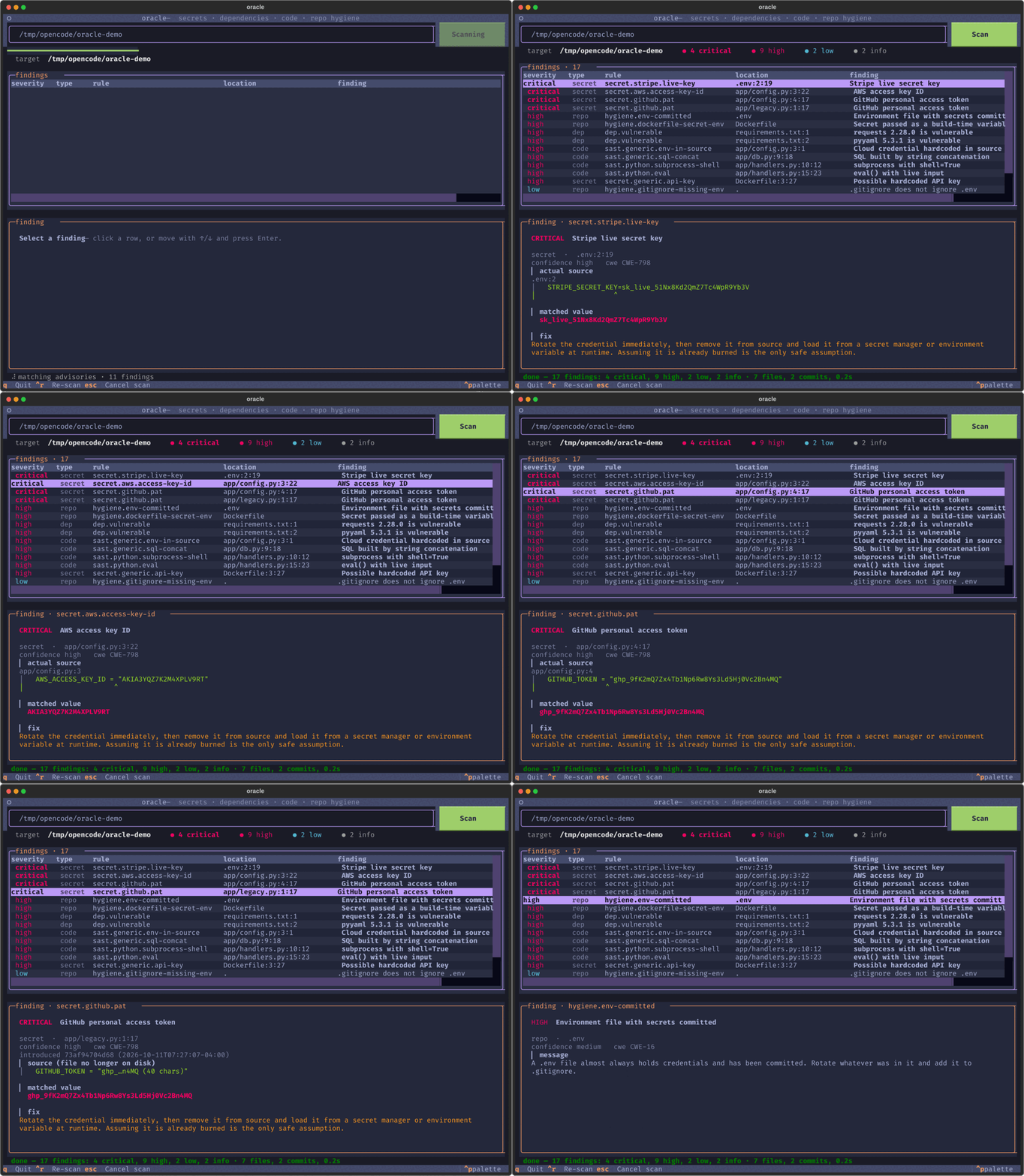
Bare oracle opens a small Textual console over the same engine the CLI uses:
type a path or an owner/repo, scan, and browse findings - worst first - with
a detail pane underneath. While a scan runs a status line shows a spinner with
live progress (files done, findings so far) and the scan button locks; when it
finishes the line reports the summary and elapsed time. The tree walk,
per-file analysis, advisory pass and the git log history pass all run off
the event loop, so the window stays responsive even on large repositories, and
a long scan can be abandoned with escape.
| key | does |
|---|---|
q |
quit |
ctrl+r |
re-scan the current target |
escape |
cancel the in-flight scan |
| enter / click | open the finding: actual source line, caret on the match, the matched value, message, fix and references |
The detail pane is the one place a raw credential is shown by design: this is
an interactive review surface on the operator's own machine, and the value is
read on demand and never written to a file. Reports and --json output keep
the strict redaction contract.
On a terminal the console opens automatically; in a script or CI it degrades
to usage help so a piped oracle never hangs. Set ORACLE_FORCE_TUI=1 to
force it, and oracle --tui to ask for it explicitly.
Commands
scan TARGET...
The whole tool: secrets, dependency advisory matching, SAST-lite and repository hygiene, plus git-history secret recovery when the target is a git repository. Multiple targets are scanned and merged into one result.
A target is either a local directory or a GitHub reference. Bare owner/repo
takes precedence over a local relative path of the same shape - if you mean a
local directory, write ./owner/repo. GitHub refs are
owner/repo
https://github.com/owner/repo
https://github.com/owner/repo.git
https://github.com/owner/repo/tree/main/src
git@github.com:owner/repo.git
ssh://git@github.com/owner/repo
Remote repositories are cloned into ~/.cache/oracle/repos and reused on the
next scan (--refresh fetches first); history scanning gets the full object
database either way. Private repositories work by passing a token via
--token, GITHUB_TOKEN or GH_TOKEN - it is inserted into the clone URL and
never printed.
Selective switches (--no-secrets, --no-deps, --no-sast,
--no-hygiene, --no-history) disable a pass; --min-severity filters the
report; --exclude GLOB prunes paths (repeatable, matched against the
relative path and the basename). Entropy can be tuned via
--no-entropy, --entropy-threshold and --entropy-min-length. Custom
rules are loaded via --rules FILE (repeatable); run oracle rules --rules FILE to list them. Files over 2 MiB and vendored directories
(node_modules, .git, vendor, dist, caches...) are skipped outright.
rules [ID...]
Every secret, SAST and hygiene rule this tool knows, with severity, so the
--exclude / --baseline / triage conversations happen against a real
inventory. oracle rules aws --json filters by rule-id substring; oracle rules --rules custom.toml --json lists built-ins plus your custom rules.
report TARGET [-o FILE]
Scan one target and write a markdown report (the default output, so report
always ends in a useful file). The same redaction contract applies: full
credentials only with --show-secrets.
Detection coverage
- Secrets - AWS access keys, GitHub PATs and fine-grained tokens, Stripe
live keys, OpenAI keys, Slack tokens and incoming webhooks, SendGrid,
Twilio, Mailgun, Telegram, Discord webhooks, Google API keys, Shopify,
npm/PyPI tokens, Hugging Face, Postman, Square, Mapbox, Vault, Datadog,
git-grade private-key blocks, JWTs and credentials in URLs, plus an
assignment-based entropy backstop that catches long random values even
when the variable name is uninformative. Custom regex rules can be loaded
from TOML via
--rulesfor your own formats. Placeholder values (changeme,your-api-key, all-digit short strings, single-symbol runs, sequential alphabet/number strings, obvious base64/image magic) are rejected. - Dependencies -
requirements.txt,Pipfile.lock,poetry.lock,pyproject.toml,package.json,package-lock.json,yarn.lock,pnpm-lock.yaml,go.mod,Gemfile.lock,Cargo.lock,composer.lock. The bundled advisory set is a curated sample (36 entries) documented indata/advisories.json;--osvqueries osv.dev live and--advisories FILEadds your own entries in the same JSON shape. - Code - a small, language-tagged rule set for python, javascript/ typescript, go, java, shell and generic patterns. Not a real SAST engine: every rule is a pattern that production code virtually never contains, so the false-positive rate stays low.
- Repo hygiene - committed
.env/key files (.env.exampleand friends are allowed), GitHub Actions triggers and permissions, Dockerfile secrets, and the repo-level facts that matter even when no file is dangerous: LICENSE, SECURITY policy,.gitignoreignoring.env.
Formats
--format / --json / --sarif / --md, or -o FILE. JSON is the
structured contract (same shape as to_dict in the codebase); SARIF is
2.1.0 with one ruleId per rule and a stable partialFingerprint; Markdown
groups findings by severity and names the fix for each.
Discovered secret?
Rotate it. A leaked credential is compromised the moment it leaves the repo,
not when it is fixed. oracle can find them; only the owner can make them
stop working.
Politeness
Scan only repositories you are entitled to scan. The tool does no scanning of
the network beyond git clone/fetch of the target you name, and it reuses a
cached clone across runs. --osv is the only always-online extra and it is
opt-in; queries are batched into one POST per run.
Exit codes
| code | meaning |
|---|---|
| 0 | scan complete; nothing at or above --fail-on (default high) |
| 1 | findings at or above --fail-on |
| 2 | usage error - unknown command or flag, missing target, unreadable clone |
| 130 | interrupted |
Development
pytest          # 121 tests, none of which touch the network
ruff check .
The test suite builds small fixture repositories on disk (tests/conftest.py)
and asserts on rule ids, redaction, baseline round-trips, exit codes, SARIF
shape and history recovery - including a secret deleted from the working tree
that still must be found in git history, entropy false positives, and custom
rule validation and execution.
Contributing
New detection rules, output formats and ecosystem coverage are all welcome. Start with CONTRIBUTING.md for the layout of the code and the output contract you should not break.
- Found a vulnerability in oracle itself? Report it privately via SECURITY.md, not a public issue.
- Adding a rule? Include a positive and a negative test case.
- Questions and half-formed ideas are fine in Discussions.
If oracle saves you a bad afternoon, a star helps other people find it.
1 maintainer

Metadata
1 maintainer
Release files for oracle-scan 0.1.2
For a detailed explanation of source distributions (sdists) and built distributions (wheels), please see the package formats documentation.
Source distribution (sdist)
| File | Size | Uploaded | |
|---|---|---|---|
| oracle_scan-0.1.2.tar.gz | 74.8 kB | Details |
Built distribution (wheel)
| File | Interpreter | ABI | Platform | Reset |
|---|---|---|---|---|
| oracle_scan-0.1.2-py3-none-any.whl | Python 3 | none | any | Details |
Total release size: 137.9 kB
Release files / oracle_scan-0.1.2.tar.gz
| Download URL | oracle_scan-0.1.2.tar.gz |
|---|---|
| Size | 74.8 kB |
| Tags | Source |
|
SHA-256 checksum How to use checksums |
54bd92a16bbe16d8193979e912483c9f4cd4f11735f086bb8872f770fd42dc71
|
|
BLAKE2b-256 checksum How to use checksums |
ccbd6c5347e0aaf52cf3544b9c509f6c0f5c62ca4d62f5cac1508a042a86f698
|
| Upload date | |
|
Uploaded using Trusted Publishing? What is trusted publishing? |
No |
| Uploaded via |
twine/7.0.0 CPython/3.13.5
|
Release files / oracle_scan-0.1.2-py3-none-any.whl
| Download URL | oracle_scan-0.1.2-py3-none-any.whl |
|---|---|
| Size | 63.2 kB |
| Tags | Python 3 |
|
SHA-256 checksum How to use checksums |
a89bde79b3e1bd51637595fdb609d724c250049fde5d11edc9a02f8d30f54926
|
|
BLAKE2b-256 checksum How to use checksums |
b6872336d0cbc4c8dfe373c27ccd82baa40687395ba4fe8b468aa54de5af1dc6
|
| Upload date | |
|
Uploaded using Trusted Publishing? What is trusted publishing? |
No |
| Uploaded via |
twine/7.0.0 CPython/3.13.5
|














