
Python ctypes binding for the Orderflow C API

Project description
Orderflow Python Binding (orderflow-gregorian09)




Production-focused Python API for the Orderflow runtime.
This package wraps the stable of_ffi_c ABI via ctypes and provides a typed,
high-level interface for lifecycle management, subscriptions, snapshots, and
external feed ingestion.
The package includes a PEP 561 py.typed marker so type checkers can consume
the inline annotations shipped with the binding.
The binding also exposes an additive execution API through ExecutionEngine.
Execution uses a separate native handle from analytics and returns typed
execution events rather than JSON on the order path.
The README is intentionally API-complete so the PyPI page can be used as a single reference, similar to high-signal package pages such as TA-Lib and FastAPI.
What's New In 0.4.0
0.4.0 is the first Python release with end-to-end analytics plus execution
concepts in one binding package. Existing Engine users keep the same market
data API; execution is exposed through separate classes and native handles.
Highlights:
- additive simulated execution APIs:
ExecutionEngine,ConcurrentExecutionEngine,OrderRequest,CancelRequest,AmendRequest,RiskLimits,RouteConfig, and execution event dataclasses - multi-route execution construction for multi-symbol order flow
- bounded concurrent execution worker for many producers and one deterministic native order-state owner
- typed execution events and command reports instead of JSON on the order path
- route/account/symbol-scoped risk checks before adapter routing
- analytics-to-execution examples in this README and the handbook
- continued PEP 561
py.typedsupport and bundled native library lookup
Version policy:
- Python package:
0.4.0 - compatible native
of_ffi_clibrary/header:0.4.0 - new Rust execution crates behind the native ABI:
0.1.0
Install the Python package and native runtime at the same release version.
Execution users should treat the Rust execution crates as a new 0.1.x
surface if they build custom native providers.
Execution quick start
from orderflow import (
    ConcurrentExecutionEngine, ExecutionEngine, ExecutionOrderType, ExecutionSide, ExecutionTimeInForce,
    OrderRequest, RiskLimits, RouteConfig,
)

limits = RiskLimits(False, 100, 1_000_000, 10, 10_000_000, 0)
routes = [
    RouteConfig("SIM", "ACC", "SIM", "ES", True, limits),
    RouteConfig("SIM", "ACC", "SIM", "NQ", True, limits),
]

with ExecutionEngine(routes) as execution:
    events = execution.submit_order(OrderRequest(
        "C1", "ACC", "SIM", "STRAT", "SIM", "ES",
        ExecutionSide.BUY, ExecutionOrderType.LIMIT, ExecutionTimeInForce.DAY,
        10, 5000,
    ))
ExecutionEngine(route) remains supported for single-symbol integrations. When
you pass a route list, native risk accounting is scoped per
route/account/symbol.
Use ConcurrentExecutionEngine(routes) when multiple producer threads need to
queue commands into one deterministic native worker. Command methods return a
sequence number; try_recv_report() returns completed command reports without
blocking.
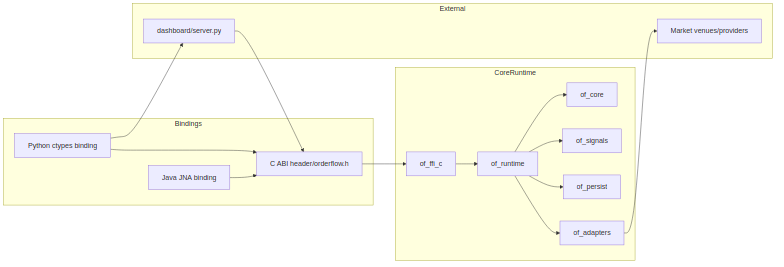
Architecture
Installation
pip install orderflow-gregorian09
Python support
- Python 3.10+
Native runtime requirement
The Python package is a wrapper. A compatible libof_ffi_c shared library must
be available at runtime. Binary wheels can bundle this library under
orderflow/native/; source installs can still use an externally-built runtime.
Library resolution order:
library_path=passed toEngine(...)ORDERFLOW_LIBRARY_PATHenvironment variable- bundled wheel library (
orderflow/native/libof_ffi_c.*) - default local debug path (
target/debug/libof_ffi_c.*)
export ORDERFLOW_LIBRARY_PATH=/absolute/path/to/libof_ffi_c.so
Quick Start
from orderflow import DataQualityFlags, Engine, EngineConfig, Symbol, StreamKind

with Engine(EngineConfig(instance_id="py-client")) as eng:
    sym = Symbol("CME", "ESM6", depth_levels=10)
    eng.subscribe(sym, StreamKind.ANALYTICS)
    eng.poll_once(DataQualityFlags.NONE)
    print("api_version", eng.api_version)
    print("build_info", eng.build_info)
    print("analytics", eng.analytics_snapshot(sym))
    print("derived", eng.derived_analytics_snapshot(sym))
    print("signal", eng.signal_snapshot(sym))
    print("metrics", eng.metrics())
Complete End-To-End Example
This example uses deterministic external ingest and simulated execution. It is safe for documentation, CI smoke tests, and first user experiments because it does not connect to a broker.
from orderflow import (
    BookAction,
    DataQualityFlags,
    Engine,
    EngineConfig,
    ExecutionEngine,
    ExecutionOrderType,
    ExecutionSide,
    ExecutionTimeInForce,
    ExternalFeedPolicy,
    OrderRequest,
    RiskLimits,
    RouteConfig,
    Side,
    StreamKind,
    Symbol,
)


def signal_allows_long(analytics: dict, signal: dict) -> bool:
    quality = int(analytics.get("quality_flags", 0))
    delta = int(analytics.get("delta", 0))
    cumulative_delta = float(analytics.get("cumulative_delta", 0.0))
    confidence = float(signal.get("confidence", 0.0))
    return (
        quality == DataQualityFlags.NONE
        and delta > 0
        and cumulative_delta > 0.0
        and confidence >= 0.50
    )


sym = Symbol("SIM", "ES", 10)
limits = RiskLimits(False, 5, 1_000_000, 1, 1_000_000, 0)
routes = [RouteConfig("SIM", "ACC", "SIM", "ES", True, limits)]

with Engine(EngineConfig(instance_id="py-end-to-end")) as market, ExecutionEngine(routes) as execution:
    market.configure_external_feed(ExternalFeedPolicy(2_000, True))
    market.subscribe(sym, StreamKind.ANALYTICS)
    market.subscribe(sym, StreamKind.SIGNALS)

    market.ingest_book(sym, Side.BID, 0, 500_000, 100, BookAction.UPSERT, sequence=1)
    market.ingest_book(sym, Side.ASK, 0, 500_025, 120, BookAction.UPSERT, sequence=2)
    market.ingest_trade(sym, 500_025, 2, Side.ASK, sequence=3)
    market.poll_once(DataQualityFlags.NONE)

    analytics = market.analytics_snapshot(sym)
    signal = market.signal_snapshot(sym)

    if signal_allows_long(analytics, signal):
        events = execution.submit_order(OrderRequest(
            "PY-0001",
            "ACC",
            "SIM",
            "DOCS",
            "SIM",
            "ES",
            ExecutionSide.BUY,
            ExecutionOrderType.LIMIT,
            ExecutionTimeInForce.DAY,
            1,
            500_025,
        ))
        print("events", events)
        print("state", execution.order_state("PY-0001"))
        print("execution metrics", execution.execution_metrics())
    else:
        print("blocked", {"analytics": analytics, "signal": signal})
Production applications add durable persistence, execution journaling, provider adapter ownership, reconnect/recovery policy, and monitoring around this shape.
Public API Reference
Constants
StreamKind
| Name | Value | Meaning |
|---|---|---|
BOOK |
1 | Level-2 book update stream |
TRADES |
2 | Trade print stream |
ANALYTICS |
3 | Analytics snapshot stream |
SIGNALS |
4 | Signal snapshot stream |
HEALTH |
5 | Health transition stream |
BOOK_SNAPSHOT |
6 | Materialized book snapshot stream after book changes |
DERIVED_ANALYTICS |
7 | Derived analytics stream after trade-driven analytics changes |
Side
| Name | Value | Meaning |
|---|---|---|
BID |
0 | Bid / buy side |
ASK |
1 | Ask / sell side |
BookAction
| Name | Value | Meaning |
|---|---|---|
UPSERT |
0 | Insert or update price level |
DELETE |
1 | Delete price level |
DataQualityFlags
| Name | Value | Meaning |
|---|---|---|
NONE |
0 |
No quality issues |
STALE_FEED |
1 << 0 |
Feed became stale |
SEQUENCE_GAP |
1 << 1 |
Sequence gap detected |
CLOCK_SKEW |
1 << 2 |
Clock skew detected |
DEPTH_TRUNCATED |
1 << 3 |
Depth truncation occurred |
OUT_OF_ORDER |
1 << 4 |
Out-of-order sequence detected |
ADAPTER_DEGRADED |
1 << 5 |
Adapter/feed degraded |
Exceptions
| Exception | Purpose |
|---|---|
OrderflowError |
Base binding/runtime failure |
OrderflowStateError |
Invalid lifecycle/state transition |
OrderflowArgError |
Invalid argument passed to native API |
Data Classes
Symbol(venue: str, symbol: str, depth_levels: int = 10)
- venue/instrument descriptor used by subscribe/snapshot/ingest APIs.
EngineConfig(...)
EngineConfig fields:
| Field | Type | Default | Notes |
|---|---|---|---|
instance_id |
str |
"python" |
Runtime instance id |
config_path |
str |
"" |
Optional runtime config file path |
log_level |
int |
0 |
Reserved log-level field |
enable_persistence |
bool |
False |
Enable local persistence |
audit_max_bytes |
int |
10*1024*1024 |
Per-file audit size before rotation |
audit_max_files |
int |
5 |
Number of rotated audit files |
audit_redact_tokens_csv |
str |
"secret,password,token,api_key" |
Redaction tokens |
data_retention_max_bytes |
int |
10*1024*1024 |
Persistence retention limit |
data_retention_max_age_secs |
int |
7*24*60*60 |
Max retention age |
ExternalFeedPolicy(stale_after_ms: int = 15000, enforce_sequence: bool = True)
- external ingest supervision policy for stale and sequence validation.
Engine API
Constructor and properties
| Signature | Description |
|---|---|
Engine(config: EngineConfig, library_path: Optional[str] = None) |
Creates native engine handle |
engine.api_version -> int |
Returns native ABI version |
engine.build_info -> str |
Returns native build descriptor |
Lifecycle and session
| Signature | Description |
|---|---|
start() -> None |
Starts runtime |
stop() -> None |
Stops runtime |
close() -> None |
Unsubscribes and destroys native handle |
context-manager (with Engine(...)) |
Calls start() / close() automatically |
Subscription and polling
| Signature | Description |
|---|---|
subscribe(symbol, stream_kind=StreamKind.ANALYTICS, callback=None) |
Registers stream subscription with optional callback |
unsubscribe(symbol) |
Unsubscribes all streams for symbol |
poll_once(quality_flags=DataQualityFlags.NONE) |
Drains adapter/runtime once |
reset_symbol_session(symbol) |
Resets per-symbol session/profile state |
External feed supervision
| Signature | Description |
|---|---|
configure_external_feed(policy) |
Sets stale/sequence policy |
set_external_reconnecting(reconnecting) |
Marks reconnect/degraded state |
external_health_tick() |
Re-evaluates stale status without ingest |
External ingest
| Signature | Description |
|---|---|
ingest_trade(symbol, price, size, aggressor_side, sequence=0, ts_exchange_ns=0, ts_recv_ns=0, quality_flags=DataQualityFlags.NONE) |
Injects one external trade |
ingest_book(symbol, side, level, price, size, action=BookAction.UPSERT, sequence=0, ts_exchange_ns=0, ts_recv_ns=0, quality_flags=DataQualityFlags.NONE) |
Injects one external book update |
Snapshots and metrics
| Signature | Description | Return |
|---|---|---|
book_snapshot(symbol) |
Current book snapshot | dict[str, Any] |
analytics_snapshot(symbol) |
Current analytics snapshot | dict[str, Any] |
derived_analytics_snapshot(symbol) |
Current derived analytics snapshot | dict[str, Any] |
session_candle_snapshot(symbol) |
Current session candle snapshot | dict[str, Any] |
interval_candle_snapshot(symbol, window_ns) |
Current rolling interval candle snapshot | dict[str, Any] |
signal_snapshot(symbol) |
Current signal snapshot | dict[str, Any] |
metrics() |
Runtime metrics | dict[str, Any] |
book_snapshot(symbol) returns a dictionary with:
venuesymbolbidsaskslast_sequencets_exchange_nsts_recv_ns
The Python wrapper retries automatically if the native snapshot payload is larger than the initial buffer.
session_candle_snapshot(symbol) returns a dictionary with:
openhighlowclosetrade_countfirst_ts_exchange_nslast_ts_exchange_ns
interval_candle_snapshot(symbol, window_ns) returns a dictionary with:
window_nsopenhighlowclosetrade_counttotal_volumevwapfirst_ts_exchange_nslast_ts_exchange_ns
Execution API Reference
Execution objects use typed dataclasses and separate native handles from the analytics runtime.
Execution constants
| Class | Values |
|---|---|
ExecutionSide |
BUY, SELL |
ExecutionOrderType |
MARKET, LIMIT, STOP, STOP_LIMIT |
ExecutionTimeInForce |
DAY, GTC, IOC, FOK, GTD |
Execution dataclasses
| Dataclass | Purpose |
|---|---|
RiskLimits |
Per-route pre-trade limits: kill switch, max quantity, max notional, max open orders, max open notional, price band |
RouteConfig |
Route/account/venue/instrument binding plus RiskLimits |
OrderRequest |
New-order command |
CancelRequest |
Cancel command with new cancel id and original client id |
AmendRequest |
Cancel/replace command |
ExecutionEvent |
Typed native execution event |
ExecutionOrderState |
Current native order state for one client order id |
ExecutionHealth |
Connected/degraded/sequence health snapshot |
ExecutionMetrics |
Submitted/cancelled/amended/events/risk/adapter/recovery counters |
ConcurrentExecutionConfig |
Command/report/event-buffer capacities |
ExecutionCommandReport |
Concurrent command result, sequence, result code, and events |
ExecutionEngine
| Signature | Description |
|---|---|
ExecutionEngine(route_or_routes, library_path=None) |
Creates a simulated execution engine for one route or a route list |
start() |
Starts adapter/session |
stop() |
Stops adapter/session |
close() |
Destroys native execution handle |
submit_order(request) |
Submits a new order and returns list[ExecutionEvent] |
cancel_order(request) |
Cancels an order and returns list[ExecutionEvent] |
amend_order(request) |
Amends an order and returns list[ExecutionEvent] |
poll_execution() |
Polls execution adapter and returns list[ExecutionEvent] |
order_state(client_order_id) |
Returns ExecutionOrderState |
execution_health() |
Returns ExecutionHealth |
execution_metrics() |
Returns ExecutionMetrics |
ConcurrentExecutionEngine
| Signature | Description |
|---|---|
ConcurrentExecutionEngine(routes, config=ConcurrentExecutionConfig(), library_path=None) |
Creates a bounded worker |
submit_order(request) |
Queues submit and returns command sequence |
cancel_order(request) |
Queues cancel and returns command sequence |
amend_order(request) |
Queues amend and returns command sequence |
poll_execution() |
Queues poll and returns command sequence |
try_recv_report() |
Returns ExecutionCommandReport or None without blocking |
stop() |
Queues worker stop and returns command sequence |
Usage Patterns
Poll-only flow (no callback)
from orderflow import DataQualityFlags, Engine, EngineConfig, Symbol, StreamKind

with Engine(EngineConfig(instance_id="poll-only")) as eng:
    sym = Symbol("CME", "ESM6", 10)
    eng.subscribe(sym, StreamKind.ANALYTICS, callback=None)
    eng.poll_once(DataQualityFlags.NONE)
    snap = eng.analytics_snapshot(sym)
    print("delta", snap.get("delta"))
Callback flow
from orderflow import Engine, EngineConfig, Symbol, StreamKind

def on_analytics(ev: dict) -> None:
    print("analytics event:", ev)

with Engine(EngineConfig(instance_id="cb-flow")) as eng:
    sym = Symbol("CME", "ESM6", 10)
    eng.subscribe(sym, StreamKind.ANALYTICS, callback=on_analytics)
    eng.poll_once()
External ingest + quality gating
from orderflow import (
    BookAction,
    DataQualityFlags,
    Engine,
    EngineConfig,
    ExternalFeedPolicy,
    Side,
    Symbol,
    StreamKind,
)

sym = Symbol("BINANCE", "BTCUSDT", depth_levels=20)

with Engine(EngineConfig(instance_id="external-ingest")) as eng:
    eng.configure_external_feed(
        ExternalFeedPolicy(stale_after_ms=2_000, enforce_sequence=True)
    )
    eng.subscribe(sym, StreamKind.HEALTH, callback=lambda ev: print("health:", ev))

    eng.ingest_book(sym, Side.BID, 0, 62500000, 1000, BookAction.UPSERT, sequence=1)
    eng.ingest_trade(sym, 62510000, 200, Side.ASK, sequence=2)
    eng.poll_once(DataQualityFlags.NONE)
Operational Notes
- callbacks fire during
poll_once(...)andingest_*calls. - callback handlers should remain non-blocking.
- snapshot APIs decode runtime JSON and return Python
dict. OrderflowStateError("engine is closed")meansclose()was already called.
Troubleshooting
FileNotFoundError: Orderflow shared library not found
- build native runtime (
cargo build -p of_ffi_c) or provide explicit path. - verify
ORDERFLOW_LIBRARY_PATHpoints to the correct platform library.
OrderflowArgError from subscribe/ingest
- validate symbol fields (
venue,symbolnot empty). - validate enum-like integer constants (
Side,BookAction,StreamKind).
No callback events
- ensure subscription callback is not
None. - call
poll_once(...)regularly if using adapter-driven mode.
Documentation and Links
- Project docs: https://github.com/gregorian-09/orderflow/tree/main/docs
- Binding guide: https://github.com/gregorian-09/orderflow/tree/main/docs/bindings/python.md
- Handbook: https://github.com/gregorian-09/orderflow/tree/main/docs/handbook
- Changelog: https://github.com/gregorian-09/orderflow/blob/main/CHANGELOG.md
Release history Release notifications | RSS feed


Download files
Download the file for your platform. If you're not sure which to choose, learn more about installing packages.
Source Distribution
Built Distribution
Filter files by name, interpreter, ABI, and platform.
If you're not sure about the file name format, learn more about wheel file names.
Copy a direct link to the current filters
File details
Details for the file orderflow_gregorian09-0.4.0.tar.gz.
File metadata
- Download URL: orderflow_gregorian09-0.4.0.tar.gz
- Upload date:
- Size: 26.8 kB
- Tags: Source
- Uploaded using Trusted Publishing? No
- Uploaded via: twine/6.2.0 CPython/3.12.13
File hashes
| Algorithm | Hash digest | |
|---|---|---|
| SHA256 |
c0b39b5dc64650cc376a41ac9d9e6dd6d7f28f38f6940dc035141bf17ec6755a
|
|
| MD5 |
87bf9f57629ae37598da18bdc7b62769
|
|
| BLAKE2b-256 |
0af822f1df287d4bfab74d0620a9bb200a35e760a1fde3b3684a48b6cb2dc366
|
File details
Details for the file orderflow_gregorian09-0.4.0-py3-none-manylinux2014_x86_64.whl.
File metadata
- Download URL: orderflow_gregorian09-0.4.0-py3-none-manylinux2014_x86_64.whl
- Upload date:
- Size: 592.3 kB
- Tags: Python 3
- Uploaded using Trusted Publishing? No
- Uploaded via: twine/6.2.0 CPython/3.12.13
File hashes
| Algorithm | Hash digest | |
|---|---|---|
| SHA256 |
7b115661b979ff68723831a2e77625f918c78051f0b45c9b9feb48c826912e61
|
|
| MD5 |
ecaff353f52e0a68feaf1bfb38bec01e
|
|
| BLAKE2b-256 |
02fcfa0f38eec90de11972e6beb3e535cc592c48cdbdec2556da1191b66016c4
|






