









Python utilities for the FOCUS datasets and challenge — Foreign Object Contextual Understanding for Surgery.
The library provides dataset loaders, preprocessing pipelines, answer-format handling, and an evaluation framework for working with the FOCUS surgical VQA datasets. It can be used independently for research on foreign-object understanding in minimally invasive surgery, and also serves as the official toolkit for the ORena SAVE FOCUS challenge at MICCAI 2026.
Challenge open for registration. Submit your results and compete on the leaderboard at orena-focus-challenge.org.

Retained foreign objects are a life-threatening and preventable surgical complication. FOCUS benchmarks vision-language models on clinically relevant VQA tasks around detecting, counting, and reasoning about foreign objects in endoscopic video.
Tracks
FOCUS offers three participation tracks, each requiring a different type of visual context:
| Track | Track enum |
Visual input | Max latency | Description |
|---|---|---|---|---|
| FRAME | Track.FRAME |
Single frame | 5 s | Answer questions from one extracted video frame. The simplest entry point — no temporal modelling required. |
| SEGMENT | Track.SEGMENT |
<= 5min clip | 15 s | Answer questions from a multi-second video segment surrounding the relevant event. Requires understanding of motion and temporal context. |
| PROCEDURE | Track.PROCEDURE |
Up to full video | 30 s | Answer questions that may require reasoning over an entire surgical procedure, including events that happened well before or after the queried moment. |
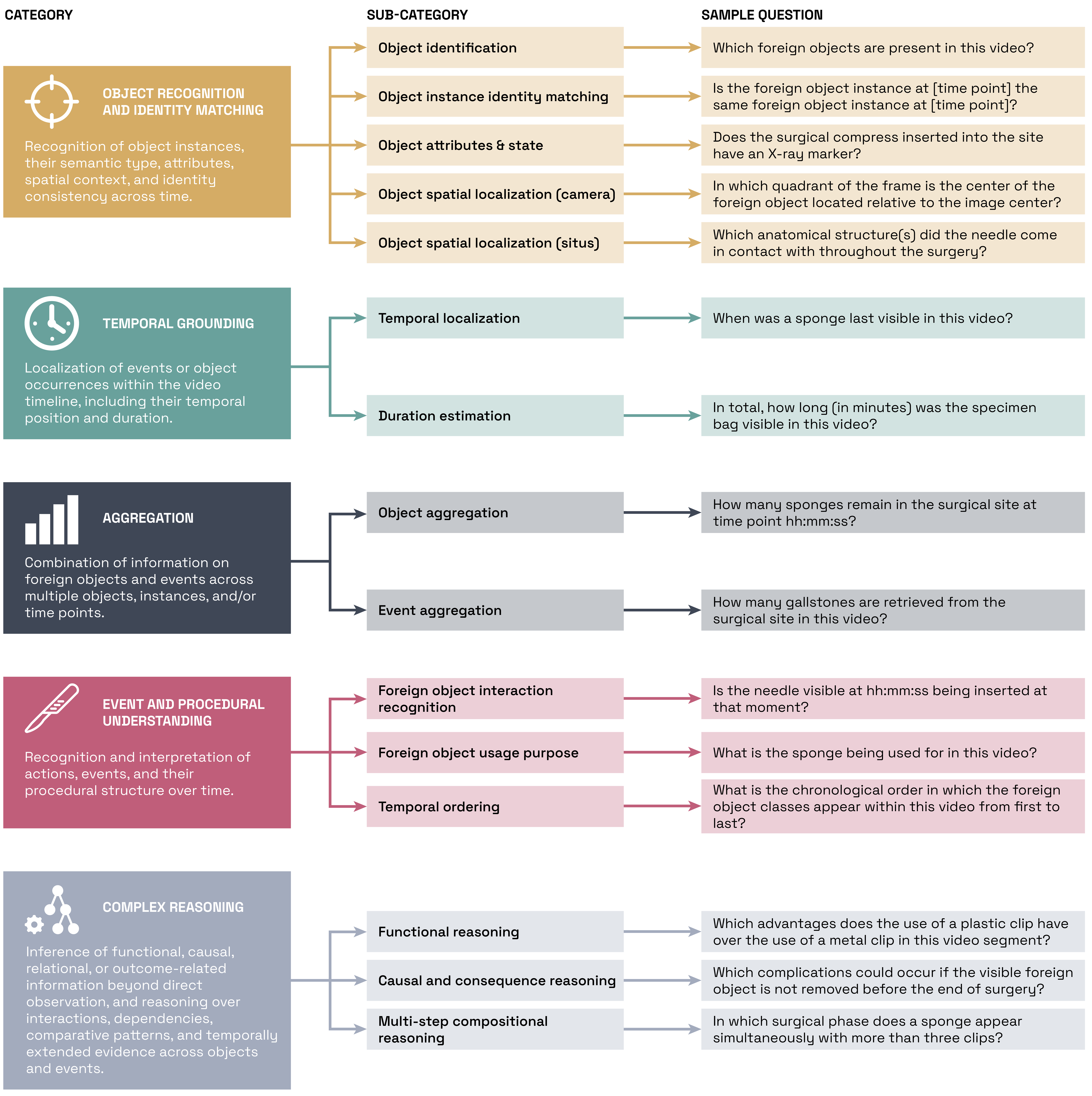
Participants may enter any subset of tracks. Each track is evaluated independently with the same hierarchical capability taxonomy.
Installation
pip install orena-focus
Quick start
from focus import FocusDataset, DatasetSplit, Track

ds = FocusDataset("heico", DatasetSplit.TEST, Track.SEGMENT)

request, reference = ds[0]
print(request.question)        # "How many sponges are visible?"
print(reference.answer)        # "2"
print(reference.format.type)   # "number"
Data preparation
Download, preprocess, and split the dataset in one script — see examples/data_preparation.py for the full walkthrough.
from focus import download
from focus.preprocessing import VideoTimestampOverlayPreprocessor, FrameExtractorPreprocessor

download("heico")

VideoTimestampOverlayPreprocessor().process(dataset="heico")
FrameExtractorPreprocessor(stride=1).process(dataset="heico")
QA annotations are fetched automatically from HuggingFace when you construct a FocusDataset.
Inference & evaluation
See examples/inference.py for an end-to-end example with Qwen3-VL.
from focus import Evaluator, Response

responses = [Response(qID=req.qID, content=my_model(req)) for req, _ in ds]

results_df, summary_df = Evaluator().run(
    requests=ds.requests,
    references=ds.references,
    responses=responses,
)
print(summary_df)
Pre-evaluation score
The pre-evaluation phase uses a single headline number: the unweighted mean over ten buckets — the five capability groups, each scored independently for in-distribution and out-of-distribution questions (flat per-question accuracy within each bucket). Missing and timed-out answers count as incorrect. It is reported as the level="pre_evaluation", name="SCORE" row of summary_df, and can also be computed directly:
score, buckets_df = Evaluator().pre_evaluation_score(results_df)
Capability taxonomy
Five capability groups, each composed of leaf capabilities assigned to questions.
Answer formats
| Format | Accepts | Returns |
|---|---|---|
Binary |
"yes" / "no" |
bool |
Number |
Non-negative integer strings | int |
Percentage |
Numeric percentage strings | float |
FOClass |
One or more registered FO class names (comma-separated) | frozenset[str] |
OpenEnded |
Free text (≤ 300 chars) | str |
Matching |
Regex-validated text | str |
MultipleChoice |
One of predefined options | str |
Time |
One or more hh:mm:ss timestamps (comma-separated) |
tuple[timedelta, ...] |
Datasets
FOCUS builds upon two datasets: HeiCo-FOCUS (30 videos) and LapChole-FOCUS (170 videos).
HeiCo-FOCUS
The QA annotations are publicly available on HuggingFace: orena-dkfz/heico-focus-vqa.
HeiCo-FOCUS is built on the HeiCo dataset. If you use this data, please cite the original publication:
Maier-Hein, L., et al. (2021). Heidelberg colorectal data set for surgical data science in the sensor operating room. https://doi.org/10.1038/s41597-021-00882-2
The HeiCo data is released under CC BY-NC-SA 4.0 — non-commercial use only, with attribution and share-alike conditions.
LapChole-FOCUS
The LapChole-FOCUS videos comprises unpublished laparoscopic cholecystectomy recordings. It is currently only available within the scope of the FOCUS-Challenge and will be publicly released after the Challenge has ended.
To access it, send a request on HuggingFace: orena-dkfz/lapchole-focus-vqa. To access and download the data you need to register yourself with HuggingFace.
Please find the data usage agreement at the dataset card or in the LICENSE file on HuggingFace.
License
The code is licensed under the permissive MIT license. The underlying data is licensed independently, see Dataset for the data licenses details.
1 maintainer

Metadata
1 maintainer
Release files for orena-focus 0.3.6
For a detailed explanation of source distributions (sdists) and built distributions (wheels), please see the package formats documentation.
Source distribution (sdist)
| File | Size | Uploaded | |
|---|---|---|---|
| orena_focus-0.3.6.tar.gz | 1.2 MB | Details |
Built distribution (wheel)
| File | Interpreter | ABI | Platform | Reset |
|---|---|---|---|---|
| orena_focus-0.3.6-py3-none-any.whl | Python 3 | none | any | Details |
Total release size: 2.5 MB
Release files / orena_focus-0.3.6.tar.gz
| Download URL | orena_focus-0.3.6.tar.gz |
|---|---|
| Size | 1.2 MB |
| Tags | Source |
|
SHA-256 checksum How to use checksums |
7797a4db1916306c43cc05c3ca04290af19d2baa8acfe7b043bd237dffe8efe1
|
|
BLAKE2b-256 checksum How to use checksums |
21e8026a4c336dbf8a816f14bc7ae8e41f566779d87b29f8d964123bfdbf7cab
|
| Upload date | |
|
Uploaded using Trusted Publishing? What is trusted publishing? |
Yes |
| Uploaded via |
twine/7.0.0 CPython/3.13.14
|
Provenance
Provenance describes where a file came from. On PyPI, provenance is shared via attestations, which provide a verifiable record of the build or publishing details. View details, limitations and caveats.


PyPI Publish Attestation
PyPI verified that this artifact, at this checksum, originated from the publisher listed below.
Signed by GitHub Actions, verified by PyPI on Oct 16, 2026.
Transparency logRelease files / orena_focus-0.3.6-py3-none-any.whl
| Download URL | orena_focus-0.3.6-py3-none-any.whl |
|---|---|
| Size | 1.2 MB |
| Tags | Python 3 |
|
SHA-256 checksum How to use checksums |
f7660f6282f51204bca6ad061e372dc56fdf55070d2d9b2c7a9677ae8d849238
|
|
BLAKE2b-256 checksum How to use checksums |
3e2402812d373f52ada777514ba6ec379705038d028c47b34afa9af24c085576
|
| Upload date | |
|
Uploaded using Trusted Publishing? What is trusted publishing? |
Yes |
| Uploaded via |
twine/7.0.0 CPython/3.13.14
|
Provenance
Provenance describes where a file came from. On PyPI, provenance is shared via attestations, which provide a verifiable record of the build or publishing details. View details, limitations and caveats.
PyPI Publish Attestation
PyPI verified that this artifact, at this checksum, originated from the publisher listed below.
Signed by GitHub Actions, verified by PyPI on Oct 16, 2026.
Transparency log













