
Local-first Proof Receipt — prove which AI model, prompt, or workflow is worth trusting.

Project description
Orionfold Proof
Prove which AI you can trust. On your own task, on your own machine, with a receipt you can rerun.
pip install orionfold-proof
orionfold up    # cockpit at http://localhost:8787
Orionfold Proof is a local-first tool for AI builders, consultants, and small teams who need to decide which model, prompt, RAG setup, or workflow is actually worth trusting. You point it at your own task data, run several candidates (local models via Ollama or LM Studio, or cloud models like OpenAI, Anthropic, Gemini, OpenRouter), score them, and it exports a Proof Receipt: a rerunnable record of which option won, at what cost, with which failures, stamped with a config hash so anyone can reproduce it.
We never say "trust us." We say "rerun it." The engine is open source (Apache-2.0) so you can read it, run it, and verify the proof before you buy.
Get the full product → orionfold.com/proof. Buying Orionfold Proof unlocks the Advisor 4B domain pack and RAG corpus so you can reproduce the headline receipt below in-tool, in one command.
The receipt that started this
A 4B model you run locally, scored on a governance bench against an 8x-bigger frontier model:
| Candidate | Score | Refusals | Fabricated answers | Cost | Speed |
|---|---|---|---|---|---|
| Advisor 4B (local, on an M3 Max) | 18 / 21 | 9 / 9 trick questions refused | 0 | $0.00 | ~59 tok/s |
| An 8x-bigger frontier model | 8 / 21 | n/a | 3 | (billed) | n/a |
Config hash 50c38b0b7439. Same inputs reproduce it byte for byte. This is a task-specific
result, not a general-intelligence claim: the big models are far smarter overall. The point
is that for governance and refusal on your domain, a small model you own can win on
accuracy, cost, and speed at once. And you do not have to take our word for it. You rerun it.
Reproduce it yourself: pip install orionfold-proof, then unlock the Advisor pack with a
license from orionfold.com/proof and run the bundled
governance bench. The receipt is the proof.
Get Orionfold Proof
Run your own comparisons in this repo, then get the product to reproduce the headline governance receipt in-tool: an Orionfold Proof license unlocks the Advisor 4B domain pack and the RAG corpus behind that bench, so the 18 / 21 result above runs turnkey on your machine, in one command.
→ orionfold.com/proof. Pricing and the buy flow live there.
The Advisor pack, its RAG corpus, and the turnkey governance rerun ship with a license. Everything in this repo runs without one.
Run a comparison
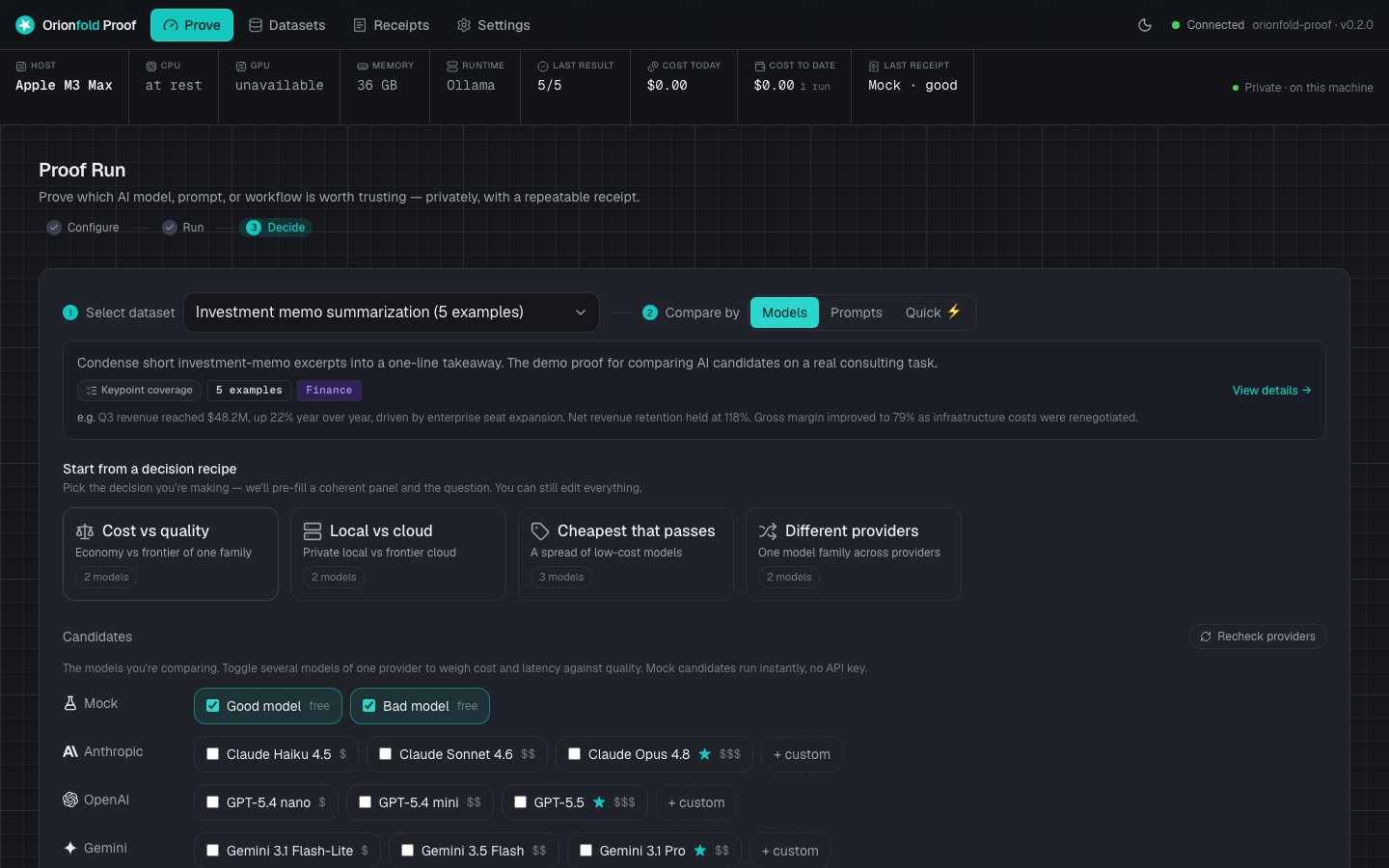
Keyless out of the box: pick the bundled sample dataset, run two deterministic mock candidates, see the leaderboard, inspect failure cases (including a surfaced provider error), and export a Proof Receipt in Markdown, HTML, and JSON — each stamped with a config hash, timestamp, and schema version (currently v12).
Real providers when you configure them: the same loop runs against local and cloud models — Ollama and LM Studio (local), plus OpenAI, OpenRouter, Google Gemini, and Anthropic (cloud) — behind one uniform result boundary. Cloud candidates appear only when their API key resolves; the keyless mock path stays the instant default. See Configure providers below.
Run it: bash scripts/build.sh && uv run orionfold up, open the cockpit, click Run proof,
then export a receipt. See a sample under
samples/receipts/,
a guided walkthrough in
docs/demo-script.md,
and the release history in
CHANGELOG.md.
Quickstart
Prerequisites: Python 3.12+, uv, and
pnpm (build-time only).
Develop (API with reload + Vite dev server with /api proxy):
uv sync                       # backend env
pnpm --dir web install        # cockpit deps
uv run orionfold dev          # API at http://127.0.0.1:8787 (reload)
pnpm --dir web dev            # cockpit at http://localhost:5173 (proxies /api)
Run the embedded build (cockpit served by FastAPI — the install-time experience):
bash scripts/build.sh         # build cockpit -> embed -> build wheel
uv run orionfold up           # open http://localhost:8787
Test:
uv run pytest                 # backend (unit + integration; keyless)
pnpm --dir web test           # cockpit (Vitest)
pnpm --dir web exec playwright install chromium  # one-time, for e2e
pnpm --dir web e2e            # Playwright happy-path (boots the embedded build)
Target install: uv tool install orionfold-proof && orionfold up.
Configure providers
The mock candidates need no setup. To prove real models, make their credentials resolvable. Orionfold reads keys from two places, in order:
- The system environment (preferred for CI / 12-factor).
- A repo-root
.env.localfile (git-ignored; convenient for local dev).
The system environment wins when both are set; empty or whitespace-only values are treated as absent. A cloud candidate is offered only when its key resolves, so the cockpit never lists a model that can't run. Keys are never logged, printed, or written into any receipt or screenshot.
Create .env.local at the repo root (an example, never commit real keys):
# .env.local — git-ignored. Set only the providers you want to prove.
OPENAI_API_KEY=sk-...
OPENROUTER_API_KEY=sk-or-...
GEMINI_API_KEY=AIza...
ANTHROPIC_API_KEY=sk-ant-...
Local providers need no key — just a reachable server: Ollama (ollama serve, models
pulled) and LM Studio (lms server start, a model loaded). Both are always offered.
Defaults and overrides — each profile ships a sensible default model and every knob is
env-overridable (set in .env.local or the environment; no code change):
| Profile | Default model | Model override | Endpoint override |
|---|---|---|---|
| Ollama (local) | llama3.2 |
ORIONFOLD_OLLAMA_MODEL |
OLLAMA_HOST |
| LM Studio (local) | local-model |
ORIONFOLD_LMSTUDIO_MODEL |
LMSTUDIO_BASE_URL |
| OpenAI | gpt-4o-mini |
ORIONFOLD_OPENAI_MODEL |
OPENAI_BASE_URL |
| OpenRouter | openai/gpt-4o-mini |
ORIONFOLD_OPENROUTER_MODEL |
OPENROUTER_BASE_URL |
| Gemini | gemini-2.5-flash |
ORIONFOLD_GEMINI_MODEL |
— |
| Anthropic | claude-haiku-4-5 |
ORIONFOLD_ANTHROPIC_MODEL |
— |
The model is part of a candidate's identity and feeds the run's config_hash, so changing
it produces a distinct, traceable receipt.
Two cross-cutting knobs apply to every provider:
ORIONFOLD_MAX_TOKENS(default2048) — per-completion output cap. Raise it for local reasoning models (qwen3, deepseek-r1, gpt-oss), which spend the budget thinking and return empty content at a low cap.ORIONFOLD_TIMEOUT_S— per-cell idle budget (how long one example may run before it fails as atimed out after …row, never crashing the run). Defaults are per provider class: local 300s (generous — slow local generation), cloud 90s (tighter). Set this to override both at once; raise it for heavy local reasoning models. The connection itself is always capped at ~10s so an unreachable host fails fast.
Other knobs: ORIONFOLD_ENV_FILE (point at a non-default env file) and ORIONFOLD_DB
(override the SQLite path; default ~/.orionfold/proof.db).
Estimated costs use a small built-in price table for the default models. An unknown model (e.g. OpenRouter's namespaced ids) shows
$0.00— costs are labeled estimated, never authoritative.
GPU telemetry (optional, macOS)
The cockpit can show real GPU utilization during a run. On Linux with an NVIDIA card this works
out of the box (the unprivileged nvidia-smi query). On Apple Silicon, macOS exposes GPU
residency only through powermetrics, which needs root — and it never shows a GUI password
prompt, so the GPU cell stays unavailable until you set it up once:
orionfold gpu enable    # installs a powermetrics-only passwordless-sudo rule (prompts once)
orionfold gpu status    # opt-in / sudoers rule / live reachability
orionfold gpu disable   # removes the rule and turns sampling off
enable writes a sudoers drop-in scoped strictly to /usr/bin/powermetrics (validated with
visudo, rolled back automatically if validation fails) and flips the Settings opt-in. Nothing
else is granted, it's removable anytime with disable, and GPU telemetry is presentation-only —
it's recorded as hardware context but never enters config_hash, so a receipt reproduces
identically with or without it. Settings shows a live GPU ready / Needs setup badge.
How development is structured
Work proceeds through operator-approved gates (see CLAUDE.md → Release gates):
- ⏸ Product brief →
docs/product-brief.md - ⏸ Release charter →
docs/release-charter.md - ⏸ Architecture →
docs/adr/0001-local-first-proof-receipt-architecture.md - Skeleton → 5. Vertical slice → 6. Provider integration → 7. Ship candidate
The ⏸ gates stop for your approval.
Start here (operator)
In Claude Code, kick off product discovery:
Read docs/opportunity.md. Do not code yet.

Use the product-release-interview skill: interview me with AskUserQuestion to clarify the
first release, challenge assumptions, and produce docs/product-brief.md and
docs/release-charter.md for a v0 a solo founder can build quickly.

Bias toward a local-first Proof Receipt product, not a broad cockpit, SaaS platform, or
generic local model runner.
Then, before activating tighter permissions, review and rename
.claude/settings.json.example → .claude/settings.json.
What's in this scaffold
CLAUDE.md                         Lean always-on operating guide (< 200 lines)
.claude/
  settings.json.example           Reviewable permissions/model template (rename to activate)
  rules/                          Path-scoped constraints (providers, receipts, storage)
  skills/                         9 procedural skills (interview, vertical slice, reviews, gates)
  agents/                         diff-reviewer · codebase-investigator · security-reviewer
docs/
  opportunity.md                  Market/product source (read once, summarize into brief)
  claude-context-and-ux-addendum.md  Context engineering + UX quality bar
  tech/                           reference-index · docs-update-log · dependency-policy
  ux/                             design system · usability/a11y/visual checklists · copy-deck
  adr/                            architecture decision records (template seeded)
  worklog/                        per-session summaries (template seeded)
src/orionfold/                    Backend: CLI, FastAPI server, domain, providers, storage
web/                              Vite/React cockpit (built + embedded into the wheel)
samples/                          Bundled demo dataset + sample receipts (MD/HTML/JSON)
tests/  scripts/                  pytest (unit + integration), Playwright e2e, build script
Stack (boring on purpose)
- Backend: Python 3.12+,
uv, FastAPI, Pydantic, Typer, SQLite, httpx, pytest, ruff, pyright. - Frontend: Vite, React, TypeScript, Tailwind, shadcn/Radix, TanStack Query, Zod, React Hook Form, Recharts.
- Testing: pytest, Vitest, Playwright (visual + e2e), deterministic mock providers.
Install: pip install orionfold-proof && orionfold up → http://localhost:8787
(or uv tool install orionfold-proof). Dev: uv sync && pnpm --dir web install && uv run orionfold dev (see Quickstart above).
PyPI distribution name: orionfold-proof (CLI command orionfold).
Prove which AI you can trust
You have read the engine and run your own comparisons. To reproduce the headline governance receipt in-tool, get the Advisor 4B pack and RAG corpus with an Orionfold Proof license.
See CLAUDE.md for full operating guidance and docs/opportunity.md for the strategy.
Release history Release notifications | RSS feed


Download files
Download the file for your platform. If you're not sure which to choose, learn more about installing packages.
Source Distribution
Built Distribution
Filter files by name, interpreter, ABI, and platform.
If you're not sure about the file name format, learn more about wheel file names.
Copy a direct link to the current filters
File details
Details for the file orionfold_proof-0.2.3.tar.gz.
File metadata
- Download URL: orionfold_proof-0.2.3.tar.gz
- Upload date:
- Size: 588.9 kB
- Tags: Source
- Uploaded using Trusted Publishing? No
- Uploaded via: twine/6.2.0 CPython/3.13.0
File hashes
| Algorithm | Hash digest | |
|---|---|---|
| SHA256 |
9977815ce07bb95e05a287eeb3fc990a89f6b0e2a4e272e73fd4f860b4eb07a8
|
|
| MD5 |
af51ade692ab5781ebce9d5cac7df2eb
|
|
| BLAKE2b-256 |
35271bea13e5a01bb0385db5d2268eb5dc61acc222d640324ba17bb31edaadfb
|
File details
Details for the file orionfold_proof-0.2.3-py3-none-any.whl.
File metadata
- Download URL: orionfold_proof-0.2.3-py3-none-any.whl
- Upload date:
- Size: 476.1 kB
- Tags: Python 3
- Uploaded using Trusted Publishing? No
- Uploaded via: twine/6.2.0 CPython/3.13.0
File hashes
| Algorithm | Hash digest | |
|---|---|---|
| SHA256 |
4ea6866bdd1d183d9081c8cb3a30acc236363057495a981ef9855ff6f95818e2
|
|
| MD5 |
eaf25e0cba8228463d2efec1ad6c644e
|
|
| BLAKE2b-256 |
12d21491800870c4761b3d230ddfe33a128c33816c0195b24f4b094eeafa1a0c
|






