

All about orthogonal polynomials.






orthopy provides various orthogonal polynomial classes for lines, triangles, disks, spheres, n-cubes, the nD space with weight function exp(-r2) and more. All computations are done using numerically stable recurrence schemes. Furthermore, all functions are fully vectorized and can return results in exact arithmetic.
Installation
Install orthopy from PyPI with
pip install orthopy
How to get a license
Licenses for personal and academic use can be purchased here. You'll receive a confirmation email with a license key. Install the key with
plm add <your-license-key>
on your machine and you're good to go.
For commercial use, please contact support@mondaytech.com.
Basic usage
The main function of all submodules is the iterator Eval which evaluates the series of
orthogonal polynomials with increasing degree at given points using a recurrence
relation, e.g.,
import orthopy

x = 0.5

evaluator = orthopy.c1.legendre.Eval(x, "classical")
for _ in range(5):
     print(next(evaluator))
1.0          # P_0(0.5)
0.5          # P_1(0.5)
-0.125       # P_2(0.5)
-0.4375      # P_3(0.5)
-0.2890625   # P_4(0.5)
Other ways of getting the first n items are
evaluator = Eval(x, "normal")
vals = [next(evaluator) for _ in range(n)]

import itertools
vals = list(itertools.islice(Eval(x, "normal"), n))
Instead of evaluating at only one point, you can provide any array for x; the
polynomials will then be evaluated for all points at once. You can also use sympy for
symbolic computation:
import itertools
import orthopy
import sympy

x = sympy.Symbol("x")

evaluator = orthopy.c1.legendre.Eval(x, "classical")
for val in itertools.islice(evaluator, 5):
     print(sympy.expand(val))
1
x
3*x**2/2 - 1/2
5*x**3/2 - 3*x/2
35*x**4/8 - 15*x**2/4 + 3/8
All Eval methods have a scaling argument which can have three values:
"monic": The leading coefficient is 1."classical": The maximum value is 1 (or (n+alpha over n))."normal": The integral of the squared function over the domain is 1.
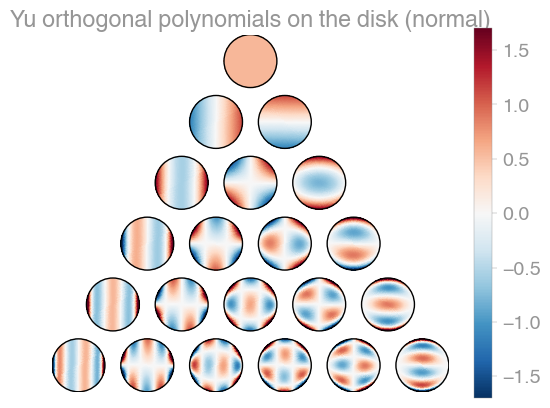
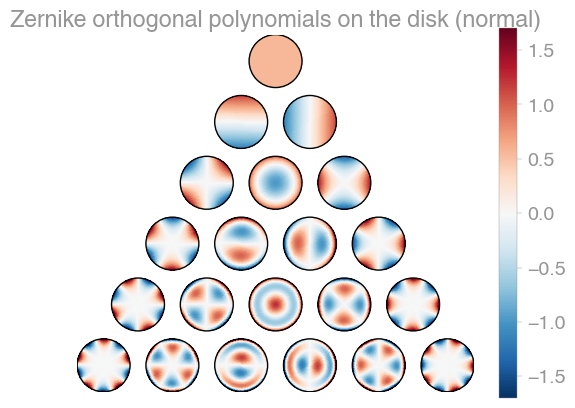
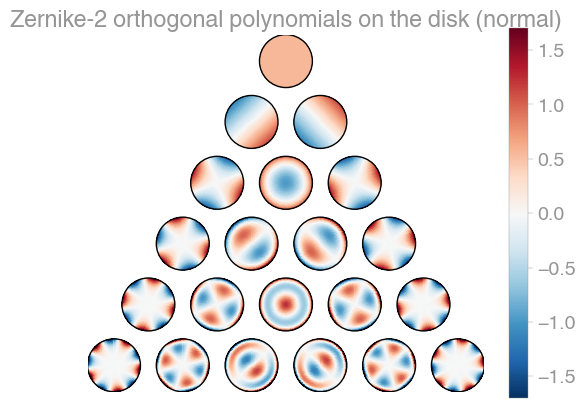
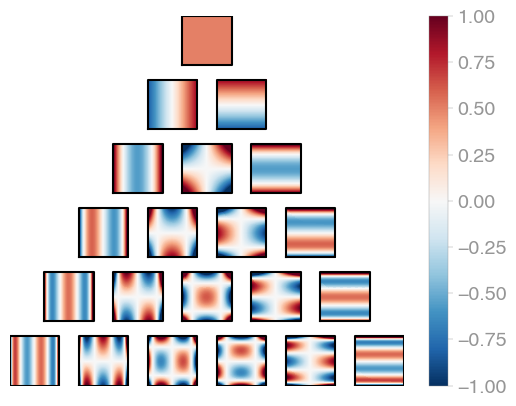
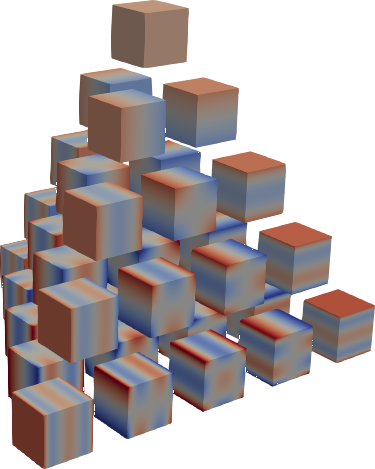
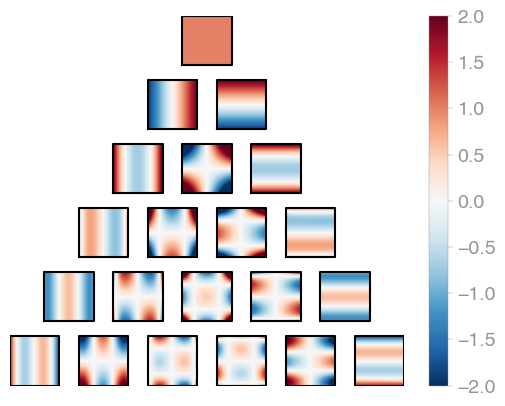
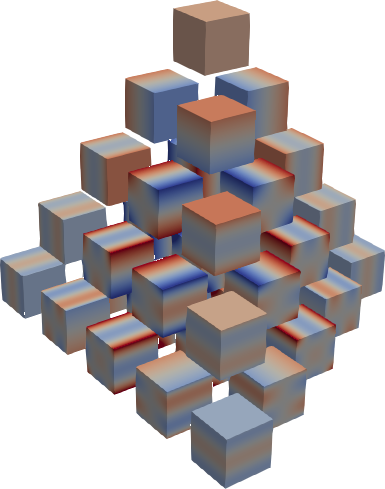
For univariate ("one-dimensional") integrals, every new iteration contains one function. For bivariate ("two-dimensional") domains, every level will contain one function more than the previous, and similarly for multivariate families. See the tree plots below.
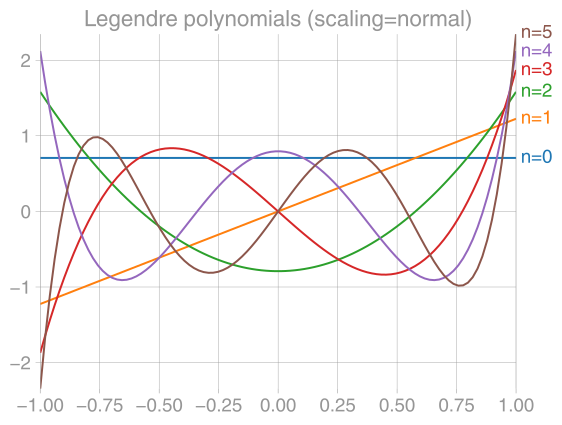
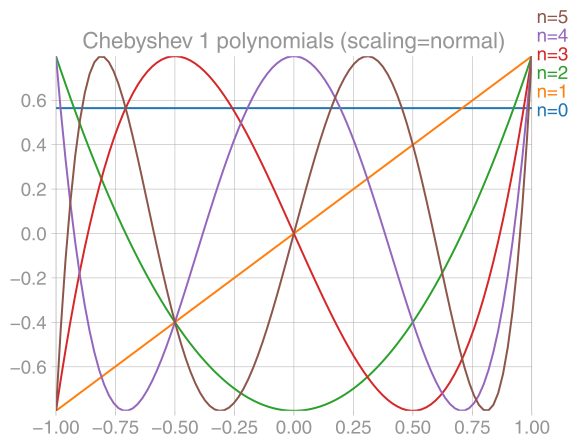
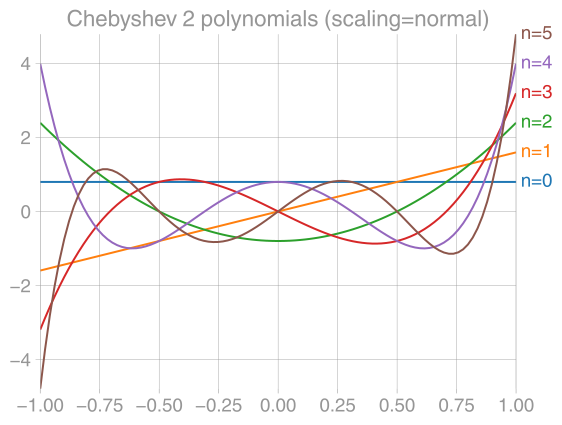
Line segment (-1, +1) with weight function (1-x)α (1+x)β
 |
 |
 |
|---|---|---|
| Legendre | Chebyshev 1 | Chebyshev 2 |
Jacobi, Gegenbauer (α=β), Chebyshev 1 (α=β=-1/2), Chebyshev 2 (α=β=1/2), Legendre (α=β=0) polynomials.
import orthopy

orthopy.c1.legendre.Eval(x, "normal")
orthopy.c1.chebyshev1.Eval(x, "normal")
orthopy.c1.chebyshev2.Eval(x, "normal")
orthopy.c1.gegenbauer.Eval(x, "normal", lmbda)
orthopy.c1.jacobi.Eval(x, "normal", alpha, beta)
The plots above are generated with
import orthopy

orthopy.c1.jacobi.show(5, "normal", 0.0, 0.0)
# plot, savefig also exist
Recurrence coefficients can be explicitly retrieved by
import orthopy

rc = orthopy.c1.jacobi.RecurrenceCoefficients(
    "monic",  # or "classical", "normal"
    alpha=0, beta=0, symbolic=True
)
print(rc.p0)
for k in range(5):
    print(rc[k])
1
(1, 0, None)
(1, 0, 1/3)
(1, 0, 4/15)
(1, 0, 9/35)
(1, 0, 16/63)
1D half-space with weight function xα exp(-r)
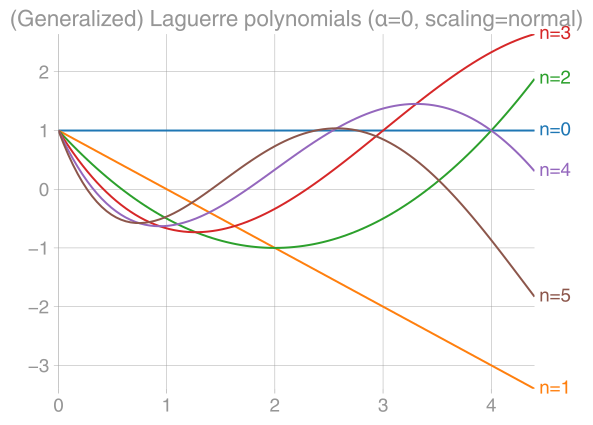
(Generalized) Laguerre polynomials.
evaluator = orthopy.e1r.Eval(x, alpha=0, scaling="normal")
1D space with weight function exp(-r2)
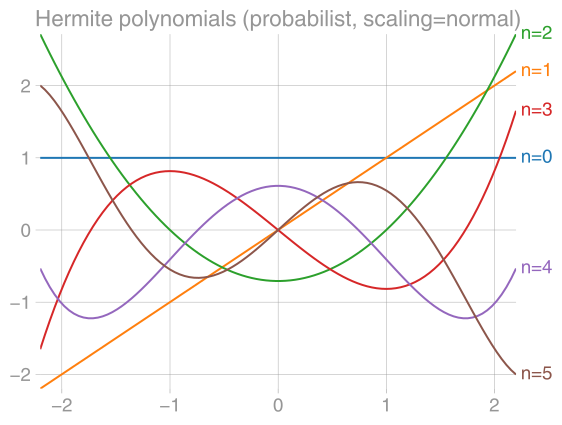
Hermite polynomials come in two standardizations:
"physicists"(against the weight functionexp(-x ** 2)"probabilists"(against the weight function1 / sqrt(2 * pi) * exp(-x ** 2 / 2)
evaluator = orthopy.e1r2.Eval(
    x,
    "probabilists",  # or "physicists"
    "normal"
)
Associated Legendre "polynomials"
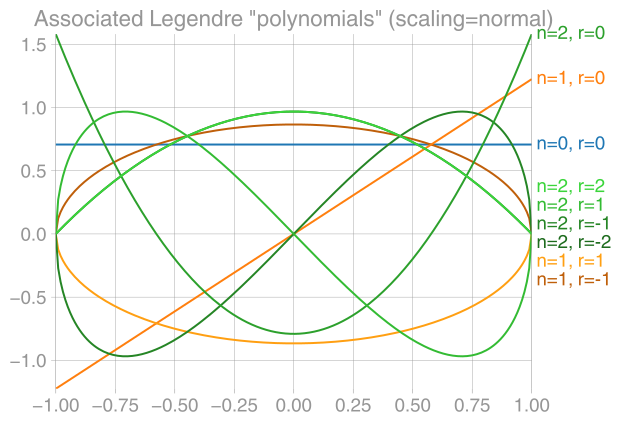
Not all of those are polynomials, so they should really be called associated Legendre functions. The kth iteration contains 2k+1 functions, indexed from -k to k. (See the color grouping in the above plot.)
evaluator = orthopy.c1.associated_legendre.Eval(
    x, phi=None, standardization="natural", with_condon_shortley_phase=True
)
Triangle (T2)
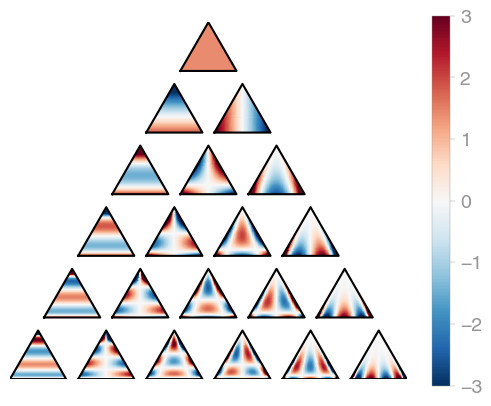
orthopy's triangle orthogonal polynomials are evaluated in terms of barycentric
coordinates, so the
X.shape[0] has to be 3.
import orthopy

bary = [0.1, 0.7, 0.2]
evaluator = orthopy.t2.Eval(bary, "normal")
Disk (S2)
 |
 |
 |
|---|---|---|
| Xu | Zernike | Zernike 2 |
orthopy contains several families of orthogonal polynomials on the unit disk: After Xu, Zernike, and a simplified version of Zernike polynomials.
import orthopy

x = [0.1, -0.3]

evaluator = orthopy.s2.xu.Eval(x, "normal")
# evaluator = orthopy.s2.zernike.Eval(x, "normal")
# evaluator = orthopy.s2.zernike2.Eval(x, "normal")
Sphere (U3)
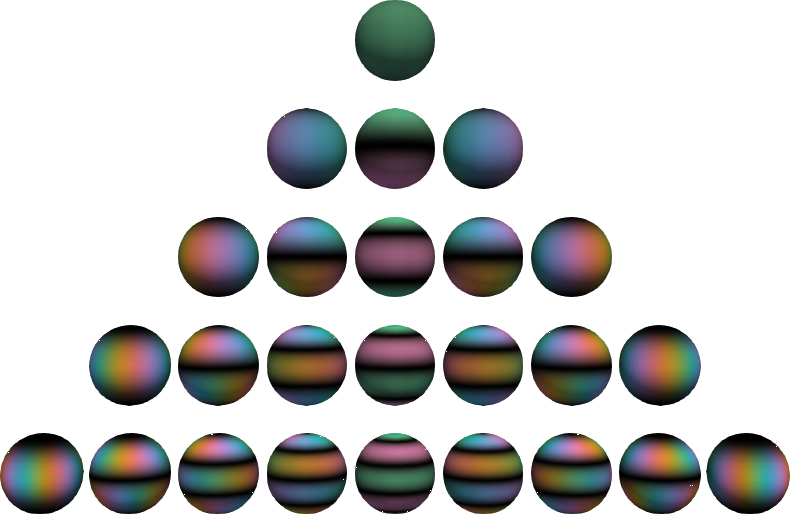
Complex-valued spherical harmonics, (black=zero, green=real positive, pink=real negative, blue=imaginary positive, yellow=imaginary negative). The functions in the middle are real-valued. The complex angle takes n turns on the nth level.
evaluator = orthopy.u3.EvalCartesian(
    x,
    scaling="quantum mechanic"  # or "acoustic", "geodetic", "schmidt"
)

evaluator = orthopy.u3.EvalSpherical(
    theta_phi,  # polar, azimuthal angles
    scaling="quantum mechanic"  # or "acoustic", "geodetic", "schmidt"
)
n-Cube (Cn)
 |
 |
 |
|---|---|---|
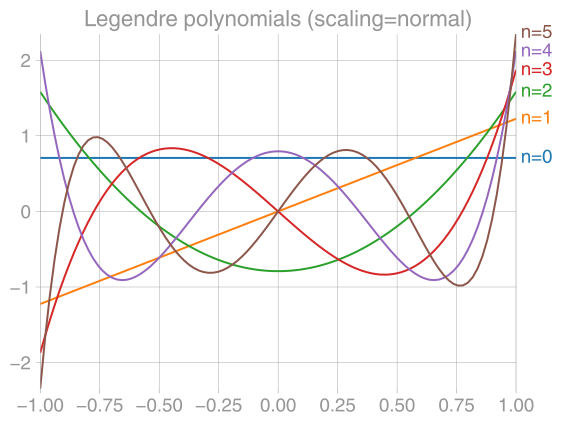
| C1 (Legendre) | C2 | C3 |
Jacobi product polynomials.
All polynomials are normalized on the n-dimensional cube. The dimensionality is
determined by X.shape[0].
evaluator = orthopy.cn.Eval(X, alpha=0, beta=0)
values, degrees = next(evaluator)
nD space with weight function exp(-r2) (Enr2)
|
 |
 |
|---|---|---|
| E1r2 | E2r2 | E3r2 |
Hermite product polynomials.
All polynomials are normalized over the measure. The dimensionality is determined by
X.shape[0].
evaluator = orthopy.enr2.Eval(
    x,
    standardization="probabilists"  # or "physicists"
)
values, degrees = next(evaluator)
Other tools
-
Generating recurrence coefficients for 1D domains with Stieltjes, Golub-Welsch, Chebyshev, and modified Chebyshev.
-
The the sanity of recurrence coefficients with test 3 from Gautschi's article: computing the weighted sum of orthogonal polynomials:
orthopy.tools.gautschi_test_3(moments, alpha, beta)
-
Clenshaw algorithm for computing the weighted sum of orthogonal polynomials:
vals = orthopy.c1.clenshaw(a, alpha, beta, t)
Relevant publications
- Robert C. Kirby, Singularity-free evaluation of collapsed-coordinate orthogonal polynomials, ACM Transactions on Mathematical Software (TOMS), Volume 37, Issue 1, January 2010
- Abedallah Rababah, Recurrence Relations for Orthogonal Polynomials on Triangular Domains, MDPI Mathematics 2016, 4(2)
- Yuan Xu, Orthogonal polynomials of several variables, arxiv.org, January 2017
1 maintainer

Release files for orthopy 0.10.10
For a detailed explanation of source distributions (sdists) and built distributions (wheels), please see the package formats documentation.
Built distributions (wheels)
| File | Reset | |||
|---|---|---|---|---|
| orthopy-0.10.10-cp314-none-any.whl | CPython 3.14 | none | any | Details |
| orthopy-0.10.10-cp313-none-any.whl | CPython 3.13 | none | any | Details |
| orthopy-0.10.10-cp312-none-any.whl | CPython 3.12 | none | any | Details |
| orthopy-0.10.10-cp311-none-any.whl | CPython 3.11 | none | any | Details |
| orthopy-0.10.10-cp310-none-any.whl | CPython 3.10 | none | any | Details |
Total release size: 758.9 kB
Release files / orthopy-0.10.10-cp314-none-any.whl
| Download URL | orthopy-0.10.10-cp314-none-any.whl |
|---|---|
| Size | 168.5 kB |
| Tags | CPython 3.14 |
|
SHA-256 checksum How to use checksums |
96a905d3165411c9681e5db46b4bbb8ff10857feffe3f5175d075a812fe82ebf
|
|
BLAKE2b-256 checksum How to use checksums |
9e8a806e8f144bdb535f017d09af3d1eafd183f6ba308cbae5ff0861ffc12424
|
| Upload date | |
|
Uploaded using Trusted Publishing? What is trusted publishing? |
Yes |
| Uploaded via |
twine/6.1.0 CPython/3.13.12
|
Provenance
Provenance describes where a file came from. On PyPI, provenance is shared via attestations, which provide a verifiable record of the build or publishing details. View details, limitations and caveats.


PyPI Publish Attestation
PyPI verified that this artifact, at this checksum, originated from the publisher listed below.
Signed by GitHub Actions, verified by PyPI on May 18, 2026.
Transparency logRelease files / orthopy-0.10.10-cp313-none-any.whl
| Download URL | orthopy-0.10.10-cp313-none-any.whl |
|---|---|
| Size | 157.9 kB |
| Tags | CPython 3.13 |
|
SHA-256 checksum How to use checksums |
1141b837f893966791c50cb250ca34b46d92f712a631a845b2fe0b172adb3440
|
|
BLAKE2b-256 checksum How to use checksums |
c96d35172e9e3178e8fe112a46e9bab06fcef75bf90b10de5ee18666d03169d1
|
| Upload date | |
|
Uploaded using Trusted Publishing? What is trusted publishing? |
Yes |
| Uploaded via |
twine/6.1.0 CPython/3.13.12
|
Provenance
Provenance describes where a file came from. On PyPI, provenance is shared via attestations, which provide a verifiable record of the build or publishing details. View details, limitations and caveats.
PyPI Publish Attestation
PyPI verified that this artifact, at this checksum, originated from the publisher listed below.
Signed by GitHub Actions, verified by PyPI on May 18, 2026.
Transparency logRelease files / orthopy-0.10.10-cp312-none-any.whl
| Download URL | orthopy-0.10.10-cp312-none-any.whl |
|---|---|
| Size | 157.3 kB |
| Tags | CPython 3.12 |
|
SHA-256 checksum How to use checksums |
dc9622a0bcf6cbf66e692cf5afdb4493f942ef8c9f675ebe02f88a126c945630
|
|
BLAKE2b-256 checksum How to use checksums |
bb5d578e63a5d9510bafe9dca34cbc077893e343d8a1d6ea4cc3b73df7e510d7
|
| Upload date | |
|
Uploaded using Trusted Publishing? What is trusted publishing? |
Yes |
| Uploaded via |
twine/6.1.0 CPython/3.13.12
|
Provenance
Provenance describes where a file came from. On PyPI, provenance is shared via attestations, which provide a verifiable record of the build or publishing details. View details, limitations and caveats.
PyPI Publish Attestation
PyPI verified that this artifact, at this checksum, originated from the publisher listed below.
Signed by GitHub Actions, verified by PyPI on May 18, 2026.
Transparency logRelease files / orthopy-0.10.10-cp311-none-any.whl
| Download URL | orthopy-0.10.10-cp311-none-any.whl |
|---|---|
| Size | 176.9 kB |
| Tags | CPython 3.11 |
|
SHA-256 checksum How to use checksums |
c645238afecf2b88cdbb6f9cdebf7c89322a0b9f275503d9d6a824c8eacf31f0
|
|
BLAKE2b-256 checksum How to use checksums |
263165fafe5e8d816816823a99d9f57b2ba7722e304aed0065233db5fbd2bbbf
|
| Upload date | |
|
Uploaded using Trusted Publishing? What is trusted publishing? |
Yes |
| Uploaded via |
twine/6.1.0 CPython/3.13.12
|
Provenance
Provenance describes where a file came from. On PyPI, provenance is shared via attestations, which provide a verifiable record of the build or publishing details. View details, limitations and caveats.
PyPI Publish Attestation
PyPI verified that this artifact, at this checksum, originated from the publisher listed below.
Signed by GitHub Actions, verified by PyPI on May 18, 2026.
Transparency logRelease files / orthopy-0.10.10-cp310-none-any.whl
| Download URL | orthopy-0.10.10-cp310-none-any.whl |
|---|---|
| Size | 98.2 kB |
| Tags | CPython 3.10 |
|
SHA-256 checksum How to use checksums |
10a788862318898574c02a85c3cc0cf7ca7e26e341fbb26d9b2e4a23c2bf4adc
|
|
BLAKE2b-256 checksum How to use checksums |
cc0241b8a9a5d93a7040e83cb5c6eae2aa8e7e6286480d9ea49bc5492af93930
|
| Upload date | |
|
Uploaded using Trusted Publishing? What is trusted publishing? |
Yes |
| Uploaded via |
twine/6.1.0 CPython/3.13.12
|
Provenance
Provenance describes where a file came from. On PyPI, provenance is shared via attestations, which provide a verifiable record of the build or publishing details. View details, limitations and caveats.
PyPI Publish Attestation
PyPI verified that this artifact, at this checksum, originated from the publisher listed below.
Signed by GitHub Actions, verified by PyPI on May 18, 2026.
Transparency log













