
Open Swiss Model Context Protocol
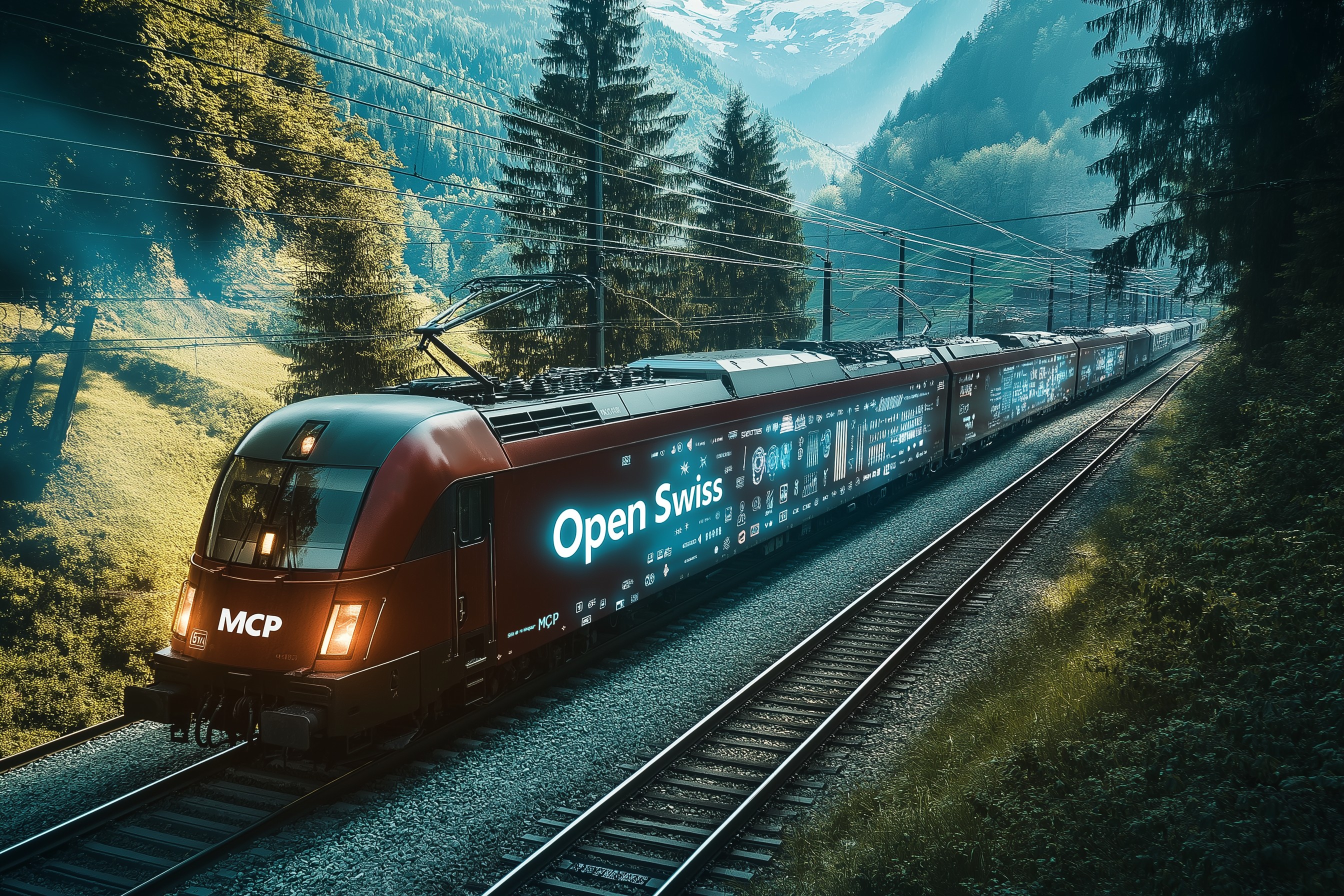




Open Swiss MCP connects Large Language Models to Switzerland's open data infrastructure through Anthropic's Open Source Model Context Protocol. This enables any LLMs to provide real-time, data-grounded responses about Swiss public services and informations.
Why Open Swiss MCP?
- Rich Data Source: Access to 12,000+ high-quality datasets from opendata.swiss, Switzerland's official open data platform.
- Real-Time Insights: Get accurate answers about Swiss public services (weather, transport, etc.)
- Simple Integration: Built on Anthropic's Model Context Protocol for seamless LLM integration with any supported clients.
- Open Architecture: Designed for community contribution and dataset expansion.
Key Features
- One-Command setup
- Access to Swiss public datasets (incl. SBB real-time train informations, Weather updates...)
- Compatible with Claude and other MCP-enabled LLMs Application
We maintain a strong focus on reliability, simplicity, and extensibility. Contributions to expand the supported datasets are welcome!
Usage
Prerequisites
If you want to use Open Swiss MCP with Claude Desktop app client you need to install the Claude Desktop app.
You will also need uv to easily run our CLI and MCP servers.
macOS & Linux
curl -LsSf https://astral.sh/uv/install.sh | sh
Windows
powershell -ExecutionPolicy ByPass -c "irm https://astral.sh/uv/install.ps1 | iex"
Open Swiss MCP - CLI Tool
Overview
# show available commands
uvx osmcp

# show available providers
uvx osmcp list

# show info about a provider
uvx osmcp info $PROVIDER_NAME

# setup a provider's MCP server on your Claude Desktop app
uvx osmcp setup $PROVIDER_NAME

# remove a provider's MCP server from your Claude Desktop app
uvx osmcp remove $PROVIDER_NAME
Example
Quickstart for the SBB provider:
uvx setup sbb
Contributing
We want to scale!
- keep things as simple as possible -> toward AI generated pages keep things in single file
- keep things as standard as possible (TOOLS, TOOLS_HANDLER) and follow the guidelines for what should be a tool, what should be a resource...
- keep it as low as possible in external dependencies (weigh always pros / cons of integrating a new dependency with always a bias toward not adding it)
- keep things formatted with ruff
- keep things tested with pytest
- use typehints and pydantic model for input output of api requests
Concretly: brew install uv / or other mean to install uv git clone uv venv uv sync pre-commit install
Roadmap
data extension
- integrate as many sources as possible from opendata.swiss
framework extension
- add support for
Limitations
- please oblige to the license must be quoted in commercial application
- please oblige to the license of the data providers
References
- Model Context Protocol (Anthropic)
License
This project is licensed under the MIT License - see the LICENSE file for details
1 maintainer

Metadata
1 maintainer
Release files for osmcp 0.1.8
For a detailed explanation of source distributions (sdists) and built distributions (wheels), please see the package formats documentation.
Source distribution (sdist)
| File | Size | Uploaded | Provenance | Actions |
|---|---|---|---|---|
| osmcp-0.1.8.tar.gz | 25.7 kB | With provenance | Details for osmcp-0.1.8.tar.gz |
Built distribution (wheel)
| File | Interpreter | ABI | Platform | Actions Reset |
|---|---|---|---|---|
| osmcp-0.1.8-py3-none-any.whl | Python 3 | none | any | Details for osmcp-0.1.8-py3-none-any.whl |
Total release size: 36.8 kB
Release files / osmcp-0.1.8.tar.gz
| Download URL | osmcp-0.1.8.tar.gz |
|---|---|
| Size | 25.7 kB |
| Tags | Source |
|
SHA-256 checksum How to use checksums |
002cb6d542b39b28124f75af9219c8438b2b6ee3323ffc89672d886561ca0faa
|
|
BLAKE2b-256 checksum How to use checksums |
18c96f63504bd2754993c05939e6b7665664e17efee6758ef160ddb6e11be329
|
| Upload date | |
|
Uploaded using Trusted Publishing? What is trusted publishing? |
Yes |
| Uploaded via |
twine/5.1.1 CPython/3.12.7
|
Provenance
Provenance describes where a file came from. On PyPI, provenance is shared via attestations, which provide a verifiable record of the build or publishing details. View details, limitations and caveats.


PyPI Publish Attestation
PyPI verified that this artifact, at this checksum, originated from the publisher listed below.
Signed by GitHub Actions, verified by PyPI on Dec 1, 2024.
Transparency logRelease files / osmcp-0.1.8-py3-none-any.whl
| Download URL | osmcp-0.1.8-py3-none-any.whl |
|---|---|
| Size | 11.0 kB |
| Tags | Python 3 |
|
SHA-256 checksum How to use checksums |
f4e3202b3d76fe28d507f871bc9809fea0c94fcd4b44b6445d05f3ae1e13008e
|
|
BLAKE2b-256 checksum How to use checksums |
621ccfd6f6961e6e512c722af1db5e69614dfb4efe0fc3b9285f8c141638d64a
|
| Upload date | |
|
Uploaded using Trusted Publishing? What is trusted publishing? |
Yes |
| Uploaded via |
twine/5.1.1 CPython/3.12.7
|
Provenance
Provenance describes where a file came from. On PyPI, provenance is shared via attestations, which provide a verifiable record of the build or publishing details. View details, limitations and caveats.
PyPI Publish Attestation
PyPI verified that this artifact, at this checksum, originated from the publisher listed below.
Signed by GitHub Actions, verified by PyPI on Dec 1, 2024.
Transparency logSecurity for osmcp 0.1.8
Provenance
Provenance describes where a file came from. On PyPI, provenance is shared via attestations, which provide a verifiable record of the build or publishing details. View details, limitations and caveats.
Full provenance
All 2 files in this release have been uploaded with provenance metadata.
Attestation for osmcp-0.1.8.tar.gz
PyPI Publish Attestation
PyPI verified that this artifact, at this checksum, originated from the publisher listed below.
Signed by GitHub Actions, verified by PyPI on Dec 1, 2024.
Transparency logA note on package security
PyPI is a repository for distributing packages, not a service for auditing them. While third-party security researchers and our staff do their best to detect and remove malicious packages, PyPI cannot guarantee the quality, security or suitability of any given package.
To learn more about protecting yourself from malicious actors, visit our package security documentation.














