
oss-intake





Evidence for deciding whether to adopt, keep or replace an open source component. oss-intake runs
Trivy and Grype, checks OSV, and turns the results into a reading order: malicious packages and exploited
vulnerabilities first, findings that apply only under stated conditions separately, the rest as routine. It
adds what a scanner alone does not: how long fixes have existed without being shipped, public exploit
evidence, the advisory's own conditions, reachability for Go binaries, and project health.
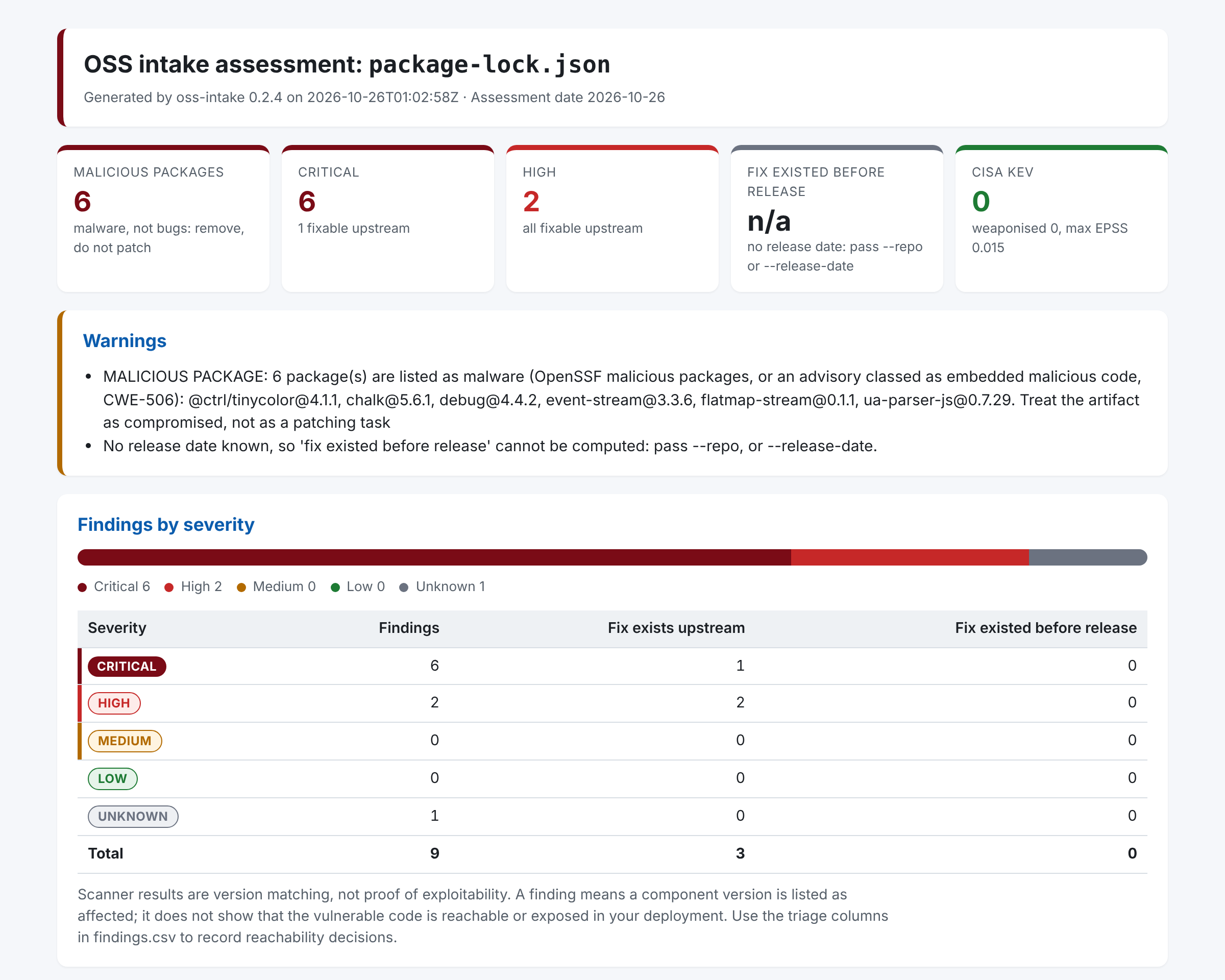
See the live sample report: six trusted npm packages (chalk, debug, @ctrl/tinycolor, ua-parser-js, event-stream, flatmap-stream), one compromised release of each, all flagged as malicious. Read why that is the case for scanning on a schedule, not once at approval.
Quickstart
pipx install oss-intake
# install Trivy and Grype, pinned and verified: see "Install the scanners yourself" below
oss-intake scan --path package-lock.json --out report
oss-intake scan --image <image:tag> --repo <owner/name> --out report
Open report/report.html. The full list, with triage columns for the assessor, is report/findings.csv.
What it answers
- Is any of it malicious? Package versions known as malware, from the OpenSSF malicious packages database or advisories classed as embedded malicious code.
- Is it vulnerable, and what matters first? Known vulnerabilities in a container image, an artifact or a lockfile, with exploit evidence and a suggested triage group for each.
- Does the project patch? Whether fixes that exist upstream are being shipped, how long they have been available, and how active the project is.
The third question is what a scanner alone does not answer. oss-intake measures release lag: findings
where the fixed version of a dependency was already published before the project's release, so the project
could have shipped it and did not. It then adds project health signals (release cadence, OpenSSF Scorecard,
CISA KEV membership).
What it does
- Runs Trivy and, if installed, Grype against an image, and queries OSV.dev for the language packages Trivy found.
- Merges the results into one row per vulnerability, package and version, recording which sources saw it.
- Looks up when each fixed dependency version was published (deps.dev) and compares that with the project's GitHub release date.
- Reports release cadence from the GitHub API and the OpenSSF Scorecard score where one exists.
- Audits the project's own GitHub Actions workflows: unpinned actions, known-bad action versions (such as the
compromised
trivy-actiontags), missing or write-all token permissions, andpull_request_targettriggers. - Optionally suggests a likelihood value for a 5x5 risk matrix from configurable rules, clearly labelled as a heuristic.
- Checks the open source an organisation already runs: a package inventory CSV or a folder of SBOMs, one per host, image or repository (an osquery collector makes them for laptops and servers), with each package version looked up once and counted per system.
- Writes
findings.csv,summary.md,assessment.jsonand a self-containedreport.html, plus the raw scanner output underraw/as evidence. - Applies integrity checks to the scanners it runs: version pinning, a known-bad version list, SHA-256 verification and optional Sigstore (cosign) verification.
What it does not do
- It does not prove exploitability. Scanners match component versions against advisory databases. A
finding means a version is listed as affected, not that the vulnerable code is reachable or exposed in your
deployment. The CSV has
triage_*columns for the assessor's decisions, which carry over to the next run. - It does not install, download, bundle or redistribute scanners. You install them; it verifies them.
- It does not assess licences, secrets or misconfiguration, and it does not detect new malware. Package versions
already known as malware are flagged as malicious: listed in the OpenSSF malicious packages database (OSV
MAL-entries), or covered by an advisory classed as embedded malicious code (CWE-506), as the compromised ua-parser-js 0.7.29 and event-stream 3.3.6 releases are. - It does not give a risk rating. The likelihood suggestion is a starting point for an assessor.
- It does not fix anything or open issues upstream.
Install
Python 3.10 or later on Windows, macOS or Linux. No administrator rights are needed.
pipx install oss-intake
Releases are published to PyPI from GitHub Actions through trusted publishing, so PyPI shows each file's
provenance (which workflow in this repository built it). Each GitHub release also carries a Sigstore signature
bundle (.sigstore.json) for every file, verifiable with sigstore-python.
Windows PowerShell without pipx:
py -m pip install --user pipx
py -m pipx ensurepath
# open a new terminal, then
pipx install oss-intake
If oss-intake is "not recognized" after pip install --user, the per-user Scripts folder is not on PATH.
Either add it, or run the tool through Python, which works everywhere:
py -m oss_intake --help
Install the scanners yourself, pinned and verified
Install a specific version of each scanner from its official GitHub release, never "latest", and verify the
download before you extract it. oss-intake verify does the hash comparison correctly on any platform
(checksum files are served as application/octet-stream; they are parsed as bytes, with BOM and CRLF handled):
oss-intake verify --file trivy_0.76.1_windows-64bit.zip --checksums trivy_0.76.1_checksums.txt
Then record the SHA-256 of the extracted executable and pass it on every run (oss-intake doctor prints it):
oss-intake doctor
Or keep the release files and let each run check the whole chain before the scanner executes: the cosign signature on the checksums file, the archive's SHA-256 in it, and the executable byte-for-byte against the one in the archive. Trivy and Grype both sign their checksums file (Trivy also each archive); neither signs the extracted executable.
oss-intake --image owner/app:1.2.3 --out ./reports --trivy-version 0.76.1 \
  --trivy-archive trivy_0.76.1_Linux-64bit.tar.gz --trivy-checksums trivy_0.76.1_checksums.txt \
  --trivy-cosign-bundle trivy_0.76.1_checksums.txt.sigstore.json
Trivy versions 0.69.4, 0.69.5 and 0.69.6 were malicious (CVE-2026-33634, March 2026). oss-intake refuses to
run any version on its known-bad list.
Usage
oss-intake --image owner/app:1.2.3 --repo owner/app --out ./reports \
  --image-src remote --trivy-version 0.76.1 --trivy-sha256 <sha256-of-trivy-executable> --likelihood
PowerShell (backtick continues a line):
$env:GITHUB_TOKEN = "<optional token, raises the GitHub API rate limit>"
oss-intake --image owner/app:1.2.3 --repo owner/app --out .\reports `
  --image-src remote --trivy-version 0.76.1 --trivy-sha256 <sha256> --likelihood
Without a container image, assess a file or folder directly with --path:
oss-intake --path ./vendor-app-2.4.1.jar --repo owner/app --out ./reports   # JAR, WAR, EAR or binary
oss-intake --path ./requirements.txt --repo owner/app --release-tag v1.4.0 --out ./reports
oss-intake --path ./renv.lock --repo owner/app --release-tag v1.4.0 --out ./reports
A JAR, WAR, EAR or binary is scanned as built artifacts (Trivy rootfs, Grype dir:), and a version in its
file name is tried as the release tag. A JAR, WAR or EAR, a Python wheel or sdist, or an npm .tgz is also
compared with the checksum its registry publishes for that exact version: Maven Central (coordinates from the
archive's pom.properties; the strongest of SHA-512, SHA-256 and SHA-1 it publishes), PyPI (SHA-256) or npm
(SHA-512). A mismatch means the file is not the one the project released (rebuilt, repackaged or tampered with)
and leads the report; a match proves only that the file is the published one, not that it is safe. A fat JAR
that bundles several projects cannot be checked this way. --no-registry-check or --offline skips it. Lockfiles the scanners understand (Python, npm, Maven, Go, Rust, PHP,
Ruby, .NET) are scanned with Trivy fs. An R renv.lock is read by oss-intake and checked against OSV's CRAN
advisories, since neither scanner reads it; packages from Bioconductor, GitHub or local sources are listed as
not checked. A folder is scanned as built artifacts; for a source checkout, pass its lockfile. Release lag needs
the project's release: --repo with --release-tag, or --release-date.
Package inventory
To check the open source an organisation already uses, pass a CSV list of packages, for example exported from Artifactory or Nexus, or kept in a spreadsheet (save it from Excel as "CSV UTF-8"):
oss-intake --path ./packages.csv --out ./reports
To re-scan it every week and get an issue when something new needs action, copy the ready-made GitHub workflow in examples/scheduled-rescan.
ecosystem,name,version,owner,system
npm,@ctrl/tinycolor,4.1.1,Web team,Customer portal
pypi,django,3.2.0,Data team,Reporting
maven,org.apache.logging.log4j:log4j-core,2.14.1,Platform team,Payments
Use either ecosystem, name and version columns, or one purl column (pkg:npm/chalk@5.6.1). Ecosystems:
npm, pypi, maven (group:artifact), go, nuget, cargo, gem, composer, cran, hex and pub, plus common aliases
such as python or java. Versions must be exact: ranges such as ^1.2 or latest are rejected. Any other
column (owner, system, host, team...) is carried through to the reports as a label; a column named like one
oss-intake fills in (systems, findings, group...) is refused with its name. Every row is validated first:
if any row is invalid, the run stops and lists each problem with its row number, before anything is looked up.
A file may hold up to 500,000 rows, one per host and package if you like: each package version is looked up
once however many rows list it.
No scanner is needed: each package version is checked against OSV, so malicious releases are flagged as well as
vulnerable ones. Besides the usual reports, packages.csv lists every package, worst first, with its findings
and label columns, systems (how many hosts, images or repositories list it, from a host, hostname or
system column or the SBOM subjects; between equally bad packages, the one on more systems comes first), and an
upgrade comparison:
- Upgrade to at least: the lowest version that fixes every listed vulnerability with a fix, and what is
still known to affect that version (
1.2.0 · 1 knownmeans the minimum fix is not enough on its own). - Latest release: the package's current release on deps.dev and what is known to affect it. Skip this lookup
(one request per package) with
--no-latestto see the current state and the minimum fix only. - major: the upgrade crosses a major version, or a minor version below 1.0, so expect breaking changes.
When a package is on more than one system, package-systems.csv lists every package and system pair, so "which
hosts run X" is a filter in a spreadsheet; long host lists are shortened elsewhere (Excel holds 32,767
characters in a cell).
Fewer known vulnerabilities is not proof that a version is safe: it may be less studied, or newer than the advisories. The HTML report shows the packages that need attention.
Inventory runs also write executive-summary.html: one page for someone who will not read the findings. It
gives the packages checked, how many need action now (malicious or known exploited), have critical
vulnerabilities, or have had no release for over a year; the top packages to act on with the action for each;
totals by owner (from an owner, team, system or application column); and the known vulnerabilities now,
after upgrading to the minimum fixes, and after upgrading to the latest releases. When --decisions points at
the previous run's findings.csv, it also shows what changed since then: new findings and findings no longer
present. Run it on a schedule: a package that was clean when approved can turn
out vulnerable or compromised later. A sample is in
examples/inventory.
SBOMs
An SBOM works wherever an inventory CSV does: a CycloneDX (1.2 to 1.7) or SPDX (2.2, 2.3) JSON file, or a folder that holds only SBOMs (one per host, image or repository). It is recognised by its content, and GitHub's dependency-graph export is read as is.
oss-intake --path ./sboms --out ./reports --label owner="Platform team"
Each component is read by its package URL. Language packages are checked as in an inventory. OS packages (deb,
rpm, apk) are checked in OSV under the distro's own ecosystem and release (Ubuntu, Debian, Alpine, Rocky Linux,
AlmaLinux, Wolfi, Chainguard) and by source package, as the distro files its advisories: libssl3t64 is looked
up as openssl. Components that cannot be checked (no package URL, a version range, an OS package whose release
the SBOM does not state, or a distro OSV has no data for, such as Amazon Linux) are listed in the report with the
reason, never counted as clean. The SBOM's subject becomes the system label and a component's supplier the
supplier label; --label key=value adds your own to every package. Recipes for Amazon Inspector, Syft, Trivy
and the GitHub dependency graph are in
examples/sbom.
For laptops and servers, examples/osquery
turns osquery's package tables, from one machine or a whole fleet's result logs, into one SBOM per host.
examples/nexus does the same for what a Nexus
Repository proxy has cached, with a gate recipe that checks only what is new since the last run.
Collectors: in the repository, not the package
The collectors are small standalone scripts (Python standard library only), kept in the repository rather than the PyPI package, so they can be copied to the machine that needs one (an osquery log server, a host that can reach Nexus) without installing anything. Get the ones matching your oss-intake version, and check them:
V=$(oss-intake --version | awk '{print $NF}')    # e.g. 0.11.1
BASE=https://raw.githubusercontent.com/ntavakol/OSS-Intake/v$V/examples
curl -fsSLO "$BASE/nexus/nexus_sbom.py"
curl -fsSLO "$BASE/osquery/osquery_sbom.py"
curl -fsSLO "$BASE/osquery/oss-intake-pack.conf"
shasum -a 256 -c <<'SUMS'
520a8480a2deaa061ed2d0f39bb46a6afcdd6629b48e289971a8c9f5fa6f8295  nexus_sbom.py
75a11d6305e639106368f77668292f61662921571cf8390e52214d3cd84b4170  osquery_sbom.py
b5dfa634d47e15ed06bed1118b40cef9ea02c78c8da2da7ed80c1546567e1a93  oss-intake-pack.conf
SUMS
The checksums above are for this release (on Linux without shasum, use sha256sum -c). Each script's
--help, and the README next to it on GitHub, says how to use it:
examples/nexus (with the gate recipe),
examples/osquery,
examples/sbom (recipes, no script) and
examples/scheduled-rescan (a
GitHub Actions workflow).
All inputs are validated before any scanner runs. The image must carry an explicit tag or digest.
| Option | Purpose |
|---|---|
--out |
Output directory (required) |
--image |
Image with explicit tag or digest |
--path |
A JAR, WAR, binary, folder, lockfile, renv.lock or package inventory .csv instead of an image |
--reachability, --govulncheck-path |
Check Go binaries with govulncheck (see Go reachability) |
--govulncheck-sha256, --govulncheck-version |
Pin govulncheck like the scanners: hash checked before it runs, version after. The Docker or crane executable used to copy binaries out of an image is recorded with its SHA-256 in assessment.json |
--repo |
GitHub owner/name (a full GitHub URL is accepted) |
--image-src remote |
Pull from the registry without Docker installed (Trivy --image-src remote, Grype registry:) |
--platform |
Image platform for both scanners (default linux/amd64, so Apple Silicon scans the same variant as a server); '' uses scanner defaults |
--scanners |
auto (default: Trivy and OSV, plus Grype if found) or a list such as trivy,grype,osv |
--trivy-version, --grype-version |
Required scanner version; the run fails on mismatch |
--trivy-sha256, --grype-sha256 |
Expected SHA-256 of the executable, checked before it is run at all |
--trivy-archive, --grype-archive |
The release archive the executable came from; the executable must be byte-for-byte the one inside it |
--trivy-checksums, --grype-checksums |
The release checksums file, which must list the archive's SHA-256 |
--trivy-cosign-bundle, --grype-cosign-bundle |
Verify the release's Sigstore bundle with cosign (on PATH): against the checksums file when given, otherwise the archive. Trivy signs its archives and checksums file, Grype only its checksums file; neither signs the extracted executable, so a bundle needs the archive |
--trivy-arg, --grype-arg |
Pass extra arguments, e.g. --trivy-arg=--db-repository=ghcr.io/aquasecurity/trivy-db:2 |
--from-trivy-json, --from-grype-json |
Use an existing JSON report instead of running the scanner; a file that is not that scanner's report is refused (exit 2) |
--release-tag, --release-date |
Set the release the image corresponds to, when tags do not match |
--grace-days |
A fix must predate the release by this many days to count as missed (default 14) |
--unshipped-days |
Days a fix must be public, with no newer release, to count as unshipped (default 90) |
--as-of |
Fix the assessment date for reproducible reports |
--min-severity |
Drop findings below a severity |
--formats |
Any of csv,md,json,html (default all; findings.csv is always written) |
--offline |
No network enrichment (OSV, deps.dev, GitHub, Scorecard, KEV, EPSS, exploit sources) |
--no-epss, --no-kev, --no-scorecard, --no-fix-dates, --no-exploits |
Skip one enrichment source (--release-age-days 0 skips the new-release check) |
--no-latest |
Package inventories: skip the latest-release lookup (the minimum fix is still checked) |
--no-registry-check |
Skip comparing a JAR, wheel, sdist or npm .tgz with its registry's published checksum |
--label KEY=VALUE |
Inventories and SBOMs: label every package that has no such label yet (repeatable), e.g. --label owner="Web team"; labels group packages.csv and the executive summary |
--decisions FILE |
Carry assessor decisions into this run: an earlier findings.csv with the triage columns filled in, or OpenVEX |
--no-workflows |
Skip the audit of the project's GitHub Actions workflows |
--trivy-path, --grype-path |
Use a scanner executable that is not on PATH |
--trivy-cosign-identity, --grype-cosign-identity |
Certificate identity (regexp) the cosign bundle must match |
--timeout |
Seconds before a scanner run is abandoned (default 1800) |
--top |
Number of findings listed in the summary (default 25; all are in findings.csv) |
--quiet |
Print only the result line and errors |
--likelihood, --likelihood-config FILE |
Add the 5x5 likelihood heuristic, with optional custom rules |
--fail-on-likelihood N |
Exit code 3 when the suggestion is N or higher, for pipelines |
--fail-on LIST |
Exit code 3 when any is found, for CI: malicious, kev, act (Act now), critical, high (high or critical), recent (a release newer than --release-age-days), unknown-age (a language package version with no release date on deps.dev: not indexed yet, as for a release only hours old, or a registry deps.dev does not cover, such as RubyGems and CRAN; versions that could not be looked up are named, and components without a usable package URL are listed as not checked instead), mismatch (registry checksum). Findings set aside by evidence or a decision do not count, apart from malicious packages. A gate whose check is turned off is refused (exit 2); one whose check could not run fully fails with exit 1 rather than passing |
--release-age-days N |
Flag language package versions published fewer than N days ago (default 7; 0 turns it off). Compromised releases are usually live only for hours or days, before any advisory exists. One deps.dev request per package version, up to --release-age-max |
--release-age-max N |
Release-date lookups for at most N package versions, counted after duplicates across hosts are merged (default 400); the rest are reported as not checked, never as old |
--cache-dir DIR, --no-cache |
Where slowly changing lookups are kept between runs: OSV advisory details for a day, deps.dev release dates for 30 days, latest versions for a day, proof-of-concept lists for 7 days (default: the user cache folder, e.g. ~/.cache/oss-intake or ~/Library/Caches/oss-intake). Which advisories affect a version, KEV, EPSS and the exploit indexes are always fetched fresh, and "not found" is never kept (a release only hours old may not be indexed yet). A folder other users can write to is not used. --no-cache keeps nothing |
--sbom |
Also write a CycloneDX SBOM to raw/ |
Other commands: oss-intake doctor (scanner paths, versions, hashes and known-bad status; --trivy-path and
--grype-path as for scan) and oss-intake verify, which checks a downloaded file:
verify option |
Purpose |
|---|---|
--file |
The downloaded file to check (required) |
--checksums |
A sha256sum-style checksums file from the release, e.g. trivy_0.76.1_checksums.txt |
--sha256 |
An expected SHA-256 instead of a checksums file |
--name |
The entry to look up in the checksums file (default: the file's name) |
--cosign-bundle, --cosign-identity |
Also verify a Sigstore bundle with cosign, against a certificate identity regexp |
Exit codes: 0 success, 1 error (including any integrity failure, a scanner failure, or an OSV outage when OSV
is the only source), 2 invalid input (found before any scanning), 3 a --fail-on or --fail-on-likelihood
threshold reached.
When a source was not consulted (--offline, --no-kev, --no-exploits, --no-epss, a failed download, or no
OSV query), the reports show it as "not checked" in grey rather than as a green zero, the Routine reasons say
which checks did not run, assessment.json records each source's state under checks, and the summary line ends
with not_checked= and the sources concerned.
GITHUB_TOKEN is optional. It is only sent to api.github.com, and it is never logged or written to reports.
How release lag is measured
For each finding with a fix, oss-intake picks the nearest fixed version above the installed one (so a fix on
an older branch is not counted for a newer one) and looks up when that version was published.
| Metric | Meaning |
|---|---|
| Fix exists upstream | A fixed version of the dependency is known |
| Fix existed before release | The fixed version was published at least --grace-days (14) days before the project's release: the project could reasonably have shipped it |
| Fix within grace period | Published in the 14 days before release; shown but not counted as missed |
| Unshipped | Forward-looking: the fix has been public for --unshipped-days (90) or more and the scanned release is still the project's latest |
| Likely already fixed | Installed version equals a listed fix apart from a build label such as .jre11; flagged and excluded from lag |
| Fix published after release | The fix arrived later; this is normal lag for the next release |
| Days a fix has been available | Assessment date minus the fixed version's publish date |
| CVE published before release | Secondary signal. A CVE can be public before any fix exists, so this overstates lag on its own |
Fix dates come from deps.dev for language packages, from Packagist for PHP Composer packages, falling back to the GitHub release date for Go modules
hosted on GitHub that deps.dev does not index. For Debian packages they come from the Debian security advisory
that shipped the fix (DSA or DLA, by the scanner's advisory ID or the exact fixed version), dated from the Debian
security tracker's advisory lists, with OSV as a fallback. Fixes that shipped without an advisory are dated from the
Debian point release (13.6 and so on) that included the fixed version, from the suite's ChangeLog; fixes still in
proposed-updates stay unknown, with a note. For Ubuntu packages they come from the Ubuntu
Security Notice (USN) that fixed the CVE in that release and source package at that version, found through OSV;
failing that, from Launchpad's publishing history: when that exact version was first published to the release in
the Release, Security or Updates pocket.
For RHEL and UBI packages they come from the Red Hat advisory (RHSA) that Trivy reports, dated from Red Hat's
CSAF document. For Alpine packages they come from the aports commit history on the image's release branch: a commit naming the
CVE, or the fixed version for a new upstream release (set GITHUB_TOKEN, one request per package).
For the Go standard library they come from the Go release history (go.dev/doc/devel/release).
Packages with no dated source yet, currently Amazon Linux and runtimes detected only from a binary, are counted as
"fix date unknown" rather than guessed. The fix_date_source column in findings.csv shows where each date came from.
Example output
Taken from the synthetic test fixtures (tests/fixtures, fictional project example/webapp) so it shows
the format, not a judgement of any real project. This section is regenerated from the code by
scripts/readme_sync.py, and the test suite fails if it falls out of date. A real report on six compromised npm
releases is in the live sample.
findings=7 critical=2 high=4 with_fix=6 fix_before_release=4 fix_date_unknown=0 likelihood=5(Almost certain,confidence=normal)
| Group | ID | Severity | CVSS | Exploit | Package | Installed | Fix | Fix before release | Days fix available |
|---|---|---|---|---|---|---|---|---|---|
| Act now | CVE-2099-0003 | HIGH | 7.5 (3.1, ghsa) | known exploited | io.netty:netty-codec-http | 4.1.100.Final | 4.1.108.Final | yes | 244 |
| Act now | CVE-2099-0005 | HIGH | 7.5 (3.1, ghsa) | weaponised | com.fasterxml.jackson.core:jackson-databind | 2.17.0 | 2.17.1 | yes | 221 |
| Act now | CVE-2099-0002 | HIGH | 7.5 (3.1, ghsa) | weaponised | com.fasterxml.jackson.core:jackson-databind | 2.17.0 | 2.17.2 | no | 129 |
| Review | CVE-2099-0001 | CRITICAL | 9.8 (3.1, ghsa) | none indexed | org.springframework:spring-web | 6.1.10 | 6.1.12 | yes | 290 |
| Review | CVE-2099-0006 | CRITICAL | 9.8 (3.1, ghsa) | public exploit | com.fasterxml.jackson.core:jackson-databind | 2.17.0 | 2.17.3 | no | 113 |
| Routine | CVE-2099-0004 | HIGH | 7.1 (3.1, ghsa) | proof of concept | org.springframework:spring-web | 6.1.10 | none | no fix | n/a |
| Routine | CVE-2099-1000 | MEDIUM | 7.5 (3.1, ghsa) | none indexed | libc6 | 2.39-0ubuntu8.4 | 2.39-0ubuntu8.5 | yes | 254 |
The summary also covers scope (scanner versions, database dates, hash verification), project health, agreement between sources and any warnings. See docs/validation.md for checking the tool against a real public image.
Exploit availability and advisory conditions
Each finding gets the strongest public exploit evidence found: known exploited (CISA KEV), weaponised (a
Metasploit module or Nuclei template), public (Exploit-DB), proof of concept (GitHub repositories only, which
are noisy and sometimes malicious), or none indexed. "None indexed" means none was found in those sources, not
that none exists; when a source cannot be reached the finding is "not checked" instead. The conditions
column quotes the advisory's own statement of when the finding applies (for example "only if the application
uses XsltView"), word for word, so the assessor can check it against the deployment.
Go reachability (optional)
With --reachability, Go binaries in the scan are checked with Go's official
govulncheck in binary mode, which reports whether a vulnerable function is
actually linked into the binary. Install it yourself (go install golang.org/x/vuln/cmd/govulncheck@v1.1.4);
oss-intake never downloads it. For an image, the binaries are copied out with Docker (docker create and
docker cp) or crane export. A finding whose vulnerable functions are absent from every binary it was seen
in is marked "not reachable" and set aside in triage, with the govulncheck ID as the reason; one whose function
is present is marked "reachable". Counts and likelihood do not change: the vulnerable version is still shipped.
This covers Go only; for other languages the advisory conditions are the assessor's guide.
Suggested triage
Each finding is placed in one group, with its reason, as a reading order for the engineer: Act now (a known malicious package, CISA KEV, or a Metasploit or Nuclei exploit), Review (an Exploit-DB exploit, EPSS 0.1 or more, or a critical whose advisory states no conditions), Check conditions (the advisory says when it applies; confirm against the deployment), Routine (none of these) and Set aside (only with evidence: a kernel header package, the installed version already matches a fix, govulncheck shows the vulnerable function is not in the binary, or the assessor recorded the finding as not affected or fixed). No group says a finding carries no risk.
Carrying decisions between runs
Scanning on a schedule only works if a finding assessed once does not have to be assessed again. Each run's
findings.csv has three columns for the assessor:
| Column | Values |
|---|---|
triage_status |
not_affected, affected, fixed or under_investigation (OpenVEX statuses; "false positive", "risk accepted", "patched" and "investigating" are accepted too), or mitigated for a compensating control: not affected, with the justification inline_mitigations_already_exist, never reported as fixed |
triage_notes |
Why. Required for not_affected and mitigated. Line breaks and a leading -, =, + or @ are kept exactly |
triage_reachable |
no records that the vulnerable code is not in the execution path |
triage_justification |
Optional OpenVEX justification for not_affected, e.g. component_not_present or vulnerable_code_not_present; filled in from an OpenVEX file |
Fill them in for the findings you have assessed, then pass the file to the next run:
oss-intake --image owner/app:1.5.0 --repo owner/app --out ./reports-2 --decisions ./reports-1/findings.csv
Each decision applies to the same vulnerability (by ID or alias) in the same package; when there are decisions for
several versions, the one for the installed version wins. For OS packages an OpenVEX product such as
pkg:deb/ubuntu/libc6@... matches package libc6. not_affected and
fixed set the finding aside, with the note as the reason; affected and under_investigation keep its group
and add the note. A decision made for another installed version still applies but is marked for review, a
decision whose vulnerability is no longer found is listed as resolved, and a decision never sets aside a
malicious package. Decisions are validated before anything is scanned.
The new findings.csv comes out with the decisions filled in (and triage_decided_version), so the next run
takes it as is and only new findings are blank. Every run with decisions also writes openvex.json
(OpenVEX v0.2.0), which Grype and Trivy can read (--vex), and vex.cdx.json
(CycloneDX 1.6 VEX) for Dependency-Track. In the CycloneDX file not_affected, affected, fixed and
under_investigation become not_affected, exploitable, resolved and in_triage, and components use the package
URL as their reference; an import matches only where the receiving project identifies components by the same
purl. An OpenVEX file is accepted as --decisions too.
Likelihood heuristic
Off by default. With --likelihood, the first matching rule wins:
| Level | Default rule |
|---|---|
| 5 Almost certain | A package listed as malicious (OpenSSF malicious packages, or a CWE-506 advisory) is present |
| 5 Almost certain | A known-exploited (CISA KEV) vulnerability has a fix the project has not shipped |
| 4 Likely | A finding with an upstream fix has a ready-to-use public exploit (Metasploit module or Nuclei template) |
| 4 Likely | A finding with an upstream fix has a high predicted exploitation probability (EPSS 0.5 or more) |
| 4 Likely | Critical fixes were available before release and the project shows weak upkeep |
| 4 Likely | Critical fixes have been available for a long time and the project has not released since |
| 3 Possible | A finding with an upstream fix has a notable predicted exploitation probability (EPSS 0.1 or more) |
| 3 Possible | A finding with an upstream fix has a published exploit (Exploit-DB) |
| 3 Possible | Critical, or several high, fixes were available before release and not shipped |
| 3 Possible | Critical, or many high, fixes have been available upstream for a long time with no newer release |
| 2 Unlikely | High or critical findings exist with upstream fixes |
| 1 Rare | No high or critical findings with available fixes |
Unknown signals (no Scorecard score, say) never trigger a rule. To use your own rules, copy
DEFAULT_CONFIG from likelihood.py into a JSON file and pass
--likelihood-config.
The available metrics are archived, critical_fix_at_release, critical_fix_unshipped, critical_with_fix, days_since_latest_release, fix_date_unknown, high_fix_at_release, high_fix_unshipped, high_with_fix, kev_with_fix, malicious, max_days_fix_available, max_epss_with_fix, public_exploit_with_fix, release_date_known, scanned_is_latest, scorecard_score, weaponised_with_fix and with_fix.
Limitations
- Results depend on the scanners' vulnerability databases and drift as those databases update. The report records scanner and database versions so a result can be reproduced or explained.
- Trivy and Grype detect packages independently, so their disagreement is informative. OSV is queried with Trivy's package list, so it is an independent database check, not an independent detector.
- Severity is the highest any source reported, which is conservative. Per-source severities are in the CSV.
- Kernel CVEs reported against kernel header packages (
linux-libc-devand similar) are excluded from lag and likelihood, because a container uses the host's kernel. They stay in findings.csv with a note; assess the host kernel separately. Use--include-kernel-headersto count them. - Version comparison is ecosystem-agnostic and approximate. It only affects which fix date is used. Build
labels (
.jre11,-jre,-android) are ignored when comparing. - Scanners can read a JAR's version without its build label and report an already-fixed build as vulnerable
(seen with
mssql-jdbc 12.10.2.jre11). These rows are kept, marked in thenotecolumn and excluded from lag. OSV inherits the same mistake because it is queried with the scanner's version. - The OpenSSF Scorecard API only covers repositories in its scheduled dataset. "Not scored" is not a negative signal.
- Release matching expects GitHub releases whose tags resemble the image tag (
1.2.3,v1.2.3,name-1.2.3,release-1.2.3), and also tries the tag without a variant suffix (2.528-jdk21matchesjenkins-2.528). If nothing matches, lag metrics are not computed rather than measured against the wrong release. Use--release-tagor--release-datein that case. Failing both, the image's build date is used and labelled "image build date": lag then means "fixes that existed when the image was built" (disable with--no-image-date). - Fix dates are unavailable for Amazon Linux and for runtimes found only in binaries. When more than half of the fixes lack a date, the likelihood suggestion is marked low confidence: read it as "not enough evidence", not "low risk".
- Only GitHub-hosted projects get health signals in this version.
- Trivy does not catalogue installed R (CRAN) packages, so R libraries inside an image are not assessed.
- Runtimes detected from binaries (
binaryin the coverage table) have no package registry to date fixes from, so they always show as "fix date unknown".
Planned work is in BACKLOG.md.
Licence
Apache License 2.0. See LICENSE.
1 maintainer

Metadata
1 maintainer
Release files for oss-intake 0.11.1
For a detailed explanation of source distributions (sdists) and built distributions (wheels), please see the package formats documentation.
Source distribution (sdist)
| File | Size | Uploaded | Provenance | Actions |
|---|---|---|---|---|
| oss_intake-0.11.1.tar.gz | 349.5 kB | With provenance | Details for oss_intake-0.11.1.tar.gz |
Built distribution (wheel)
| File | Interpreter | ABI | Platform | Actions Reset |
|---|---|---|---|---|
| oss_intake-0.11.1-py3-none-any.whl | Python 3 | none | any | Details for oss_intake-0.11.1-py3-none-any.whl |
Total release size: 521.0 kB
Release files / oss_intake-0.11.1.tar.gz
| Download URL | oss_intake-0.11.1.tar.gz |
|---|---|
| Size | 349.5 kB |
| Tags | Source |
|
SHA-256 checksum How to use checksums |
6ea42bcbdf2bed9353a3bda36c6f8565a10b493bd304d1b683d9e512d4b3d305
|
|
BLAKE2b-256 checksum How to use checksums |
5636e20f5c07d8ed2ec09fb7b3149c602dcf14352eed8f904e2b721576388692
|
| Upload date | |
|
Uploaded using Trusted Publishing? What is trusted publishing? |
Yes |
| Uploaded via |
twine/7.0.0 CPython/3.13.16
|
Provenance
Provenance describes where a file came from. On PyPI, provenance is shared via attestations, which provide a verifiable record of the build or publishing details. View details, limitations and caveats.


PyPI Publish Attestation
PyPI verified that this artifact, at this checksum, originated from the publisher listed below.
Signed by GitHub Actions, verified by PyPI on Oct 30, 2026.
Transparency logRelease files / oss_intake-0.11.1-py3-none-any.whl
| Download URL | oss_intake-0.11.1-py3-none-any.whl |
|---|---|
| Size | 171.5 kB |
| Tags | Python 3 |
|
SHA-256 checksum How to use checksums |
5d8aaf74a347426133f7307ad3e6fe6b3dffd74271adfcf12e25b579b86b2603
|
|
BLAKE2b-256 checksum How to use checksums |
9b94f49b0c2fcc43d15fdcca49e327e7e2e315880452119ea16b695ff52c22a1
|
| Upload date | |
|
Uploaded using Trusted Publishing? What is trusted publishing? |
Yes |
| Uploaded via |
twine/7.0.0 CPython/3.13.16
|
Provenance
Provenance describes where a file came from. On PyPI, provenance is shared via attestations, which provide a verifiable record of the build or publishing details. View details, limitations and caveats.
PyPI Publish Attestation
PyPI verified that this artifact, at this checksum, originated from the publisher listed below.
Signed by GitHub Actions, verified by PyPI on Oct 30, 2026.
Transparency logSecurity for oss-intake 0.11.1
Provenance
Provenance describes where a file came from. On PyPI, provenance is shared via attestations, which provide a verifiable record of the build or publishing details. View details, limitations and caveats.
Full provenance
Both files in this release have been uploaded with provenance metadata.
Attestation for oss_intake-0.11.1.tar.gz
PyPI Publish Attestation
PyPI verified that this artifact, at this checksum, originated from the publisher listed below.
Signed by GitHub Actions, verified by PyPI on Oct 30, 2026.
Transparency logA note on package security
PyPI is a repository for distributing packages, not a service for auditing them. While third-party security researchers and our staff do their best to detect and remove malicious packages, PyPI cannot guarantee the quality, security or suitability of any given package.
To learn more about protecting yourself from malicious actors, visit our package security documentation.














