
Self-Improving AI Workflow System

Project description
English | 한국어
◯ ─────────── ◯

O U R O B O R O S
◯ ─────────── ◯
Stop prompting. Start specifying.
A Claude Code plugin that turns vague ideas into validated specs — before AI writes a single line of code.


Quick Start · Philosophy · How · Commands · Agents
Security Notice (2026-03-24): LiteLLM PyPI Supply Chain Attack
LiteLLM versions 1.82.7 and 1.82.8 on PyPI contained a malicious
.pthfile that auto-executes on every Python startup (noimportneeded), exfiltrating environment variables, API keys, SSH keys, and cloud credentials to an external server.Am I affected? You are at risk if, after March 23, 2026, you either:
- Fresh-installed Ouroboros (
pip install ouroboros-ai,uv tool install ouroboros-ai), or- Upgraded an existing install (
pip install --upgrade ouroboros-ai)In both cases,
litellm>=1.80.0was a dependency, and your package manager would have resolved it to the malicious 1.82.7/1.82.8. If you installed before that date and haven't reinstalled or upgraded since, you are likely safe.Ouroboros has removed litellm entirely as of v0.25.2 (stable) and v0.26.0b7 (beta). However, upgrading Ouroboros only removes litellm from the dependency list — it does NOT uninstall litellm itself or delete the malicious
.pthfile already on your system. You must clean up manually:# 1. Find the malicious file — delete any results find / -name "litellm_init.pth" 2>/dev/null # 2. Clean package manager caches uv cache clean litellm # if using uv pip cache purge # if using pip # 3. Rotate ALL credentials that were on your system during the exposure windowReferences: LiteLLM #24512 · Ouroboros #195 · Analysis
AI can build anything. The hard part is knowing what to build.
Ouroboros is a specification-first AI development system. It applies Socratic questioning and ontological analysis to expose your hidden assumptions — before a single line of code is written.
Most AI coding fails at the input, not the output. The bottleneck isn't AI capability. It's human clarity. Ouroboros fixes the human, not the machine.
From Wonder to Ontology
Wonder → "How should I live?" → "What IS 'live'?" → Ontology — Socrates
This is the philosophical engine behind Ouroboros. Every great question leads to a deeper question — and that deeper question is always ontological: not "how do I do this?" but "what IS this, really?"
   Wonder                          Ontology
     💡                               🔬
"What do I want?"    →    "What IS the thing I want?"
"Build a task CLI"   →    "What IS a task? What IS priority?"
"Fix the auth bug"   →    "Is this the root cause, or a symptom?"
This is not abstraction for its own sake. When you answer "What IS a task?" — deletable or archivable? solo or team? — you eliminate an entire class of rework. The ontological question is the most practical question.
Ouroboros embeds this into its architecture through the Double Diamond:
    ◇ Wonder          ◇ Design
   ╱  (diverge)      ╱  (diverge)
  ╱    explore      ╱    create
 ╱                 ╱
◆ ──────────── ◆ ──────────── ◆
 ╲                 ╲
  ╲    define       ╲    deliver
   ╲  (converge)     ╲  (converge)
    ◇ Ontology        ◇ Evaluation
The first diamond is Socratic: diverge into questions, converge into ontological clarity. The second diamond is pragmatic: diverge into design options, converge into verified delivery. Each diamond requires the one before it — you cannot design what you haven't understood.
Quick Start
Step 1 — Install the plugin (in your terminal):
claude plugin marketplace add Q00/ouroboros
claude plugin install ouroboros@ouroboros
Step 2 — Run setup (inside a Claude Code session):
# Start Claude Code, then type:
ooo setup
ooocommands are Claude Code skills — they run inside a Claude Code session, not in your terminal. Setup registers the MCP server globally (one-time) and optionally adds an Ouroboros reference block to your project's CLAUDE.md.
Step 3 — Start building:
ooo interview "I want to build a task management CLI"
What just happened?
ooo interview  →  Socratic questioning exposed 12 hidden assumptions
ooo seed       →  Crystallized answers into an immutable spec (Ambiguity: 0.15)
ooo run        →  Executed via Double Diamond decomposition
ooo evaluate   →  3-stage verification: Mechanical → Semantic → Consensus
The serpent completed one loop. Each loop, it knows more than the last.
The Loop
The ouroboros — a serpent devouring its own tail — isn't decoration. It IS the architecture:
    Interview → Seed → Execute → Evaluate
        ↑                           ↓
        └──── Evolutionary Loop ────┘
Each cycle doesn't repeat — it evolves. The output of evaluation feeds back as input for the next generation, until the system truly knows what it's building.
| Phase | What Happens |
|---|---|
| Interview | Socratic questioning exposes hidden assumptions |
| Seed | Answers crystallize into an immutable specification |
| Execute | Double Diamond: Discover → Define → Design → Deliver |
| Evaluate | 3-stage gate: Mechanical ($0) → Semantic → Multi-Model Consensus |
| Evolve | Wonder ("What do we still not know?") → Reflect → next generation |
"This is where the Ouroboros eats its tail: the output of evaluation becomes the input for the next generation's seed specification." —
reflect.py
Convergence is reached when ontology similarity ≥ 0.95 — when the system has questioned itself into clarity.
Ralph: The Loop That Never Stops
ooo ralph runs the evolutionary loop persistently — across session boundaries — until convergence is reached. Each step is stateless: the EventStore reconstructs the full lineage, so even if your machine restarts, the serpent picks up where it left off.
Ralph Cycle 1: evolve_step(lineage, seed) → Gen 1 → action=CONTINUE
Ralph Cycle 2: evolve_step(lineage)       → Gen 2 → action=CONTINUE
Ralph Cycle 3: evolve_step(lineage)       → Gen 3 → action=CONVERGED ✓
                                                └── Ralph stops.
                                                    The ontology has stabilized.
Ambiguity Score: The Gate Between Wonder and Code
The Interview doesn't end when you feel ready — it ends when the math says you're ready. Ouroboros quantifies ambiguity as the inverse of weighted clarity:
Ambiguity = 1 − Σ(clarityᵢ × weightᵢ)
Each dimension is scored 0.0–1.0 by the LLM (temperature 0.1 for reproducibility), then weighted:
| Dimension | Greenfield | Brownfield |
|---|---|---|
| Goal Clarity — Is the goal specific? | 40% | 35% |
| Constraint Clarity — Are limitations defined? | 30% | 25% |
| Success Criteria — Are outcomes measurable? | 30% | 25% |
| Context Clarity — Is the existing codebase understood? | — | 15% |
Threshold: Ambiguity ≤ 0.2 — only then can a Seed be generated.
Example (Greenfield):

  Goal: 0.9 × 0.4  = 0.36
  Constraint: 0.8 × 0.3  = 0.24
  Success: 0.7 × 0.3  = 0.21
                        ──────
  Clarity             = 0.81
  Ambiguity = 1 − 0.81 = 0.19  ≤ 0.2 → ✓ Ready for Seed
Why 0.2? Because at 80% weighted clarity, the remaining unknowns are small enough that code-level decisions can resolve them. Above that threshold, you're still guessing at architecture.
Ontology Convergence: When the Serpent Stops
The evolutionary loop doesn't run forever. It stops when consecutive generations produce ontologically identical schemas. Similarity is measured as a weighted comparison of schema fields:
Similarity = 0.5 × name_overlap + 0.3 × type_match + 0.2 × exact_match
| Component | Weight | What It Measures |
|---|---|---|
| Name overlap | 50% | Do the same field names exist in both generations? |
| Type match | 30% | Do shared fields have the same types? |
| Exact match | 20% | Are name, type, AND description all identical? |
Threshold: Similarity ≥ 0.95 — the loop converges and stops evolving.
But raw similarity isn't the only signal. The system also detects pathological patterns:
| Signal | Condition | What It Means |
|---|---|---|
| Stagnation | Similarity ≥ 0.95 for 3 consecutive generations | Ontology has stabilized |
| Oscillation | Gen N ≈ Gen N-2 (period-2 cycle) | Stuck bouncing between two designs |
| Repetitive feedback | ≥ 70% question overlap across 3 generations | Wonder is asking the same things |
| Hard cap | 30 generations reached | Safety valve |
Gen 1: {Task, Priority, Status}
Gen 2: {Task, Priority, Status, DueDate}     → similarity 0.78 → CONTINUE
Gen 3: {Task, Priority, Status, DueDate}     → similarity 1.00 → CONVERGED ✓
Two mathematical gates, one philosophy: don't build until you're clear (Ambiguity ≤ 0.2), don't stop evolving until you're stable (Similarity ≥ 0.95).
Commands
All
ooocommands run inside a Claude Code session, not in your terminal. Runooo setupafter installation to register the MCP server (one-time) and optionally integrate with your project's CLAUDE.md.
| Command | What It Does |
|---|---|
ooo setup |
Register MCP server (one-time) |
ooo interview |
Socratic questioning → expose hidden assumptions |
ooo seed |
Crystallize into immutable spec |
ooo run |
Execute via Double Diamond decomposition |
ooo evaluate |
3-stage verification gate |
ooo evolve |
Evolutionary loop until ontology converges |
ooo unstuck |
5 lateral thinking personas when you're stuck |
ooo status |
Drift detection + session tracking |
ooo ralph |
Persistent loop until verified |
ooo tutorial |
Interactive hands-on learning |
ooo help |
Full reference |
The Nine Minds
Nine agents, each a different mode of thinking. Loaded on-demand, never preloaded:
| Agent | Role | Core Question |
|---|---|---|
| Socratic Interviewer | Questions-only. Never builds. | "What are you assuming?" |
| Ontologist | Finds essence, not symptoms | "What IS this, really?" |
| Seed Architect | Crystallizes specs from dialogue | "Is this complete and unambiguous?" |
| Evaluator | 3-stage verification | "Did we build the right thing?" |
| Contrarian | Challenges every assumption | "What if the opposite were true?" |
| Hacker | Finds unconventional paths | "What constraints are actually real?" |
| Simplifier | Removes complexity | "What's the simplest thing that could work?" |
| Researcher | Stops coding, starts investigating | "What evidence do we actually have?" |
| Architect | Identifies structural causes | "If we started over, would we build it this way?" |
Under the Hood
18 packages · 166 modules · 95 test files · Python 3.14+
src/ouroboros/
├── bigbang/        Interview, ambiguity scoring, brownfield explorer
├── routing/        PAL Router — 3-tier cost optimization (1x / 10x / 30x)
├── execution/      Double Diamond, hierarchical AC decomposition
├── evaluation/     Mechanical → Semantic → Multi-Model Consensus
├── evolution/      Wonder / Reflect cycle, convergence detection
├── resilience/     4-pattern stagnation detection, 5 lateral personas
├── observability/  3-component drift measurement, auto-retrospective
├── persistence/    Event sourcing (SQLAlchemy + aiosqlite), checkpoints
├── orchestrator/   Claude Agent SDK integration, session management
├── core/           Types, errors, seed, ontology, security
├── providers/      LiteLLM adapter (100+ models)
├── mcp/            MCP client/server for Claude Code
├── plugin/         Claude Code plugin system
├── tui/            Terminal UI dashboard
└── cli/            Typer-based CLI
Key internals:
- PAL Router — Frugal (1x) → Standard (10x) → Frontier (30x) with auto-escalation on failure, auto-downgrade on success
- Drift — Goal (50%) + Constraint (30%) + Ontology (20%) weighted measurement, threshold ≤ 0.3
- Brownfield — Scans 15 config file types across 12+ language ecosystems
- Evolution — Up to 30 generations, convergence at ontology similarity ≥ 0.95
- Stagnation — Detects spinning, oscillation, no-drift, and diminishing returns patterns
Real-Time Monitoring (TUI)
Ouroboros includes a terminal dashboard for real-time workflow monitoring. Run it in a separate terminal while ooo run or ooo evolve is executing:
# Install and launch
uvx --from ouroboros-ai ouroboros tui monitor

# Or if installed locally
uv run ouroboros tui monitor
| Key | Screen | What You See |
|---|---|---|
1 |
Dashboard | Phase progress, acceptance criteria tree, live status |
2 |
Execution | Timeline, phase outputs, detailed events |
3 |
Logs | Filterable log viewer with level-based coloring |
4 |
Debug | State inspector, raw events, configuration |
See TUI Usage Guide for full details.
Contributing
git clone https://github.com/Q00/ouroboros
cd ouroboros
uv sync --all-groups && uv run pytest
Star History
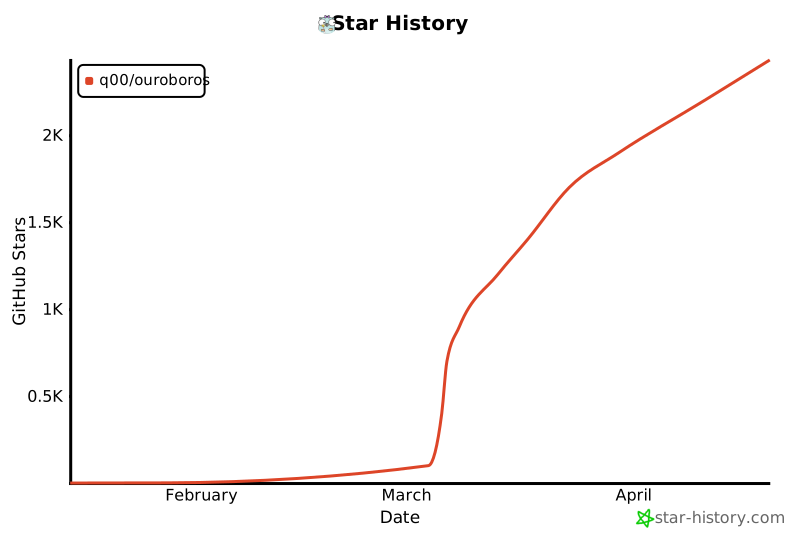
"The beginning is the end, and the end is the beginning."
The serpent doesn't repeat — it evolves.
MIT License
Release history Release notifications | RSS feed


Download files
Download the file for your platform. If you're not sure which to choose, learn more about installing packages.
Source Distribution
Built Distribution
Filter files by name, interpreter, ABI, and platform.
If you're not sure about the file name format, learn more about wheel file names.
Copy a direct link to the current filters
File details
Details for the file ouroboros_ai-0.25.3.dev3.tar.gz.
File metadata
- Download URL: ouroboros_ai-0.25.3.dev3.tar.gz
- Upload date:
- Size: 8.1 MB
- Tags: Source
- Uploaded using Trusted Publishing? No
- Uploaded via: uv/0.11.1 {"installer":{"name":"uv","version":"0.11.1","subcommand":["publish"]},"python":null,"implementation":{"name":null,"version":null},"distro":{"name":"Ubuntu","version":"24.04","id":"noble","libc":null},"system":{"name":null,"release":null},"cpu":null,"openssl_version":null,"setuptools_version":null,"rustc_version":null,"ci":true}
File hashes
| Algorithm | Hash digest | |
|---|---|---|
| SHA256 |
b4e0865ffc25b06f87e79ee6c01bb47ab93aead726ebf51a7ed7189512812559
|
|
| MD5 |
a4e657a4258c98c673ad07a2414afd6b
|
|
| BLAKE2b-256 |
b3431cd0754e89faeae22f0caef2d8ab5e1de0656f0c7e62fc2925ca9be04359
|
File details
Details for the file ouroboros_ai-0.25.3.dev3-py3-none-any.whl.
File metadata
- Download URL: ouroboros_ai-0.25.3.dev3-py3-none-any.whl
- Upload date:
- Size: 561.2 kB
- Tags: Python 3
- Uploaded using Trusted Publishing? No
- Uploaded via: uv/0.11.1 {"installer":{"name":"uv","version":"0.11.1","subcommand":["publish"]},"python":null,"implementation":{"name":null,"version":null},"distro":{"name":"Ubuntu","version":"24.04","id":"noble","libc":null},"system":{"name":null,"release":null},"cpu":null,"openssl_version":null,"setuptools_version":null,"rustc_version":null,"ci":true}
File hashes
| Algorithm | Hash digest | |
|---|---|---|
| SHA256 |
df33a8c9ff2042aac615c84c0ffbed5d276b37854d550fd2327ce2abafa86f3b
|
|
| MD5 |
ce9a2af95824eb4e6ec3d987b463024e
|
|
| BLAKE2b-256 |
9f2714d6807e54d1020d47bb8644134892c320ec32f688dc47234f7b69833d41
|






