
overture2gmns
overture2gmns is an alpha Python package that converts the Overture Maps transportation theme into a GMNS road network. Its user-facing API intentionally mirrors osm2gmns, while its topology engine is designed around Overture's native segment and connector model.
pip install overture2gmns
Conversion quality at a glance
Validated against osm2gmns (reference) and three agency planning models (ARC Atlanta, TRMG2, NVTA). Full evidence: research/conversion_quality/.
| quality dimension | result | evidence |
|---|---|---|
| GMNS validity | 0 errors on all 5 networks | gmns-ready + dtalite_qa |
| Geometric agreement | 0.89–0.93 length correlation with osm2gmns | ~500 m grid |
| Routing consistency * | VMT within 1% under identical synthetic demand | TAPLite assignment |
| Topology | more connected than osm2gmns (18 vs 22, 74 vs 91 components) | weak components |
| Semantic fidelity | 3 system interchanges recovered vs 0 from osm2gmns | freeway tokens |
| Agency validation | ARC & TRM model links 100% present; NVTA 87% | map matching |
* Relative check only: demand is synthetic (no observed OD) and capacity is an inferred class default (neither Overture nor OSM provides observed capacity). It isolates the network as the variable — not a validated volume forecast. VMT is robust; VHT is more assumption-sensitive.
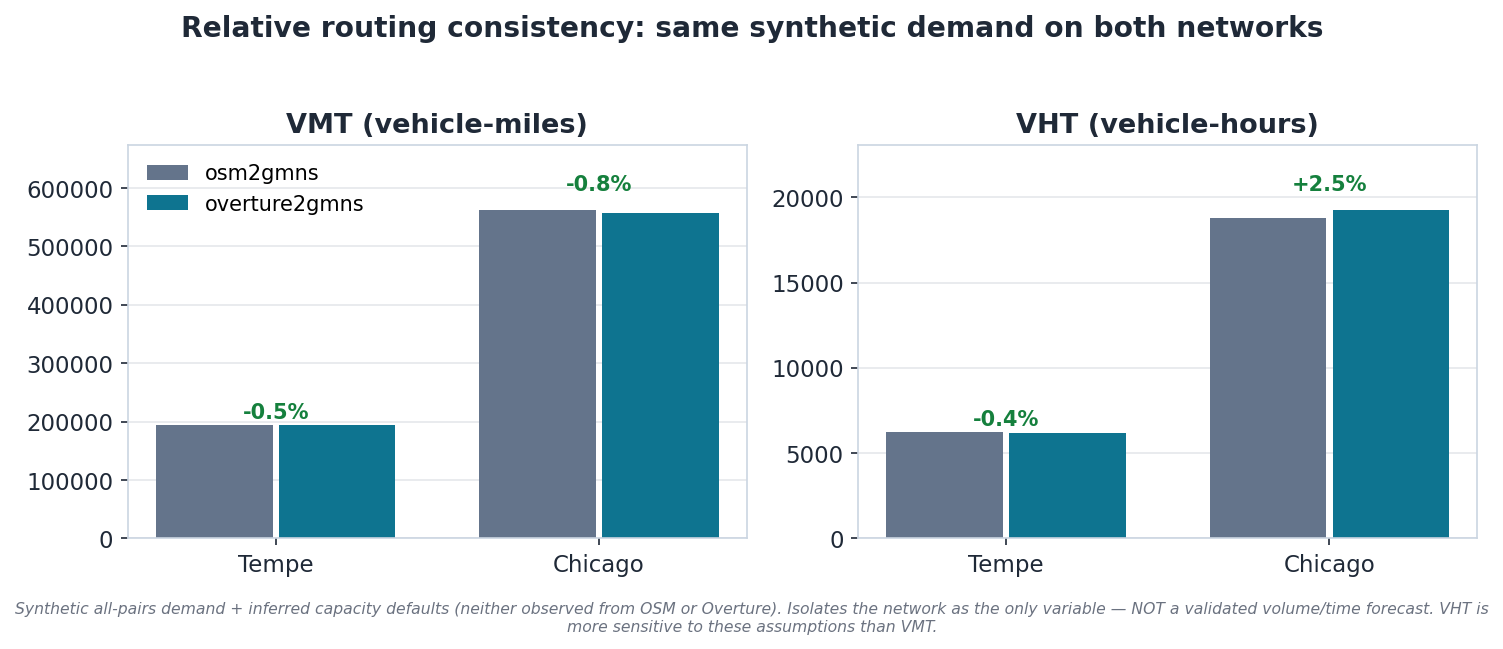
Same synthetic demand and same inferred capacity on both networks, so the converter output is the only variable: VMT stays within 1% in a small city and a full metro — the network representation does not shift where traffic goes. This is a controlled relative comparison, not a validated forecast.
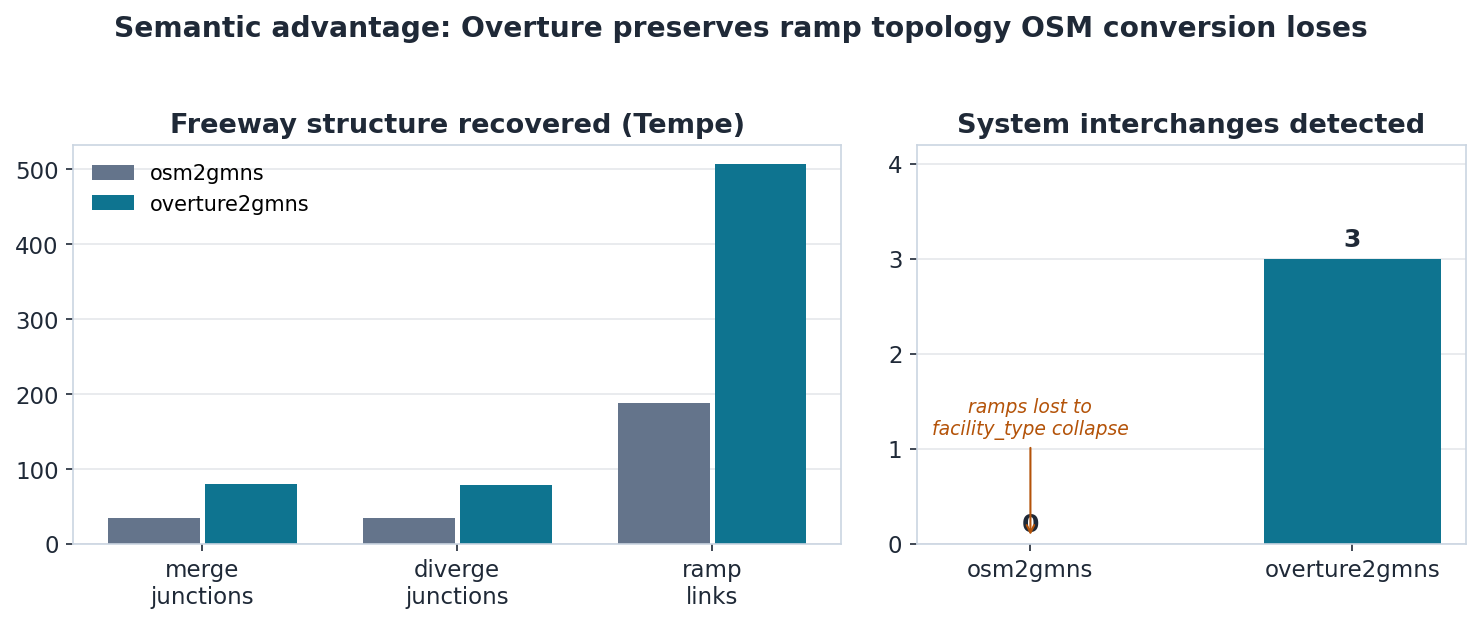
Where the converters differ: osm2gmns collapses ramp types into motorway,
so no freeway system interchange is recoverable — Overture's subclass=link
survives, and overture2gmns detects all three Tempe system interchanges.
Scope: conversion + verification (not general QA/QC)
overture2gmns deliberately stays focused on the pipeline
Overture data → extraction → GMNS conversion → attribute cleaning →
source-to-output verification. Its verify_conversion() checks that the
transformation faithfully preserves its own Overture source (linear-reference
conservation, crosswalk completeness, attribute provenance, GMNS integrity):
import overture2gmns as o2g
result = o2g.verify_conversion("gmns_output")     # or: overture2gmns verify gmns_output
print(o2g.verification_report_markdown(result))
Broader evaluation — comparing a network against other networks or against
observations (agency-model comparison, TMC/INRIX matching, trajectory
validation, assignment-based comparison, dashboards) — lives in the separate
qaqc4gmns package, so each package's claims stay precise.
Why a separate converter is needed
Overture differs materially from raw OSM:
- Topology is explicit. A segment contains connector IDs and normalized linear-reference positions.
- Connectors can occur inside a segment. The converter must split a segment at connector positions before creating GMNS links.
- Properties can vary along one segment. Speed, access, surface, level, and related values can be scoped using
between=[start,end]; the converter can split at these boundaries. - Rules can be directional and modal. Overture uses ordered rule lists; the last matching rule determines the value.
- Some modeling attributes remain application defaults. Overture intentionally does not prescribe jurisdiction-specific implied access or implied speed, and the current transportation schema does not directly provide a GMNS-ready lane/capacity model. This package exposes transparent class defaults rather than silently treating them as observed facts.
Installation
pip install -e .
For direct cloud download through Overture's official Python client:
pip install -e ".[download]"
For local GeoParquet files:
pip install -e ".[geoparquet]"
Python API (osm2gmns-style)
import overture2gmns as o2g

net = o2g.getNetFromFile(
    "segments.geojson",
    "connectors.geojson",
    mode_types=("auto", "bike", "walk"),   # str or sequence, like osm2gmns
    link_types=("motorway", "primary"),    # optional Overture class filter
)

o2g.fillLinkAttributesWithDefaultValues(
    net,
    default_lanes=True, default_lanes_dict={"motorway": 3},
    default_speed=True,
    default_capacity=True, default_capacity_dict={"primary": 1800},
)
o2g.generateNodeActivityInfo(net)
o2g.consolidateComplexIntersections(net, auto_identify=True, int_buffer=20.0)

o2g.outputNetToCSV(net, "gmns_output")
print(net.number_of_nodes, net.number_of_links)
network_types= is accepted as a backward-compatible alias for mode_types=.
Direct bounding-box access:
net = o2g.getNetFromBBox(
    (-111.95, 33.41, -111.92, 33.44),
    mode_types=("auto",),
    release=None,  # latest release
)
o2g.outputNetToCSV(net, "tempe_gmns")
Download-then-convert (the osm2gmns downloadOSMData workflow):
files = o2g.downloadOvertureData((-111.95, 33.41, -111.92, 33.44), "raw_overture")
net = o2g.getNetFromFile(files["segment"], files["connector"], mode_types="auto")
API mapping to osm2gmns
| osm2gmns 1.0.x | overture2gmns | Notes |
|---|---|---|
getNetFromFile(filepath, mode_types, link_types, ...) |
getNetFromFile(segment_file, connector_file, mode_types, link_types, ...) |
Overture ships topology in two feature types |
downloadOSMData(area_id, path) |
downloadOvertureData(bbox, folder) |
Overture is queried by bbox, not relation ID |
fillLinkAttributesWithDefaultValues(net, ...) |
same name, same signature | dicts keyed by Overture road class; speeds in mph |
generateNodeActivityInfo(net, zone_filepath) |
same name, same signature | activity from incident link classes |
consolidateComplexIntersections(net, auto_identify, file, int_buffer) |
same name, same signature | Overture has no signal tag; proximity rule only |
outputNetToCSV(net, output_folder='') |
same name, same signature | adds diagnostics.json |
net.number_of_nodes / net.number_of_links |
same |
Command line
Convert downloaded GeoJSON, GeoJSONSeq, or GeoParquet:
overture2gmns convert \
  --segments segments.geojson \
  --connectors connectors.geojson \
  --modes auto,bike,walk \
  --output gmns_output
Download the latest Overture release for a bounding box and convert it:
overture2gmns download \
  --bbox -111.95 33.41 -111.92 33.44 \
  --modes auto \
  --output tempe_gmns
Current outputs
node.csv: GMNS nodes, keyed by integernode_id, preserving Overture connector IDs, plusactivity_type/is_boundary/zone_id/intersection_idwhen generated.link.csv: directed GMNS links with WKT geometry, length (miles), free speed (mph), inferred lanes/capacity, allowed uses, Overture segment/version IDs, linear-reference ranges, and heading.diagnostics.json: skipped records, unresolved conditional rules, and turn restrictions not yet exported.
Only node.csv and link.csv are required for a basic GMNS static network. Extension columns are deliberately retained because GERS/Overture IDs are valuable for conflation and release-to-release tracking.
Implemented conversion logic
- Reads GeoJSON FeatureCollections, GeoJSONSeq, and optional GeoParquet input.
- Optionally reads authoritative connector point features.
- Splits each road segment at interior connectors.
- Splits at boundaries of geometrically scoped properties.
- Reuses a shared GMNS node whenever segments reference the same connector ID.
- Evaluates forward/backward access independently.
- Applies Overture's "last matching rule" rule-list semantics.
- Converts explicit
km/hormphspeed limits to GMNS mph. - Falls back to user-replaceable road-class defaults for implied access, speed, lanes, and capacity.
- Emits one directed GMNS link per allowed heading.
- Filters by Overture road class via
link_types, like osm2gmns's link-type filter.
Important alpha limitations
prohibited_transitionsare detected but not yet translated tomovement.csv.- Temporal rules (
during), user-purpose rules (using), recognized-status rules, and vehicle-dimension rules require scenario context; they are reported rather than flattened incorrectly. - Lane count and capacity are inferred from class defaults and are explicitly marked with source fields.
- Only
subtype=roadis converted; rail and water are planned extensions. - Country/jurisdiction-specific access defaults should replace the generic table for production routing.
- Very large regional extracts will benefit from a streamed Arrow implementation or a compiled geometry/topology core.
Testing
pytest -q
The fixtures verify interior-connector splitting, shared-node reuse, directional access, scoped speed limits, mode/class filtering, default filling, node activity generation, intersection consolidation, and GMNS CSV output.
Licensing and attribution
The package source code is MIT licensed. Overture transportation data is distributed under ODbL and carries upstream attribution requirements. A typical attribution is:
© OpenStreetMap contributors, Overture Maps Foundation
Users remain responsible for complying with the terms applicable to the specific Overture release and derivative database they distribute.
1 maintainer

Metadata
1 maintainer
Release files for overture2gmns 0.2.1
For a detailed explanation of source distributions (sdists) and built distributions (wheels), please see the package formats documentation.
Source distribution (sdist)
| File | Size | Uploaded | Provenance | Actions |
|---|---|---|---|---|
| overture2gmns-0.2.1.tar.gz | 33.0 kB | With provenance | Details for overture2gmns-0.2.1.tar.gz |
Built distribution (wheel)
| File | Interpreter | ABI | Platform | Actions Reset |
|---|---|---|---|---|
| overture2gmns-0.2.1-py3-none-any.whl | Python 3 | none | any | Details for overture2gmns-0.2.1-py3-none-any.whl |
Total release size: 62.4 kB
Release files / overture2gmns-0.2.1.tar.gz
| Download URL | overture2gmns-0.2.1.tar.gz |
|---|---|
| Size | 33.0 kB |
| Tags | Source |
|
SHA-256 checksum How to use checksums |
8b422702d7827df7db1bda4633a79e798135b970cc00b568a5afa781206a37cd
|
|
BLAKE2b-256 checksum How to use checksums |
019dd95f495e27df0aa0c762a046cf1f8942a5962e25799c6babbb70d4b70229
|
| Upload date | |
|
Uploaded using Trusted Publishing? What is trusted publishing? |
Yes |
| Uploaded via |
twine/6.1.0 CPython/3.13.12
|
Provenance
Provenance describes where a file came from. On PyPI, provenance is shared via attestations, which provide a verifiable record of the build or publishing details. View details, limitations and caveats.


PyPI Publish Attestation
PyPI verified that this artifact, at this checksum, originated from the publisher listed below.
Signed by GitHub Actions, verified by PyPI on Jul 17, 2026.
Transparency logRelease files / overture2gmns-0.2.1-py3-none-any.whl
| Download URL | overture2gmns-0.2.1-py3-none-any.whl |
|---|---|
| Size | 29.5 kB |
| Tags | Python 3 |
|
SHA-256 checksum How to use checksums |
557bd54247e03fe27e273f21068f4e8cb9dd375268981ce1b084246ce6be2bc4
|
|
BLAKE2b-256 checksum How to use checksums |
e9032993fffd428534cc94dbe8d4808a3d245f03e5b671e16f1c30ec6e4fa20f
|
| Upload date | |
|
Uploaded using Trusted Publishing? What is trusted publishing? |
Yes |
| Uploaded via |
twine/6.1.0 CPython/3.13.12
|
Provenance
Provenance describes where a file came from. On PyPI, provenance is shared via attestations, which provide a verifiable record of the build or publishing details. View details, limitations and caveats.
PyPI Publish Attestation
PyPI verified that this artifact, at this checksum, originated from the publisher listed below.
Signed by GitHub Actions, verified by PyPI on Jul 17, 2026.
Transparency logSecurity for overture2gmns 0.2.1
Provenance
Provenance describes where a file came from. On PyPI, provenance is shared via attestations, which provide a verifiable record of the build or publishing details. View details, limitations and caveats.
Full provenance
All 2 files in this release have been uploaded with provenance metadata.
Attestation for overture2gmns-0.2.1.tar.gz
PyPI Publish Attestation
PyPI verified that this artifact, at this checksum, originated from the publisher listed below.
Signed by GitHub Actions, verified by PyPI on Jul 17, 2026.
Transparency logA note on package security
PyPI is a repository for distributing packages, not a service for auditing them. While third-party security researchers and our staff do their best to detect and remove malicious packages, PyPI cannot guarantee the quality, security or suitability of any given package.
To learn more about protecting yourself from malicious actors, visit our package security documentation.














