
owui-deploy
English | 한국어
Keep your Open WebUI Tools and Functions (Filter, Pipe, Action) in a git folder, check them before upload, see what would change on the server, and apply the changes so that running the same command twice gives the same result. A lint, plan, apply and pull command line tool, with no code execution on your machine.

owui-deploy lint finds problems that the server would only report as "Error creating function". Exit code 1 means problems were found.
Who it is for
- You run Open WebUI for a team or at home and paste Tool and Function code into the admin screen by hand.
- You want a pull request to show what will change on the server, and a check that nobody edited a Function in the browser (drift).
- You keep a collection of Functions in a repository and want the same version on a dev and a prod instance.
Think of Terraform: the folder is the source of truth, plan shows the difference, apply makes the server match.
Install
Needs Python 3.11 or newer. uv is the easiest way to get it: curl -LsSf https://astral.sh/uv/install.sh | sh. On a minimal Linux image you also need git (apt-get install -y git).
uv tool install git+https://github.com/LeeGyeongPil/owui-deploy
owui-deploy --version
To try it from a clone instead (this is what the examples below use):
git clone https://github.com/LeeGyeongPil/owui-deploy
cd owui-deploy
uv run owui-deploy --version
Quick start (no server needed)
--fake switches to a practice mock: a small built-in model of Open WebUI 0.13.3 that keeps its state in a JSON file next to your config. It is not a real Open WebUI, and it never runs your code (it only reads the class names with ast). Use it to learn the commands. Use a real server to verify real behavior. A real server can be slow to start (installing Open WebUI took about 76 seconds and 2 GB in our probe, and start-up another minute), which is why the practice mock exists.
uv run owui-deploy plan --config examples/demo/owui-deploy.toml --fake
Server: fake server (practice mock, not a real Open WebUI). State file: examples/demo/.owui-deploy-fake.json
+ create    function shout_action   (content, name, description, active)
~ update    tool     clock          (content, description)
~ state     function pii_mask       (active: false -> true, global: false -> true)
? unmanaged function legacy_filter  (only on the server; left alone without --prune)

Plan: 1 to create, 1 to update, 1 to change state, 1 unmanaged.

How to read it:
| Mark | Meaning |
|---|---|
+ create |
In your folder, not on the server yet. |
~ update |
On both, but the code or description differs. |
~ state |
The on/off (active) or "for all models" (global) switch differs. |
? unmanaged |
Only on the server. Left alone unless you pass --prune. It does not make the exit code 1. |
Now apply it, twice:
uv run owui-deploy apply --yes --config examples/demo/owui-deploy.toml --fake
uv run owui-deploy apply --yes --config examples/demo/owui-deploy.toml --fake
Server: fake server (practice mock, not a real Open WebUI). State file: examples/demo/.owui-deploy-fake.json
+ create    function shout_action   (content, name, description, active)
~ update    tool     clock          (content, description)
~ state     function pii_mask       (active: false -> true, global: false -> true)
? unmanaged function legacy_filter  (only on the server; left alone without --prune)

Plan: 1 to create, 1 to update, 1 to change state, 1 unmanaged.
applied: create function shout_action
applied: toggle function shout_action
applied: update tool clock
applied: toggle function pii_mask
applied: toggle_global function pii_mask
Apply: 5 requests applied, 0 rejected.
Second run:
Server: fake server (practice mock, not a real Open WebUI). State file: examples/demo/.owui-deploy-fake.json
? unmanaged function legacy_filter  (only on the server; left alone without --prune)

Plan: 1 unmanaged.
No changes.
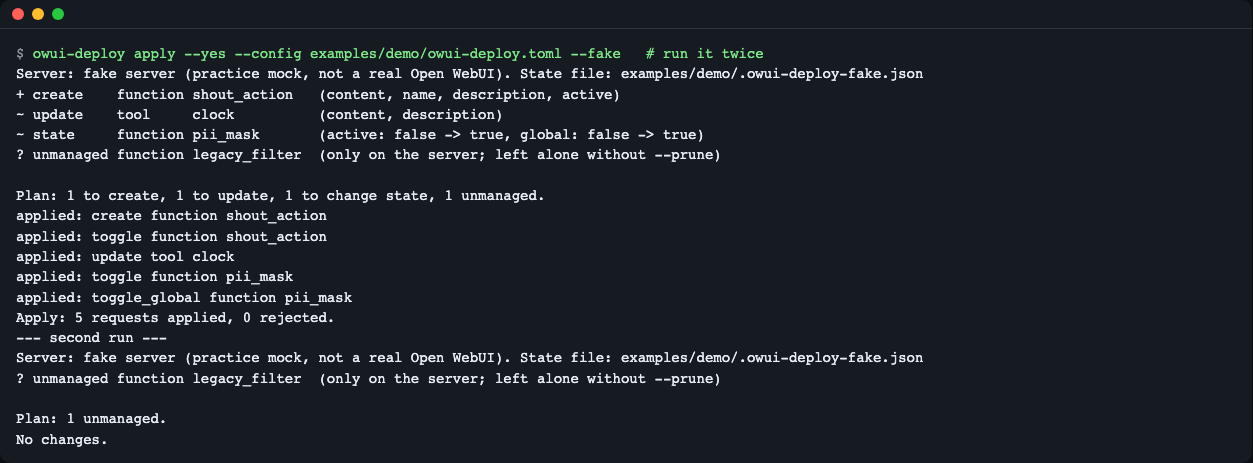
Apply created examples/demo/.owui-deploy-fake.json (ignored by git). Delete it to start over: rm examples/demo/.owui-deploy-fake.json.
Connect to your Open WebUI
export OWUI_URL=http://localhost:8080
export OWUI_TOKEN=<admin token>
owui-deploy plan
- The token is never read from the config file, only from
OWUI_TOKEN. - An admin login token (JWT) works: sign in with
POST /api/v1/auths/signin(JSON body withemailandpassword) and taketokenfrom the answer. - An API key also works, but Open WebUI only lets you create one when the server runs with
ENABLE_API_KEYS=true. Without that, use the JWT. - The server URL can also come from
server.urlin the config file or--url(priority:--url, thenOWUI_URL, then the file). applymakes the server run your code. Read Security notes before you point it at a real server.
Commands
| Command | What it does | Example |
|---|---|---|
lint [PATH] |
Static checks, no code is executed. --json for machines, --strict makes warnings exit 1. |
owui-deploy lint examples/broken |
plan |
Shows what apply would change. --diff adds a unified diff, --json prints JSON, --prune shows server-only items as deletions, --fail-on-unmanaged exits 1 for them. |
owui-deploy plan --diff |
apply |
Creates and updates, switches state only when it differs, deletes only with --prune. Asks first; --yes skips the question (required when stdin is not a terminal). --message is stored in the server history (default: the git short hash). |
owui-deploy apply --yes |
pull --out DIR |
Downloads Tools and Functions into files and creates DIR/owui-deploy.toml if missing. Does not overwrite files that differ from the server unless --force. |
owui-deploy pull --out ./owui |
Options differ per command (all of them take --lang en|ko):
| Command | Options |
|---|---|
plan, apply |
--config PATH (default ./owui-deploy.toml), --url, --fake, --lang |
pull |
--out DIR, --url, --fake, --force, --lang (the config file is DIR/owui-deploy.toml) |
lint |
[PATH], --config PATH, --json, --strict, --lang (needs no server, so no --url or --fake) |
Exit codes:
| Code | Meaning |
|---|---|
| 0 | No difference, no problem. |
| 1 | A difference or problem was found: plan drift, lint error, or the server rejected an item. |
| 2 | Tool error: missing config or token, cannot connect, 401/403, wrong usage. |
See the content difference
The quick start already applied everything, so the fake server matches the folder and there is nothing to compare. Reset the fake server state first, then run --diff:
rm -f examples/demo/.owui-deploy-fake.json
uv run owui-deploy plan --config examples/demo/owui-deploy.toml --fake --diff
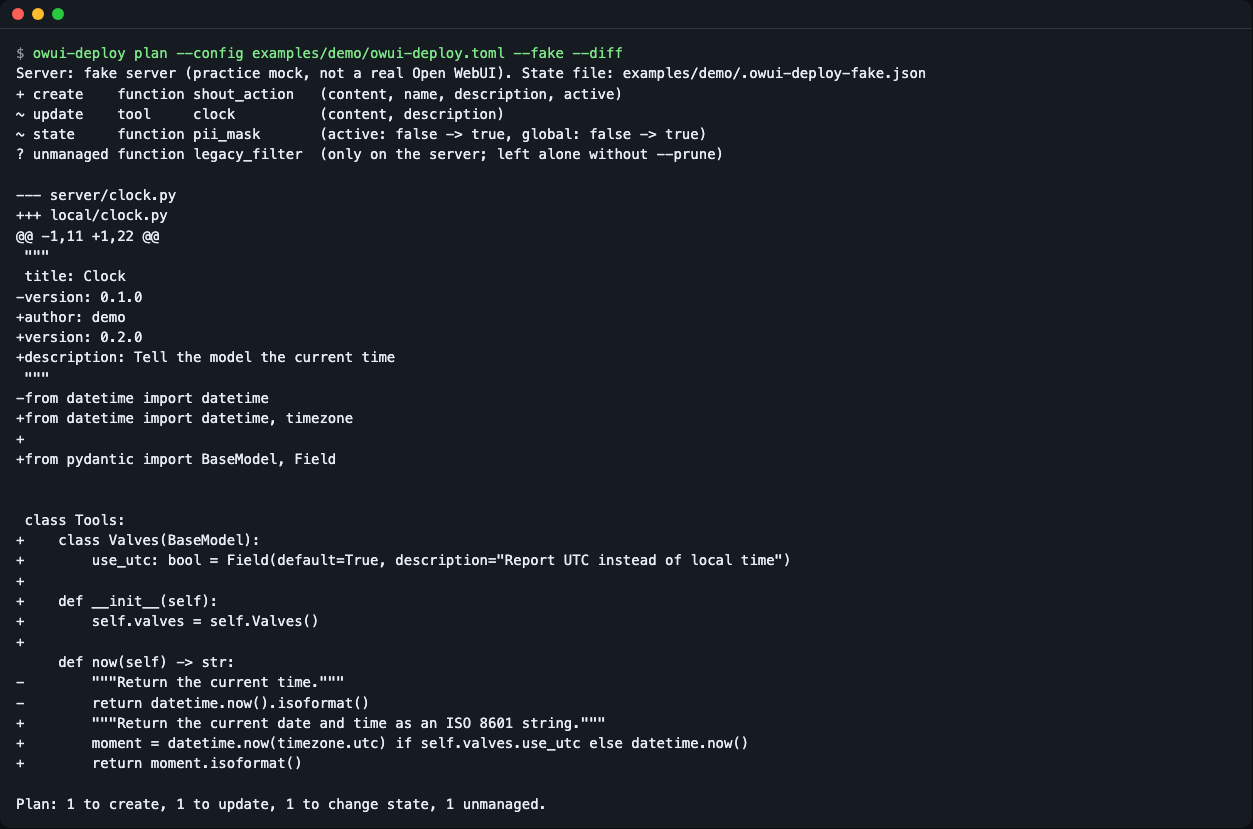
--diff shows the code difference. The from utils.misc line in pii_mask is not listed as a difference, see "How plan stays honest".
Pull an existing server into git
uv run owui-deploy pull --fake --out pulled
Server: fake server (practice mock, not a real Open WebUI). State file: pulled/.owui-deploy-fake.json
wrote tool:clock
wrote function:pii_mask
wrote function:legacy_filter
Pull: 3 written, 0 unchanged, 0 kept.
wrote config file pulled/owui-deploy.toml
Valves (settings and secrets) are not exported; they stay on the server.

The result is pulled/tools/clock.py, pulled/functions/*.py and pulled/owui-deploy.toml. Clean up with rm -r pulled.
Config file
owui-deploy.toml, paths are relative to the file. The id of an item is its file name without .py.
[server]
url = "http://localhost:8080"   # OWUI_URL overrides it, --url overrides both

[paths]
tools = "tools"
functions = "functions"

[defaults]
active = true     # deploy everything switched on unless said otherwise
global = false

[functions.pii_mask]
global = true     # a Filter that should run for every model

[functions.shout_action]
name = "Shout"
description = "Add a button that repeats the last answer in capital letters"
Config keys are case-insensitive (matched in lowercase, like server ids), and two keys that differ only in case are a config error.
The name comes from the config, else the title: in the file's first docstring, else the id. A working copy is in examples/demo/.
| Variable | Use |
|---|---|
OWUI_URL |
Server address. |
OWUI_TOKEN |
Admin JWT or API key. |
OWUI_DEPLOY_LANG |
en or ko. |
Lint rules
The server answers a broken upload with one line ([ERROR: Error creating function]) and the reason only appears in its log. lint reads the files with Python's ast and reports the reason, with file, line and rule code.
| Code | Level | What it finds |
|---|---|---|
| OWD001 | error | Syntax error. |
| OWD002 | error | No Tools class in a tool file, or no Pipe/Filter/Action/Event class in a function file. |
| OWD003 | warning | Several Function classes in one file. The server uses one (Pipe first). |
| OWD004 | error / warning | File name is not a valid id (error), or contains capitals (warning). |
| OWD005 | warning | First line is not exactly """, so the server ignores the frontmatter; or title/version missing. |
| OWD006 | error | Valves or UserValves does not inherit from pydantic BaseModel. |
| OWD007 | warning | from utils, from apps, from main or from config imports, which the server rewrites. |
| OWD008 | warning | Public Tool method without docstring or type hints (the model reads them as the tool description). |
| OWD009 | warning | A secret-looking valve (api_key, token, ...) with a non-empty default in the source. |
How plan stays honest
flowchart LR
  F["folder: tools/ functions/"] --> L["lint (ast)"]
  F --> N["normalize like the server"]
  S["server (export)"] --> P["plan"]
  N --> P
  P --> A["apply"]
  A -->|"create / update / toggle if differs / delete only with --prune"| S
plan compares your files with the server, apply changes only what differs. The server has four traps that the tool handles in code (observed on Open WebUI 0.13.3):
- Import rewriting. The server rewrites
from utils...tofrom open_webui.utils...when saving, so a naive diff never reaches zero.planapplies the same rewrite to your file before comparing.lintwarns with OWD007. - The toggle endpoint flips. Calling it twice turns the Function off again.
applyreads the current state right before and calls it only when the state differs. - New Functions start inactive. After creating,
applyswitches them to the state you declared. /functions/syncdeletes silently. Syncing a partial list deletes everything else, so this tool never calls it. Deleting needs the explicit--prune.
The practice mock reproduces these four behaviors, and the tests compare it with responses recorded from a real 0.13.3 server (tests/fixtures/owui-0.13.3/).
Use in CI
owui-deploy plan --json > plan.json
Exit code 0: nothing to do. 1: the server differs from the folder. 2: setup problem (token, URL, config). Output of the same command on the practice mock after an apply (the Server: line goes to the other stream):
{
  "server": "fake (examples/demo/.owui-deploy-fake.json)",
  "mock": true,
  "changes": [
    {
      "kind": "function",
      "id": "legacy_filter",
      "action": "unmanaged",
      "fields": []
    }
  ],
  "summary": {
    "create": 0,
    "update": 0,
    "state": 0,
    "delete": 0,
    "unmanaged": 1,
    "skipped": 0
  }
}
Server-only items do not fail the check unless you add --fail-on-unmanaged.
Security notes
This tool holds an admin token and makes a server run code, so read this once.
applymakes the server execute your code. Open WebUI runs uploaded Tool and Function code withexec, and installs the packages listed in therequirements:line of the file's frontmatter withpip install. Deploy only code you have reviewed. Open WebUI treats this as intended behavior, see its vendor disposition for CVE-2026-0765 (checked 2026-11-12).- Valves values never touch your files.
pulldoes not request valves and drops them if a server sends them, so API keys set in the admin screen do not end up in git.lintrule OWD009 warns about secret-looking defaults in the source. - The token comes only from
OWUI_TOKEN. It is never read from the config file and never printed. - The token is sent to the server URL. The URL can come from
server.urlin the config file, so in CI pinOWUI_URLas a secret or protected variable. Then a pull request cannot change the URL in the file to send your token elsewhere. Usehttps://when the server is not on your own machine. lintand--fakenever run your code; they only parse it withast.
Language
Output and --help are available in English and Korean. Priority: --lang en|ko, then OWUI_DEPLOY_LANG, then LC_ALL, LC_MESSAGES, LANG. Anything that is not Korean falls back to English.
uv run owui-deploy --lang ko plan --config examples/demo/owui-deploy.toml --fake
See README.ko.md for the Korean screenshots.
When to use it
- Good fit: your own Tools and Functions live in git and you want lint, a reviewable plan and a repeatable apply.
- Different tools for other jobs: see Compared with other tools below.
- Not covered in 0.1.4: valves values, several environments in one config, history and rollback, Models, Prompts and Knowledge.
Compared with other tools
The short version: owui-cli is an imperative tool (you run one command per file, it changes the server right away). owui-deploy is declarative (the folder and owui-deploy.toml describe the wanted state, plan shows the difference, apply closes it) and adds lint before anything is uploaded.
| Tool (version checked 2026-11-12) | What it is | Tools and Functions from files | Preview before change (plan/diff, drift exit code) | Static checks before upload | Declared active / global state |
|---|---|---|---|---|---|
| oikb 0.6.0 (official) | Syncs files from local folders, GitHub, Confluence and more into knowledge bases, with --dry-run |
Not its job | For knowledge bases (--dry-run) |
No | No |
| owui-cli 0.7.1 | Imperative CLI for many Open WebUI resources: tools deploy file.py (create or update), pull-all, valves-set |
Yes, one file per command (this overlaps with owui-deploy) | No | No | No |
| owui-client 11.0.0 | Async Python client for the whole API, for your own scripts | Through your own code (create/update, sync_functions) |
No | No | Through your own code |
suurt8ll/open_webui_functions dev/function_updater.py |
Development script inside one repository: uploads the files listed in FILEPATHS, watches for changes |
Yes, for that repository | No | No | No |
| owui-deploy 0.1.4 (this repo) | Declarative lint / plan / apply / pull |
Yes, a whole folder | Yes (plan, --diff, --json, exit code 1 on drift) |
Yes (lint, OWD001-OWD009) |
Yes |
Notes:
- owui-cli can also deploy a Tool file and export everything with
pull-all. If you only need to push one file now and then, it does the job. owui-deploy is for when the folder in git is the source of truth and you want to review a plan in CI before changing the server. - owui-deploy also matches the server's import rewriting before comparing (no false diffs), flips the toggle only when the state differs, and never calls
/functions/sync, which deletes every Function missing from the list it receives. If you use owui-client'ssync_functions, send the full list. - owui-deploy does not manage knowledge bases; use oikb for that.
Sources, checked 2026-11-12: oikb docs, oikb on PyPI, owui-cli on GitHub, owui-cli on PyPI, owui-client reference, owui-client on PyPI, suurt8ll/open_webui_functions. These tools may have changed since that date.
Troubleshooting
| Symptom | Cause | Fix |
|---|---|---|
error: no token. Export OWUI_TOKEN ... (exit 2) |
OWUI_TOKEN is not set. |
Export an admin JWT or API key, or add --fake. |
error: cannot connect to ... (exit 2) |
Server is down or the URL is wrong. | Check the URL and that Open WebUI is running. |
the server refused the token (HTTP 401/403 ...) (exit 2) |
Token expired, not admin, or API keys disabled. | Use a fresh admin JWT, or start the server with ENABLE_API_KEYS=true. |
error: config file not found: ... (exit 2) |
No owui-deploy.toml in the current folder. |
Pass --config PATH or run pull --out to create one. |
| The server rejected an item, exit 1 | Usually a lint error the server will not explain. | Run owui-deploy lint and fix the lines it lists. |
plan shows ? unmanaged |
The item exists only on the server. | Add the file with pull, or delete it with apply --prune. |
Development
uv run pytest -q
Bugs and ideas are welcome as issues. Changes are listed in CHANGELOG.md.
Tested with
| What | Version | How |
|---|---|---|
| Open WebUI | 0.13.3 | One run against a real server (tests/test_e2e_real.py, needs OWUI_E2E_URL and OWUI_E2E_TOKEN). |
Practice mock (--fake) |
follows 0.13.3 | Matched to responses recorded from 0.13.3 by contract tests. |
| Python | 3.11 and 3.13 (CI) | uv run pytest -q. |
License
MIT, see LICENSE. Open WebUI has its own license; this project is not affiliated with it.
1 maintainer

Metadata
1 maintainer
Release files for owui-deploy 0.1.4
For a detailed explanation of source distributions (sdists) and built distributions (wheels), please see the package formats documentation.
Source distribution (sdist)
| File | Size | Uploaded | Provenance | Actions |
|---|---|---|---|---|
| owui_deploy-0.1.4.tar.gz | 37.2 kB | Without provenance | Details for owui_deploy-0.1.4.tar.gz |
Built distribution (wheel)
| File | Interpreter | ABI | Platform | Actions Reset |
|---|---|---|---|---|
| owui_deploy-0.1.4-py3-none-any.whl | Python 3 | none | any | Details for owui_deploy-0.1.4-py3-none-any.whl |
Total release size: 80.7 kB
Release files / owui_deploy-0.1.4.tar.gz
| Download URL | owui_deploy-0.1.4.tar.gz |
|---|---|
| Size | 37.2 kB |
| Tags | Source |
|
SHA-256 checksum How to use checksums |
0b2f025d0f589aacf00c612aa2810986e432a334fdb17bf09a4cd3704293e397
|
|
BLAKE2b-256 checksum How to use checksums |
8ff9bc53da2d03d0e706314bcaccf33c7d39f9b316acd70c47b5090846a5f410
|
| Upload date | |
|
Uploaded using Trusted Publishing? What is trusted publishing? |
No |
| Uploaded via |
uv/0.13.6 {"installer":{"name":"uv","version":"0.13.6","subcommand":["publish"]},"python":null,"implementation":{"name":null,"version":null},"distro":{"name":"macOS","version":null,"id":null,"libc":null},"system":{"name":null,"release":null},"cpu":null,"openssl_version":null,"setuptools_version":null,"rustc_version":null,"ci":null}
|
Release files / owui_deploy-0.1.4-py3-none-any.whl
| Download URL | owui_deploy-0.1.4-py3-none-any.whl |
|---|---|
| Size | 43.5 kB |
| Tags | Python 3 |
|
SHA-256 checksum How to use checksums |
9f2d1ab879c08ade066ba8b6da2e2242cb1ea20b4526aa723a8ce973d2ed82e8
|
|
BLAKE2b-256 checksum How to use checksums |
42ca33274294eca5a52028bd8a8089decb776c6266f8a06b0e414134492ce9de
|
| Upload date | |
|
Uploaded using Trusted Publishing? What is trusted publishing? |
No |
| Uploaded via |
uv/0.13.6 {"installer":{"name":"uv","version":"0.13.6","subcommand":["publish"]},"python":null,"implementation":{"name":null,"version":null},"distro":{"name":"macOS","version":null,"id":null,"libc":null},"system":{"name":null,"release":null},"cpu":null,"openssl_version":null,"setuptools_version":null,"rustc_version":null,"ci":null}
|
Security for owui-deploy 0.1.4
Provenance
Provenance describes where a file came from. On PyPI, provenance is shared via attestations, which provide a verifiable record of the build or publishing details. View details, limitations and caveats.
No provenance found
None of the files in this release were uploaded with provenance metadata.
A note on package security
PyPI is a repository for distributing packages, not a service for auditing them. While third-party security researchers and our staff do their best to detect and remove malicious packages, PyPI cannot guarantee the quality, security or suitability of any given package.
To learn more about protecting yourself from malicious actors, visit our package security documentation.














