
oxidize-pdf





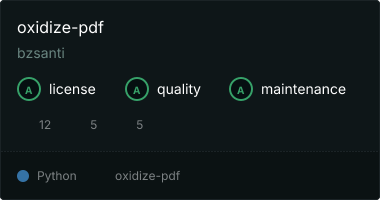
Rust-powered PDF library for Python. Generate, parse, split, merge, and manipulate PDFs with native performance. Ships with a built-in MCP server so AI agents can work with PDFs out of the box.
No C dependencies. No Java. No subprocess calls.
Installation
pip install oxidize-pdf            # Core library
pip install "oxidize-pdf[mcp]"     # + MCP server for AI agents
Platforms: Linux (x86_64, aarch64) | macOS (x86_64, Apple Silicon) | Windows (x86_64) Requires: Python 3.10+
Version 0.21.1 pins Rust core 5.4.1, using the MIT-licensed oxidize-webpki
RustCrypto provider for certificate verification. See the
dependency policy for supported builds and limits.
New APIs include explicit text recovery, non-breaking-space normalization,
build identification controls and incremental signature slots. See the
API guide and validation.
Why oxidize-pdf?
| oxidize-pdf | Pure-Python libs | C/Java wrappers | |
|---|---|---|---|
| Performance | Native (compiled Rust) | Interpreted | Native but heavy |
| Dependencies | Zero | Varies | Poppler, Java, Ghostscript |
| Memory safety | Rust ownership model | GC-dependent | Manual / GC |
| Type stubs | Full (mypy/pyright) | Partial | Rare |
| AI-ready (MCP) | Built-in | No | No |
MCP Server
Give your AI agent full PDF capabilities in one line:
oxidize-mcp
The built-in Model Context Protocol server exposes 12 tools, 5 static resources plus a session resource template, and 5 prompts over stdio. Install oxidize-pdf[mcp] to include its dependencies; the base library keeps MCP optional.
Version 0.20 uses FastMCP 4 and MCP Python SDK 2, with support for both modern and legacy stdio clients. See the migration guide for versions and installation routes.
If tools/list returns an empty array with an older installation (issue #198), upgrade to 0.20.0 or newer. These versions fix tool registration when starting server.py directly. On Windows, use the same Python environment for installation and startup:
python -m pip install --upgrade "oxidize-pdf[mcp]"
python -m oxidize_pdf.mcp.server
For a custom JSON-RPC client, send initialize, wait for its response, then send notifications/initialized before tools/list. Read newline-delimited JSON-RPC from stdout and keep stderr separate; the startup banner is written to stderr.
Claude Desktop integration
Add to your claude_desktop_config.json:
{
  "mcpServers": {
    "oxidize-pdf": {
      "command": "oxidize-mcp",
      "env": {
        "OXIDIZE_WORKSPACE": "/path/to/your/pdfs"
      }
    }
  }
}
GitHub Copilot (VS Code) integration
Copilot's agent mode speaks MCP. Add .vscode/mcp.json to your workspace:
{
  "servers": {
    "oxidize-pdf": {
      "command": "oxidize-mcp",
      "env": {
        "OXIDIZE_WORKSPACE": "/path/to/your/pdfs"
      }
    }
  }
}
Open the Chat view, switch to Agent mode, and the 12 PDF tools appear in
the tool picker. (The same block also works under the mcp.servers key in your
user settings.json if you prefer a global install.)
OpenAI Agents SDK integration
The OpenAI Agents SDK spawns the server over stdio and exposes its tools to an agent:
from agents import Agent, Runner
from agents.mcp import MCPServerStdio

async with MCPServerStdio(
    params={"command": "oxidize-mcp", "env": {"OXIDIZE_WORKSPACE": "/path/to/your/pdfs"}},
    cache_tools_list=True,
) as server:
    agent = Agent(
        name="PDF assistant",
        instructions="Use the oxidize-pdf tools to inspect and manipulate PDFs.",
        mcp_servers=[server],
    )
    result = await Runner.run(agent, "How many pages does report.pdf have?")
    print(result.final_output)
A runnable version is in examples/openai_agents_quickstart.py.
Both integrations run the server locally over stdio, so its tools operate on PDFs in the configured workspace directory. This package does not expose a hosted HTTP endpoint. ChatGPT web needs a remote connection; developer-mode testing can also use Secure MCP Tunnel with a local stdio server. No ChatGPT plugin is published by this migration.
Available tools
| Tool | What it does |
|---|---|
read_pdf |
Read metadata — page count, version, encryption status, title, author |
extract_text |
Extract text from all pages or a specific page |
convert_pdf |
Convert to markdown, chunks, or RAG-optimized format |
create_pdf |
Create a new PDF with optional metadata |
save_pdf |
Save a session to disk, with optional encryption |
add_content |
Add pages, text, and graphics to a session |
annotate_pdf |
Add text annotations and highlights |
manipulate_pdf |
Split, merge, rotate, extract pages, reverse, overlay |
manage_forms |
Create, fill, read, and validate form fields |
secure_pdf |
Encrypt, check permissions, verify signatures |
extract_entities |
Extract structured entities from pages |
analyze_pdf |
Validate structure, detect corruption, check PDF/A compliance |
The server also exposes resources (session data, capabilities, version info) and prompts (guided workflows for summarization, data extraction, form filling, and more).
Configuration
OXIDIZE_WORKSPACE=/path/to/pdfs oxidize-mcp
The server is configured entirely through environment variables:
| Variable | Default | Purpose |
|---|---|---|
OXIDIZE_WORKSPACE |
~/Documents/oxidize-mcp |
Sandbox root; all paths must resolve inside it. |
OXIDIZE_ALLOWED_PATHS |
(none) | Comma-separated extra directories allowed outside the workspace. |
OXIDIZE_MAX_FILE_SIZE_MB |
100 |
Reject input PDFs larger than this on disk. |
OXIDIZE_MAX_PAGES |
10000 |
Reject documents with more pages than this before any extraction work. |
OXIDIZE_MAX_OUTPUT_BYTES |
10485760 |
Cap the serialized size of a tool's JSON response (10 MB). |
OXIDIZE_MAX_SESSIONS |
10 |
Maximum concurrent stateful PDF-creation sessions. |
OXIDIZE_MAX_SESSION_BYTES |
10485760 |
Cap the content a single session may accumulate (10 MB). |
OXIDIZE_SESSION_TIMEOUT |
3600 |
Session expiry, in seconds. |
Resource caps (OXIDIZE_MAX_*) protect the server from a large or malicious
PDF: oversized documents are rejected up front and tool responses are bounded
rather than serialized unbounded. Exceeding a cap returns an error with code
RESOURCE_LIMIT.
Or start programmatically:
from oxidize_pdf.mcp.server import run
run()
Python API
Create a PDF
from oxidize_pdf import Document, Page, Font, Color

doc = Document()
doc.set_title("My Document")
doc.set_author("Jane Doe")

page = Page.a4()
page.set_font(Font.HELVETICA, 24.0)
page.set_text_color(Color.black())
page.text_at(72.0, 750.0, "Hello from oxidize-pdf!")

page.set_font(Font.TIMES_ROMAN, 12.0)
page.text_at(72.0, 700.0, "Generated with Python + Rust.")

doc.add_page(page)
doc.save("output.pdf")
Parse an existing PDF
from oxidize_pdf import PdfReader

reader = PdfReader.open("document.pdf")
print(f"Pages: {reader.page_count}, Version: {reader.version}")

for i, text in enumerate(reader.extract_text()):
    print(f"--- Page {i + 1} ---")
    print(text)
Operations
from oxidize_pdf import split_pdf, merge_pdfs, rotate_pdf, extract_pages

split_pdf("input.pdf", "output_dir/")                       # Split into individual pages
merge_pdfs(["part1.pdf", "part2.pdf"], "merged.pdf")         # Merge multiple PDFs
rotate_pdf("input.pdf", "rotated.pdf", 90)                   # Rotate all pages
extract_pages("input.pdf", "subset.pdf", [0, 2, 4])          # Extract specific pages
Graphics
from oxidize_pdf import Document, Page, Color

doc = Document()
page = Page.a4()

page.set_fill_color(Color.hex("#3498db"))
page.draw_rect(72.0, 700.0, 200.0, 100.0)
page.fill()

page.set_stroke_color(Color.red())
page.set_line_width(2.0)
page.draw_circle(300.0, 500.0, 50.0)
page.stroke()

doc.add_page(page)
doc.save("graphics.pdf")
Types
from oxidize_pdf import Color, Point, Rectangle, Margins, Font

# Colors
Color.rgb(1.0, 0.0, 0.0)          # RGB
Color.hex("#ff6600")               # Hex
Color.cmyk(0.0, 1.0, 1.0, 0.0)   # CMYK

# Geometry
Point(72.0, 720.0)
Rectangle.from_xywh(72.0, 72.0, 468.0, 648.0)
Margins.uniform(72.0)

# Fonts — all 14 standard PDF fonts
Font.HELVETICA    # Font.HELVETICA_BOLD
Font.TIMES_ROMAN  # Font.TIMES_BOLD
Font.COURIER      # Font.COURIER_BOLD
Error handling
from oxidize_pdf import PdfReader, PdfError, PdfIoError, PdfParseError

try:
    reader = PdfReader.open("missing.pdf")
except PdfIoError as e:
    print(f"I/O error: {e}")
except PdfParseError as e:
    print(f"Parse error: {e}")
except PdfError as e:
    print(f"PDF error: {e}")
Exception hierarchy: PdfError > PdfIoError, PdfParseError, PdfEncryptionError, PdfPermissionError
MCP Server
oxidize-pdf includes an MCP server that exposes PDF capabilities to AI assistants like Claude. Install with the mcp extra:
pip install oxidize-pdf[mcp]
Claude Desktop
Add this to your claude_desktop_config.json:
{
  "mcpServers": {
    "oxidize-pdf": {
      "command": "uvx",
      "args": ["--from", "oxidize-pdf[mcp]", "oxidize-mcp"]
    }
  }
}
Claude Code
claude mcp add oxidize-pdf -- uvx --from "oxidize-pdf[mcp]" oxidize-mcp
Available tools
| Tool | Description |
|---|---|
read_pdf |
Open a PDF and get metadata (pages, version, encryption) |
extract_text |
Extract text content from PDF pages |
convert_pdf |
Convert between PDF versions |
analyze_pdf |
Analyze structure, fonts, images, and compliance |
extract_entities |
Extract images and digital signatures |
manipulate_pdf |
Split, merge, rotate, extract, and reorder pages |
annotate_pdf |
Add text annotations, highlights, and stamps |
manage_forms |
Create, fill, and read PDF form fields |
secure_pdf |
Encrypt, decrypt, and set document permissions |
create_pdf |
Create a new PDF document with pages |
add_pdf_content |
Add text, shapes, and images to pages |
save_pdf |
Save the document to file or bytes |
Resources
oxidize://fonts— Available built-in PDF fontsoxidize://page-sizes— Standard page sizes with dimensionsoxidize://capabilities— Server capabilities and tool listingoxidize://version— Version informationoxidize://workspace— PDF files in the workspace directoryoxidize://session/{id}— Session data by ID
Known limitations
- Encryption write support:
Document.encrypt()configures encryption parameters but the underlying Rust library does not yet serialize the encryption dictionary to the PDF output. Reading encrypted PDFs works correctly. - Image extraction returns raw embedded streams:
extract_images_from_pdfextracts each embedded image as-is (e.g. aDCTDecodeJPEG is written byte-for-byte). Image preprocessing — auto rotation-correction, contrast enhancement, denoise, upscaling, force-grayscale — is not available, because the build excludes the upstreamexternal-imagesfeature (and itsimage-crate dependency). This keeps extraction faithful and lossless; it does not silently return empty or stub results. - CPython only: PyPy and GraalPy are not supported.
License
MIT — see LICENSE for details.
1 maintainer

Metadata
1 maintainer
Release files for oxidize-pdf 0.21.1
For a detailed explanation of source distributions (sdists) and built distributions (wheels), please see the package formats documentation.
Source distribution (sdist)
| File | Size | Uploaded | |
|---|---|---|---|
| oxidize_pdf-0.21.1.tar.gz | 743.4 kB | Details |
Built distributions (wheels)
| File | Reset | |||
|---|---|---|---|---|
| oxidize_pdf-0.21.1-cp310-abi3-win_amd64.whl | CPython 3.10 | abi3 | Windows x86-64 | Details |
| oxidize_pdf-0.21.1-cp310-abi3-manylinux_2_28_x86_64.whl | CPython 3.10 | abi3 | Linux glibc 2.28+ x86-64 | Details |
| oxidize_pdf-0.21.1-cp310-abi3-manylinux_2_28_aarch64.whl | CPython 3.10 | abi3 | Linux glibc 2.28+ ARM64 | Details |
| oxidize_pdf-0.21.1-cp310-abi3-macosx_11_0_arm64.whl | CPython 3.10 | abi3 | macOS 11.0+ ARM64 | Details |
| oxidize_pdf-0.21.1-cp310-abi3-macosx_10_12_x86_64.whl | CPython 3.10 | abi3 | macOS 10.12+ x86-64 | Details |
Total release size: 41.0 MB
Release files / oxidize_pdf-0.21.1.tar.gz
| Download URL | oxidize_pdf-0.21.1.tar.gz |
|---|---|
| Size | 743.4 kB |
| Tags | Source |
|
SHA-256 checksum How to use checksums |
c463e4d3d62de72af3b47350acfd28819559fcbd530c85d35d12432bf82c53af
|
|
BLAKE2b-256 checksum How to use checksums |
4615c3306afe94a3c7796254a0dcf5ec955af2c6e357a74ce29179dbde32d93f
|
| Upload date | |
|
Uploaded using Trusted Publishing? What is trusted publishing? |
Yes |
| Uploaded via |
twine/7.0.0 CPython/3.13.14
|
Provenance
Provenance describes where a file came from. On PyPI, provenance is shared via attestations, which provide a verifiable record of the build or publishing details. View details, limitations and caveats.


PyPI Publish Attestation
PyPI verified that this artifact, at this checksum, originated from the publisher listed below.
Signed by GitHub Actions, verified by PyPI on Oct 10, 2026.
Transparency logRelease files / oxidize_pdf-0.21.1-cp310-abi3-win_amd64.whl
| Download URL | oxidize_pdf-0.21.1-cp310-abi3-win_amd64.whl |
|---|---|
| Size | 7.2 MB |
| Tags | CPython 3.10 Windows x86-64 abi3 |
|
SHA-256 checksum How to use checksums |
b8f044a64f4cc7021b2f82e8818173bae89954254765743bae1fabb8a01159f1
|
|
BLAKE2b-256 checksum How to use checksums |
19db63ed5063046477df01488b6536a10c3eb3f9b70687c74f80dd7b80c6f48a
|
| Upload date | |
|
Uploaded using Trusted Publishing? What is trusted publishing? |
Yes |
| Uploaded via |
twine/7.0.0 CPython/3.13.14
|
Provenance
Provenance describes where a file came from. On PyPI, provenance is shared via attestations, which provide a verifiable record of the build or publishing details. View details, limitations and caveats.
PyPI Publish Attestation
PyPI verified that this artifact, at this checksum, originated from the publisher listed below.
Signed by GitHub Actions, verified by PyPI on Oct 10, 2026.
Transparency logRelease files / oxidize_pdf-0.21.1-cp310-abi3-manylinux_2_28_x86_64.whl
| Download URL | oxidize_pdf-0.21.1-cp310-abi3-manylinux_2_28_x86_64.whl |
|---|---|
| Size | 8.4 MB |
| Tags | CPython 3.10 Linux glibc 2.28+ x86-64 abi3 |
|
SHA-256 checksum How to use checksums |
915d46a5778b5a50acb984d4dfe3ba21e64b29149a5339e57d21efc074d7e49d
|
|
BLAKE2b-256 checksum How to use checksums |
8c9c94c1c9670a2fe379e1132d43aa423453f0cee93e3477d38112c29a3d1dde
|
| Upload date | |
|
Uploaded using Trusted Publishing? What is trusted publishing? |
Yes |
| Uploaded via |
twine/7.0.0 CPython/3.13.14
|
Provenance
Provenance describes where a file came from. On PyPI, provenance is shared via attestations, which provide a verifiable record of the build or publishing details. View details, limitations and caveats.
PyPI Publish Attestation
PyPI verified that this artifact, at this checksum, originated from the publisher listed below.
Signed by GitHub Actions, verified by PyPI on Oct 10, 2026.
Transparency logRelease files / oxidize_pdf-0.21.1-cp310-abi3-manylinux_2_28_aarch64.whl
| Download URL | oxidize_pdf-0.21.1-cp310-abi3-manylinux_2_28_aarch64.whl |
|---|---|
| Size | 9.1 MB |
| Tags | CPython 3.10 Linux glibc 2.28+ ARM64 abi3 |
|
SHA-256 checksum How to use checksums |
c2583983fd3faffdf7897cc47daeb2181c58fda47ee86b6c85ae99e43b0b6d33
|
|
BLAKE2b-256 checksum How to use checksums |
806f857cddf468610688993d8940ab2eab4861ba09b100b7a14104847620d599
|
| Upload date | |
|
Uploaded using Trusted Publishing? What is trusted publishing? |
Yes |
| Uploaded via |
twine/7.0.0 CPython/3.13.14
|
Provenance
Provenance describes where a file came from. On PyPI, provenance is shared via attestations, which provide a verifiable record of the build or publishing details. View details, limitations and caveats.
PyPI Publish Attestation
PyPI verified that this artifact, at this checksum, originated from the publisher listed below.
Signed by GitHub Actions, verified by PyPI on Oct 10, 2026.
Transparency logRelease files / oxidize_pdf-0.21.1-cp310-abi3-macosx_11_0_arm64.whl
| Download URL | oxidize_pdf-0.21.1-cp310-abi3-macosx_11_0_arm64.whl |
|---|---|
| Size | 7.7 MB |
| Tags | CPython 3.10 abi3 macOS 11.0+ ARM64 |
|
SHA-256 checksum How to use checksums |
e4db931702f05ee4fc42e3026c6a5c9d91cf57d46626558f04779605cb4d94da
|
|
BLAKE2b-256 checksum How to use checksums |
39ca715601b54fbd88d3d8a492b9df498c70e87619c033044e154ea9c42f96f9
|
| Upload date | |
|
Uploaded using Trusted Publishing? What is trusted publishing? |
Yes |
| Uploaded via |
twine/7.0.0 CPython/3.13.14
|
Provenance
Provenance describes where a file came from. On PyPI, provenance is shared via attestations, which provide a verifiable record of the build or publishing details. View details, limitations and caveats.
PyPI Publish Attestation
PyPI verified that this artifact, at this checksum, originated from the publisher listed below.
Signed by GitHub Actions, verified by PyPI on Oct 10, 2026.
Transparency logRelease files / oxidize_pdf-0.21.1-cp310-abi3-macosx_10_12_x86_64.whl
| Download URL | oxidize_pdf-0.21.1-cp310-abi3-macosx_10_12_x86_64.whl |
|---|---|
| Size | 7.9 MB |
| Tags | CPython 3.10 abi3 macOS 10.12+ x86-64 |
|
SHA-256 checksum How to use checksums |
f9198e07dadd016e8151e19ac2e7605172fecc559a670decb42dd4827a2fc39c
|
|
BLAKE2b-256 checksum How to use checksums |
b92a3f2132f87b5ce1856ee46d96a4dae97573f9fa4cfa39cec01265d688d03b
|
| Upload date | |
|
Uploaded using Trusted Publishing? What is trusted publishing? |
Yes |
| Uploaded via |
twine/7.0.0 CPython/3.13.14
|
Provenance
Provenance describes where a file came from. On PyPI, provenance is shared via attestations, which provide a verifiable record of the build or publishing details. View details, limitations and caveats.
PyPI Publish Attestation
PyPI verified that this artifact, at this checksum, originated from the publisher listed below.
Signed by GitHub Actions, verified by PyPI on Oct 10, 2026.
Transparency log













