
Prove what your API pagination actually did. Offline, from a trace you already have.






⚡ Install · 🔍 How it works · 🎯 Presets · 🧭 What it will not tell you · 🔒 Security · 📐 Invariants
💡 Why this exists
Pagination fails quietly. Every page returns 200 OK, the loop terminates, nothing is logged as
an error, and the export is short by four hundred rows. Nobody notices until someone reconciles
a total a month later, and by then the capture is gone.
The usual tools are the wrong shape for it. An integration test hits the live API and goes flaky. Logs show you individual requests, never the relationship between them - and the bug always lives in the relationship: page 3 asked for a token page 2 never handed out. Reading a HAR by hand works right up to the twelfth page.
PageTrace takes the recording you already have and reports what it proves.
| You have heard | PageTrace answers, from the trace alone |
|---|---|
| "The export is missing rows" | whether a page was requested with a token the previous page never returned, whether the sequence revisited a state, whether the capture just stopped early |
| "The job runs forever" | whether the cursor stalled on one value, or the request sequence returned to a state it had already visited |
| "We get duplicates downstream" | which item identity appeared on which two pages |
| "Their API is broken" | which side the trace can actually attribute it to, which is often neither |
[!IMPORTANT] The one rule: never claim more than the trace proves. Every finding carries a certainty and the exact observations behind it. There are no confidence scores anywhere in this tool. When the evidence is not there, it says
INSUFFICIENT_EVIDENCEand names the flag you need to set, instead of guessing.
Three places it earns its keep: pinned to a regression test in CI, where a proven defect fails the build; in your hand during an incident, where a colleague's HAR is the only evidence left; and pointed at a vendor before you integrate, where you need the claim to survive being quoted back at you.
⚡ See it in 30 seconds
uv run pagetrace check examples/broken-cursor.jsonl
broken-cursor.jsonl: 3 pages, preset cursor

PROVEN ERROR CURSOR_CONTINUATION_MISMATCH [INV-CURSOR-001] pages 1, 2
  Page 2 was requested with a continuation token that page 1 did not return.
  page[1].response.next_cursor = "eyJvIjo0fQ"
  page[2].request.cursor = "eyJvIjozfQ"

PROVEN WARNING DUPLICATE_ITEM_ACROSS_PAGES [INV-ITEM-001] pages 1, 2
  An item observed on page 1 was observed again on page 2; its identity is in the evidence below. That the same item appears twice is a fact; whether it means overlapping pages depends on a uniqueness contract this trace does not contain.
  page[1].items[0].id = 3
  page[2].items[0].id = 3

2 proven, 0 suspicious, 0 insufficient evidence
Exit code 1. Note what the second finding refuses to do: it reports the duplicate as a fact and declines to call it a pagination bug, because no trace can carry a uniqueness contract. That is the whole design in one message.
examples/clean-cursor.jsonl is the same run without the defects, and exits 0.
🔍 How it works
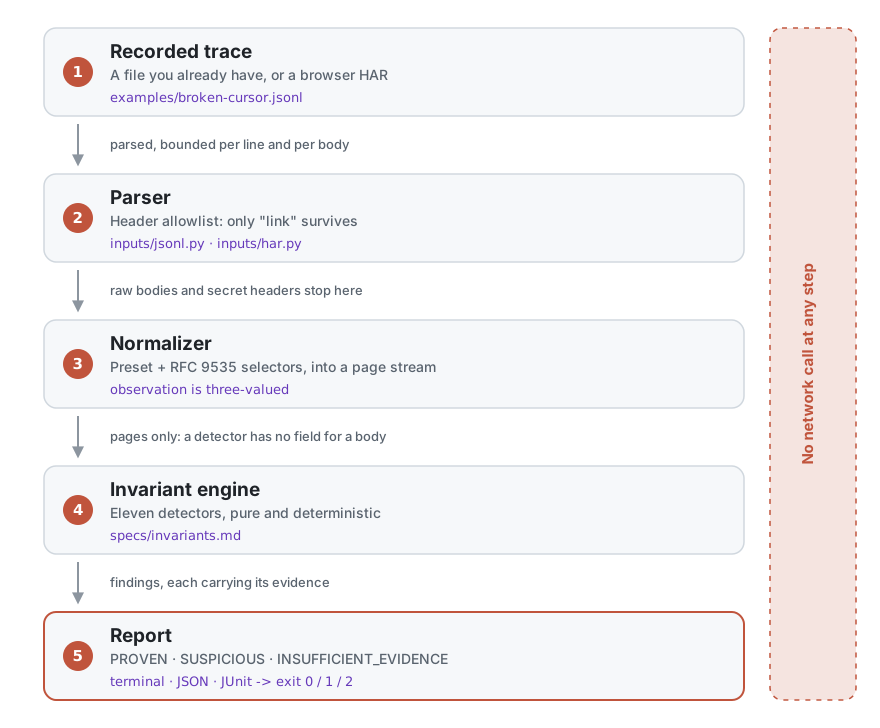
The important part is structural, not a promise. A detector receives normalized observations and
nothing else: Page has no field for a raw body or an authorization header, so the engine
physically cannot read one. See docs/architecture.md.
⚡ Install
[!NOTE] Installing from PyPI is not available yet. The release workflow publishes through Trusted Publishing over OIDC with no token fallback, so nothing can be published until a trusted publisher is configured for the project and the
pypienvironment (docs/compatibility.md).
From a clone, with uv:
uv sync
uv run pagetrace check examples/broken-cursor.jsonl
With pip into an environment of your own, or pipx install . for a standalone command:
pip install .
📼 Record a trace
A JSONL trace is one JSON object per line, one per request/response pair, in capture order:
{"v": 1, "seq": 0, "request": {"method": "GET", "url": "https://api.example.com/v1/items?limit=2"}, "response": {"status": 200, "headers": {"content-type": "application/json"}, "body": {"items": [{"id": 1, "name": "item-1"}, {"id": 2, "name": "item-2"}], "next_cursor": "eyJvIjoyfQ", "has_more": true, "total": 5}}}
v and response.status are required; seq is optional and line order is authoritative. Full
rules: specs/formats/jsonl-v1.md.
Or export a HAR from the browser - no code to write, works against anyone's API
Open DevTools, go to the Network tab, reproduce the pagination, export the request list as HAR. A browser capture holds every asset the page loaded, so filter it down to the API calls:
uv run pagetrace check your-capture.har --url-filter /v1/items
OPTIONS and HEAD requests are dropped before pages are numbered, so a CORS preflight never
looks like a client that failed to advance.
[!WARNING] A HAR holds live credentials. PageTrace keeps exactly one response header and never renders a body, but the file on your disk still contains your
Authorizationheader - treat it like a password, and do not attach it to a public issue.
🎯 Presets
Selectors are RFC 9535 JSONPath. A preset default that does not match resolves to "not found" and proves nothing, rather than becoming a guess.
| Preset | Default selectors | Fits |
|---|---|---|
cursor default |
--cursor $.query.cursor --next $.next_cursor --items $.items --id $.id --total $.total --has-more $.has_more |
APIs that hand back an opaque continuation token |
page |
--page $.query.page, plus the same items / id / total / has-more defaults |
page numbers, 0-based or 1-based |
offset |
--offset $.query.offset, plus the same items / id / total / has-more defaults |
an offset and a limit |
link |
items / id / total / has-more only; continuation comes from the HTTP Link header |
rel="next" in a Link header (RFC 8288) |
[!TIP] Every default is overridable by flag, and
uv run pagetrace check --helpprints all of them with the preset each belongs to. If a finding saysINSUFFICIENT_EVIDENCE, the flag to set is named in the message.
📊 Certainty, severity, exit codes
Two independent axes. Certainty is what the evidence supports; severity is how much it matters if true. A finding is never a probability.
| Certainty | Meaning |
|---|---|
PROVEN |
the trace itself shows it, with the preconditions satisfied |
SUSPICIOUS |
consistent with a defect and with an innocent explanation |
INSUFFICIENT_EVIDENCE |
the selector or the trace did not supply what the check needs |
| Exit | Meaning |
|---|---|
0 |
nothing both proven and severe |
1 |
at least one PROVEN finding of severity ERROR |
2 |
invalid input or configuration |
Exit 1 needs both axes. A duplicate item across pages is PROVEN WARNING and does not fail a
build: the finding declines to say whether overlapping windows are a bug, so failing on it would
be the tool claiming what its own message refuses to. A build that goes red on "this might be a
cache" trains people to ignore the tool.
For CI, take the machine formats rather than the terminal text, which is not a contract:
uv run pagetrace check examples/broken-cursor.jsonl --format json --output report.json
🧭 What it will not tell you
This section is the point of the project, not a disclaimer.
- That pagination never terminates. A finite trace can prove the sequence revisited a state,
and that is what
INV-CURSOR-003says. A cycle back to the page-0 state after anullcursor drops toSUSPICIOUS, because two concatenated runs look exactly the same. - That records are missing.
INV-TOTAL-001compares a declared total against observed identities and is never worded as "N records are missing": PageTrace does not know thattotalcounts the same population, that the dataset held still, or that the same filters applied. - That the API is at fault.
INV-CONT-001andINV-TRACE-001report that the trace ended while the server was still offering more, and name neither the API, the client, nor the recorder. - Anything about a duplicate beyond the duplicate itself, without a uniqueness contract the trace does not contain.
- Anything from a page it could not read. Non-2xx responses are excluded from every
body-derived check and reported once by
INV-TRACE-002, so a trace nobody could read never looks clean. - Anything a selector did not resolve. Matching nothing, matching twice, or landing on an
object is
INSUFFICIENT_EVIDENCEnaming the flag, never a guess. JSONnullis a different state: an observation meaning "the server declared no continuation". - That
5and"5"differ - comparison is on the canonical text form, because a query parameter can only carry text - or that a truthy1or"true"meanshas_more. Only a boolean counts.
Every claim and every non-claim condition is in specs/invariants.md, the normative contract for the tool. Eleven invariants, each with written preconditions.
🔒 Security
A HAR or JSONL trace is an untrusted, secret-bearing file. Parsers keep exactly one response
header, link, because exactly one is read; authorization, cookie and everything else is
dropped before the model is built. Raw bodies never reach a detector or a renderer, so only the
scalars you selected are displayed, with control characters escaped and lengths truncated. Input
is bounded per line and per decoded body, exceeding a limit is a usage error rather than a
traceback, and the package contains no networking dependency or code path at all. Threat table
and limits: docs/security.md.
📈 Performance
Measured 2026-09-11, one run per shape on a Windows 11 developer machine with CPython 3.12.6;
memory is peak Python allocation from tracemalloc. The shape of the numbers is the finding, not
the third digit.
| Shape | Pages | Items | Seconds | Peak MiB |
|---|---|---|---|---|
| wide | 1 000 | 100 000 | 2.6 | 16.1 |
| very wide | 1 000 | 1 000 000 | 20.9 | 156.8 |
| ten thousand pages | 10 000 | 1 000 000 | 28.3 | 142.8 |
| hundred thousand pages | 100 000 | 5 000 000 | 120.8 | 715.4 |
[!NOTE] Three time targets are missed and stay written down as targets rather than quietly relaxed: 1k pages / 100k ids wants 2 s and takes 2.6 s; 10k / 1M wants 10 s and takes 28.3 s, about 3x over; the 100k / 5M stretch target wants 60 s and takes 120.8 s, about 2x over. Both memory targets are met with room to spare. Full table and reasoning: docs/performance.md.
🛠 Contributing
uv run ruff check . && uv run ruff format --check . && uv run pyright && uv run pytest
425 tests pass locally at 98.97% branch coverage, on 3.11, 3.12, 3.13 and 3.14 on Windows. The
property suite in tests/property/ is the main correctness layer: a valid generated trace must
produce no PROVEN finding, and each mutation operator must wake exactly one detector. Mutation
score is 77.9% against the unit tests as of 2026-09-12, with the survivors sorted by hand in
docs/testing.md; mutmut refuses to run on Windows, so that run came from a
Linux container.
Before a new detector: an entry in specs/invariants.md with its non-claim conditions, then the test oracle, then the code. CONTRIBUTING.md has the workflow and the definition of done, AGENTS.md the same for coding agents, and the rest is in docs/architecture.md, docs/testing.md, docs/compatibility.md, docs/adr/ and CHANGELOG.md.
MIT · LICENSE
1 maintainer

Download files
Download the file for your platform. If you're not sure which to choose, learn more about installing packages.
Source Distribution
Built Distribution
Filter files by name, interpreter, ABI, and platform.
If you're not sure about the file name format, learn more about wheel file names.
Copy a direct link to the current filters
File details
Details for the file pagetrace-0.1.0.tar.gz.
File metadata
- Download URL: pagetrace-0.1.0.tar.gz
- Upload date:
- Size: 34.9 kB
- Tags: Source
- Uploaded using Trusted Publishing? Yes
- Uploaded via:
twine/7.0.0 CPython/3.13.14
File hashes
| Algorithm | Hash digest | |
|---|---|---|
| SHA256 |
4244e010f902bdd2ec5c15928ab14f1e372b51026701fdf91c8b1f01ec26f0ce
|
|
| MD5 |
eef9208c6c14a9063d7076dba1b7b7f8
|
|
| BLAKE2b-256 |
e10d84064bdf3d95fdfb38927c417f7f00217c781afd337ec9a4526261039de3
|
Provenance
The following attestation bundles were made for pagetrace-0.1.0.tar.gz:
Publisher:
release.yml on Corner324/PageTrace
-
Statement:
-
Statement type:
https://in-toto.io/Statement/v1 -
Predicate type:
https://docs.pypi.org/attestations/publish/v1 -
Subject name:
pagetrace-0.1.0.tar.gz -
Subject digest:
4244e010f902bdd2ec5c15928ab14f1e372b51026701fdf91c8b1f01ec26f0ce - Sigstore transparency entry: 2811409227
- Sigstore integration time:
-
Permalink:
Corner324/PageTrace@e1fda8cb60f1c4d5faea713a169d5abc805deb5f -
Branch / Tag:
refs/tags/v0.1.0 - Owner: https://github.com/Corner324
-
Access:
public
-
Token Issuer:
https://token.actions.githubusercontent.com -
Runner Environment:
github-hosted -
Publication workflow:
release.yml@e1fda8cb60f1c4d5faea713a169d5abc805deb5f -
Trigger Event:
push
-
Statement type:
File details
Details for the file pagetrace-0.1.0-py3-none-any.whl.
File metadata
- Download URL: pagetrace-0.1.0-py3-none-any.whl
- Upload date:
- Size: 45.6 kB
- Tags: Python 3
- Uploaded using Trusted Publishing? Yes
- Uploaded via:
twine/7.0.0 CPython/3.13.14
File hashes
| Algorithm | Hash digest | |
|---|---|---|
| SHA256 |
8cdb2cb02e9ca74812aa1282b2624472eef746d7576af11611b56e9fc1142136
|
|
| MD5 |
cdf77eeedd96b9b0b63240bae95a4eae
|
|
| BLAKE2b-256 |
ba83aa8b11b06083d8f8ba03f7ed138a6b1b20f4ad8f2b74f0721abaa6a02303
|
Provenance
The following attestation bundles were made for pagetrace-0.1.0-py3-none-any.whl:
Publisher:
release.yml on Corner324/PageTrace
-
Statement:
-
Statement type:
https://in-toto.io/Statement/v1 -
Predicate type:
https://docs.pypi.org/attestations/publish/v1 -
Subject name:
pagetrace-0.1.0-py3-none-any.whl -
Subject digest:
8cdb2cb02e9ca74812aa1282b2624472eef746d7576af11611b56e9fc1142136 - Sigstore transparency entry: 2811409425
- Sigstore integration time:
-
Permalink:
Corner324/PageTrace@e1fda8cb60f1c4d5faea713a169d5abc805deb5f -
Branch / Tag:
refs/tags/v0.1.0 - Owner: https://github.com/Corner324
-
Access:
public
-
Token Issuer:
https://token.actions.githubusercontent.com -
Runner Environment:
github-hosted -
Publication workflow:
release.yml@e1fda8cb60f1c4d5faea713a169d5abc805deb5f -
Trigger Event:
push
-
Statement type:













