
 palimpsest
A palimpsest is a manuscript page scraped clean so the surface can be reused — the
original artwork and impressions intact, new text written over it. That's what this
tool does to a document: same pages, same artwork, same typography — only the words change.





Layout-preserving Spanish→English document translation for PDF and Office formats
(.docx / .pptx / .xlsx) — as a CLI, a library, or a local web UI.
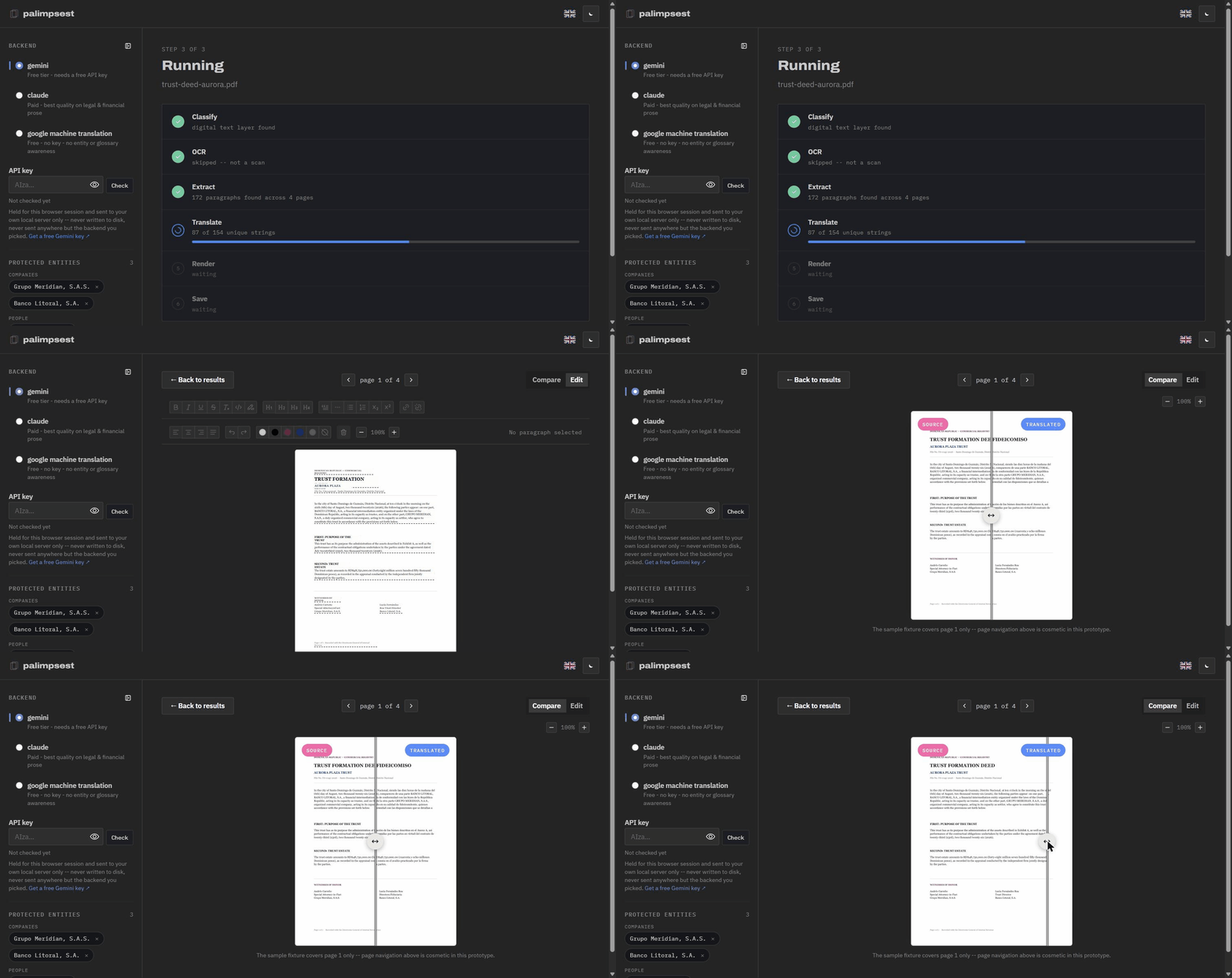
OCR when there's no text layer, styled-run extraction, in-place redraw with real embedded fonts, entity/glossary-aware machine translation (Gemini, Claude, or Google Translate), and an honest translation cache that never lets a failed translation masquerade as a successful one.
- Replicas, not rebuilds — same pages, same fonts, same artwork; only the prose changes.
- Protected entities — company names, personal names, and amounts survive verbatim, guaranteed.
- Three backends, one protocol — Gemini (free tier, default), Claude (paid, highest quality), or Google Translate (free, no key).
- An honest report, always — a paragraph that fails to translate is never silently dropped or rendered as if it succeeded.
- A local web UI, in addition to the CLI and the library — drop a file, watch it translate, compare pages side by side.
Contents: Install · Quickstart · Web UI · Why this exists · Architecture · Contributing · License
Install
pip install palimpsest-translate            # Google Translate backend only, free, no key
pip install palimpsest-translate[gemini]    # + Gemini backend (default, free API key)
pip install palimpsest-translate[anthropic] # + Claude backend (paid, highest quality)
pip install palimpsest-translate[ocr]       # + OCR for scanned PDFs (needs Tesseract on PATH)
pip install palimpsest-translate[all]       # everything
Requires Python 3.11+. To work on palimpsest itself, or to install from source:
git clone https://github.com/ianperaltahirujo/palimpsest.git
cd palimpsest
pip install -e ".[all,dev]"
Quickstart
palimpsest translate deed.pdf                    # -> deed.en.pdf, Gemini backend (needs GEMINI_API_KEY, free)
palimpsest translate deed.pdf --backend anthropic # needs ANTHROPIC_API_KEY in the environment
palimpsest translate deed.pdf --backend google    # Google Translate, no key at all
palimpsest translate deed.pdf --dry-run           # classify, count paragraphs, estimate cost -- no translation
That's it for a single file — no config required. palimpsest translate
works out of the box because a missing palimpsest.toml just means "no
protected entities, no glossary, default thresholds," not an error.
A whole corpus
palimpsest config init            # scaffolds private/ (gitignored) for your entity list and document map
palimpsest batch                  # translates everything named in private/documents.toml, resumes on re-run
palimpsest batch --force          # rebuild everything
palimpsest batch --only pdf --jobs 4
See examples/palimpsest.toml, examples/entities.example.toml, and
examples/documents.example.toml for the file shapes, and
docs/configuration.md for the full reference.
Web UI
pip install "palimpsest-translate[server]"
python tools/build_frontend.py   # builds web/prototype and stages it into the package
palimpsest serve                 # http://127.0.0.1:8765, opens your browser
Local-first, single-user, no accounts: everything runs on your own machine
and binds to loopback by default (--host requires an explicit --i-know
to bind wider). API keys are read from the environment exactly like the
CLI, and never stored in a job record or echoed back in a response — you
can also type one into the page itself instead of a shell (PUT /api/keys, applied immediately, saved to .env). See
web/prototype/README.md for the frontend
itself, including --dev mode for working on the UI against a live API
without rebuilding on every change, its "Standalone" mode for publishing
a build somewhere other than this server (e.g. GitHub Pages, via
--allow-origin), and its "Office files" section for what previewing a
.docx/.pptx/.xlsx in the browser needs
(LibreOffice, optional
and only for that preview — translation itself never needs it).
A standalone frontend build's default expectation is that each visitor runs their own
palimpsest serve locally. For a zero-command deployment instead — a visitor opens the page,
types an API key, and translates — see docs/deployment.md for running the
backend itself somewhere persistent (a Dockerfile and a Render walkthrough), plus what
per-visitor isolation that requires and doesn't guarantee.
Why this exists, not just what it does
Generic "translate this PDF" tools tend to do one of two things badly: rebuild the document from extracted text (losing layout, fonts, and artwork), or leave the original untouched and bolt on a translation elsewhere. Neither produces a document you'd actually hand to someone in place of the original.
palimpsest was extracted from a real pipeline built for legal and financial documents — trust deeds, audited financial statements, environmental permits, budget workbooks — where the layout, the signatures, the letterhead, and the exact numbers all have to survive untouched, and only the prose changes language. That constraint shaped almost every design decision here:
- Replicas, not rebuilds. A digital PDF's text is extracted with its styled runs, alignment, and measured leading, cleared without touching images or vector art, and redrawn in a real embedded font at the original position. A scanned PDF gets a real OCR text layer first.
- An honest cache. Every cached translation carries an explicit status
(
ok/failed/identical/refused) — a failed machine translation can never be silently served as a successful one, and a document that still has untranslated paragraphs says so in its report rather than shipping quietly incomplete. - Protected entities as a first-class concept, not a glossary
workaround — company names, personal names, and amounts are guaranteed
to survive verbatim, including the specific failure modes documented in
docs/design/protected-entities.md: OCR fragmenting a heading into a bareGRUPOand letting it machine-translate as if it were an ordinary noun.
The four documents in docs/design/ are a genuine engineering postmortem
— what broke, why, and what specifically fixed it — carried over (and
de-identified) from the pipeline this project was extracted from:
v1-postmortem.md— the first version of this pipeline rebuilt documents from scratch and lost logos, fonts, and whole spreadsheet parts; nine concrete bugs and what fixed each one.protected-entities.md— a company name translated as if it were a common noun, found after a full corpus run had already shipped; two independent root causes and three separate places a protective guard got bypassed before the fix became architectural instead of another patch.bold-calibration.md— how bold text is recovered from scanned pixels when the OCR text layer carries no weight information, and why the threshold is a corpus-fitted number, not a universal constant.limitations.md— an honest account of what this pipeline does not handle, from a real corpus run rather than written speculatively.backends.md— why the Gemini/Claude LLM backends handle entity protection completely differently from Google Translate's phrase-level API, why Gemini is the default despite Claude being the stronger model, and the pricing/quality tradeoffs between all three.
Architecture
src/palimpsest/
  cli.py                 subcommands: translate, batch, compare, cache, audit, config
  corpus.py               whole-corpus batch orchestration
  config/                 layered TOML config (packaged defaults -> project file -> private/)
  core/                   cross-platform paths, errors, logging, the IR serialization boundary
  text/                   entity protection, glossary, ordinals, post-translation fixups
  pdf/                    classify, OCR, layout extraction, font resolution, clearing, render, pipeline
  office/                 OOXML surgery (translate .xlsx/.docx/.pptx by editing the zip in place)
  translate/              backend protocol, Gemini + Claude + Google backends, cache, cost estimation
  qa/                     side-by-side comparison renders, bilingual PDF output, cache audit
Three backends behind one Backend protocol: Gemini (the google-genai
SDK, free-tier, LLM — the default) and Claude (the anthropic SDK, paid,
LLM) both protect entities by prompt instruction plus a post-hoc
verification pass, since an LLM benefits from reading the whole sentence
in a way placeholder substitution would defeat; Google Translate
(deep-translator, free, phrase-level, no key at all) has no concept of
"entity" at all, so its entities are protected by placeholder substitution
instead. See docs/design/backends.md for why they're architected
differently rather than sharing one protection scheme.
What this borrows from, and doesn't share code with
Several architectural ideas — most notably TOML-based project
configuration and bilingual side-by-side PDF output — were inspired by
BabelDOC, an AGPL-3.0
scientific-PDF translation tool, after comparing it against this
pipeline's own approach. BabelDOC's headline feature, ML-based layout
analysis (DocLayout-YOLO), was deliberately not adopted: this
pipeline's own geometry-based column/paragraph detection
(pdf.layout.column_bands) already solves the layout problem it exists
for, for this document type, without a model download or GPU dependency.
See NOTICE — no BabelDOC source is included in or derived into this
project.
Contributing
See CONTRIBUTING.md. The short version: no test may
make a real network call, and tools/scrub_check.py runs in CI to keep
this repository free of the confidential document data it was extracted
from.
License
Apache 2.0 — see LICENSE. See NOTICE for the
BabelDOC design-inspiration credit above.
1 maintainer

Metadata
1 maintainer
Release files for palimpsest-translate 0.2.2
For a detailed explanation of source distributions (sdists) and built distributions (wheels), please see the package formats documentation.
Source distribution (sdist)
| File | Size | Uploaded | |
|---|---|---|---|
| palimpsest_translate-0.2.2.tar.gz | 2.3 MB | Details |
Built distribution (wheel)
| File | Interpreter | ABI | Platform | Reset |
|---|---|---|---|---|
| palimpsest_translate-0.2.2-py3-none-any.whl | Python 3 | none | any | Details |
Total release size: 2.5 MB
Release files / palimpsest_translate-0.2.2.tar.gz
| Download URL | palimpsest_translate-0.2.2.tar.gz |
|---|---|
| Size | 2.3 MB |
| Tags | Source |
|
SHA-256 checksum How to use checksums |
48ae0f9b3ed2acc38bfb2844cded0134f27d34d23ca4dbb25ef49216f306c7bb
|
|
BLAKE2b-256 checksum How to use checksums |
d8ff8ed924ca478bafb8a6147f76c09eca02ec48d87433a6fa7be851d3c80a88
|
| Upload date | |
|
Uploaded using Trusted Publishing? What is trusted publishing? |
Yes |
| Uploaded via |
twine/7.0.0 CPython/3.13.14
|
Provenance
Provenance describes where a file came from. On PyPI, provenance is shared via attestations, which provide a verifiable record of the build or publishing details. View details, limitations and caveats.


PyPI Publish Attestation
PyPI verified that this artifact, at this checksum, originated from the publisher listed below.
Signed by GitHub Actions, verified by PyPI on Aug 9, 2026.
Transparency logRelease files / palimpsest_translate-0.2.2-py3-none-any.whl
| Download URL | palimpsest_translate-0.2.2-py3-none-any.whl |
|---|---|
| Size | 154.1 kB |
| Tags | Python 3 |
|
SHA-256 checksum How to use checksums |
1db433f4d380dd5b878a4f9e1972b53f56e5f7968631b7f74839a330528a258d
|
|
BLAKE2b-256 checksum How to use checksums |
555de7fd2ea8f7e252c6a956c6c23e853548031a6c41fe571d8fe1164d49b1ef
|
| Upload date | |
|
Uploaded using Trusted Publishing? What is trusted publishing? |
Yes |
| Uploaded via |
twine/7.0.0 CPython/3.13.14
|
Provenance
Provenance describes where a file came from. On PyPI, provenance is shared via attestations, which provide a verifiable record of the build or publishing details. View details, limitations and caveats.
PyPI Publish Attestation
PyPI verified that this artifact, at this checksum, originated from the publisher listed below.
Signed by GitHub Actions, verified by PyPI on Aug 9, 2026.
Transparency log













