
palmwtc
Automated whole-tree chamber workflow for perennial-crop ecophysiology.





palmwtc is a data-processing and analysis pipeline for automated whole-tree
chambers (WTC) that enclose an individual perennial-crop tree. Its reference
deployment is the first such chamber built for oil palm, at the LIBZ field site
(Riau, Indonesia), instrumented with LI-COR LI-850 gas analyzers. It transforms
raw sensor cycles into validated CO₂ and H₂O fluxes, applies multi-stage quality
control, and produces inputs for the XPalm digital-twin calibration pipeline.
What it does
raw chamber cycles  ──►  QC (rules + ML + breakpoints)  ──►  flux calculation  ──►  science validation
        │                                                                                  │
        └── 30-min weather + soil + tree biophysics ──┬───────────────────────────────────►┘
                                                       └── high-confidence calibration windows
End-to-end run on the bundled synthetic sample:
pip install palmwtc
palmwtc run            # uses bundled sample if no PALMWTC_DATA_DIR set
For your own data:
export PALMWTC_DATA_DIR=/path/to/your/chamber/data
palmwtc run --skip 022 025          # mirrors the original notebook-runner CLI
palmwtc run --notebooks             # papermill mode, produces HTML reports
Install
pip install palmwtc                 # core only
pip install 'palmwtc[ml]'           # + scikit-learn IsolationForest QC
pip install 'palmwtc[interactive]'  # + ipywidgets / anywidget for Jupyter dashboards
pip install 'palmwtc[gpu]'          # + torch (Apple-Silicon MPS / CUDA)
pip install 'palmwtc[all]'          # everything
Requires Python 3.11–3.13.
Library use
from palmwtc.config import DataPaths
from palmwtc.qc import QCProcessor
from palmwtc.flux import calculate_flux_cycles

paths = DataPaths.resolve()                     # layered: CLI → env → yaml → sample
qc_result = QCProcessor(paths).run("CO2_C1")
flux = calculate_flux_cycles(qc_result.data)
Full API reference: adisapoetro.github.io/palmwtc/api/
Citation
If you use palmwtc in scientific work, please cite the Zenodo DOI. The
concept DOI 10.5281/zenodo.19680893
always resolves to the latest version; to cite a specific release, use
its own version DOI (visible on the Zenodo record
→ Versions panel).
@software{adisaputro_palmwtc_2026,
  author  = {Adisaputro, Didi and Raharjo, Doni Artanto},
  title   = {palmwtc: Automated whole-tree chamber workflow for oil-palm ecophysiology},
  year    = {2026},
  version = {0.4.5},
  doi     = {10.5281/zenodo.19680893},
  url     = {https://github.com/adisapoetro/palmwtc},
}
See CITATION.cff for machine-readable metadata.
Background
Most ecosystem-scale flux measurements over oil-palm plantations use eddy
covariance, which integrates over hectares of canopy and cannot resolve
single-tree behaviour. palmwtc is built around a different instrument: an
automated whole-tree chamber, sized and ventilated to enclose an individual
mature oil palm, with an LI-COR LI-850 gas analyzer cycling open and closed on
a programmed schedule. This is, to our knowledge, the first WTC deployment for
oil palm; the WTC method was previously applied to temperate broadleaf
species.
What does an automated whole-tree chamber look like?
The illustration below shows one concrete example — the LIBZ chamber from
which palmwtc was originally developed (Riau, Indonesia; whole-tree chamber
around an individual mature oil palm; aboveground sensor pole carrying sonic
anemometers, temperature/humidity sensors, and LI-850 air inlets at five
heights; underground TEROS-21 + Watermark sensors at five depths).
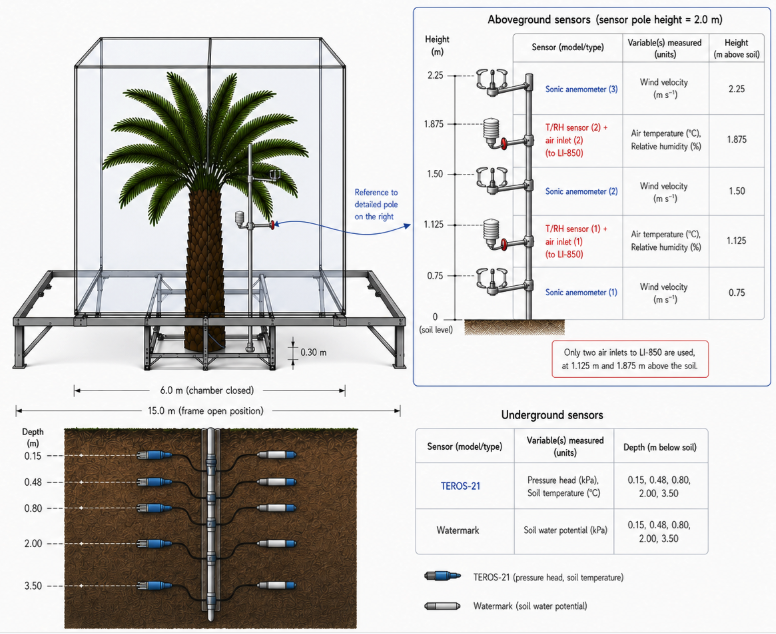
This is one possible implementation, not a specification. palmwtc is a
generic toolkit — it does not assume any one chamber design. Other deployments
will differ in:
- Chamber dimensions —
palmwtctakes the chamber volume as a configuration input; chambers from a few cubic metres to large enclosures all work. - Tree species and growth form — the package is not oil-palm-specific; any plant that fits in a closed chamber can be processed.
- Sensor pole design — the number of heights and the sensor mix (sonic anemometer, T/RH, PAR, gas-analyser inlets) varies per deployment.
- Soil instrumentation — depth count and sensor brand (TEROS-21, Watermark, TDR, capacitance) varies per deployment.
- Datalogger choice — Campbell Scientific is one common option; others work as long as the data files can be loaded.
palmwtc consumes whatever data your chamber produces and computes flux. The
hardware, materials, and dimensions are out of scope for the package itself —
they belong to your specific field setup.
Contributing
See CONTRIBUTING.md. Bug reports and feature requests:
github.com/adisapoetro/palmwtc/issues.
License
MIT — see LICENSE.
1 maintainer

Metadata
1 maintainer
Release files for palmwtc 0.4.5
For a detailed explanation of source distributions (sdists) and built distributions (wheels), please see the package formats documentation.
Source distribution (sdist)
| File | Size | Uploaded | Provenance | Actions |
|---|---|---|---|---|
| palmwtc-0.4.5.tar.gz | 2.9 MB | With provenance | Details for palmwtc-0.4.5.tar.gz |
Built distribution (wheel)
| File | Interpreter | ABI | Platform | Actions Reset |
|---|---|---|---|---|
| palmwtc-0.4.5-py3-none-any.whl | Python 3 | none | any | Details for palmwtc-0.4.5-py3-none-any.whl |
Total release size: 5.8 MB
Release files / palmwtc-0.4.5.tar.gz
| Download URL | palmwtc-0.4.5.tar.gz |
|---|---|
| Size | 2.9 MB |
| Tags | Source |
|
SHA-256 checksum How to use checksums |
aa0013332cf223f5d0c2604608b3979dd7af7d591d7cd387cbccd657fe5cb056
|
|
BLAKE2b-256 checksum How to use checksums |
6b5a79da657c76d7f06453ede2db86184f02532ad828473e777fbc7f8aef4395
|
| Upload date | |
|
Uploaded using Trusted Publishing? What is trusted publishing? |
Yes |
| Uploaded via |
twine/6.1.0 CPython/3.13.14
|
Provenance
Provenance describes where a file came from. On PyPI, provenance is shared via attestations, which provide a verifiable record of the build or publishing details. View details, limitations and caveats.


PyPI Publish Attestation
PyPI verified that this artifact, at this checksum, originated from the publisher listed below.
Signed by GitHub Actions, verified by PyPI on Jul 21, 2026.
Transparency logRelease files / palmwtc-0.4.5-py3-none-any.whl
| Download URL | palmwtc-0.4.5-py3-none-any.whl |
|---|---|
| Size | 2.9 MB |
| Tags | Python 3 |
|
SHA-256 checksum How to use checksums |
b8e01dd072be4c088259ab41dc9986936fdccdc19173556f92125993d22b41c8
|
|
BLAKE2b-256 checksum How to use checksums |
850f220926a036ebbd6c6a4a60d92bae69582abdc3d984107879925ed1c98222
|
| Upload date | |
|
Uploaded using Trusted Publishing? What is trusted publishing? |
Yes |
| Uploaded via |
twine/6.1.0 CPython/3.13.14
|
Provenance
Provenance describes where a file came from. On PyPI, provenance is shared via attestations, which provide a verifiable record of the build or publishing details. View details, limitations and caveats.
PyPI Publish Attestation
PyPI verified that this artifact, at this checksum, originated from the publisher listed below.
Signed by GitHub Actions, verified by PyPI on Jul 21, 2026.
Transparency logSecurity for palmwtc 0.4.5
Provenance
Provenance describes where a file came from. On PyPI, provenance is shared via attestations, which provide a verifiable record of the build or publishing details. View details, limitations and caveats.
Full provenance
Both files in this release have been uploaded with provenance metadata.
Attestation for palmwtc-0.4.5.tar.gz
PyPI Publish Attestation
PyPI verified that this artifact, at this checksum, originated from the publisher listed below.
Signed by GitHub Actions, verified by PyPI on Jul 21, 2026.
Transparency logA note on package security
PyPI is a repository for distributing packages, not a service for auditing them. While third-party security researchers and our staff do their best to detect and remove malicious packages, PyPI cannot guarantee the quality, security or suitability of any given package.
To learn more about protecting yourself from malicious actors, visit our package security documentation.














