
📌 paperpin
Pin every value an LLM extracts from a document to the exact spot on the page it came from, and flag the values that aren't there at all.


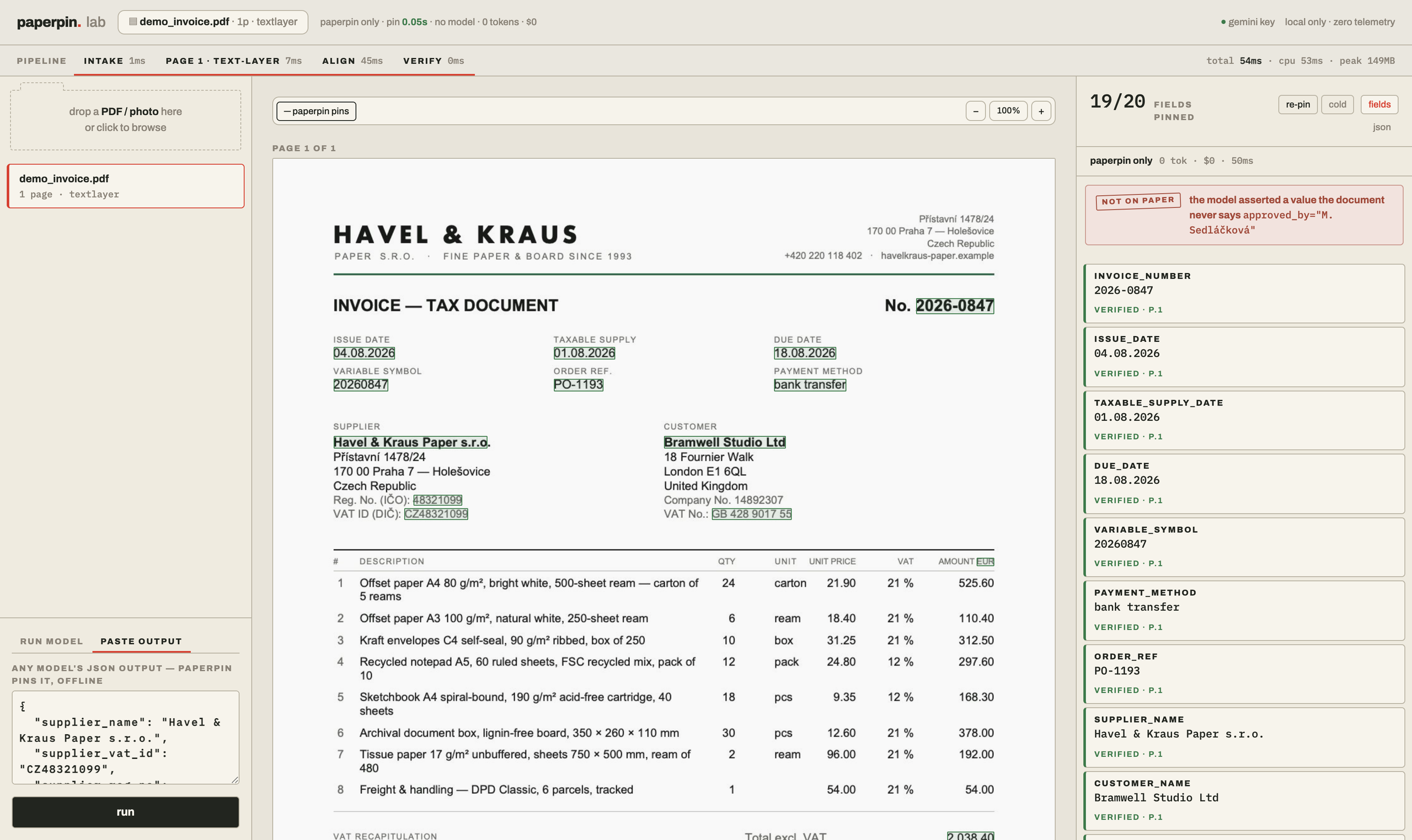
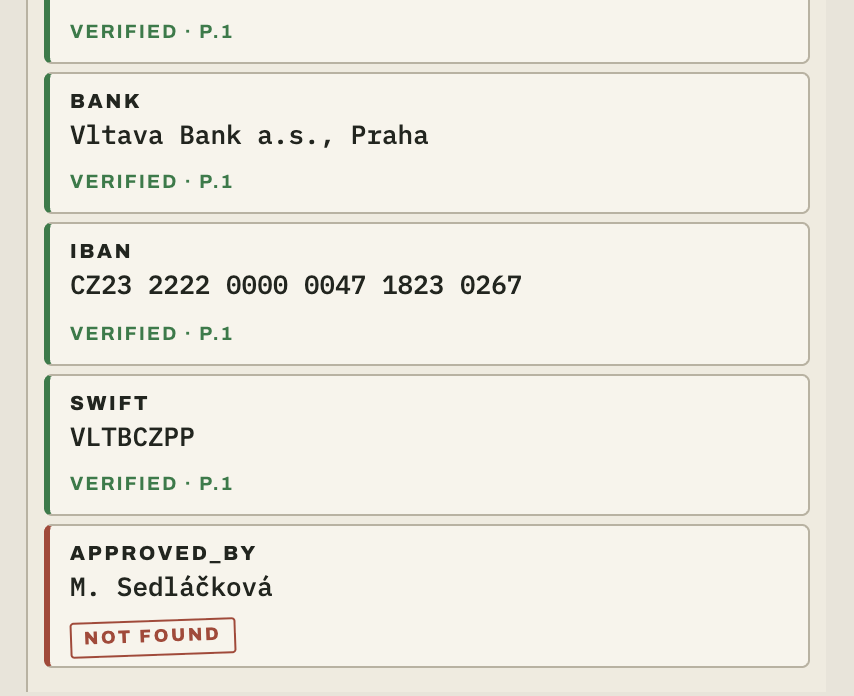
One value was fabricated on purpose. paperpin caught it.
Models read documents well and lie about coordinates badly. Ask an LLM where a value sits on the page and you get plausible boxes that drift, snap to the wrong line, or point at whitespace. The one value it hallucinated gets a confident box too.
paperpin never asks the model for coordinates. The model only reads; deterministic OCR / text-layer geometry locates; an alignment algorithm links the two; verification proves or flags every field:
- a box produced this way cannot be hallucinated: it exists only where document text actually matched;
- a value the model invented matches nothing and comes back
not_found, the hallucination flag; - everything else gets one of five honest statuses, never a silent guess.
| status | meaning |
|---|---|
verified |
located exactly; every verification check that ran agreed (checksum/arithmetic proof recorded in proof when one exists) |
low_confidence |
located, with doubt: a fuzzy match, or an exact match a verification check demoted. A human should glance |
ambiguous |
multiple equally plausible locations; all candidates in the JSON (overlay/viewer draw the pinned one) |
not_found |
the model asserted a value that matches nothing on the page. The hallucination flag |
not_present |
the model itself said the field isn't on the document |
Install
pip install "paperpin[full]"        # recommended: PDF + OCR + model adapters
# pip install paperpin              # core only: images + BYO-JSON, no PDF/OCR
Use
from paperpin import ground, extract

# ground ANY existing extraction: yours, Azure's, anyone's JSON
result = ground("invoice.pdf", extraction={"total": "146,14", "iban": "SK73..."})

# or extract + ground in one call. No schema needed, the model names the fields
result = extract("photo.jpg", model="gemini/gemini-2.5-flash")

result["total"].status    # "verified"
result["total"].bbox      # (x0, y0, x1, y1) normalized, on the ORIGINAL page
result["total"].evidence  # the exact document text it matched
result.overlay("proof.png"); result.viewer("proof.html")
No document types anywhere. With no schema the model names the fields itself and paperpin pins whatever it asserted; pass a field list (schema="invoice" or your own) only when you want guided recall.
Runnable examples live in examples/: grounding any JSON offline, every schema knob, the full result surface with a triage pattern, the CLI, all tuning options, and calling paperpin from Node. Every parameter is documented right below in Every knob.
Try the same flow visually:
pip install "paperpin[full,lab]"
paperpin lab
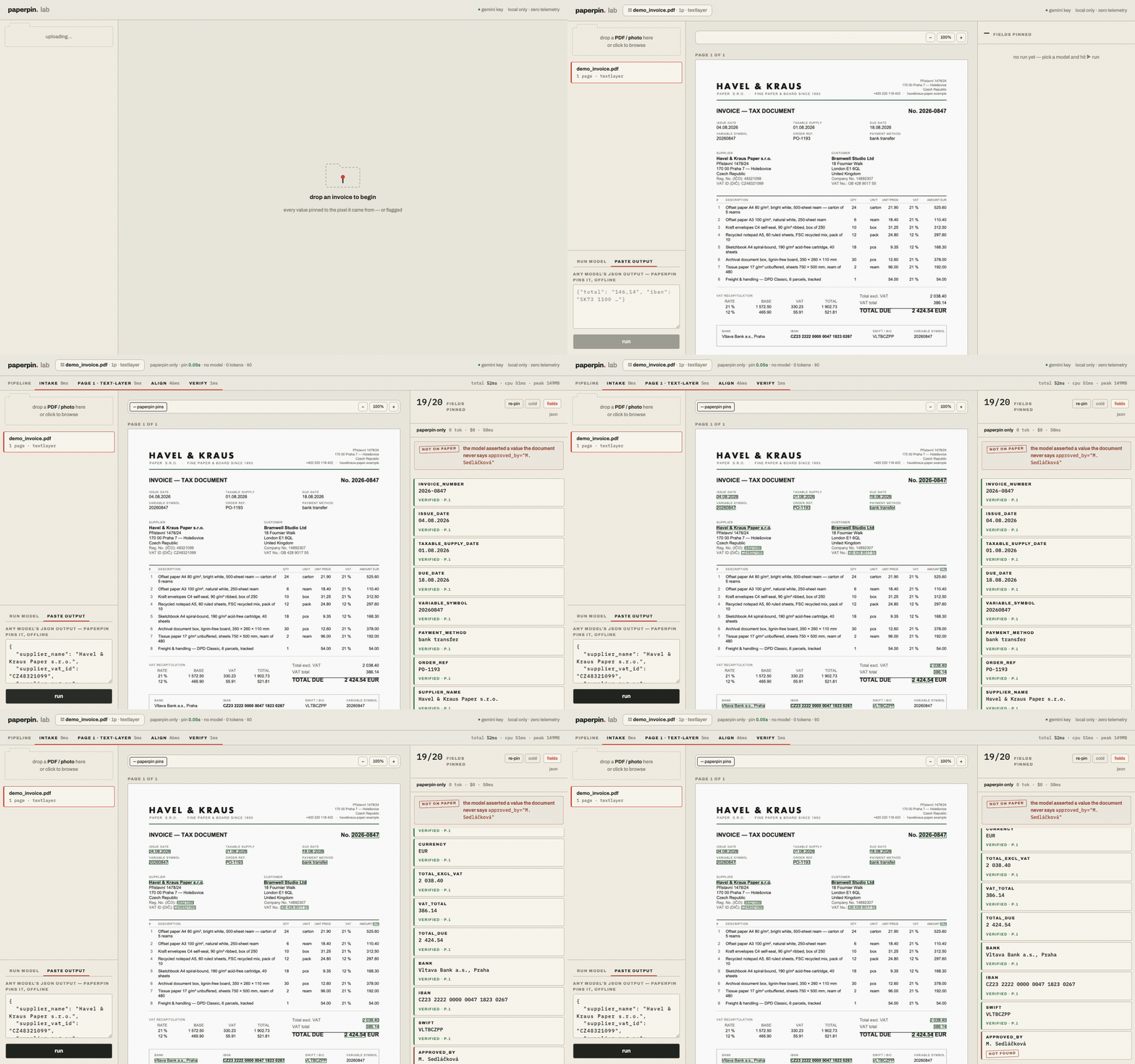
The document in every screenshot is synthetic: a fictional company with a deliberately invalid registration number, because demos on real customer invoices are someone's real data. What the screenshots show is a real run, and a test asserts it stays true.
Measured, not promised
On a private corpus of 847 real documents (invoices, bills, credit notes, delivery lists, proformas, contracts, statements across 7 countries; born-digital PDFs, scans, and phone photos, handwriting and crumpled paper included), the current engine grounds 6,830 model-asserted fields like this:
| outcome | share |
|---|---|
pinned to an exact page location (verified + low_confidence) |
87.8% |
ambiguous, all candidate locations returned |
1.4% |
not_found, asserted by the model but not locatable on paper |
10.7% |
The number that matters is what it refuses to guess: every unpinned field says so out loud. The corpus is private (it is real people's paperwork, the reason this library exists); the grading method is deterministic and the synthetic fixture corpus in fixtures/corpus runs the same gates at CI speed on every change.
Why not just ask the model for boxes?
Because you cannot audit a guess with another guess. Text-grounding tools (Google's LangExtract, 38k★) solved this for plain text by matching the model's output back to the source, and their own issue tracker shows people asking for exactly this on documents. Documents are harder: the "source" is pixels, OCR is noisy, layouts wrap and repeat. That geometry is the whole of what paperpin does:
- Intake: PDF text layer when it's trustworthy, OCR when it isn't (RapidOCR, CPU-only).
- Align: the model's value strings are matched against located document text: exact, normalized (dates, amounts, IBANs), then fuzzy, with per-field-type rules.
- Verify: checksums (IBAN/VAT), arithmetic (totals), format checks promote or demote every match; disagreement is a status, never a silent pick.
- CPU-only. Runs on a slow laptop. No GPU, no cloud, fully offline in BYO-JSON mode.
- Any model.
gemini/…,openai/…,openrouter/…,deepseek/…,ollama/…, any OpenAI-compatible endpoint. Or no model at all: bring the JSON you already have. - Background-friendly.
PAPERPIN_OCR_THREADS=1pins OCR to one core; combine withnice -n 19and grounding runs invisibly. - Zero telemetry. Nothing phones home. API keys go only to the provider you chose. The OCR cache lives in
~/.paperpin/cache/, local only.
Honest limits
- Model calls send at most 12 pages (
meta["pages_truncated"]tells you when more existed); multi-frame images decode at most 50 pages. - Dense handwriting is the hardest corpus slice. Statuses stay honest about it (
not_foundrather than a wrong box), but recall drops. - Rotated pages are handled per-page; mixed-orientation rescue is on the roadmap.
- Table cell geometry on 500+ item documents gets slow (quadratic matching; a fix is scoped).
Every knob
The complete surface. Nothing exists beyond what is listed here.
ground(source, extraction, schema=None, backend="auto", use_cache=True, progress=None)
Pin an existing extraction to the document. Offline, no model involved.
| param | type | meaning |
|---|---|---|
source |
str / Path | PDF or image (jpg, png, webp, tiff, heic/heif). Multi-frame images decode up to 50 frames |
extraction |
dict / JSON str / path | the values to ground. Lists of row objects are grounded per cell and flattened to name[i].col |
schema |
None / "invoice" / "receipt" / path / dict |
optional field specs, see Schemas below. None = types inferred from names and values |
backend |
"auto" |
OCR backend for pages without a usable text layer. "auto" = RapidOCR (CPU). PDF text layers never touch OCR |
use_cache |
bool | OCR text cache in ~/.paperpin/cache/, local only. Re-runs on the same file are instant |
progress |
callable | fn(stage, phase, info) called around each pipeline stage; exceptions in it never break a run |
Returns a GroundResult.
extract(source, schema=None, model="byo", prompt=None, extraction=None, backend="auto", use_cache=True, api_key=None, base_url=None, timeout=180.0, progress=None)
Model read + grounding in one call.
| param | meaning |
|---|---|
model |
"gemini/…", "openai/…" (bare gpt-… works), "openrouter/…", "deepseek/…", "ollama/…", or "byo" (default) which requires extraction= and behaves like ground() |
schema |
None (default) = schema-free: the model names the fields itself. A schema means guided recall: the model is asked for exactly those fields |
prompt |
extra steering appended to the extraction request ("dates exactly as printed") |
api_key |
overrides the provider env var (GEMINI_API_KEY, OPENAI_API_KEY, …) |
base_url |
any OpenAI-compatible endpoint (Ollama, vLLM, LM Studio) via model="openai/<name>" |
timeout |
seconds per model call, default 180 |
Model calls send at most 12 pages; result.meta["pages_truncated"] says
how many were dropped when more existed.
GroundResult
Mapping-style container: result["total"], in, len, iter,
.keys() / .items() / .get(), .fields (plain dict).
| member | meaning |
|---|---|
.counts() |
{"verified": 9, "not_found": 1, ...} |
.pages |
list of PageInfo: .index, .width, .height (original space: pixels for images, points for PDF), .route ("textlayer" / "ocr"), .dpi, .px_width, .px_height |
.meta |
run metadata: adapter, backend, ground_seconds, and for model runs extract_seconds, token_usage, pages_truncated |
.source |
the input path |
.save(path) |
versioned JSON, written atomically |
.to_json(indent=1) |
the same JSON as a string, for piping or POSTing |
GroundResult.from_dict(json) |
rebuild from save() output; unknown keys ignored |
.page_image(page=0, width=None) |
PIL image of the page a bbox is normalized against — multiply a bbox by its (width, height) for pixels |
.overlay(path, page=None) |
PNG of the page(s) with status-colored boxes |
.viewer(path) |
self-contained interactive HTML viewer |
FieldResult
| attr | meaning |
|---|---|
.status |
verified / low_confidence / ambiguous / not_found / not_present (enum; .value is the string) |
.page |
0-based page index |
.bbox |
(x0, y0, x1, y1) normalized 0..1, origin top-left, on the upright ORIGINAL page (EXIF orientation already applied). Multiply by pages[page].width/height for pixels |
.evidence |
the exact document text that matched |
.proof |
"checksum" or "arithmetic" when a verification proved the value, else None |
.candidates |
for ambiguous: every tied location as Candidate(.page, .bbox) |
Schemas
A schema is a dict of field_name -> spec (or a preset name, or a path
to a JSON file with the same shape). Every spec key is optional:
| key | values | buys you |
|---|---|---|
type |
text number date id percent block table |
type-aware normalization and matching (dates in any print format, numbers with any separators, token-set matching for multi-line block values) |
anchors |
list of label words | tie-breaking toward the printed label ("invoice", "no.") when a value appears twice |
checksum |
"iban" "ean" "vat" |
checksum-valid match is recorded as proof="checksum"; invalid candidates are demoted |
proof |
{"sum": [f, ...]} / {"product": [f, ...]} / {"percent_of": [base, rate]} |
arithmetic across sibling fields recorded as proof="arithmetic"; disagreement demotes |
columns |
dict of specs | table only: per-cell specs for row objects |
aliases |
{"EUR": ["€"]} |
the document may print an alternate literal for the value; matching any alias grounds the field |
pattern |
regex | id fields: a page print full-matching the pattern can rescue OCR-garbled ids sharing the same core |
affinity |
list of field names | prefer the line where those fields pinned (a currency mark beside its total) |
Presets shipping today: invoice, receipt.
CLI
paperpin ground  FILE --extraction JSON [--schema S] [--backend B]
                 [--no-cache] [-o result.json|-] [--quiet]
                 [--overlay proof.png] [--view proof.html]
paperpin extract FILE [--model M] [--schema S] [--prompt P]
                 [--extraction JSON] [--backend B] [--no-cache]
                 [-o result.json|-] [--quiet] [--overlay] [--view]
paperpin overlay FILE result.json [-o proof.png] [--page N]   # N is 0-based
paperpin view    FILE result.json [-o proof.html]
paperpin pages   FILE [-o dir] [--width N] [--page N] [--format png|jpg]
paperpin lab     [--port 8377] [--no-browser]
paperpin version
paperpin pages writes the page rasters a viewer needs; boxes are
normalized, so any --width renders them correctly.
-o - writes the result JSON to stdout and moves the summary to stderr, so
paperpin ground doc.pdf --extraction e.json -o - | jq pipes cleanly from any
language; --quiet drops the summary entirely.
The CLI loads a local .env before running; as a library, export the
provider variable yourself or pass api_key=.
Environment
| var | effect |
|---|---|
PAPERPIN_OCR_THREADS=1 |
pin OCR to one core (about 2x slower, machine stays responsive; pair with nice -n 19) |
GEMINI_API_KEY, OPENAI_API_KEY, OPENROUTER_API_KEY, DEEPSEEK_API_KEY |
adapter keys |
PAPERPIN_LAB_TOKEN |
fixes the Lab's per-start auth token (dev convenience) |
Output JSON shape
The shape is a contract other languages read, so it is written down as JSON
Schema in paperpin/result.schema.json,
which ships inside the installed package, and every
release is validated against it. paperpin.schema is the version of the
shape — branch on that, not on paperpin.version, which moves every
release. meta keys vary by run: tolerate ones you do not know.
save() / -o writes:
{
  "paperpin": { "version": "0.1.0", "schema": 1,
                "coordinate_space": "normalized 0..1, origin top-left, upright original page" },
  "source": "invoice.pdf",
  "pages":  [ { "index": 0, "width": 595.3, "height": 841.9, "route": "textlayer" } ],
  "fields": { "total_due": { "status": "verified", "page": 0,
                             "bbox": [0.68, 0.62, 0.9, 0.64],
                             "evidence": "2 424.54", "proof": "arithmetic",
                             "candidates": [] } },
  "summary": { "verified": 9, "not_found": 1 },
  "meta":    { "adapter": "byo", "backend": "textlayer", "ground_seconds": 0.05 }
}
Contributing
Issues are very welcome, especially documents where a status lied. See CONTRIBUTING.md for how to run the two test gates; PRs are best opened after an issue. Security reports: SECURITY.md.
MIT © Rjabov
1 maintainer

Metadata
1 maintainer
Release files for paperpin 0.2.1
For a detailed explanation of source distributions (sdists) and built distributions (wheels), please see the package formats documentation.
Source distribution (sdist)
| File | Size | Uploaded | |
|---|---|---|---|
| paperpin-0.2.1.tar.gz | 853.8 kB | Details |
Built distribution (wheel)
| File | Interpreter | ABI | Platform | Reset |
|---|---|---|---|---|
| paperpin-0.2.1-py3-none-any.whl | Python 3 | none | any | Details |
Total release size: 968.1 kB
Release files / paperpin-0.2.1.tar.gz
| Download URL | paperpin-0.2.1.tar.gz |
|---|---|
| Size | 853.8 kB |
| Tags | Source |
|
SHA-256 checksum How to use checksums |
193f77714a216ce652ec97a03d47cbd0d19184d3cf8e5f944c286836af80f38c
|
|
BLAKE2b-256 checksum How to use checksums |
8a036174791cf091f094e16656177639723773b7d40149ef74f07d60a96cacfa
|
| Upload date | |
|
Uploaded using Trusted Publishing? What is trusted publishing? |
No |
| Uploaded via |
twine/7.0.0 CPython/3.13.3
|
Release files / paperpin-0.2.1-py3-none-any.whl
| Download URL | paperpin-0.2.1-py3-none-any.whl |
|---|---|
| Size | 114.4 kB |
| Tags | Python 3 |
|
SHA-256 checksum How to use checksums |
5a739b63b637b0b7815e0b125af7f46244dd53b23332e57113960279309b3c6c
|
|
BLAKE2b-256 checksum How to use checksums |
75149d8d6000082a97a84354e02bf793d31c5a675f528537c9de068a3cca0578
|
| Upload date | |
|
Uploaded using Trusted Publishing? What is trusted publishing? |
No |
| Uploaded via |
twine/7.0.0 CPython/3.13.3
|














