
ParaScape
← Back · Next → · Open slide viewer · PDF · PowerPoint · Home page











ParaScape brings the published evidence about one parasite gene into a single place and predicts what has not been measured, with a stated uncertainty on every prediction. It holds expression, fitness screens, localisation, protein features, interactions and literature annotation for 8,140 Toxoplasma gondii and 5,720 Plasmodium falciparum genes, viewed one organism at a time. Starting from a gene, a gene list or your own screen table, it produces source-linked evidence for each gene, embeddings and clusterings you choose the inputs for, held-out predictions with calibrated confidence, and ranked candidate lists for follow-up. Every prediction is graded against known answers it was not allowed to see, and a prediction that does not clear the bar ranks genes rather than writing anything down. Runs as a desktop application, or headlessly for the command-line pipelines.
User guide · Python API · Dataset catalogue · Changes
Try ParaScape
conda create -n parascape python=3.12 -y
conda activate parascape
python -m pip install parascape
parascape
On first launch a prompt offers the versioned data download from Hugging Face. After it verifies, browsing works offline; the datasets live outside the package. Protein structures are fetched when requested and cached.
Where to start in the app
The home screen asks what you have, and there are three answers, because the data is a table of genes and there are only three ways to point at it.
| You have | It opens on | |
|---|---|---|
| Gene | one gene — a row | its card: structure, every dataset it appears in, its partners, what is predicted for it and how well that prediction grades |
| List | a set of genes — a block of rows | what the set has in common, which mechanism it points to, and a ranking of the genome by resemblance to it |
| Label | a question — a column | the strategies that can answer it, the data each is allowed to use, and the scorecard saying whether the answer may be trusted |
A card whose view does not exist yet, or whose data is absent, is shown greyed with the reason
rather than hidden — twelve of the thirty-three are, today, including the set-level mechanism and
ranking views above. Label ▸ Fill is greyed by computation, not by hand: it opens only when a
question has cleared its bar, and none has. The search bar reaches all of it — genes, questions,
strategies, datasets and guide pages ranked together, so the best answer wins whatever kind of
thing it is.
Install
Python 3.12 or newer. The desktop app needs a display and OpenGL.
From a checkout:
git clone https://github.com/EinarOlafsson/parascape.git
cd parascape
pip install -e .
parascape
For an NVIDIA GPU on Linux x86_64 with a CUDA 12 driver, pip install "parascape[gpu]";
parascape-install-gpu inspects the driver and offers a command. macOS and Windows run analyses
on the CPU, and the 3D display still uses OpenGL. Optional extras install separately:
parascape[sequence], parascape[structures], parascape[ingest].
Strategies
The strategies tab lists 39 named ways of turning the combined data into a claim — from holding a category out and searching for the map that finds it, to calling genes with a stated error rate (conformal prediction), to learning how far to trust each kind of evidence (stacking). Each carries a self-test that hides known information, asks for it back, and compares the answer against the same procedure on shuffled data; each reports a scorecard of the standard metrics for its kind of task, in a fixed order, so strategies doing the same thing compare number by number. The start here tab asks what you have instead, one question at a time, and ends at the three to six strategies worth running, ranked by their grade on that organism with their settings filled in.
Every column is annotated with the kind of knowledge it carries, so predicting a label excludes all evidence of that same kind. Without it an embedding built from "all the data" and scored against held-out localisation is circular, and the circularity is in the input selection rather than the model, where nobody sees it.
Latest publication 2026-11-08 (7,640 self-tests in this sweep). Tables retain earlier results for unswept strategies and species, with each entry's sweep recorded in the calibration file. Each strategy's self-test runs over a grid of its settings, several held-out known labels and five seeds. Skill puts every metric on one scale -- 0 is the same procedure on shuffled data, 1 is perfect. Tuned is the best setting chosen on seeds 1-3 and reported on seeds 4-5, so it is not the luckiest of many settings. Intervals are 95%, by bootstrap over held-out targets and runs. Every number, per target and per setting.
Plasmodium falciparum -- 26 reliable, 9 weak, 2 untestable, 2 works when tuned
Toxoplasma gondii -- 30 reliable, 6 weak, 2 works when tuned, 1 untestable
Scorecards: the same metrics for every strategy doing the same task
Skill says how far above chance a strategy is; the scorecard says in what way. Each strategy performs one of six tasks, and every strategy performing a task reports that task's metrics, in this order, on the same hidden genes as its verdict: mean [95% CI] over held-out labels and seeds, at the default settings, on T. gondii. Every metric explained, the techniques behind each strategy, P. falciparum and the tuned settings.
All 39 strategies · their measured verdicts · every scorecard metric · explore, predict and compare
Explore a screen
- Choose the organism under File → Species.
- Search for a gene, or drop a CSV, TSV, XLS or XLSX gene list onto the window.
- Colour and filter the map by the measurements you want to compare.
- Click a gene to read its evidence and inspect each kind of relationship separately.
- Select a group with a lasso or brush and export the list for follow-up.
compare → Gene expression covers all 296 verified RNA-seq runs from 23 studies, with samples browsable and values exportable; coverage is partial (RNA expression). compare → Coexpression finds RNA or protein features that vary together within one source (coexpression). The package ships frozen sequence representations for 8,064 T. gondii proteins and AF3 summary features for 1,210 exactly mapped genes, both optional prediction inputs (protein sequences, local AF3 structures).
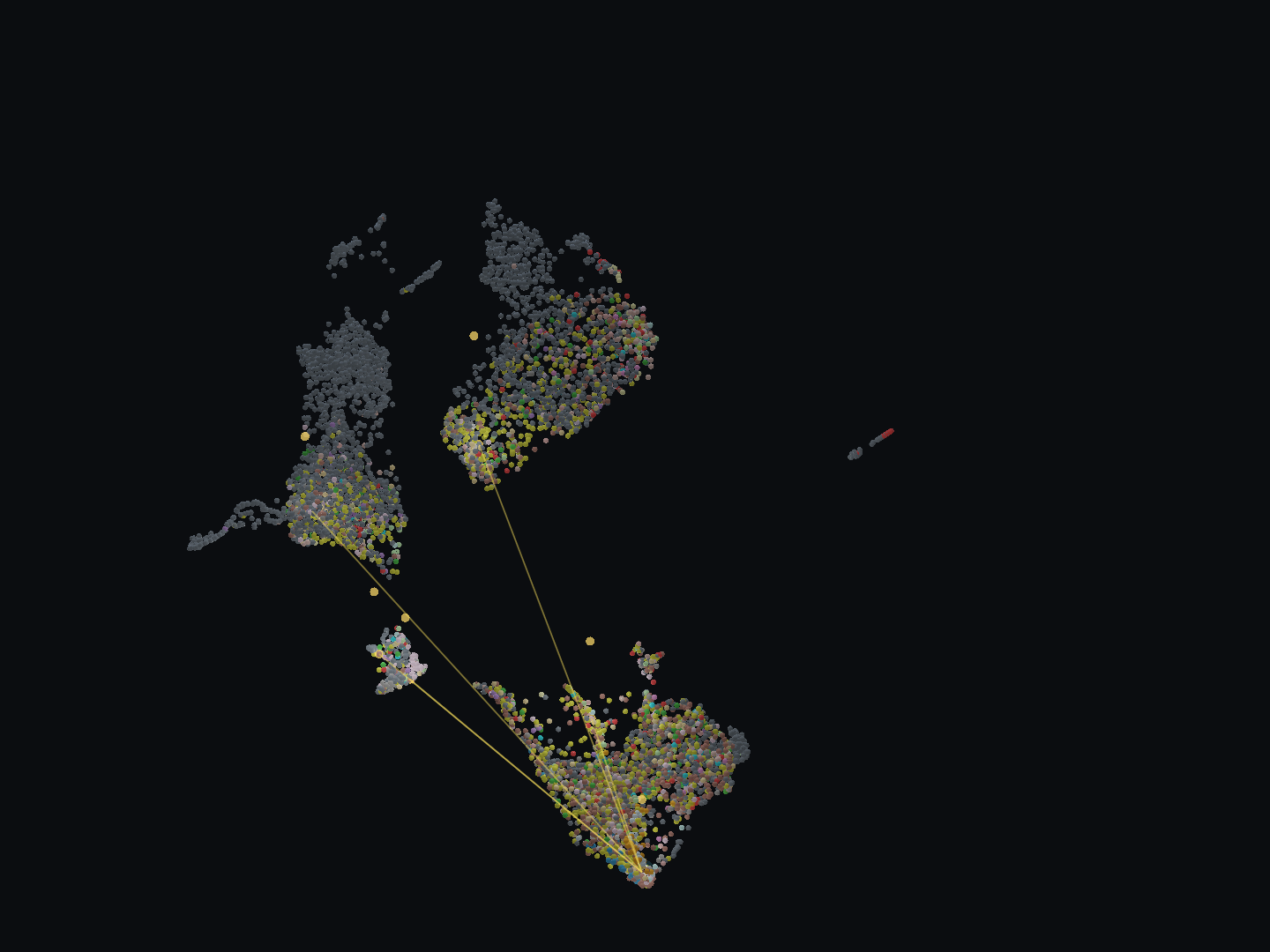
Each point is a gene, positioned by an embedding of the features you selected. Nearby points have similar inputs — that is all. Proximity does not demonstrate shared function or physical interaction, and missing evidence is shown separately from measured values rather than as a zero.
In the 0.43 benchmark, boosted trees with sequence and structure features reached 56.2% localisation accuracy across held-out orthogroups; UMAP neighbours did less well and several rare classes stayed poorly recovered. These are hypotheses, not established annotations.
Working with spaCR
spaCR analyses microscopy screens. Its launcher installs and opens ParaScape in a separate Python environment. Export a gene-level table from spaCR and import it into ParaScape; launching the app does not transfer results.
Data and reproducibility
Full table of included data and source links →
Tools → Datasets opens sources, coverage, provenance and stored values (guide).
The catalogue lists all 130 registered datasets and computed layers, with their measurements, coverage, publication references, and links to source data or inputs. Coverage differs by organism and assay; absence from a literature search does not establish that a gene has never been studied.
python -m parascape.paths       # show data locations and missing cache files
python -m parascape.build_graph # rebuild from available source datasets
| Variable | Purpose |
|---|---|
PARASCAPE_CACHE |
Override the directory containing built gene tables and graphs |
PARASCAPE_DATA |
Locate raw datasets used for rebuilding |
PARASCAPE_STATE |
Override the directory for saved runs, annotations, and downloads |
Methods are described in MATERIALS_AND_METHODS.md. HANDOFF.md contains the development history and earlier design decisions. The repository review describes the current architecture and its limitations.
Development
pip install -e ".[dev,docs]"
QT_QPA_PLATFORM=offscreen pytest tests/test_app_smoke.py tests/test_docstrings.py -q
python scripts/build_docs.py
Open docs/site/index.html for the guide and generated API reference.
Some tests need source datasets, CUDA, or a working OpenGL context; see
development and releases for the release checks.
Develop on nightly and merge checked changes into main. To release, update all
package and runtime versions together with python scripts/release.py bump 0.43.0 and update
the changelog before merging. A version increase on main triggers checks,
builds, PyPI publishing, and a GitHub release. Ordinary merges do not publish.
The initial PyPI account setup is described in the release guide.
The source code is distributed under the MIT license. Source datasets and third-party artwork retain their own licenses and attribution.
1 maintainer

Metadata
1 maintainer
Release files for parascape 0.0.13.0
For a detailed explanation of source distributions (sdists) and built distributions (wheels), please see the package formats documentation.
Source distribution (sdist)
| File | Size | Uploaded | Provenance | Actions |
|---|---|---|---|---|
| parascape-0.0.13.0.tar.gz | 3.7 MB | With provenance | Details for parascape-0.0.13.0.tar.gz |
Built distribution (wheel)
| File | Interpreter | ABI | Platform | Actions Reset |
|---|---|---|---|---|
| parascape-0.0.13.0-py3-none-any.whl | Python 3 | none | any | Details for parascape-0.0.13.0-py3-none-any.whl |
Total release size: 6.7 MB
Release files / parascape-0.0.13.0.tar.gz
| Download URL | parascape-0.0.13.0.tar.gz |
|---|---|
| Size | 3.7 MB |
| Tags | Source |
|
SHA-256 checksum How to use checksums |
cb14f4bdca8398a8d9b1f3b84156b7e31646357127322d18996b16b20f49993f
|
|
BLAKE2b-256 checksum How to use checksums |
7585aae97c4c4611f7a39c784cd6fa86f0ff8bff0b53a8bde6aa1001cbf54ed9
|
| Upload date | |
|
Uploaded using Trusted Publishing? What is trusted publishing? |
Yes |
| Uploaded via |
twine/7.0.0 CPython/3.13.16
|
Provenance
Provenance describes where a file came from. On PyPI, provenance is shared via attestations, which provide a verifiable record of the build or publishing details. View details, limitations and caveats.


PyPI Publish Attestation
PyPI verified that this artifact, at this checksum, originated from the publisher listed below.
Signed by GitHub Actions, verified by PyPI on Nov 14, 2026.
Transparency logRelease files / parascape-0.0.13.0-py3-none-any.whl
| Download URL | parascape-0.0.13.0-py3-none-any.whl |
|---|---|
| Size | 3.0 MB |
| Tags | Python 3 |
|
SHA-256 checksum How to use checksums |
95850179252075f49c3a476e898a0e2e0d15f229cd3959dbf0aa7e3d3baa97d6
|
|
BLAKE2b-256 checksum How to use checksums |
066418f2c9aa98fd65c807d98b70224b51b382c0ab4b2d236fa91dcd34c15b0f
|
| Upload date | |
|
Uploaded using Trusted Publishing? What is trusted publishing? |
Yes |
| Uploaded via |
twine/7.0.0 CPython/3.13.16
|
Provenance
Provenance describes where a file came from. On PyPI, provenance is shared via attestations, which provide a verifiable record of the build or publishing details. View details, limitations and caveats.
PyPI Publish Attestation
PyPI verified that this artifact, at this checksum, originated from the publisher listed below.
Signed by GitHub Actions, verified by PyPI on Nov 14, 2026.
Transparency logSecurity for parascape 0.0.13.0
Provenance
Provenance describes where a file came from. On PyPI, provenance is shared via attestations, which provide a verifiable record of the build or publishing details. View details, limitations and caveats.
Full provenance
Both files in this release have been uploaded with provenance metadata.
Attestation for parascape-0.0.13.0.tar.gz
PyPI Publish Attestation
PyPI verified that this artifact, at this checksum, originated from the publisher listed below.
Signed by GitHub Actions, verified by PyPI on Nov 14, 2026.
Transparency logA note on package security
PyPI is a repository for distributing packages, not a service for auditing them. While third-party security researchers and our staff do their best to detect and remove malicious packages, PyPI cannot guarantee the quality, security or suitability of any given package.
To learn more about protecting yourself from malicious actors, visit our package security documentation.














