
parasync is a parallelized rsync tool written in Python.

Project description
parasync

Overview
parasync is a parallelized rsync tool written in Python. It is designed to be used in a situation where you have a large number of files to transfer and you want to utilize multiple CPU cores to speed up the transfer. It can also suspend/resume rsync processes based on the CPU usage to avoid overloading the system.
It's inspired by parsync but written in Python. I've been using the original parsync for a long time, but it's no longer maintained and has some issues. So I decided to rewrite it in Python.
Table of Contents
Installation
Just add tap and install homebrew package.
brew tap rioriost/parasync
brew install parasync
You can also install it on Linux with homebrew or install it from the source code.
Usage
Execute parasync command.
parasync --help
usage: parasync [-h] [--max-procs MAX_PROCS] [--suspend-threshold SUSPEND_THRESHOLD] [--resume-threshold RESUME_THRESHOLD] [--compress] [--progress]
               local_dir remote_path

A tool to transfer all files under a specified directory to a remote location using rsync.

positional arguments:
  local_dir             The root source directory (all files underneath will be transferred).
  remote_path           Transfer destination (e.g. "rsync://host/path/").

optional arguments:
  -h, --help            show this help message and exit
  --max-procs MAX_PROCS
                        Number of rsync processes to run in parallel (if not specified, the number of CPU cores is used).
  --suspend-threshold SUSPEND_THRESHOLD
                        Pause rsync if CPU usage is above this threshold (default: 80.0).
  --resume-threshold RESUME_THRESHOLD
                        Resume rsync if CPU usage is below this threshold (default: 60.0).
  --compress, -z        Compress file data during transfer.
  --progress            Display overall transfer progress (total bytes, transfer rate, CPU usage, etc.) every second.
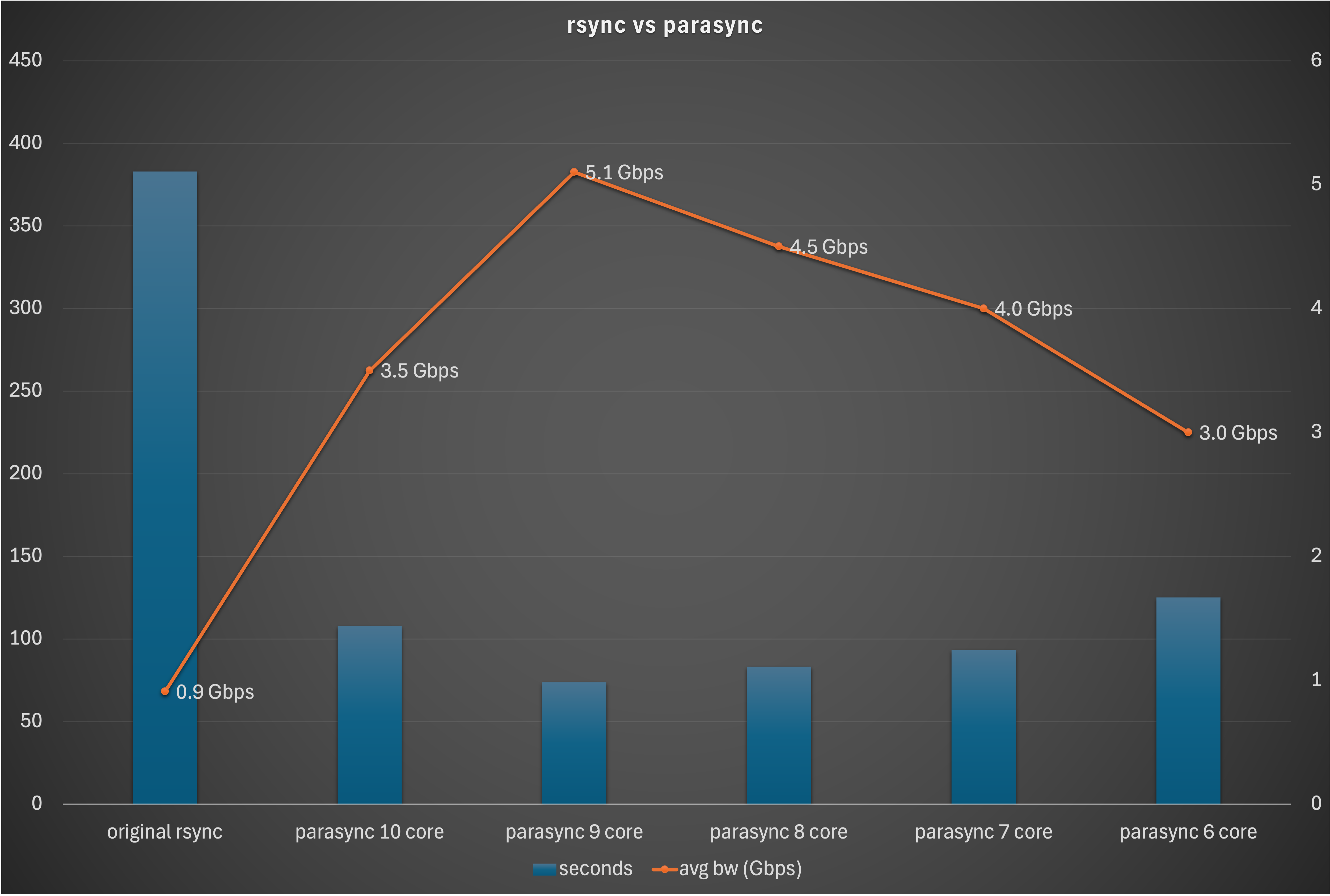
Comparison with the original rsync
-
Environment
- Local: macOS Sequoia 15.3, MacStudio 2022, Apple M1 Max (10-Core), 64GB Mem, 512GB SSD
- Remote: Red Hat Enterprise Linux 8.10, AMD Ryzen 5 5600G (12-Core), 64GB Mem, 2TB NVMe Gen4 SSD
- Network: 10Gbps Ethernet
-
original rsync: 932 Mbps
rsync -av --progress /Users/rifujita/parasync_src/ rsync://192.168.1.2/parasync_tgt/
...
sent 46,861,733,173 bytes  received 8,665 bytes  122,194,893.97 bytes/sec
total size is 46,850,265,318  speedup is 1.00
- parasync (--max-procs 10): 3.5 Gbps
parasync --max-procs 10 --progress /Users/rifujita/parasync_src/ rsync://192.168.1.2/parasync_tgt/
...
[Summary] Transferred file count: 454 files, Data transferred: 43.6 GB, Average transfer speed: 3.5 Gbps (Total time: 107.8 seconds)
- parasync (default: --max-procs 9): 5.1 Gbps
parasync --progress /Users/rifujita/parasync_src/ rsync://192.168.1.2/parasync_tgt/
...
[Summary] Transferred file count: 454 files, Data transferred: 43.6 GB, Average transfer speed: 5.1 Gbps (Total time: 74.0 seconds)
- parasync (--max-procs 8): 4.5 Gbps
parasync --max-procs 8 --progress /Users/rifujita/parasync_src/ rsync://192.168.1.2/parasync_tgt/
...
[Summary] Transferred file count: 454 files, Data transferred: 43.6 GB, Average transfer speed: 4.5 Gbps (Total time: 83.2 seconds)
- parasync (--max-procs 7): 4.0 Gbps
parasync --max-procs 7 --progress /Users/rifujita/parasync_src/ rsync://192.168.1.2/parasync_tgt/
...
[Summary] Transferred file count: 454 files, Data transferred: 43.6 GB, Average transfer speed: 4.0 Gbps (Total time: 93.4 seconds)
- parasync (--max-procs 6): 3.0 Gbps
parasync --max-procs 6 --progress /Users/rifujita/parasync_src/ rsync://192.168.1.2/parasync_tgt/
...
[Summary] Transferred file count: 454 files, Data transferred: 43.6 GB, Average transfer speed: 3.0 Gbps (Total time: 125.2 seconds)
Summary
- parasync is faster than the original rsync. But the best number of --max-procs depends on the environment, number of CPU cores and IOPS of SSDs on the local and remote hosts, network bandwidth, and so on.
Limitations
- 0.1.0: parasync uses rsync, not scp or sftp, and so on. If a directory specified does not exist on the remote destination, it fails. Because ryync does not fork shell on the remote host.
e.g.,
parasync /path/to/local_dir/ rsync://host_name/path/to/remote_dir/fails if/pathdoes not exist on the remote host. And, parasync does not use 'compress' option of rsync. With wide network bandwidth, it may be better not to use 'compress' option.
Release Notes
0.1.0 Release
- First release.
License
MIT License


Download files
Download the file for your platform. If you're not sure which to choose, learn more about installing packages.
Source Distribution
Built Distribution
Filter files by name, interpreter, ABI, and platform.
If you're not sure about the file name format, learn more about wheel file names.
Copy a direct link to the current filters
File details
Details for the file parasync-0.1.1.tar.gz.
File metadata
- Download URL: parasync-0.1.1.tar.gz
- Upload date:
- Size: 9.0 kB
- Tags: Source
- Uploaded using Trusted Publishing? No
- Uploaded via: uv/0.5.27
File hashes
| Algorithm | Hash digest | |
|---|---|---|
| SHA256 |
113d5d5b98de60faadf0a7e43c0afeb785679ee07d23ad93b2e5cd9741ad0977
|
|
| MD5 |
b846b2fff42a9aef75ddfa7bed60389b
|
|
| BLAKE2b-256 |
c05442a9591a339d82cf5bfe6dd8bf23472208dc92e16f305f291529742150af
|
File details
Details for the file parasync-0.1.1-py3-none-any.whl.
File metadata
- Download URL: parasync-0.1.1-py3-none-any.whl
- Upload date:
- Size: 8.7 kB
- Tags: Python 3
- Uploaded using Trusted Publishing? No
- Uploaded via: uv/0.5.27
File hashes
| Algorithm | Hash digest | |
|---|---|---|
| SHA256 |
201c9c6aab26e9100e67c0aab3808bc55de3578c6114c8cc3a51aae7c32b8d4d
|
|
| MD5 |
311eef10320ceae2ab6ebb70786799ac
|
|
| BLAKE2b-256 |
2491d40219f4af4638e5dd5be52c39e8dc8d90a80250fa01f4841506a09fb7ed
|






