
parse-broken-json
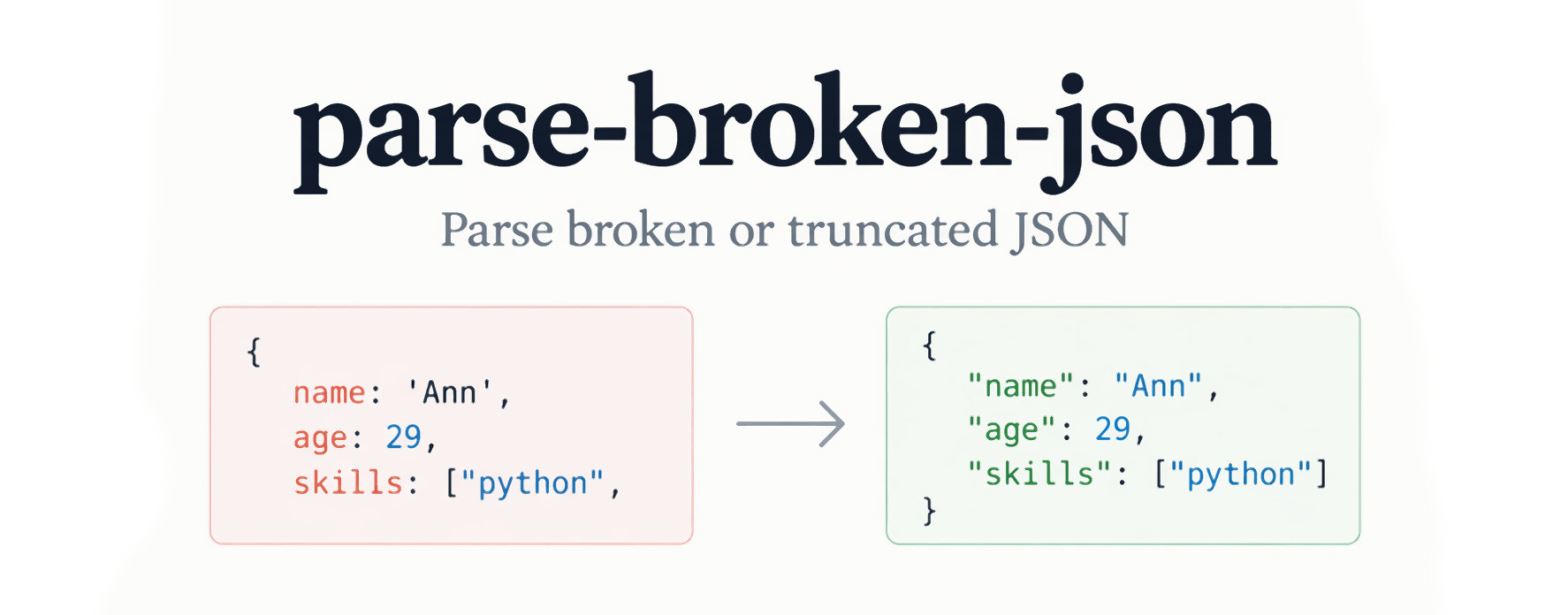





Parse broken or truncated JSON, as produced by LLMs, recovering as much as possible.
parse_broken_json takes text that should have been JSON and was not: cut
short by a token limit, wrapped in prose or a code fence, written with single
quotes, unquoted keys, comments or trailing commas, or with a quote that was
never closed. It returns whatever structure can be recovered, tells you what
it had to repair, and never raises on bad input unless you ask it to.
- Pure Python, no dependencies, typed.
- Valid JSON takes the fast path through the standard
jsonmodule and is never touched. - Truncated input keeps every complete key/value pair, nested container and trailing string.
- Streams are parsed incrementally, in linear time, and every value returned mid-stream is final.
- A result object reports whether the input was valid, whether it was complete, and every repair made.
Installation
uv add parse-broken-json
or pip install parse-broken-json. Python 3.11 or later.
Quick start
from parse_broken_json import parse_broken_json

parse_broken_json('Sure! Here it is:\n{"name": "John", "age": 30, "address": {"city": "New')
# {'name': 'John', 'age': 30, 'address': {'city': 'New'}}

parse_broken_json("{'name': 'John', age: 30, // comment\n tags: [a, b,]}")
# {'name': 'John', 'age': 30, 'tags': ['a', 'b']}
Nothing recoverable returns None. Pass default= to tell that apart from
a recovered null, or ask for the full report:
from parse_broken_json import parse_broken_json_result

result = parse_broken_json_result('{"a": "x, "b": tru')
result.value     # {'a': 'x'}
result.found     # True: something was recovered
result.valid     # False: the text was not valid JSON
result.complete  # False: the input ended inside the value
result.repairs   # (Repair(position=8, message='missing closing quote'),
                 #  Repair(position=18, message='input ended inside a value'))
Streaming
StreamParser takes the stream chunk by chunk. At any point, value holds
what has been decided so far. Every value in it was settled without looking
past the end of the input received, so it never changes when more input
arrives: a string shows up once its closing quote and the character after it
are in, a number once the character after it is in.
from parse_broken_json import StreamParser

parser = StreamParser(multiple="first")
for chunk in ['{"done": tr', 'ue, "text": "Once upon', ' a time", "n": 1', '2}']:
    parser.feed(chunk)
    print(parser.value)
# None
# {'done': True}
# {'done': True, 'text': 'Once upon a time'}
# {'done': True, 'text': 'Once upon a time', 'n': 12}

parser.finish()  # the same ParseResult parse_broken_json_result would give for the whole text
The work done is linear in the stream: the parser suspends where it needs
more input and resumes from there. Chunks may be text or UTF-8 bytes, even
when a multi-byte character is split between two of them. snapshot()
returns the same report as finish(), for the input so far.
The one-shot equivalent is stream_stable=True: parse_broken_json(prefix, stream_stable=True) returns exactly what a StreamParser fed that prefix
would.
parse_broken_json('{"done": true, "text": "Once upon a ti', stream_stable=True)
# {'done': True}
parse_broken_json('{"done": true, "text": "Once upon a ti')
# {'done': True, 'text': 'Once upon a ti'}
With multiple="auto" (the default) the shape of the value changes once a
second top-level object shows up: a dict becomes a list of dicts. Use
multiple="first" or multiple="all" when streaming if the shape must not
change.
Strict mode
parse_broken_json('{"a": 1,}', strict=True)
# BrokenJSONError: trailing comma at position 8
BrokenJSONError is a ValueError with .position, .message and
.repairs. Strict mode also rejects valid JSON with duplicate keys, which
json.loads accepts.
Keeping only known keys
allowed_keys drops every other key. An iterable applies at every nesting
level; a mapping describes a shape, where None or True keeps everything
under a key:
text = '{"user": {"name": "Ann", "pw": "x"}, "meta": 3, "junk": 4}'
parse_broken_json(text, ["user", "name"])
# {'user': {'name': 'Ann'}}
parse_broken_json(text, {"user": {"name": None}, "meta": True})
# {'user': {'name': 'Ann'}, 'meta': 3}
Several values in one text
Several top-level objects come back together as a list, which suits
NDJSON-like output. Otherwise the longest value wins. multiple= changes
that: "all" always returns a list, "first" and "longest" return one
value.
The json module names and hooks
The input may be text, UTF-8 bytes or a file-like object. A leading byte
order mark is ignored. loads, load and from_file mirror the json
module, and the json.loads hooks work everywhere: parse_float,
parse_int, parse_constant, object_hook and object_pairs_hook. The
object hooks run after allowed_keys filtering.
from decimal import Decimal

from parse_broken_json import loads

loads('{"price": 19.90, "qty": 2', parse_float=Decimal)
# {'price': Decimal('19.90'), 'qty': 2}
Duplicate keys keep the last value, as in json.loads, and are listed in the
repairs.
Command line
parse-broken-json broken.json                 # repaired JSON on standard output
cat broken.json | parse-broken-json --compact
parse-broken-json broken.json -o fixed.json
parse-broken-json broken.json -i --report     # fix in place, list the repairs on stderr
parse-broken-json --help
What it repairs
Every repair is a bounded guess that only applies to invalid input.
| Problem | Example | Result |
|---|---|---|
| Truncated anywhere | {"a": 1, "b": {"c": "d |
{'a': 1, 'b': {'c': 'd'}} |
| Prose or code fences around the JSON | Here: ```json {"a": 1} ``` |
{'a': 1} |
| Single or typographic quotes | {'a': “x”} |
{'a': 'x'} |
| Unquoted keys and values | {a: hello world} |
{'a': 'hello world'} |
| Comments | {"a": 1 /* c */, // d⏎"b": 2} |
{'a': 1, 'b': 2} |
| Python and JavaScript literals | {"a": True, "b": None, "c": undefined} |
{'a': True, 'b': None, 'c': None} |
| Lenient numbers | {"a": 01, "b": +1, "c": .5, "d": 1_000, "e": 0x1F} |
{'a': 1, 'b': 1, 'c': 0.5, 'd': 1000, 'e': 31} |
| Missing, doubled or trailing commas | {"a": 1 "b": 2,, "c": 3,} |
{'a': 1, 'b': 2, 'c': 3} |
| Missing colon or missing value | {"a" 1, "b": , "c": 2} |
{'a': 1, 'c': 2} |
| Missing closing quote | {"a": "x, "b": 2} |
{'a': 'x', 'b': 2} |
| Unescaped quotes inside a string | {"a": "say "hi"", "b": 2} |
{'a': 'say "hi"', 'b': 2} |
| Array left open before the next key | {"a": [1, 2, "b": 3} |
{'a': [1, 2], 'b': 3} |
Limits:
- Repairs are guesses and can pick the wrong reading. An unescaped quote
followed by a comma before the closing quote is not recovered:
{"a": "say "hi, there"", "b": 2}stops atsay. - Nesting deeper than 200 levels is cut there on the recovery path. The fast
path for valid JSON has the limits of
json.loads. - No schema-guided repair. Validate the result with Pydantic instead, see below.
- Pure Python. Fine for LLM-sized output; see the numbers below for large documents.
Using with Pydantic
Repair first, then validate. Pydantic reports what is missing or of the wrong type, which is a better place for that logic than a parser:
from pydantic import BaseModel

from parse_broken_json import parse_broken_json


class Article(BaseModel):
    title: str
    tags: list[str] = []


Article.model_validate(parse_broken_json(text, default={}))
For truncated JSON with no syntax errors, Pydantic can also parse partial
input by itself:
TypeAdapter(Article).validate_json(text, experimental_allow_partial="trailing-strings").
Compared with json_repair and jiter
Measured on 2026-09-30 with json_repair 0.63.5 and jiter 0.17.0.
- json_repair repairs a similar
set of problems, adds schema-guided repair and returns a repaired JSON
string by default. On a battery of 41 malformed inputs the two agree on
every recoverable case; where they differ, this library keeps
12:30and<b>bold</b>intact, readsNaNand0x1Fas numbers, and drops a key with a missing value instead of inventing an empty string. - jiter, the Rust parser behind Pydantic, handles truncation only, with no tolerance for syntax deviations.
On a 284 KB document truncated in the middle: parse-broken-json 35 ms,
json_repair 82 ms, jiter 0.5 ms. Streaming the same document through
StreamParser in 4 KB chunks, with a snapshot after each: 49 ms in total.
These are the best of 20 rounds of benchmarks/bench.py, timed on
2026-10-03 with Python 3.14. On a busy machine all four times grow
together, so compare the ratios.
Which one to use:
- jiter, when the JSON is well-formed and only cut short, like structured
output stopped by a token limit. It is by far the fastest, and
partial_mode=Truedrops an unfinished trailing string. - json_repair, when you want the repaired JSON as a string, repair guided by a schema, or Python 3.10.
- This library, when you read a stream and act on values as they arrive.
StreamParserparses incrementally and only returns values that are final. json_repair'sstream_stable=Truetakes the whole text at each call and keeps unfinished strings:{"a": 1, "b": "xgives{"a": 1, "b": "x"}.
Development
uv sync                                  # installs the dev group
uv run pytest --cov=parse_broken_json
uv run ruff check parse_broken_json tests benchmarks
uv run ruff format --check parse_broken_json tests benchmarks
uv run ty check                          # the everyday type checker, fast
uv run mypy                              # the gate in CI, strict
uv run --group bench python benchmarks/bench.py   # the timings quoted above
Both type checkers run in CI. ty is the one to use while working; mypy
stays because the package ships py.typed and its users check their own
code with mypy or pyright. A # type: ignore comment silences both.
The property-based tests in tests/test_properties.py pin down the
guarantees: no input raises, valid JSON comes back unchanged with no repairs,
and any chunking of a stream gives the same final result while every
snapshot only holds final values.
License
MIT.
1 maintainer

Metadata
1 maintainer
Release files for parse-broken-json 0.4.0
For a detailed explanation of source distributions (sdists) and built distributions (wheels), please see the package formats documentation.
Source distribution (sdist)
| File | Size | Uploaded | |
|---|---|---|---|
| parse_broken_json-0.4.0.tar.gz | 35.2 kB | Details |
Built distribution (wheel)
| File | Interpreter | ABI | Platform | Reset |
|---|---|---|---|---|
| parse_broken_json-0.4.0-py3-none-any.whl | Python 3 | none | any | Details |
Total release size: 60.0 kB
Release files / parse_broken_json-0.4.0.tar.gz
| Download URL | parse_broken_json-0.4.0.tar.gz |
|---|---|
| Size | 35.2 kB |
| Tags | Source |
|
SHA-256 checksum How to use checksums |
761f7aa9e0f52d96ce5acded6cdef82e3474573b14c480db0270b04928fc8bb2
|
|
BLAKE2b-256 checksum How to use checksums |
1aba424e310db450c11f611a23ce9fdcb90a3f91ac6a1b099d4a0d490d663dc0
|
| Upload date | |
|
Uploaded using Trusted Publishing? What is trusted publishing? |
Yes |
| Uploaded via |
uv/0.12.23 {"installer":{"name":"uv","version":"0.12.23","subcommand":["publish"]},"python":null,"implementation":{"name":null,"version":null},"distro":{"name":"Ubuntu","version":"24.04","id":"noble","libc":null},"system":{"name":null,"release":null},"cpu":null,"openssl_version":null,"setuptools_version":null,"rustc_version":null,"ci":true}
|
Provenance
Provenance describes where a file came from. On PyPI, provenance is shared via attestations, which provide a verifiable record of the build or publishing details. View details, limitations and caveats.


PyPI Publish Attestation
PyPI verified that this artifact, at this checksum, originated from the publisher listed below.
Signed by GitHub Actions, verified by PyPI on Oct 3, 2026.
Transparency logRelease files / parse_broken_json-0.4.0-py3-none-any.whl
| Download URL | parse_broken_json-0.4.0-py3-none-any.whl |
|---|---|
| Size | 24.8 kB |
| Tags | Python 3 |
|
SHA-256 checksum How to use checksums |
86e2476ff1fdb7a14986531b8e3989e500a8b1b38eeec715e2680c353dd1a4a7
|
|
BLAKE2b-256 checksum How to use checksums |
236af744de79d35bec9e60eb69698c503a6ea8f53d755910a32a332ef4b11c89
|
| Upload date | |
|
Uploaded using Trusted Publishing? What is trusted publishing? |
Yes |
| Uploaded via |
uv/0.12.23 {"installer":{"name":"uv","version":"0.12.23","subcommand":["publish"]},"python":null,"implementation":{"name":null,"version":null},"distro":{"name":"Ubuntu","version":"24.04","id":"noble","libc":null},"system":{"name":null,"release":null},"cpu":null,"openssl_version":null,"setuptools_version":null,"rustc_version":null,"ci":true}
|
Provenance
Provenance describes where a file came from. On PyPI, provenance is shared via attestations, which provide a verifiable record of the build or publishing details. View details, limitations and caveats.
PyPI Publish Attestation
PyPI verified that this artifact, at this checksum, originated from the publisher listed below.
Signed by GitHub Actions, verified by PyPI on Oct 3, 2026.
Transparency log













