
patch-cc


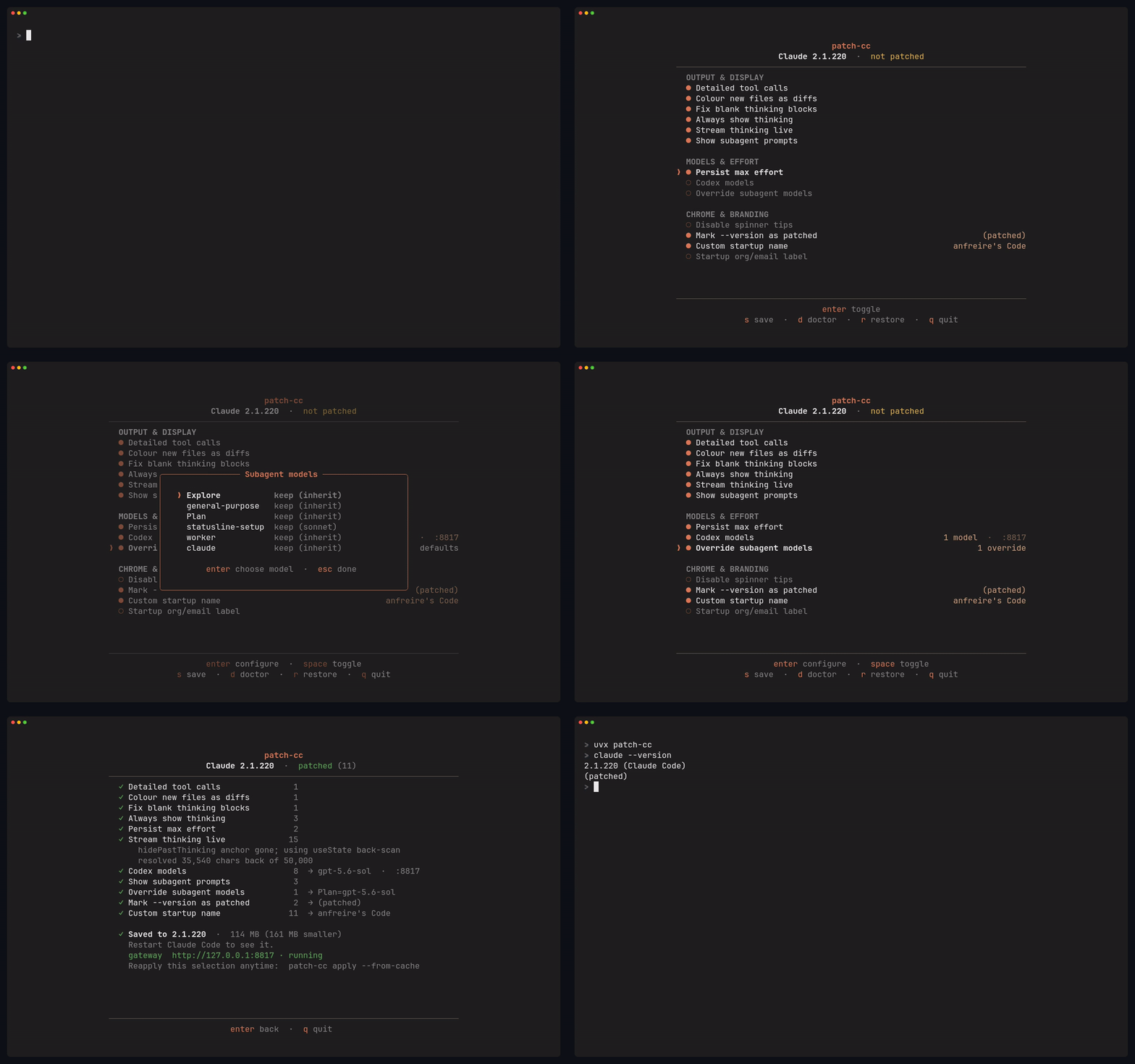
An interactive patcher for the Claude Code native binary. Pick the tweaks
you want — inline and live thinking, detailed tool calls, subagent model
overrides, your own startup name, custom models through your own
Anthropic-compatible endpoint — and apply them to your installed claude.
Fully reversible: a pristine backup is kept, patch-cc restore puts it back.
No Node, no Bun.
uvx --no-cache patch-cc # fullscreen menu, no install needed
Requirements
- Linux or macOS
- Python 3.11+
- uv — how patch-cc is run and installed
below. Install it with
curl -LsSf https://astral.sh/uv/install.sh | sh. Not using uv?pipx install patch-cc(orpip install patch-cc) works too; it is an ordinary PyPI package. - macOS only: the Xcode command line tools, for
codesign— a patched binary has to be re-signed or macOS refuses to run it.
The menu is a single centered panel: move with ↑ ↓, toggle with space,
press s to apply. Patches that carry a setting — subagent models, custom models,
the startup name, the --version marker, the org/email label — open a centered
modal on enter, and the row then shows what you chose. Everything choosable
is a picker: the agent names and model aliases are discovered from your
binary itself (and custom models from your endpoint, with manual entry available), so the menu can never
offer something your build would reject. Typing exists only for the genuinely
free-text values.
The menu remembers your selection, including the settings of patches you switch off, and its header says when the binary differs from it.
Prefer it always available on your PATH? Install it:
uv tool install patch-cc
patch-cc                       # then just run it
What it can do
| Group | Patch | |
|---|---|---|
| Output & display | Detailed tool calls | Show full read/search calls, not collapsed summaries |
| Colour new files as diffs | Created files render with + lines and green |
|
| Fix blank thinking blocks | Opt out of the server-side experiment that can empty every thinking block | |
| Always show thinking | Thinking blocks stay inline — no ctrl+o |
|
| Stream thinking live | See reasoning as it is generated, inline and in order | |
| Show subagent prompts | Prompt blocks visible during normal use | |
| Models & effort | Persist max effort | /effort max saves as your default for new sessions, like the other levels |
| Custom models | Register external models and route them to an Anthropic-compatible endpoint — see Custom models | |
| Override subagent models | Pick the model per built-in agent (discovered from your binary) | |
| Chrome & branding | Disable spinner tips | No rotating tips on the spinner |
Mark --version |
Appends (patched) — or any marker you choose |
|
| Custom startup name | Defaults to <your username>'s Code |
|
| Startup org/email label | Replace the org/email on the welcome screen — or hide it (demo mode keeps the stock line). Upstream stopped drawing the segment in 2.1.246, so newer builds do not offer it |
Usage
The menu is the one place choices are made; two commands act on them (shown
with uvx --no-cache; drop it if you installed the tool):
uvx --no-cache patch-cc apply     # bake the saved selection — after a Claude update, this is all you need
uvx --no-cache patch-cc restore   # put the original back
apply takes no flags: it bakes exactly what the menu would open on — your
saved selection, else what the installed binary already records, else the
default set — and says what this build cannot honour before it writes.
Agents and models are checked against what your installed binary actually
ships, and custom model ids against Claude's own names. The saved selection
is a readable file (~/.cache/patch-cc/selection.json, under
$XDG_CACHE_HOME when set) if you ever want to script it.
Custom models
Register models served by your own Anthropic Messages endpoint beside
Claude's: in /model, in the status line, and as subagent targets. The endpoint
can be a proxy (CLIProxyAPI, OmniRoute, 9router, LiteLLM, …), a provider's
Anthropic-compatible API, or a local server such as Ollama; patch-cc runs no
server and vouches for none of them. If you have no preference,
EasyCLIProxyAPI is the one patch-cc
is tested against. Only the chosen models' requests are diverted. Claude models
keep their endpoint, your login and every feature.
In the menu, open Custom models (? there opens this section) and set
the Endpoint: the base URL before /v1/messages, such as
http://127.0.0.1:8317 or https://api.z.ai/api/anthropic. Add a Key if
the endpoint needs one, then open Models: tab lists what the endpoint
offers, space picks, a adds an id by hand, and enter edits a model's
name, /model alias, context window and effort levels. Names, windows and
levels come from the endpoint where it reports them; a model with a default
and a larger window offers both, and the window and effort pickers take your
own value under c (256k, 272000, 1m; a comma-separated ladder). Without
a window, Claude's 200K default stands, and nothing checks a number you type.
Discovery only suggests: apply never contacts the endpoint and bakes exactly
what was chosen, so it replays unchanged after a Claude update.
The key. The patched binary sends PATCH_CC_API_KEY when it is set, and
otherwise the key the menu saves to ~/.local/share/patch-cc/api-key (mode 600,
under $XDG_DATA_HOME when set; the path is resolved when you apply and baked
as-is). It goes out as both Authorization: Bearer and x-api-key, read per
request, so a new key needs no re-apply. Your Claude login is removed from those
requests. No key means no credential header, which is what keyless local
servers expect. The key never enters the binary or the saved selection.
What the endpoint must speak is Anthropic's gateway protocol. Routed turns always carry the full history and never mid-conversation system messages or context edits; token counting may 404. Three things endpoints get wrong:
- The final
message_delta.usagemust be the whole object, with cache tokens subtracted andinput_tokensat least 1. stop_reason: "refusal"makes Claude Code re-run the turn on a Claude fallback model at Anthropic, carrying the routed conversation.- CLIProxyAPI and LiteLLM listen on all interfaces by default. Bind them to
127.0.0.1(server.host,--host).
HTTP is accepted on loopback only; remote endpoints need HTTPS. Effort is a
request setting the endpoint translates; the menu offers the ladder cut at
each top the binary can express, or off. A model that reports no levels
starts off — nothing is offered that was not declared, since Claude Code
would otherwise offer every level to a model it does not know. Levels a model
excludes are switched off from Claude 2.1.267 on, through
CLAUDE_CODE_MODEL_CAPABILITIES, and your own entries in that variable win;
on the same builds the /effort and /model pickers stop at the declared
top, through Claude's own per-model maxEffortLevel setting, and a lower cap
in your settings still wins. Managed availableModels allowlists still
apply. Bedrock, Vertex and Foundry modes are out of scope.
After a Claude update
Claude auto-updates roughly daily and replaces the binary, which reverts the
patch. Run patch-cc apply — it bakes your saved selection and says what the
new build cannot honour — or open patch-cc, whose header reads pending
apply until you do. The startup name and the --version marker are visible
tells too.
Why native-only, and what the write does
Claude Code ships only as a Bun single-file executable; the npm package is a
wrapper that downloads it. patch-cc edits the JavaScript modules embedded in the
binary's .bun section — since 2.1.242 the app is code-split across more than a
thousand of them, and patch-cc treats every one as a single surface. The write never moves a
byte of the original: each edited module's source is appended and its stale
precompiled bytecode is unlinked (editing a module's source invalidates its
bytecode anyway), so a patched binary is a few percent larger than the original,
and everything else the binary carries — Bun's own records, however its format
grows — is exactly where it was. That is what keeps the container layer out of
the way when Bun changes its format under Claude.
docs/INTERNALS.md has
the reasoning; the apply report has your numbers.
See docs/INTERNALS.md for the container format and docs/PLAYBOOK.md for repairing a patch after an update. Changing anything here starts at docs/CONDUCT.md — how this is built, and what a patch has to prove before it ships.
Credits
The patch set is a Python port of a-connoisseur/patch-claude-code, with the subagent-model override idea from aleks-apostle/claude-code-patches. Registering external models inside the bundle follows clodex; the routing here is done in the bundle rather than with clodex's TLS interception.
License
MIT
More agent tooling — summon-cc: give your agent a crew of Claude Code workers · cc-oc: drive opencode from inside Claude Code · omoctl: manage oh-my-openagent profiles · wiki-spaces: a wiki your AI agent keeps
1 maintainer

Metadata
1 maintainer
Release files for patch-cc 0.7.2
For a detailed explanation of source distributions (sdists) and built distributions (wheels), please see the package formats documentation.
Source distribution (sdist)
| File | Size | Uploaded | Provenance | Actions |
|---|---|---|---|---|
| patch_cc-0.7.2.tar.gz | 1.6 MB | With provenance | Details for patch_cc-0.7.2.tar.gz |
Built distribution (wheel)
| File | Interpreter | ABI | Platform | Actions Reset |
|---|---|---|---|---|
| patch_cc-0.7.2-py3-none-any.whl | Python 3 | none | any | Details for patch_cc-0.7.2-py3-none-any.whl |
Total release size: 1.7 MB
Release files / patch_cc-0.7.2.tar.gz
| Download URL | patch_cc-0.7.2.tar.gz |
|---|---|
| Size | 1.6 MB |
| Tags | Source |
|
SHA-256 checksum How to use checksums |
b9a4969b0b5afda40e58927eec409910077a277b22af8efd6a5747da2659289d
|
|
BLAKE2b-256 checksum How to use checksums |
5c0ce14afc34947f7083b3b3f9865df11eaaacfeeb3b6d9b49a448f44209666a
|
| Upload date | |
|
Uploaded using Trusted Publishing? What is trusted publishing? |
Yes |
| Uploaded via |
twine/7.0.0 CPython/3.13.14
|
Provenance
Provenance describes where a file came from. On PyPI, provenance is shared via attestations, which provide a verifiable record of the build or publishing details. View details, limitations and caveats.


PyPI Publish Attestation
PyPI verified that this artifact, at this checksum, originated from the publisher listed below.
Signed by GitHub Actions, verified by PyPI on Oct 15, 2026.
Transparency logRelease files / patch_cc-0.7.2-py3-none-any.whl
| Download URL | patch_cc-0.7.2-py3-none-any.whl |
|---|---|
| Size | 149.4 kB |
| Tags | Python 3 |
|
SHA-256 checksum How to use checksums |
5214bc68d2671f921684123e123c3132932180ebdbc57919558323900b010b9f
|
|
BLAKE2b-256 checksum How to use checksums |
439265c30334e0612aed97cb68e643d1cb4406cdd423e4db596f1fd07d3a5bdf
|
| Upload date | |
|
Uploaded using Trusted Publishing? What is trusted publishing? |
Yes |
| Uploaded via |
twine/7.0.0 CPython/3.13.14
|
Provenance
Provenance describes where a file came from. On PyPI, provenance is shared via attestations, which provide a verifiable record of the build or publishing details. View details, limitations and caveats.
PyPI Publish Attestation
PyPI verified that this artifact, at this checksum, originated from the publisher listed below.
Signed by GitHub Actions, verified by PyPI on Oct 15, 2026.
Transparency logSecurity for patch-cc 0.7.2
Provenance
Provenance describes where a file came from. On PyPI, provenance is shared via attestations, which provide a verifiable record of the build or publishing details. View details, limitations and caveats.
Full provenance
All 2 files in this release have been uploaded with provenance metadata.
Attestation for patch_cc-0.7.2.tar.gz
PyPI Publish Attestation
PyPI verified that this artifact, at this checksum, originated from the publisher listed below.
Signed by GitHub Actions, verified by PyPI on Oct 15, 2026.
Transparency logA note on package security
PyPI is a repository for distributing packages, not a service for auditing them. While third-party security researchers and our staff do their best to detect and remove malicious packages, PyPI cannot guarantee the quality, security or suitability of any given package.
To learn more about protecting yourself from malicious actors, visit our package security documentation.














