
PatchAhead
When an API you depend on changes, PatchAhead updates your Python code to match, and proves the fix works with your own tests.
You give it the release note. It finds the code that breaks, writes the smallest fix in a temporary copy of your project, and runs your tests. It only calls a fix done when a test that failed before the fix passes after it. When it is not sure, it says so and leaves your code alone.
release note -> find affected code -> plan -> patch a copy -> run your tests -> verdict
Why this exists
Almost every app talks to services it does not control: payments, email, storage, AI models. Those services change. A field gets renamed, a method gets a new name, pagination switches from page numbers to cursors. Your code did not change, but it is now broken.
Keeping up is slow and risky by hand. Someone has to read the release note, search the codebase, fix every spot without touching unrelated code that happens to use the same name, and test it all. Teams put it off, and old versions pile up.
PatchAhead automates that work, and it is deliberately careful about it. A migration tool that makes a wrong edit is worse than no tool, so every step can refuse, and nothing is called a success without evidence from your tests.
See it in 30 seconds
pip install 'patchahead[demo]'
patchahead demo
This opens a local page with six example scenarios against a small, deliberately broken service. Three end in a verified fix. The other three show it refusing, being rejected by the tests, and reporting a patch it could not prove.
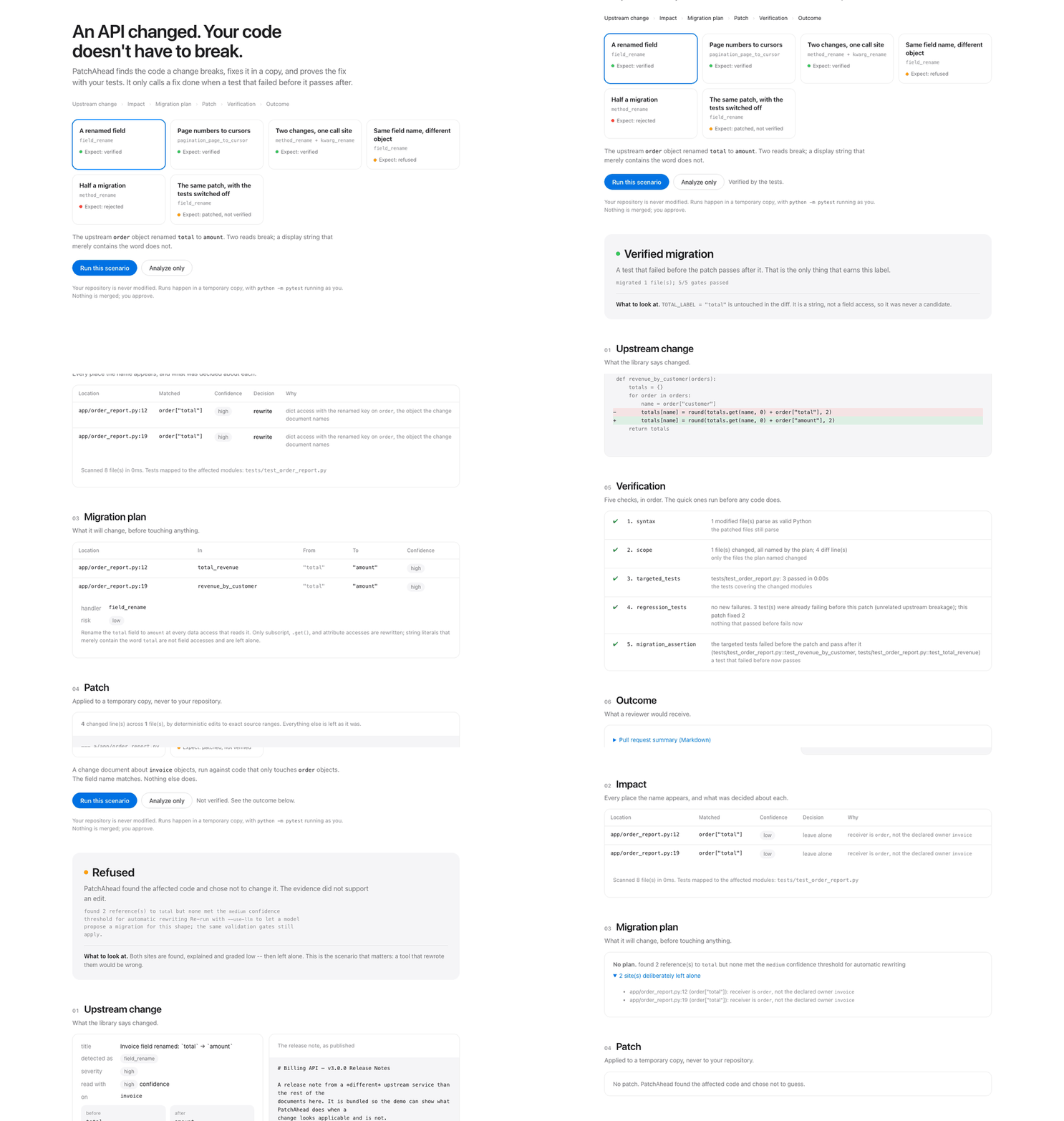
Python 3.10 or newer. pip install patchahead alone is the core tool, with no
third-party dependencies on 3.11+; docs/usage.md lists
the extras.
What it looks like
Given a release note that says the page parameter was replaced by cursor:
$ patchahead migrate --repo ./my-service --change ./release-notes.md

Pagination is now cursor-based
  1 finding(s) in 1 file(s), scanned 8 file(s) in 0ms
  + app/order_sync.py:12  high  sync_all_orders  while True: ... page=page ...

proposed diff
  -    page = 1
  +    cursor = None
  -        response = api_client.get_orders(page=page)
  +        response = api_client.get_orders(cursor=cursor)
  -        if page >= response["total_pages"]:
  +        if not response.get("has_more"):
  -        page += 1
  +        cursor = response.get("next_cursor")

validation
  [pass] syntax               1 modified file(s) parse as valid Python
  [pass] scope                1 file(s) changed, all named by the plan; 8 diff line(s)
  [pass] targeted_tests       tests/test_order_sync.py: 1 passed
  [pass] regression_tests     no new failures
  [pass] migration_assertion  the targeted tests failed before the patch and pass after it

completeness
  `page` -> `cursor`: no code, dynamic access, or test still uses `page`

migrated: migrated 1 file(s); 5/5 gates passed
Your repository was not touched. The diff was made in a temporary copy, and the tests ran there. You review it and apply it.
The last section matters as much as the tests. Passing tests show that the code
they run works; they do not show the migration is finished. So after
patching, PatchAhead searches the patched copy for every place the old name
still appears and sorts them: code it did not rewrite (a bare reference, a
getattr(obj, "old_name")), tests that still use the old name, sites on a
different object left alone on purpose, and mere mentions in strings, comments,
config, and docs. --require-complete makes CI fail while any code or test
still uses the old name.
What it can fix
| Change | Example |
|---|---|
| A renamed field | order["total"] becomes order["amount"] |
| A renamed method | client.fetch_orders() becomes client.list_orders() |
| A renamed keyword argument | fetch(timeout_seconds=5) becomes fetch(timeout=5) |
| Page numbers to cursors | a page / total_pages loop becomes cursor / has_more |
| A renamed query parameter | get(f"{BASE}/orders", params={"page": 2}) becomes params={"cursor": 2}, only for that endpoint |
| A moved endpoint | post(f"{BASE}/pages/deployment") becomes .../pages/deployments |
It reads release notes the way vendors write them: headings, bullet lists, tables, reStructuredText and Sphinx (CPython's own "What's New"), and phrasings like "renamed to", "is now", or "deprecated in favor of". Query parameter renames come from comparing two versions of an OpenAPI spec (below), and so do endpoint moves. Anything outside these six kinds of change is reported as unsupported, not forced into one that almost fits.
No release note? Compare the versions
Many libraries describe breaking changes badly, or not at all. PatchAhead can read them out of the library itself, by comparing the version you use with the one you are upgrading to:
$ patchahead api-diff pydantic 1.10.13 2.0 --out changes.json
pydantic 1.10.13 -> 2.0: compared 459 public member(s)
  ...
  method_rename   `pydantic.main.BaseModel.dict` renamed to `model_dump`
  method_rename   `pydantic.main.BaseModel.parse_obj` renamed to `model_validate`
  reported        `pydantic.main.BaseModel.json` is deprecated in favor of `model_dump_json`
                  `BaseModel.json` is newly deprecated in favor of `BaseModel.model_dump_json`,
                  which does not accept every call it does -- not a rename PatchAhead can apply
  ...

$ patchahead migrate --repo ./my-service --change changes.json
It downloads both versions from PyPI as wheels and parses them. Nothing is installed or run. A method counts as renamed only when the old one is gone or deprecated and the new one accepts every call the old one did. A replacement that takes different arguments is reported, never applied.
For a web API, compare two versions of its OpenAPI spec instead:
$ patchahead openapi-diff shop-v1.yaml shop-v2.yaml --out changes.json
Shop API 1.0 -> 2.0: compared 2 schema(s) and 1 operation(s)
  field_rename    `Order.total` renamed to `amount`
A property counts as renamed only when the spec leaves one answer: the old one
is deprecated and names its replacement, or exactly one property of the same
type was added to the same schema. The rename applies to order["total"] and
never to customer["total"].
Use it in CI
PatchAhead ships as a GitHub Action. Put it on the pull requests Dependabot or Renovate open, and every dependency bump gets checked:
on: pull_request
permissions:
  contents: read
  pull-requests: write          # for the comment; Dependabot's token is read-only otherwise
jobs:
  patchahead:
    if: github.actor == 'dependabot[bot]'
    runs-on: ubuntu-latest
    steps:
      - uses: actions/checkout@v4
      - uses: FrimpsManu/patchahead@v0.8.0
        with:
          from-pull-request: true
          install-command: pip install -r requirements-dev.txt
          comment: true
It reads the release notes in the pull request and compares the two versions of each package it bumps. The two check each other: a release note that renames something to a name the new version does not have is dropped, with a note saying so. Then it migrates a temporary copy, runs your tests, and posts the verdict, the diff, and what is left of the old API as one comment, updated in place on re-runs.
If you keep a copy of an API's OpenAPI spec in the repository, name it in
openapi-spec: a pull request that updates the spec is compared with the base
branch's version and the code is migrated in the same run.
It never commits to your branches. With open-pull-request: true,
a verified fix is opened as its own pull request against the bump's branch, so
merging it adds the fix to the bump. All inputs are in
docs/usage.md.
How it stays safe
- Your code is never written to. All patching happens in a temporary copy.
- It edits as little as possible. Only the exact tokens that change, so comments and formatting stay as they were.
- It refuses when unsure. If
customer["total"]appears next to theorder["total"]a note is about, it reports that site and leaves it alone. - Tests decide. A fix counts as done only when a test goes from failing to passing. Tests that pass before and after prove nothing, and it says so. Tests that use the old API are migrated too, but a test PatchAhead edited never counts as proof that its own edit worked.
- It shows what is left. Every place the old name survives is listed, so a green test run cannot hide an unfinished migration.
- A human approves. It never applies, commits, or merges anything.
It does run your test command, as you, so only point it at code you would run tests on anyway. docs/safety.md has the full threat model.
System architecture
How one run flows. A release note goes in, five steps run in order, and a verdict comes out. Your repository is only read; the patch is made in a copy.
flowchart LR
    note["Release note, or two<br/>versions of the library"] --> read
    repo[("Your repository<br/>never written to")] --> find

    subgraph engine["PatchAhead engine"]
        read["1. Read<br/>what changed"] --> find["2. Find<br/>affected code"]
        find --> plan["3. Plan<br/>the smallest fix"]
        plan --> patch["4. Patch<br/>a temporary copy"]
        patch --> prove["5. Prove<br/>five checks"]
    end

    repo -. copied .-> patch
    ai["AI fallback<br/>off by default"] -. only if a plan is refused .-> patch
    prove --> result["Diff, verdict,<br/>PR summary"]
How the code is organized. The command line, the GitHub Action, the local
web UI, and the test suite all call the same engine, so there is no separate demo path that behaves
differently from the real one. The engine runs each step through its own
package, and the steps pass typed objects to each other through domain.
flowchart TB
    cli["Command line"] --> engine
    web["Local web UI"] --> engine
    action["GitHub Action"] --> engine
    bench["Tests and benchmark"] --> engine
    engine["engine<br/>runs the five steps in order"]

    engine --> ingest["ingest<br/>reads release notes"]
    engine --> analysis["analysis<br/>parses Python, finds sites"]
    engine --> handlers["handlers<br/>one plugin per kind of change"]
    engine --> workspace["workspace<br/>the temporary copy tests run in"]
    engine --> validation["validation<br/>the five checks"]
    engine -. optional .-> llm["llm<br/>AI fallback"]

    ingest --> domain
    analysis --> domain
    handlers --> domain
    workspace --> domain
    validation --> domain
    domain["domain<br/>the typed objects passed between steps"]
Each step hands a typed object to the next, and each one can stop the run with a reason:
| Step | Done by | Produces | Stops the run when |
|---|---|---|---|
| 1. Read | ingest |
one BreakingChange per change in the note, with a confidence |
the note is unclear, or the change is not one it can migrate |
| 2. Find | a handler, using analysis |
an ImpactReport: every site using the old name, graded high, medium, or low, with a reason |
no code uses the old name |
| 3. Plan | the same handler | a MigrationPlan you can read before anything changes |
no site is safe to change, or the code shape is unfamiliar |
| 4. Patch | the handler, in a workspace |
a PatchProposal: small text edits and a diff |
an edit would not apply cleanly |
| 5. Prove | validation |
a ValidationResult from five checks |
a check fails, or the tests prove nothing |
The five checks run cheapest first:
- Syntax: every changed file still parses.
- Scope: only the files in the plan changed, within size limits.
- Targeted tests: the tests for the changed modules pass.
- Regression: no test that passed before now fails.
- Migration assertion: a test that failed before the patch passes after it.
Only the fifth check can make a run migrated. Anything less is reported as
patched_unverified or validation_failed. After the checks, a completeness
scan lists every place the old name still appears in the patched copy.
Each kind of change is a plugin: a handler class with four methods (supports,
analyze, plan, generate) registered in one place, so the engine has no
special cases. More detail: docs/architecture.md.
How it is measured
- 668 automated tests, covering unit, integration, and full end-to-end runs with real test subprocesses.
- An evaluation benchmark of 195 cases, run on every CI build: release notes
written the way vendors write them, before-and-after library versions
(including what requests and pydantic actually did), before-and-after OpenAPI
specs, repositories built to trick it (unrelated objects with the same field
name,
os.environ.getnext to a renamedclient.get, Unicode, nested scopes), full migrations, and the checks themselves. - Zero wrong edits across all site cases, and zero misread changes across all release notes and library comparisons. Both are enforced: a case that produces a wrong edit fails the build.
- Replayed on real migrations. 22 public projects that migrated by hand,
re-migrated by PatchAhead: pydantic 1 -> 2 from nothing but the two library
versions, and Python 3.12's
unittestremovals from CPython's own release note. 509 edits, 337 identical to the maintainers', 0 wrong; the rest were checked against each receiver's class. Method, results, and the wrong edits earlier runs made and how they were fixed: docs/real-world.md. - Known gaps are recorded, not hidden. Four cases describe things it does not do yet, and all of them fail safely by doing nothing. They are listed in docs/evaluation.md.
Run it yourself with python evals/run.py.
Limitations
- Python only.
- Six kinds of change. Other changes are reported as unsupported.
- No type inference. It matches names, and follows them only within a
function:
current = orderandfor o in ordersare understood, butfor i, o in enumerate(orders)is not, so that site is reported and not patched. - One pagination loop shape. Other shapes are refused.
- One repository at a time.
Roadmap
- Reading OpenAPI spec changes directly
- More kinds of change, such as moved endpoints and changed response shapes
- Tracking a renamed value through variables (
current = order) - TypeScript
Documentation
| Read | For |
|---|---|
| docs/usage.md | Commands, configuration, exit codes, comparing versions, the GitHub Action, AI mode, web UI |
| docs/architecture.md | How the engine is built, and why |
| docs/migrations.md | Each kind of change in detail, including what it refuses |
| docs/safety.md | What it protects you from, and what it does not |
| docs/evaluation.md | The benchmark, and how to add a case |
| docs/real-world.md | Replaying real migrations: pydantic 1 -> 2, and Python 3.12's unittest removals |
| docs/contributing.md | Setting up, and adding a new kind of change |
License
MIT. See LICENSE.
1 maintainer

Metadata
1 maintainer
Release files for patchahead 0.8.0
For a detailed explanation of source distributions (sdists) and built distributions (wheels), please see the package formats documentation.
Source distribution (sdist)
| File | Size | Uploaded | Provenance | Actions |
|---|---|---|---|---|
| patchahead-0.8.0.tar.gz | 260.8 kB | With provenance | Details for patchahead-0.8.0.tar.gz |
Built distribution (wheel)
| File | Interpreter | ABI | Platform | Actions Reset |
|---|---|---|---|---|
| patchahead-0.8.0-py3-none-any.whl | Python 3 | none | any | Details for patchahead-0.8.0-py3-none-any.whl |
Total release size: 480.9 kB
Release files / patchahead-0.8.0.tar.gz
| Download URL | patchahead-0.8.0.tar.gz |
|---|---|
| Size | 260.8 kB |
| Tags | Source |
|
SHA-256 checksum How to use checksums |
315332a4900532075fed9338595c7927dcf206ad37df8eb39a1ea4c312248ff8
|
|
BLAKE2b-256 checksum How to use checksums |
c537f46a6006e1a84d5f0471658060d3fcabb46e82ecf1d001493279791faeea
|
| Upload date | |
|
Uploaded using Trusted Publishing? What is trusted publishing? |
Yes |
| Uploaded via |
twine/7.0.0 CPython/3.13.14
|
Provenance
Provenance describes where a file came from. On PyPI, provenance is shared via attestations, which provide a verifiable record of the build or publishing details. View details, limitations and caveats.


PyPI Publish Attestation
PyPI verified that this artifact, at this checksum, originated from the publisher listed below.
Signed by GitHub Actions, verified by PyPI on Oct 5, 2026.
Transparency logRelease files / patchahead-0.8.0-py3-none-any.whl
| Download URL | patchahead-0.8.0-py3-none-any.whl |
|---|---|
| Size | 220.1 kB |
| Tags | Python 3 |
|
SHA-256 checksum How to use checksums |
f3bb876138839b163e7ad857a0253a7dc684de44a78f6b27a7934e654d1635a1
|
|
BLAKE2b-256 checksum How to use checksums |
a362eb8132ff8d624174efe319deb12c9bd97bd8d90f966a7b0a0cb09ce98886
|
| Upload date | |
|
Uploaded using Trusted Publishing? What is trusted publishing? |
Yes |
| Uploaded via |
twine/7.0.0 CPython/3.13.14
|
Provenance
Provenance describes where a file came from. On PyPI, provenance is shared via attestations, which provide a verifiable record of the build or publishing details. View details, limitations and caveats.
PyPI Publish Attestation
PyPI verified that this artifact, at this checksum, originated from the publisher listed below.
Signed by GitHub Actions, verified by PyPI on Oct 5, 2026.
Transparency logSecurity for patchahead 0.8.0
Provenance
Provenance describes where a file came from. On PyPI, provenance is shared via attestations, which provide a verifiable record of the build or publishing details. View details, limitations and caveats.
Full provenance
All 2 files in this release have been uploaded with provenance metadata.
Attestation for patchahead-0.8.0.tar.gz
PyPI Publish Attestation
PyPI verified that this artifact, at this checksum, originated from the publisher listed below.
Signed by GitHub Actions, verified by PyPI on Oct 5, 2026.
Transparency logA note on package security
PyPI is a repository for distributing packages, not a service for auditing them. While third-party security researchers and our staff do their best to detect and remove malicious packages, PyPI cannot guarantee the quality, security or suitability of any given package.
To learn more about protecting yourself from malicious actors, visit our package security documentation.














