
Patchmentation


Patchmentation is a python library to perform patch augmentation, a data augmentation technique for object detection, that allows for the synthesis of new images by combining objects from one or more source images into a background image.
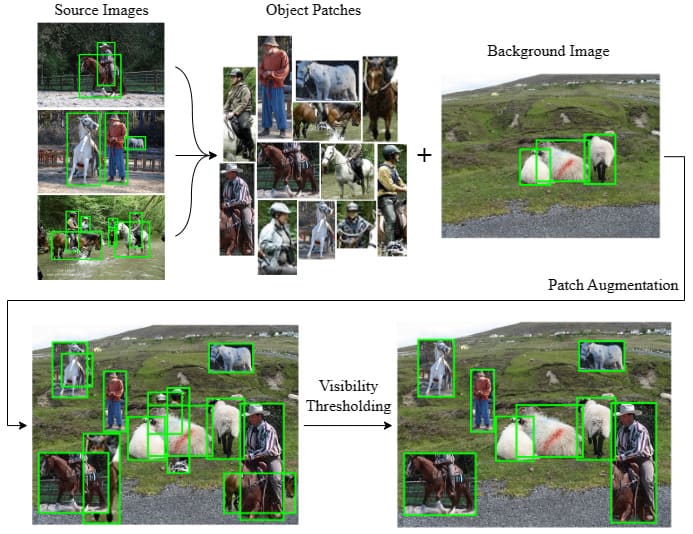
The process of patch augmentation involves extracting objects of interest from the source images, transforming them, and then pasting them onto the background image to create a composite image, therefore increasing diversity at the object level. The resulting dataset offers a greater variety of object combinations within a single image, making it more robust and accurate when training object detection models.
Installation
The easiest way to install patchmentation is through pip.
pip install patchmentation
Note: Some functionality of patchmentation might not be working on non-Linux systems.
External Links
-
GitHub Repository: https://github.com/Xu-Justin/patchmentation
-
Docs: TBA
-
Research Paper: TBA
-
Benchmarking Results: https://github.com/Xu-Justin/patchmentation-yolov5
This project was developed as part of thesis project, Computer Science, BINUS University.
1 maintainer

Metadata
1 maintainer
Release files for patchmentation 0.1.16
For a detailed explanation of source distributions (sdists) and built distributions (wheels), please see the package formats documentation.
Built distribution (wheel)
| File | Interpreter | ABI | Platform | Actions Reset |
|---|---|---|---|---|
| patchmentation-0.1.16-py3-none-any.whl | Python 3 | none | any | Details for patchmentation-0.1.16-py3-none-any.whl |
Release files / patchmentation-0.1.16-py3-none-any.whl
| Download URL | patchmentation-0.1.16-py3-none-any.whl |
|---|---|
| Size | 27.3 kB |
| Tags | Python 3 |
|
SHA-256 checksum How to use checksums |
615d8d4dfb6fb3441b895758c174538500d53981eb114c57b3b9452d3a4b8f74
|
|
BLAKE2b-256 checksum How to use checksums |
2876bcf3f103aead410257b545e61a242b735ee10b4e8a5c945d552d80458d20
|
| Upload date | |
|
Uploaded using Trusted Publishing? What is trusted publishing? |
No |
| Uploaded via |
twine/4.0.1 CPython/3.10.6
|
Security for patchmentation 0.1.16
Provenance
Provenance describes where a file came from. On PyPI, provenance is shared via attestations, which provide a verifiable record of the build or publishing details. View details, limitations and caveats.
No provenance found
None of the files in this release were uploaded with provenance metadata.
A note on package security
PyPI is a repository for distributing packages, not a service for auditing them. While third-party security researchers and our staff do their best to detect and remove malicious packages, PyPI cannot guarantee the quality, security or suitability of any given package.
To learn more about protecting yourself from malicious actors, visit our package security documentation.














