












Getting Started |
Deployment |
Documentation and Support |
Blog |
License
Pathway Live Data Framework
Pathway Live Data Framework is a Python ETL framework for stream processing, real-time analytics, LLM pipelines, and RAG.
Pathway Live Data Framework comes with an easy-to-use Python API, allowing you to seamlessly integrate your favorite Python ML libraries. Pathway Live Data Framework code is versatile and robust: you can use it in both development and production environments, handling both batch and streaming data effectively. The same code can be used for local development, CI/CD tests, running batch jobs, handling stream replays, and processing data streams.
Pathway Live Data Framework is powered by a scalable Rust engine based on Differential Dataflow and performs incremental computation. Your Pathway Live Data Framework code, despite being written in Python, is run by the Rust engine, enabling multithreading, multiprocessing, and distributed computations. All the pipeline is kept in memory and can be easily deployed with Docker and Kubernetes.
You can install Pathway Live Data Framework with pip:
pip install -U pathway
For any questions, you will find the community and team behind the project on Discord.
Use-cases and templates
Ready to see what Pathway Live Data Framework can do?
Try one of our easy-to-run examples!
Available in both notebook and docker formats, these ready-to-launch examples can be launched in just a few clicks. Pick one and start your hands-on experience with Pathway Live Data Framework today!
Event processing and real-time analytics pipelines
With its unified engine for batch and streaming and its full Python compatibility, Pathway Live Data Framework makes data processing as easy as possible. It's the ideal solution for a wide range of data processing pipelines, including:
- Showcase: Real-time ETL.
- Showcase: Event-driven pipelines with alerting.
- Showcase: Realtime analytics.
- Docs: Switch from batch to streaming.
AI Pipelines
Pathway Live Data Framework provides dedicated LLM tooling to build live LLM and RAG pipelines. Wrappers for most common LLM services and utilities are included, making working with LLMs and RAGs pipelines incredibly easy. Check out our LLM xpack documentation.
Don't hesitate to try one of our runnable examples featuring LLM tooling. You can find such examples here.
- Template: Unstructured data to SQL on-the-fly.
- Template: Private RAG with Ollama and Mistral AI
- Template: Adaptive RAG
- Template: Multimodal RAG with gpt-4o
Features
- A wide range of connectors: Pathway Live Data Framework comes with connectors that connect to external data sources such as Kafka, GDrive, PostgreSQL, or SharePoint. Its Airbyte connector allows you to connect to more than 300 different data sources. If the connector you want is not available, you can build your own custom connector using Pathway Live Data Framework Python connector.
- Stateless and stateful transformations: Pathway Live Data Framework supports stateful transformations such as joins, windowing, and sorting. It provides many transformations directly implemented in Rust. In addition to the provided transformation, you can use any Python function. You can implement your own or you can use any Python library to process your data.
- Persistence: Pathway Live Data Framework provides persistence to save the state of the computation. This allows you to restart your pipeline after an update or a crash. Your pipelines are in good hands with Pathway Live Data Framework !
- Consistency: Pathway Live Data Framework handles the time for you, making sure all your computations are consistent. In particular, Pathway Live Data Framework manages late and out-of-order points by updating its results whenever new (or late, in this case) data points come into the system. The free version of Pathway Live Data Framework gives the "at least once" consistency while the enterprise version provides the "exactly once" consistency.
- Scalable Rust engine: with Pathway Live Data Framework Rust engine, you are free from the usual limits imposed by Python. You can easily do multithreading, multiprocessing, and distributed computations.
- LLM helpers: Pathway Live Data Framework provides an LLM extension with all the utilities to integrate LLMs with your data pipelines (LLM wrappers, parsers, embedders, splitters), including an in-memory real-time Vector Index, and integrations with LLamaIndex and LangChain. You can quickly build and deploy RAG applications with your live documents.
Getting started
Installation
Pathway Live Data Framework requires Python 3.10 or above.
You can install the current release of Pathway Live Data Framework using pip:
$ pip install -U pathway
⚠️ Pathway Live Data Framework is available on MacOS and Linux. Users of other systems should run Pathway Live Data Framework on a Virtual Machine.
Example: computing the sum of positive values in real time.
import pathway as pw

# Define the schema of your data (Optional)
class InputSchema(pw.Schema):
  value: int

# Connect to your data using connectors
input_table = pw.io.csv.read(
  "./input/",
  schema=InputSchema
)

#Define your operations on the data
filtered_table = input_table.filter(input_table.value>=0)
result_table = filtered_table.reduce(
  sum_value = pw.reducers.sum(filtered_table.value)
)

# Load your results to external systems
pw.io.jsonlines.write(result_table, "output.jsonl")

# Run the computation
pw.run()
Run Pathway Live Data Framework in Google Colab.
You can find more examples here.
Deployment
Locally
To use Pathway Live Data Framework, you only need to import it:
import pathway as pw
Now, you can easily create your processing pipeline, and let Pathway Live Data Framework handle the updates. Once your pipeline is created, you can launch the computation on streaming data with a one-line command:
pw.run()
You can then run your Pathway Live Data Framework project (say, main.py) just like a normal Python script: $ python main.py.
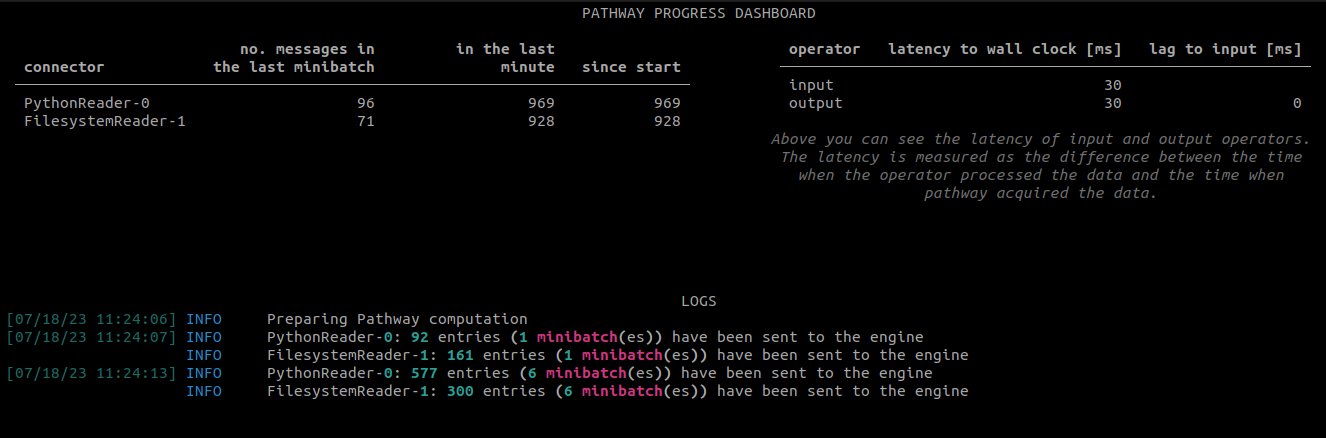
Pathway Live Data Framework comes with a monitoring dashboard that allows you to keep track of the number of messages sent by each connector and the latency of the system. The dashboard also includes log messages.
Alternatively, you can use the pathway'ish version:
$ pathway spawn python main.py
Pathway Live Data Framework natively supports multithreading. To launch your application with 3 threads, you can do as follows:
$ pathway spawn --threads 3 python main.py
To jumpstart a Pathway Live Data Framework project, you can use our cookiecutter template.
Docker
You can easily run Pathway Live Data Framework using docker.
Pathway Live Data Framework image
You can use the Pathway Live Data Framework docker image, using a Dockerfile:
FROM pathwaycom/pathway:latest

WORKDIR /app

COPY requirements.txt ./
RUN pip install --no-cache-dir -r requirements.txt

COPY . .

CMD [ "python", "./your-script.py" ]
You can then build and run the Docker image:
docker build -t my-pathway-app .
docker run -it --rm --name my-pathway-app my-pathway-app
Run a single Python script
When dealing with single-file projects, creating a full-fledged Dockerfile
might seem unnecessary. In such scenarios, you can execute a
Python script directly using the Pathway Live Data Framework Docker image. For example:
docker run -it --rm --name my-pathway-app -v "$PWD":/app pathwaycom/pathway:latest python my-pathway-app.py
Python docker image
You can also use a standard Python image and install Pathway Live Data Framework using pip with a Dockerfile:
FROM --platform=linux/x86_64 python:3.10

RUN pip install -U pathway
COPY ./pathway-script.py pathway-script.py

CMD ["python", "-u", "pathway-script.py"]
Kubernetes and cloud
Docker containers are ideally suited for deployment on the cloud with Kubernetes. If you want to scale your Pathway Live Data Framework application, you may be interested in our Pathway Live Data Framework for Enterprise. Pathway Live Data Framework for Enterprise is specially tailored towards end-to-end data processing and real time intelligent analytics. It scales using distributed computing on the cloud and supports distributed Kubernetes deployment, with external persistence setup.
You can easily deploy Pathway Live Data Framework using services like Render: see how to deploy Pathway Live Data Framework in a few clicks.
If you are interested, don't hesitate to contact us to learn more.
Performance
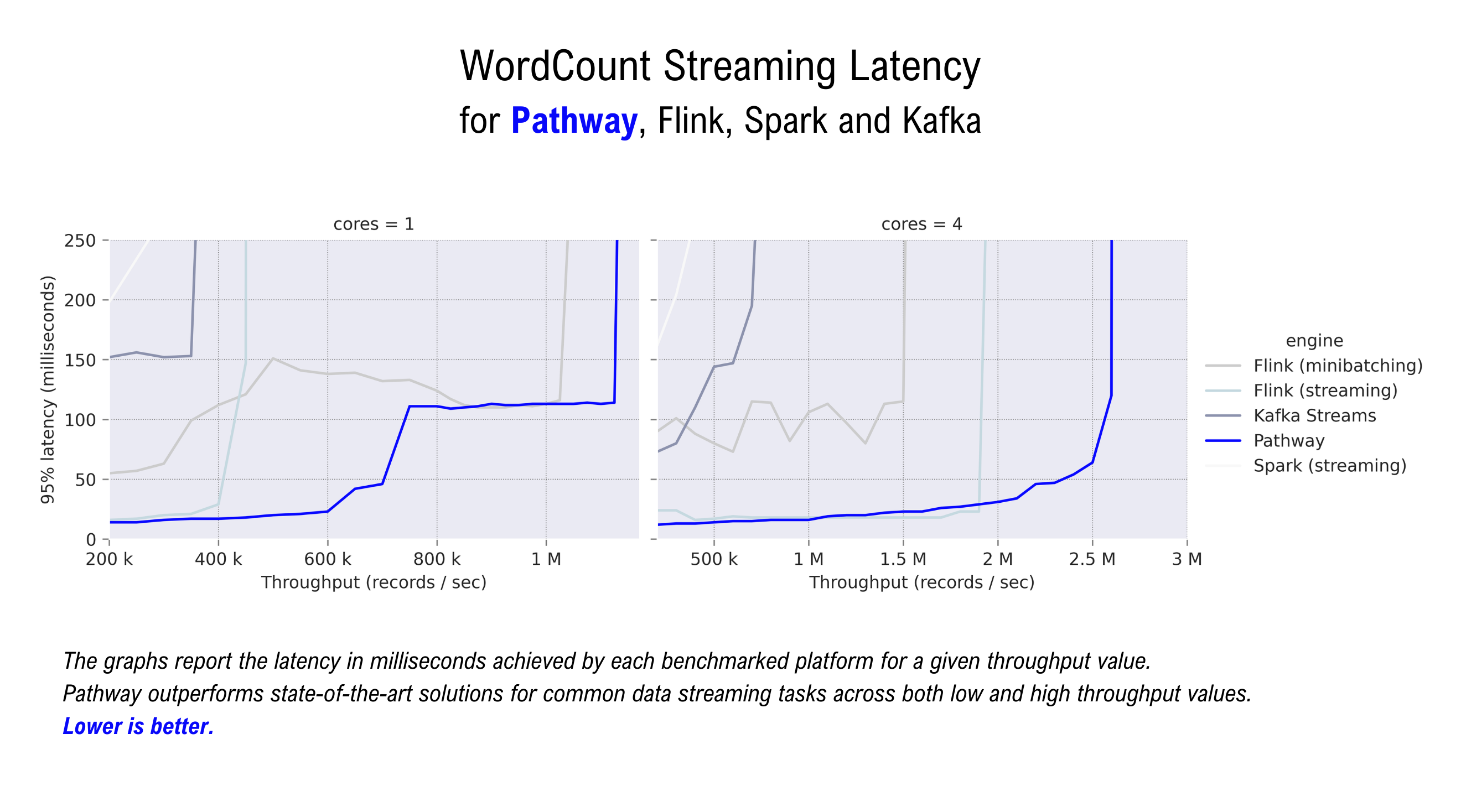
Pathway Live Data Framework is made to outperform state-of-the-art technologies designed for streaming and batch data processing tasks, including: Flink, Spark, and Kafka Streaming. It also makes it possible to implement a lot of algorithms/UDF's in streaming mode which are not readily supported by other streaming frameworks (especially: temporal joins, iterative graph algorithms, machine learning routines).
If you are curious, here are some benchmarks to play with.
Documentation and Support
The entire documentation of Pathway Live Data Framework is available at pathway.com/developers/, including the API Docs.
If you have any question, don't hesitate to open an issue on GitHub, join us on Discord, or send us an email at contact@pathway.com.
🤝 Featured Collaborations & Integrations
We build cutting-edge data processing pipelines and co-promote solutions that push the boundaries of what's possible with Python and streaming data. Meet the people helping us shape the future of data engineering.
| Project | Description |
|---|---|
| Databento | A simpler, faster way to get market data. |
| LangChain | LangChain is the platform for agent engineering. |
| LlamaIndex | The developer-trusted framework for building context-aware AI agents. |
| MinIO | MinIO is a high-performance, S3 compatible object store, open sourced under GNU AGPLv3 license. |
| PaddleOCR | PaddleOCR is an industry-leading, production-ready OCR and document AI engine, offering end-to-end solutions from text extraction to intelligent document understanding. |
| Redpanda | Build, operate, and govern streaming and AI applications without the complexity of Kafka. |
License
Pathway Live Data Framework is distributed on a BSL 1.1 License which allows for unlimited non-commercial use, as well as use of the Pathway Live Data Framework package for most commercial purposes, free of charge. Code in this repository automatically converts to Open Source (Apache 2.0 License) after 4 years. Some public repos which are complementary to this one (examples, libraries, connectors, etc.) are licensed as Open Source, under the MIT license.
Contribution guidelines
If you develop a library or connector which you would like to integrate with this repo, we suggest releasing it first as a separate repo on a MIT/Apache 2.0 license.
For all concerns regarding core Pathway Live Data Framework functionalities, Issues are encouraged. For further information, don't hesitate to engage with Pathway's Discord community.
4 maintainers


Metadata
4 maintainers
Release files for pathway 0.33.0
For a detailed explanation of source distributions (sdists) and built distributions (wheels), please see the package formats documentation.
Built distributions (wheels)
| File | Reset | |||
|---|---|---|---|---|
| pathway-0.33.0-cp310-abi3-manylinux_2_28_x86_64.whl | CPython 3.10 | abi3 | Linux glibc 2.28+ x86-64 | Details |
| pathway-0.33.0-cp310-abi3-manylinux_2_28_aarch64.whl | CPython 3.10 | abi3 | Linux glibc 2.28+ ARM64 | Details |
| pathway-0.33.0-cp310-abi3-macosx_11_0_arm64.whl | CPython 3.10 | abi3 | macOS 11.0+ ARM64 | Details |
| pathway-0.33.0-cp310-abi3-macosx_10_15_x86_64.whl | CPython 3.10 | abi3 | macOS 10.15+ x86-64 | Details |
Total release size: 392.0 MB
Release files / pathway-0.33.0-cp310-abi3-manylinux_2_28_x86_64.whl
| Download URL | pathway-0.33.0-cp310-abi3-manylinux_2_28_x86_64.whl |
|---|---|
| Size | 105.6 MB |
| Tags | CPython 3.10 Linux glibc 2.28+ x86-64 abi3 |
|
SHA-256 checksum How to use checksums |
6aa118a6f2837d4342cb5a84907911b1f91d9c7a1778aef2ef789217df4b5d02
|
|
BLAKE2b-256 checksum How to use checksums |
5d5d4b89e456e8c6c64231eb7f926e21d5ef914aea0755d3e9250972efe5d684
|
| Upload date | |
|
Uploaded using Trusted Publishing? What is trusted publishing? |
No |
| Uploaded via |
twine/7.0.0 CPython/3.13.14
|
Release files / pathway-0.33.0-cp310-abi3-manylinux_2_28_aarch64.whl
| Download URL | pathway-0.33.0-cp310-abi3-manylinux_2_28_aarch64.whl |
|---|---|
| Size | 98.3 MB |
| Tags | CPython 3.10 Linux glibc 2.28+ ARM64 abi3 |
|
SHA-256 checksum How to use checksums |
0004026057a84134d716bf8558e08df6c6c097c075c79498f5a245115eb8acc9
|
|
BLAKE2b-256 checksum How to use checksums |
1627fe76dba1738f243bd6edbe190932d99af39cf90d58bb9b5a0aafe0e87e94
|
| Upload date | |
|
Uploaded using Trusted Publishing? What is trusted publishing? |
No |
| Uploaded via |
twine/7.0.0 CPython/3.13.14
|
Release files / pathway-0.33.0-cp310-abi3-macosx_11_0_arm64.whl
| Download URL | pathway-0.33.0-cp310-abi3-macosx_11_0_arm64.whl |
|---|---|
| Size | 91.6 MB |
| Tags | CPython 3.10 abi3 macOS 11.0+ ARM64 |
|
SHA-256 checksum How to use checksums |
86b63aa2e5e68434a01515609181168f6d3dec3c2aa2a75708643627ed3129e1
|
|
BLAKE2b-256 checksum How to use checksums |
1a6da7ad4a54abf91d8907ee76fde608268825a5620f1837a49b14d35878557c
|
| Upload date | |
|
Uploaded using Trusted Publishing? What is trusted publishing? |
No |
| Uploaded via |
twine/7.0.0 CPython/3.13.14
|
Release files / pathway-0.33.0-cp310-abi3-macosx_10_15_x86_64.whl
| Download URL | pathway-0.33.0-cp310-abi3-macosx_10_15_x86_64.whl |
|---|---|
| Size | 96.5 MB |
| Tags | CPython 3.10 abi3 macOS 10.15+ x86-64 |
|
SHA-256 checksum How to use checksums |
87b04af98301dfda1adf2e0d2137d7b28b426b537d6e72abeb0babd07412df89
|
|
BLAKE2b-256 checksum How to use checksums |
a7171a721d23ac0b17322ef95874fc4f6727774745dc6a53485f4b47a72196cd
|
| Upload date | |
|
Uploaded using Trusted Publishing? What is trusted publishing? |
No |
| Uploaded via |
twine/7.0.0 CPython/3.13.14
|














