

PATKIT - Phonetic Analysis ToolKIT
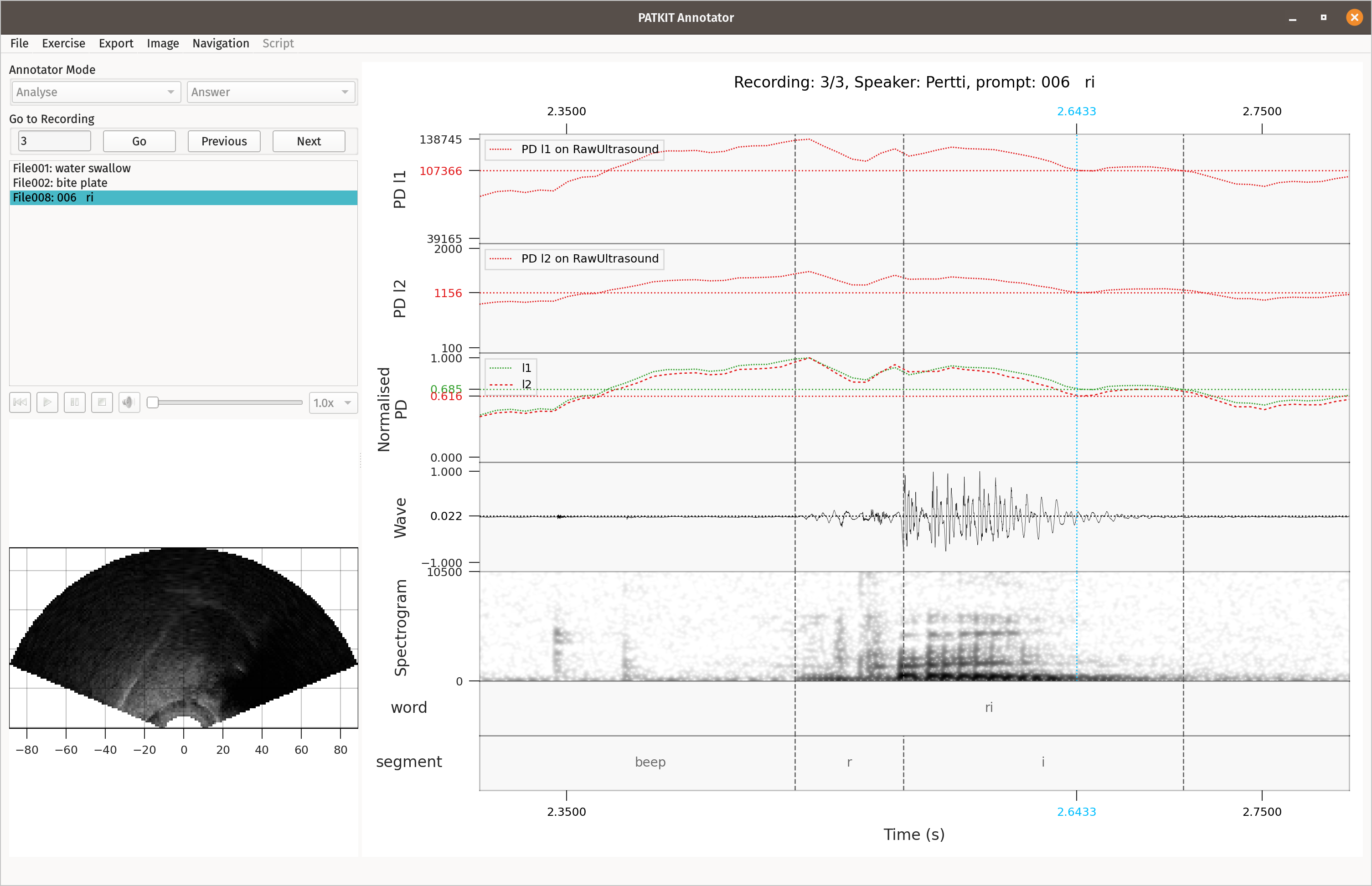
PATKIT provides tools for phonetic analysis of speech data. It includes a GUI for manual assessment/analysis/annotation (see picture above), command line tools for batch processing, and an API for programming your own tools.
While currently PATKIT's tools mainly work on tongue and larynx ultrasound as well as audio, in the future, the toolkit will include facilities for processing other kinds of articulatory data. The first two tools to be implemented are Optical Flow and Pixel Difference.
Optical Flow tracks local changes in ultrasound frames and estimates the flow field based on these.
Pixel Difference and Scanline Based Pixel Difference -- work on raw, uninterpolated data and produce measures of change over the course of a recording. How they work is explained in Chapter 3 of Pertti Palo's PhD thesis.
Getting PATKIT
Quick start guide:
-
Install the package manager uv:
- MacOS/Linux run
curl -LsSf https://astral.sh/uv/install.sh | sh - Windows run
powershell -ExecutionPolicy ByPass -c "irm https://astral.sh/uv/install.ps1 | iex" - See uv for more details.
- MacOS/Linux run
-
On the commandline run
uv tool install patkit -
Run
patkit --helpfor instructions. -
If you want to run the example data, see 'What's included' below for instructions.
-
If on Linux of the debian variety (ubuntu, popos, others), you may also need to run the following:
apt-get update
apt-get upgrade
sudo apt-get install -y libxcb-cursor-dev
Try this in case trying to run patkit complains about a missing xcb plugin.
Documentation
Current version and development plans
See Changelog, for what's new in the current version and what's coming up.
What's included
There is some test and demo data that is temporarily hosted in the GitHub repo.
Download the contents of
https://github.com/giuthas/patkit/tree/main/recorded_data/ and
https://github.com/giuthas/patkit/tree/main/scenarios/. Easiest way to do
this is by copy-pasting the URLs to this
page to get a zip file with the
contents of the directory.
Place the unzipped directories in the same directory and after installing patkit try running
patkit scenarios/minimal
and experiment from there.
TODO 1.0: Move the data elsewhere to be optionally loaded.
Contributing
Please get in touch with Pertti, if you would like to contribute to the project. All help is welcome regardless of your skill level. You can contribute by trying to use it according to instructions and reporting back when they lead you astray, proofreading docs, commenting code, testing PATKIT on a new platform, writing new functionality, writing tests for the code, roasting the code, doing UI design, contributing use cases...
Versioning
We use SemVer for versioning under the rules as set out by PEP 440 with the additional understanding that releases before 1.0 (i.e. current releases at time of writing) have not been tested in any way.
For the versions available, see the tags on this repository.
Contributors
List of contributors
Copyright and License
The Phonetic Analysis ToolKIT (PATKIT or patkit for short) and examples is a tool box for analysing phonetic data.
PATKIT Copyright (C) 2019-2025 Pertti Palo, Scott Moisik, Matthew Faytak and Motoki Saito.
Optical Flow tools Copyright (C) 2020-2025 Scott Moisik
Pixel Difference tools Copyright (C) 2019-2025 Pertti Palo
Laryngeal example data Copyright (C) 2020 Scott Moisik
Tongue and tongue spline example data Copyright (C) 2013-2020 Pertti Palo
Program license
PATKIT is licensed under GPL 3.0.
This program (see below for data) is free software: you can redistribute it and/or modify it under the terms of the GNU General Public License as published by the Free Software Foundation, either version 3 of the License, or (at your option) any later version.
This program is distributed in the hope that it will be useful, but WITHOUT ANY WARRANTY; without even the implied warranty of MERCHANTABILITY or FITNESS FOR A PARTICULAR PURPOSE. See the GNU General Public License for more details.
You should have received a copy of the GNU General Public License along with this program. If not, see https://www.gnu.org/licenses/gpl-3.0.en.html
Data license
The data in directories larynx_data, tongue_data_1,
tongue_data_1_2, and tongue_data_2 are licensed under the Creative
Commons Attribution-NonCommercial-ShareAlike 4.0 International (CC
BY-NC-SA 4.0) License. See link above or
https://creativecommons.org/licenses/by-nc-sa/4.0/ for details.
Citing the code
When using any part of PATKIT, please cite:
- Palo, P., Moisik, S. R., and Faytak, M. (2023). “Analysing Speech Data with SATKIT”. In: International Conference of Phonetic Sciences (ICPhS 2023). Prague.
- Faytak, M., Moisik, S. & Palo, P. (2020): The Speech Articulation Toolkit (SATKit): Ultrasound image analysis in Python. In ISSP 2020, Online (planned as Providence, Rhode Island)
When making use of the Optic Flow code, please cite:
- Esling, J. H., & Moisik, S. R. (2012). Laryngeal aperture in relation to larynx height change: An analysis using simultaneous laryngoscopy and laryngeal ultrasound. In D. Gibbon, D. Hirst, & N. Campbell (Eds.), Rhythm, melody and harmony in speech: Studies in honour of Wiktor Jassem: Vol. 14/15 (pp. 117–127). Polskie Towarzystwo Fonetyczne.
- Moisik, S. R., Lin, H., & Esling, J. H. (2014). A study of laryngeal gestures in Mandarin citation tones using simultaneous laryngoscopy and laryngeal ultrasound (SLLUS). Journal of the International Phonetic Association, 44(01), 21–58. https://doi.org/10.1017/S0025100313000327
- Poh, D. P. Z., & Moisik, S. R. (2019). An acoustic and articulatory investigation of citation tones in Singaporean Mandarin using laryngeal ultrasound. In S. Calhoun, P. Escudero, M. Tabain, & P. Warren (Eds.), Proceedings of the 19th International Congress of the Phonetic Sciences.
When using the Pixel Difference (PD) code, please cite:
- Pertti Palo (2019). Measuring Pre-Speech Articulation. PhD thesis. Queen Margaret University, Scotland, UK. Available here PhD thesis.
Acknowledgments
-
Inspiration for PD was drawn from previous projects using Euclidean distance to measure change in articulatory speech data. For references, see Pertti Palo's PhD thesis.
-
The project uses a nifty python tool called licenseheaders by Johann Petrak and contributors to add and update license headers for python files.
1 maintainer

Metadata
1 maintainer
Release files for patkit 0.22.3
For a detailed explanation of source distributions (sdists) and built distributions (wheels), please see the package formats documentation.
Source distribution (sdist)
| File | Size | Uploaded | |
|---|---|---|---|
| patkit-0.22.3.tar.gz | 204.0 kB | Details |
Built distribution (wheel)
| File | Interpreter | ABI | Platform | Reset |
|---|---|---|---|---|
| patkit-0.22.3-py3-none-any.whl | Python 3 | none | any | Details |
Total release size: 534.7 kB
Release files / patkit-0.22.3.tar.gz
| Download URL | patkit-0.22.3.tar.gz |
|---|---|
| Size | 204.0 kB |
| Tags | Source |
|
SHA-256 checksum How to use checksums |
408c01f08d15b98b581c27eaaa8126329030d0f9219c6fe28158e407d15cd0b0
|
|
BLAKE2b-256 checksum How to use checksums |
8a42785c9544b9ad783740464d72d8255fc830b5edb57201395862239722fdc0
|
| Upload date | |
|
Uploaded using Trusted Publishing? What is trusted publishing? |
Yes |
| Uploaded via |
twine/7.0.0 CPython/3.13.14
|
Provenance
Provenance describes where a file came from. On PyPI, provenance is shared via attestations, which provide a verifiable record of the build or publishing details. View details, limitations and caveats.


PyPI Publish Attestation
PyPI verified that this artifact, at this checksum, originated from the publisher listed below.
Signed by GitHub Actions, verified by PyPI on Oct 6, 2026.
Transparency logRelease files / patkit-0.22.3-py3-none-any.whl
| Download URL | patkit-0.22.3-py3-none-any.whl |
|---|---|
| Size | 330.8 kB |
| Tags | Python 3 |
|
SHA-256 checksum How to use checksums |
b162928e2a8d5812de34f8f4f4e33c9e5ed8fc0d9da929b10c5f901ce1a97081
|
|
BLAKE2b-256 checksum How to use checksums |
7a8dd78c8c059bfbba8b3a6f56ae0062149adf4ad8b67296f7633929742c4055
|
| Upload date | |
|
Uploaded using Trusted Publishing? What is trusted publishing? |
Yes |
| Uploaded via |
twine/7.0.0 CPython/3.13.14
|
Provenance
Provenance describes where a file came from. On PyPI, provenance is shared via attestations, which provide a verifiable record of the build or publishing details. View details, limitations and caveats.
PyPI Publish Attestation
PyPI verified that this artifact, at this checksum, originated from the publisher listed below.
Signed by GitHub Actions, verified by PyPI on Oct 6, 2026.
Transparency log













