
pavi — plate-amortized variational inference in Pyro
Scalable Bayesian inference for hierarchical models with millions of latent variables.




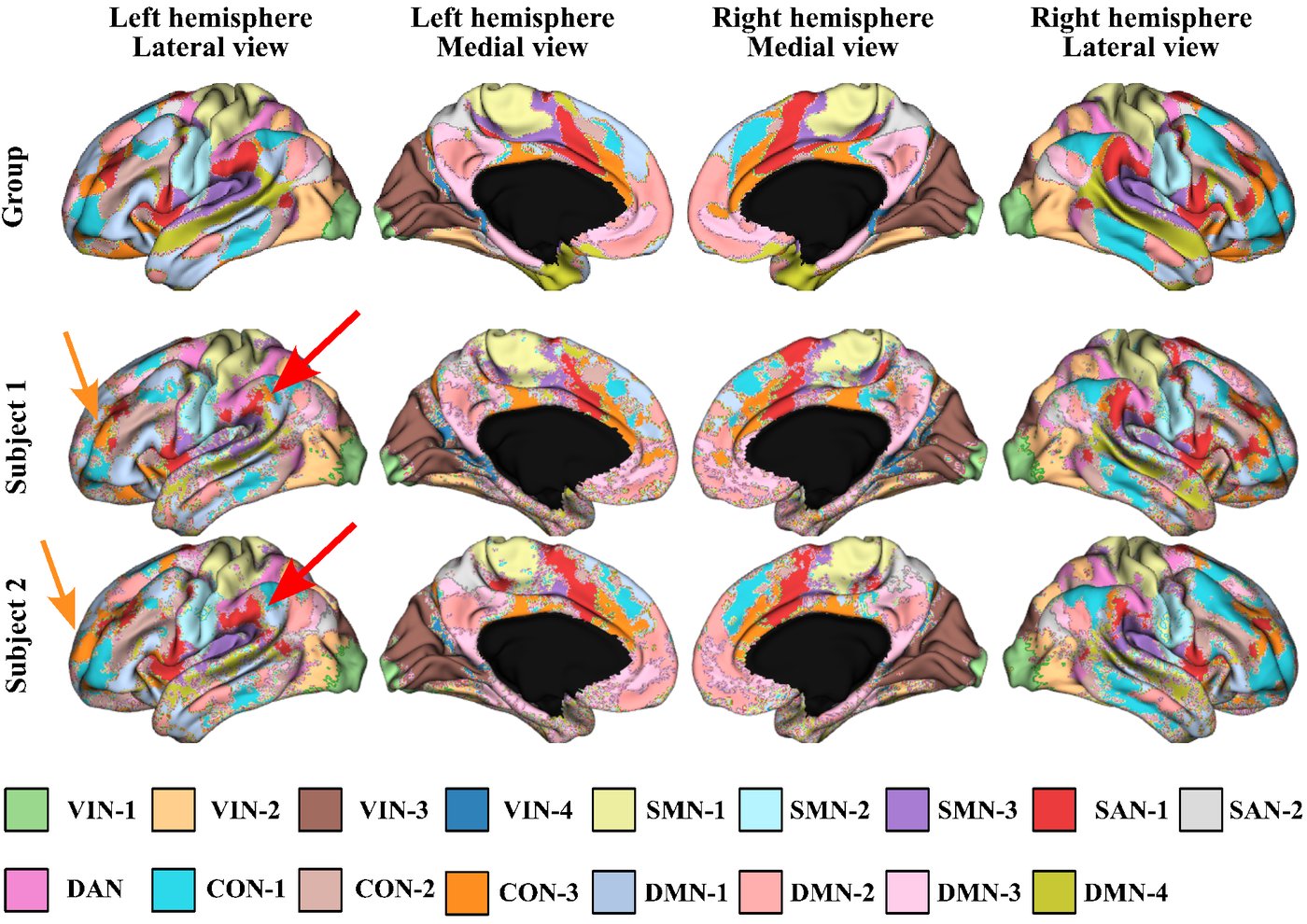
Population-level (top) and individual (bottom) parcellations of the cortex into 17 functional networks, inferred with PAVI from HCP resting-state fMRI (Le Bris et al., 2024).
pavi implements PAVI (Rouillard et al., 2023) for Pyro, the probabilistic programming library built on PyTorch. You describe your data with a hierarchical Bayesian model; pavi approximates the posterior distribution of its latent variables, even when there are millions of them. In particular, a main application of the algorithm and this implementation was estimating individualized functional networks over the cortex from fMRI data (see the figure above and Le Bris et al., 2024).
Why PAVI?
Hierarchical models repeat the same variable across plates1, and the number of latent variables quickly explodes. In the brain application, about 1,000 subjects × 60,000 cortical vertices give 60 million latent variables. With a classical mean-field Gaussian approximation over about 20 functional networks, this requires more than 2 billion variational parameters.
PAVI builds the variational family with normalizing flows: a simple base distribution is mapped to a complex one by an invertible, learnable transform $f$. For an instance $n$ of a plate,
$$z^n = f(u^n;\ \phi, E^n), \qquad u^n \sim \text{base distribution}.$$
- The parameters $\phi$ of the transform are shared by all the instances of the plate. They capture what instances have in common and act as a group-level regularization.
- Each instance only keeps a small encoding $E^n \in \mathbb{R}^m$, which encodes the statistics of its posterior (hence the name).
The number of parameters still grows with the number of instances $N$, but much more slowly: for large $N$ it is reduced by a factor $O(m/d)$ compared to the mean-field approximation, where $d$ is the size of each variable and $m \ll d$. The mean-field approximation itself is the special case of a standard normal base and a diagonal affine transform. New subjects can be inferred by refitting only their encodings.
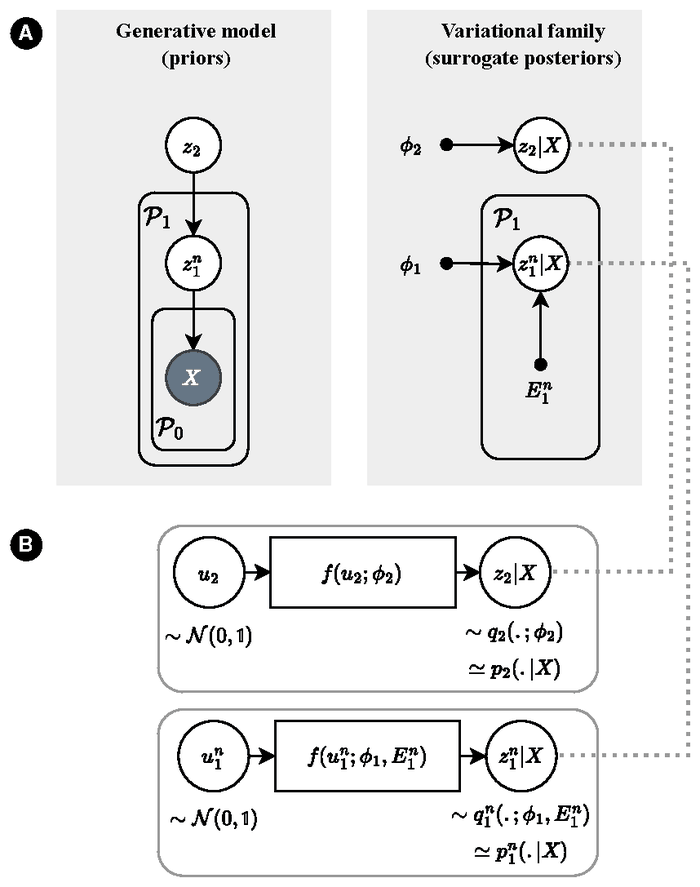
Learn more in Concepts.
Features
- Bring your own generative model, implemented with Pyro and PyTorch.
- An off-the-shelf implementation of PAVI, with training utilities: plate-aware mini-batch sampler, PyTorch Lightning inference module, KL annealing and logging callbacks.
- Many customization options:
- a wide choice of parameterized invertible transforms;
- several strategies to manage the encodings;
- several strategies for the base distribution, called schemes.
Installation
pavi requires Python ≥ 3.14. It is published on PyPI as pavi-pyro and imported as pavi:
pip install pavi-pyro # or: uv add pavi-pyro
See Getting started to install from source.
Quickstart
A three-level hierarchical model: a global mean $z_2$, the means $z_1^i$ of 5 groups (plate P_1), and 50 observations $X^{i,j}$ per group (plate P_0).
1. Write the generative model in Pyro. The model receives the data and, optionally, the indices of a mini-batch (idx).
import pyro
import pyro.distributions as dist
import torch

from pavi.core import JointEM, NormalizingFlowScheme, PAVIGuide
from pavi.distributions import affine, conditional_affine

NUM_GROUPS, NUM_OBS, DIM = 5, 50, 2


def model(data=None, idx=None):
    idx = idx or {}
    z_2 = pyro.sample("z_2", dist.Normal(torch.zeros(DIM), 1.0).to_event(1))
    with pyro.plate("P_1", NUM_GROUPS, subsample=idx.get("P_1"), dim=-1):
        z_1 = pyro.sample("z_1", dist.Normal(z_2, 5.0).to_event(1))
        with pyro.plate("P_0", NUM_OBS, subsample=idx.get("P_0"), dim=-2):
            pyro.sample("X", dist.Normal(z_1, 1.0).to_event(1), obs=data)


# Simulate a dataset from the model
pyro.set_rng_seed(0)
X = pyro.poutine.trace(model).get_trace().nodes["X"]["value"]
2. Build the PAVI guide2. Choose a transform for each latent site3, an encoding manager and a scheme.
guide = PAVIGuide(
    model,
    transform_modules={
        "z_2": [affine(scale_init=1.0)],                     # global variable
        "z_1": [conditional_affine(hidden_layers=[32, 32])],  # plate P_1: conditioned on encodings
    },
    transform_scheme=NormalizingFlowScheme,
    encoding_manager=JointEM(encoding_size={"P_1": 8}),
    hidden_sites=["X"],  # observed sites are not inferred
    device="cpu",
    data=X,
)
3. Fit the guide by maximizing the evidence lower bound (ELBO).
elbo = pyro.infer.Trace_ELBO(num_particles=8)
optimizer = torch.optim.Adam(guide.parameters(), lr=1e-2)
for step in range(2000):
    optimizer.zero_grad()
    loss = elbo.differentiable_loss(model, guide, X)
    loss.backward()
    optimizer.step()
4. Sample from the approximate posterior.
with torch.no_grad():
    posterior_sample = guide(X)
print(posterior_sample["z_1"])  # one sample of the 5 group means
The toy-model notebook compares the result with the exact posterior.
How it works
flowchart LR
    M["Pyro model<br/>with plates"] -->|"inspected once"| S["latent sites<br/>and their plates"]
    S --> EM["encoding manager<br/>encodings E"]
    S --> T["transforms<br/>per site"]
    EM -->|"conditions"| T
    T --> SC["scheme<br/>base distribution"]
    SC --> Q["approximate posterior q"]
When it is created, the guide runs the model once to list its latent sites and their plates. The encoding manager then creates the encodings, and each site gets its chain of transforms, conditioned on the encodings when the site lives in a plate. The scheme chooses the base distribution that the transforms are applied to. See The PAVI guide.
Application: individual brain functional networks
PAVI makes it possible to map the functional networks of each individual brain at the resolution of the cortical mesh, from resting-state fMRI (Le Bris et al., 2024). A hierarchical model explains the functional connectivity of each vertex as a mixture of 17 networks, whose spatial organization varies across individuals around a population-level atlas.
Instead of a discrete atlas, the model yields a continuous, probabilistic map of each network, at the population level (below) and for each individual:
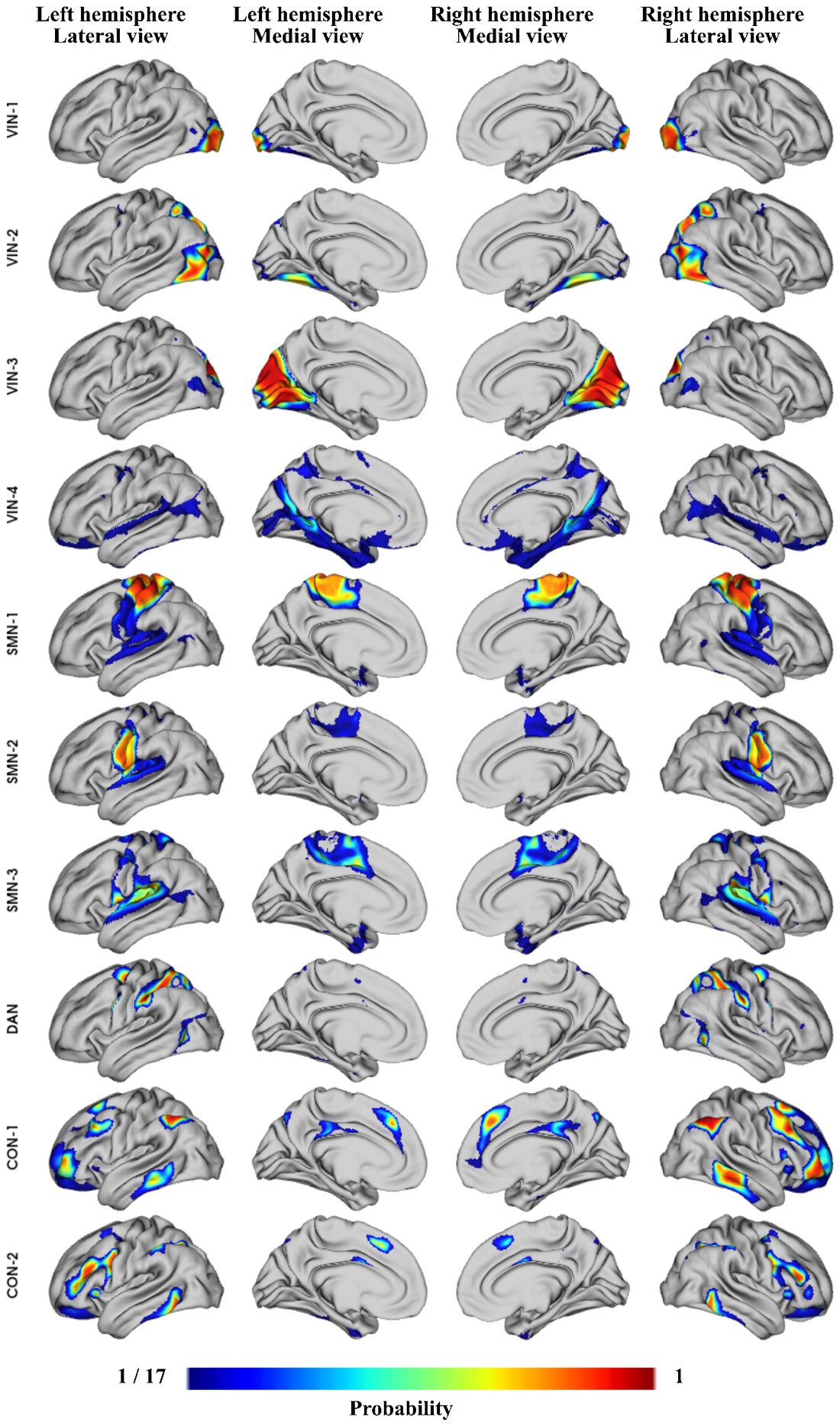
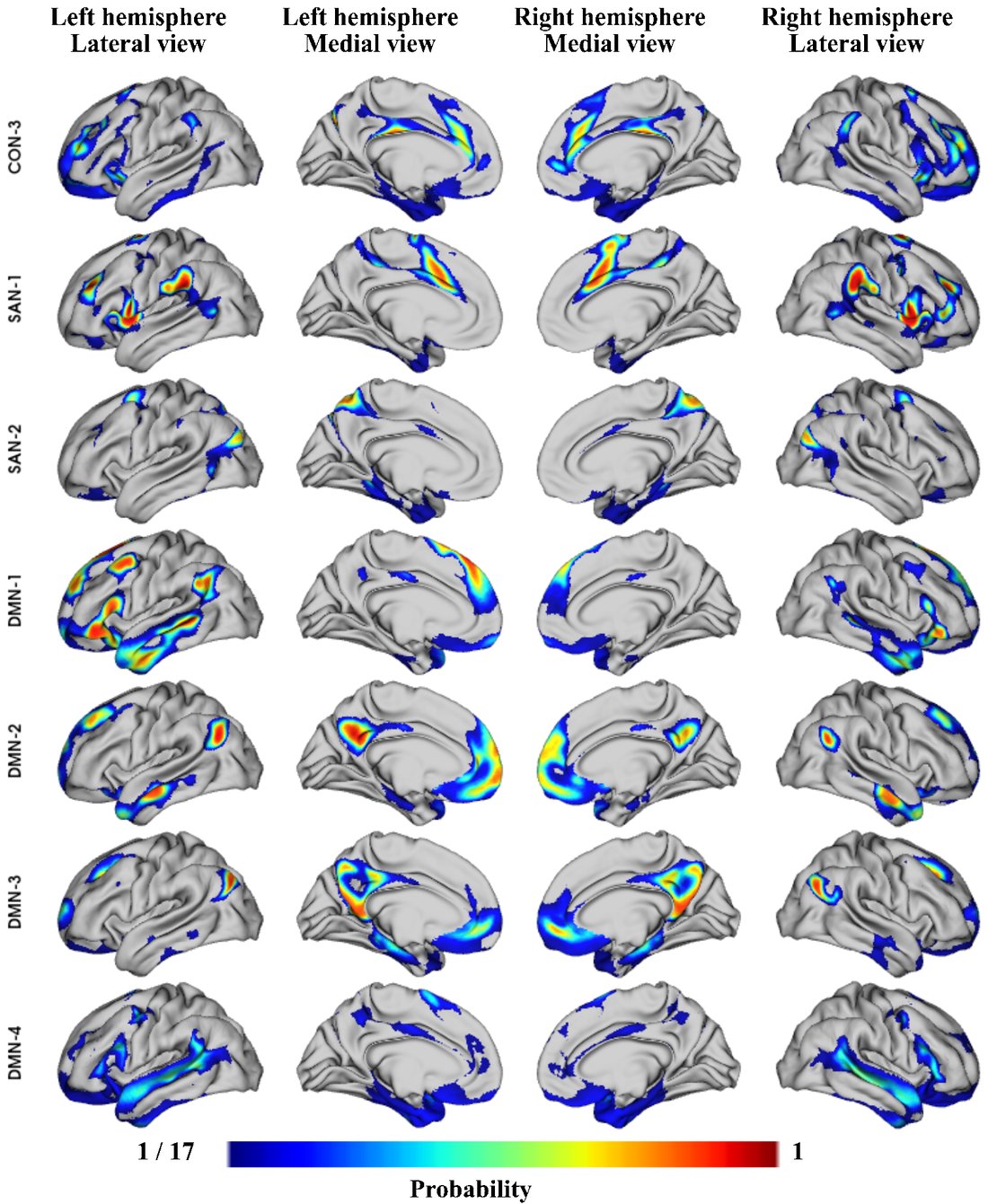
These individual maps are reliable, reflect individual-specific organization, predict behavior, and transfer to small datasets through the population-level priors. See the brain application example.
Documentation
| Page | Content |
|---|---|
| Getting started | installation and a first model |
| Concepts | hierarchical models, variational inference, normalizing flows, plate amortization |
| The PAVI guide | the arguments of PAVIGuide |
| Encodings · Transforms · Schemes | the building blocks and their options |
| Training | ELBOs, enumeration, mini-batches, Lightning, KL annealing |
| Examples | toy model, brain functional networks |
The documentation is published at https://dubris.github.io/pavi-pyro/. To browse it locally, run uv run --group docs mkdocs serve.
Citation
If you use pavi, please cite:
@article{rouillard2023pavi,
  title   = {{PAVI}: Plate-Amortized Variational Inference},
  author  = {Rouillard, Louis and Le Bris, Alexandre and Moreau, Thomas and Wassermann, Demian},
  journal = {Transactions on Machine Learning Research},
  year    = {2023}
}
For the brain functional network application:
@unpublished{lebris2024transfer,
  title  = {Improving Individual-Specific Functional Parcellation through Transfer Learning},
  author = {Le Bris, Alexandre and Rouillard, Louis and Wassermann, Demian},
  year   = {2024},
  url    = {https://hal.science/hal-04506561}
}
License
-
Plate: a set of random variables that are conditionally independent given their parents, e.g. one variable per subject or per brain vertex. Declared with
pyro.plate. ↩ -
Guide: in Pyro, the parameterized family of distributions $q$ (the variational family) that is fitted to approximate the posterior.
paviprovides the guide; you provide the model. ↩ -
Site: a random variable of a Pyro model, declared with
pyro.sample("name", distribution). Latent sites are inferred; observed sites hold the data. ↩
1 maintainer

Metadata
1 maintainer
Release files for pavi-pyro 0.1.0
For a detailed explanation of source distributions (sdists) and built distributions (wheels), please see the package formats documentation.
Source distribution (sdist)
| File | Size | Uploaded | Provenance | Actions |
|---|---|---|---|---|
| pavi_pyro-0.1.0.tar.gz | 40.4 kB | Without provenance | Details for pavi_pyro-0.1.0.tar.gz |
Built distribution (wheel)
| File | Interpreter | ABI | Platform | Actions Reset |
|---|---|---|---|---|
| pavi_pyro-0.1.0-py3-none-any.whl | Python 3 | none | any | Details for pavi_pyro-0.1.0-py3-none-any.whl |
Total release size: 89.7 kB
Release files / pavi_pyro-0.1.0.tar.gz
| Download URL | pavi_pyro-0.1.0.tar.gz |
|---|---|
| Size | 40.4 kB |
| Tags | Source |
|
SHA-256 checksum How to use checksums |
f953caff3d45f7323552aef85f427cbfb2ffd5745ee297ec948f69ec4d6fc2c1
|
|
BLAKE2b-256 checksum How to use checksums |
5b219649ede2eec5d0099d671bdb53bbff7caee10bde9c7c0a4ca4d3ae0a02f3
|
| Upload date | |
|
Uploaded using Trusted Publishing? What is trusted publishing? |
No |
| Uploaded via |
uv/0.12.3 {"installer":{"name":"uv","version":"0.12.3","subcommand":["publish"]},"python":null,"implementation":{"name":null,"version":null},"distro":{"name":"macOS","version":null,"id":null,"libc":null},"system":{"name":null,"release":null},"cpu":null,"openssl_version":null,"setuptools_version":null,"rustc_version":null,"ci":null}
|
Release files / pavi_pyro-0.1.0-py3-none-any.whl
| Download URL | pavi_pyro-0.1.0-py3-none-any.whl |
|---|---|
| Size | 49.3 kB |
| Tags | Python 3 |
|
SHA-256 checksum How to use checksums |
858179b1442fc693a336ac72b71bc5d838c75b37468f0639d237c0539f5bc5c3
|
|
BLAKE2b-256 checksum How to use checksums |
6e29813e862889e496c21454f385350647f9ce79cee7af36f188b32759404b41
|
| Upload date | |
|
Uploaded using Trusted Publishing? What is trusted publishing? |
No |
| Uploaded via |
uv/0.12.3 {"installer":{"name":"uv","version":"0.12.3","subcommand":["publish"]},"python":null,"implementation":{"name":null,"version":null},"distro":{"name":"macOS","version":null,"id":null,"libc":null},"system":{"name":null,"release":null},"cpu":null,"openssl_version":null,"setuptools_version":null,"rustc_version":null,"ci":null}
|
Security for pavi-pyro 0.1.0
Provenance
Provenance describes where a file came from. On PyPI, provenance is shared via attestations, which provide a verifiable record of the build or publishing details. View details, limitations and caveats.
No provenance found
None of the files in this release were uploaded with provenance metadata.
A note on package security
PyPI is a repository for distributing packages, not a service for auditing them. While third-party security researchers and our staff do their best to detect and remove malicious packages, PyPI cannot guarantee the quality, security or suitability of any given package.
To learn more about protecting yourself from malicious actors, visit our package security documentation.













