
Pchips


Overview
Pchips is a monotonicity-preserving piecewise cubic Hermite interpolant that is fourth-order accurate, including at peaks and troughs. It is a drop-in replacement for SciPy's PchipInterpolator, and just as fast to evaluate. See Should you switch from SciPy? for the trade-offs, and the quickstart notebook for a complete tour, with plots comparing Pchips and SciPy.
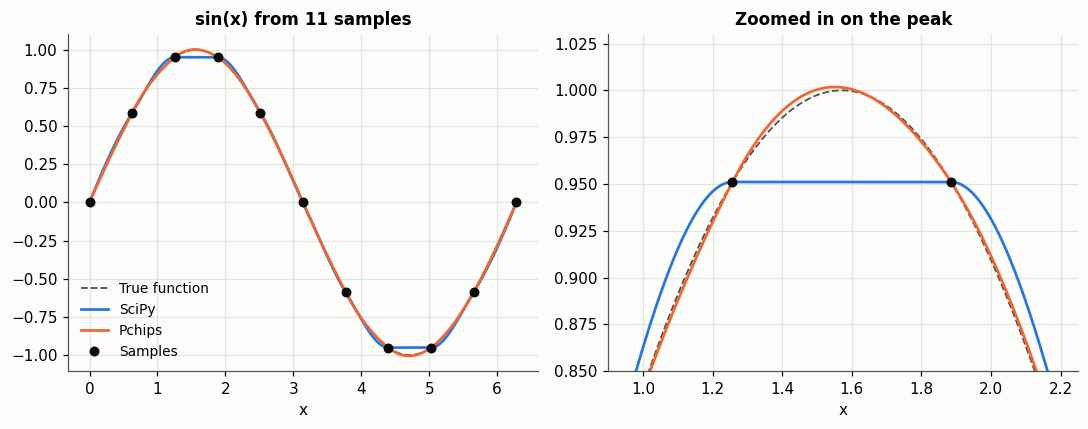
Classical monotone Hermite interpolants, SciPy's included, impose monotonicity: they flatten the interpolant at every local maximum and minimum, which cuts peaks off and limits them to O(h²) accuracy. Pchips only preserves monotonicity: where the data are monotone, so is the interpolant, but the constraint is relaxed near strict local extrema, so the interpolant follows the data through them and stays O(h⁴) accurate.
- Cubic or quartic derivative approximations. The derivatives at the samples can be estimated with a cubic approximation (the default) or a quartic one, which has a smaller error constant on smooth, well-resolved data. Both give an O(h⁴) interpolant
- Two monotonicity constraints. M3 (the default) guarantees a monotone interpolant on monotone data. M4 stays O(h⁴) even at flat inflection points, where M3 may drop to O(h³), at the cost of a weaker monotonicity guarantee
- A one-line switch from SciPy. Same signature, same methods (derivatives, integrals, roots, extrapolation), and SciPy's own
PchipInterpolatortests pass, apart from one that checks the interpolant never overshoots and one that checks the exact values of SciPy's method
The algorithm, due to H. T. Huynh, is described in this NASA Technical Memo, which is self-contained and quite readable. A nearly identical version was later published in the SIAM Journal on Numerical Analysis.
Installation
Pchips is on PyPI and requires Python 3.10 or later, NumPy 1.23.5 or later and SciPy 1.10 or later:
pip install pchips
# or
uv add pchips
To get the latest unreleased changes, install it from GitHub instead:
pip install git+https://github.com/vglazer/pchips
Usage
Change the import and leave everything else as it is:
# from scipy.interpolate import PchipInterpolator, pchip_interpolate
from pchips import PchipInterpolator, pchip_interpolate

interp = PchipInterpolator(x, y)            # also axis=..., extrapolate=...
interp(u)                                   # also interp(u, nu=1)
interp.derivative(), interp.antiderivative(), interp.integrate(a, b), interp.roots()
PchipInterpolator has the same signature and input validation as SciPy's, and like SciPy's version it is a CubicHermiteSpline, so it has the same methods, output shapes and extrapolation behavior. On top of that, two keyword-only options select the variant of Huynh's method:
approx_order:'cubic'(default) or'quartic', the derivative approximationmono_constraint:'M3'(default) or'M4', the monotonicity constraint
See below for when to use which. With fewer than five data points, the result is the same as SciPy's, up to rounding error.
As with SciPy, extrapolation is on by default and simply extends the first and last cubics, so the interpolant drifts away from the data quickly outside its range. Pass extrapolate=False to get nan there instead.
Choosing between cubic and quartic
Use 'quartic' if your data are smooth and sampled finely enough to resolve their features, and 'cubic', the default, otherwise.
Why:
- Quartic is more accurate on well-resolved smooth data. Both give an O(h⁴) interpolant, but the quartic derivative approximation has a smaller error constant. With 321 samples, the maximum error is 3.9e-10 instead of 5.8e-9 for sin(x), and 4.2e-9 instead of 5.8e-8 for e^(−x²)
- Cubic can be more accurate on coarse data. The quartic approximation uses five neighbouring samples instead of four, so it relies on the data being smooth over a wider stencil. With only 11 samples of e^(−x²) on [-3, 3], the maximum error is 5.2e-2 with quartic and 3.6e-2 with cubic, and the same happens with a steep tanh(5x) and Runge's function
- Quartic is about 5% slower to construct
Choosing between M3 and M4
Use M3, the default, unless your data are smooth samples of a monotone function whose slope drops to zero somewhere between the samples, i.e. a flat inflection point such as x - sin(x) at x = 0 or x³ at x = 0.
Why:
- On most data the two are identical. For smooth, well-sampled data the constraint only kicks in near points where the slope of the data is close to zero. At peaks and troughs both constraints relax in the same way, which is what gives Pchips its accuracy there. On sin, e^(−x²), tanh, Runge's function and others, M3 and M4 give exactly the same interpolant
- M4 is more accurate at flat inflection points. M3 guarantees monotonicity by keeping the derivative at each sample between 0 and a bound computed from the neighbouring data: 3 times the smaller of the neighbouring slopes, or 1.5 times a local parabola's slope if that is larger. Near a flat inflection point, both are tiny, so this clips the derivatives and accuracy drops to roughly O(h³), and erratically so. M4 uses extra information from neighbouring cubics to allow larger derivatives there and stays O(h⁴). For x - sin(x) on [-2, 3.1] with 641 samples, the maximum error is 7.1e-10 with M3 and 1.0e-10 with M4 (see
test_m4_fourth_order_at_flat_inflectionin test_vs_scipy.py). For x³, M4 is exact while M3 is not. If the flat point happens to be one of the samples, the two agree again - M4 weakens the monotonicity guarantee. Fourth-order accuracy is incompatible with monotonicity in general: there are monotone data which lie on a non-monotone cubic, and M4 reproduces the cubic. Huynh therefore only guarantees a monotone interpolant where the data are "q-monotone" (Theorem 3 in the paper), and in the two intervals at either end. On rough monotone data this matters: in 300 random monotone datasets, M4 gave an interpolant which decreases somewhere in 82 (equally spaced samples) and 141 (unequally spaced samples) of them, while M3 never did
- M4 is about 1.3-1.6 times slower to construct
So if your data are noisy or irregular, or a monotone result is a hard requirement, stick with M3. If they are smooth and you need the extra accuracy near flat inflection points, use M4, and check the result for monotonicity if that matters.
Should you switch from SciPy?
In short: switch if your data come from a smooth underlying function and accuracy matters, especially near peaks and troughs. Stay with SciPy if your code relies on the interpolant never leaving the range of the data.
Reasons to switch
-
Much higher accuracy near local extrema. SciPy's interpolant flattens out at every local maximum and minimum, which makes it only O(h²) accurate there. Pchips is O(h⁴) there too, and everywhere else, except at flat inflection points with the default M3 constraint (see above). Here is the maximum error with 321 equally spaced samples (see
test_convergence_vs_scipyin test_vs_scipy.py):Function SciPy Pchips (default) Pchips ( approx_order='quartic')sin(x) on [0, 2π] 1.4e-5 5.8e-9 3.9e-10 e^(−x²) on [-3, 3] 2.6e-5 5.8e-8 4.2e-9 tanh(x) on [-3, 3] (no extrema) 2.1e-7 1.3e-8 1.4e-9 Put differently, Pchips with 41 samples of sin(x) (2.2e-5) is nearly as accurate as SciPy with 321 (1.4e-5), and the gap grows as you add samples
-
The same monotonicity guarantee. With the default M3 constraint, monotone data give a monotone interpolant, just like SciPy's
-
Low-degree polynomials are reproduced exactly, along with their derivatives and integrals. Quadratics always are, and so are cubics with M4. With the default M3, cubics are exact where they are monotone, but not across a flat inflection point, nor near their extrema when the samples are coarse. SciPy's interpolant is not exact even for quadratics
-
Switching is a one-line change. Only the import changes, and SciPy's own
PchipInterpolatortests pass, apart from two: one checks that the interpolant never overshoots, which Huynh's method deliberately gives up, and the other checks the exact values of SciPy's method (see test_scipy_suite.py)
Reasons not to switch
-
The interpolant may overshoot the data near strict local extrema. This is the price of accuracy: between any two neighbouring samples, SciPy's interpolant always stays between their values, which is exactly what limits it to O(h²) at peaks and troughs. How far Pchips overshoots depends on how smooth the data are:
- On smooth data the overshoot is small, and usually closer to the truth, since the underlying function typically peaks between samples. For example, data with a minimum of 0.02 can give an interpolant which dips to -0.004
- On rough data it can be large. In SciPy's
test_overshoot, which interpolates 20 random values (one of the two expected failures in test_scipy_suite.py), Pchips leaves the range of the neighbouring samples in 3 of the 19 intervals, by up to 0.50 when the data span 0.86
If that matters, e.g. for probabilities, concentrations or anything passed to
log, stay with SciPy or clip the result -
Construction is 1.3-3 times slower (see below). This only matters if you build interpolators in a hot loop
-
Rough or noisy data gain little, since the higher accuracy relies on the data being smooth
Performance
Evaluating the interpolant, along with its derivatives and integrals, is exactly as fast as SciPy's, since both use the same CubicHermiteSpline code: about 0.5 ms for 100,000 points. Construction does more work, because Huynh's method uses higher-order divided differences and a more elaborate monotonicity constraint. Construction times for samples of sin(x) on [0, 10] (and, with several columns, standard normal values on [0, 1]), best of 7 runs on an Apple M3 Max with Python 3.13, NumPy 2.3 and SciPy 1.16, with the slowdown relative to SciPy in brackets:
| Data | SciPy | Pchips (default) | Pchips (approx_order='quartic', mono_constraint='M4') |
|---|---|---|---|
| 20 points | 0.05 ms | 0.08 ms (1.6× slower) | 0.11 ms (2.2× slower) |
| 1,000 points | 0.06 ms | 0.10 ms (1.6× slower) | 0.14 ms (2.3× slower) |
| 100,000 points | 1.3 ms | 2.3 ms (1.8× slower) | 3.7 ms (2.9× slower) |
| 50 points × 1,000 columns | 0.9 ms | 1.1 ms (1.3× slower) | 1.7 ms (1.9× slower) |
Mathematical background
The mathematical background is written in LaTeX, which PyPI cannot display, so read it on GitHub.
Development
See DEVELOPMENT.md for setting up, testing, the scripts and releasing.
Citation
If you use Pchips in published work, please cite Huynh's paper:
@article{huynh1993accurate,
  author  = {Huynh, Hung T.},
  title   = {Accurate Monotone Cubic Interpolation},
  journal = {SIAM Journal on Numerical Analysis},
  volume  = {30},
  number  = {1},
  pages   = {57--100},
  year    = {1993},
  doi     = {10.1137/0730004}
}
License
Pchips is released under the MIT License. test_scipy_suite.py is adapted from SciPy's tests and keeps SciPy's BSD 3-Clause License, which is reproduced at the top of that file.
1 maintainer

Metadata
1 maintainer
Release files for pchips 1.0.9
For a detailed explanation of source distributions (sdists) and built distributions (wheels), please see the package formats documentation.
Source distribution (sdist)
| File | Size | Uploaded | Provenance | Actions |
|---|---|---|---|---|
| pchips-1.0.9.tar.gz | 25.7 kB | With provenance | Details for pchips-1.0.9.tar.gz |
Built distribution (wheel)
| File | Interpreter | ABI | Platform | Actions Reset |
|---|---|---|---|---|
| pchips-1.0.9-py3-none-any.whl | Python 3 | none | any | Details for pchips-1.0.9-py3-none-any.whl |
Total release size: 35.9 kB
Release files / pchips-1.0.9.tar.gz
| Download URL | pchips-1.0.9.tar.gz |
|---|---|
| Size | 25.7 kB |
| Tags | Source |
|
SHA-256 checksum How to use checksums |
3728a743253c6174a74d899cb717084eb49c9febe66b4ae3accce68644f7fa3e
|
|
BLAKE2b-256 checksum How to use checksums |
650bf9e3c29dfedbfb851a07fe8d92567404917ecceea3bbd1b2536303d1e181
|
| Upload date | |
|
Uploaded using Trusted Publishing? What is trusted publishing? |
Yes |
| Uploaded via |
twine/7.0.0 CPython/3.13.16
|
Provenance
Provenance describes where a file came from. On PyPI, provenance is shared via attestations, which provide a verifiable record of the build or publishing details. View details, limitations and caveats.


PyPI Publish Attestation
PyPI verified that this artifact, at this checksum, originated from the publisher listed below.
Signed by GitHub Actions, verified by PyPI on Nov 8, 2026.
Transparency logRelease files / pchips-1.0.9-py3-none-any.whl
| Download URL | pchips-1.0.9-py3-none-any.whl |
|---|---|
| Size | 10.2 kB |
| Tags | Python 3 |
|
SHA-256 checksum How to use checksums |
e4119c1eff45bed151873c3bd5fff5df39a2b20d6cd509e7e8efff9d6dfc1811
|
|
BLAKE2b-256 checksum How to use checksums |
93a7234014e7eeba359b7b74d6865a6e3c6658ba2aa079a949fdc9fe5497b0a0
|
| Upload date | |
|
Uploaded using Trusted Publishing? What is trusted publishing? |
Yes |
| Uploaded via |
twine/7.0.0 CPython/3.13.16
|
Provenance
Provenance describes where a file came from. On PyPI, provenance is shared via attestations, which provide a verifiable record of the build or publishing details. View details, limitations and caveats.
PyPI Publish Attestation
PyPI verified that this artifact, at this checksum, originated from the publisher listed below.
Signed by GitHub Actions, verified by PyPI on Nov 8, 2026.
Transparency logSecurity for pchips 1.0.9
Provenance
Provenance describes where a file came from. On PyPI, provenance is shared via attestations, which provide a verifiable record of the build or publishing details. View details, limitations and caveats.
Full provenance
Both files in this release have been uploaded with provenance metadata.
Attestation for pchips-1.0.9.tar.gz
PyPI Publish Attestation
PyPI verified that this artifact, at this checksum, originated from the publisher listed below.
Signed by GitHub Actions, verified by PyPI on Nov 8, 2026.
Transparency logA note on package security
PyPI is a repository for distributing packages, not a service for auditing them. While third-party security researchers and our staff do their best to detect and remove malicious packages, PyPI cannot guarantee the quality, security or suitability of any given package.
To learn more about protecting yourself from malicious actors, visit our package security documentation.














