
pdaqp is a Python package for solving multi-parametric quadratic programs of the form
$$ \begin{align} \min_{z} & ~\frac{1}{2}z^{T}Hz+(f+F \theta)^{T}z \ \text{s.t.} & ~A z \leq b + B \theta \ & ~\theta \in \Theta \end{align} $$
where $H \succ 0$ and $\Theta \triangleq \lbrace l \leq \theta \leq u : A_{\theta} \theta \leq b_{\theta}\rbrace$.
pdaqp is based on the Julia package ParametricDAQP.jl and the Python module juliacall. More information about the underlying algorithm and numerical experiments can be found in the paper "A High-Performant Multi-Parametric Quadratic Programming Solver".
pdaqp is also the used in CVXPYgen to compute explicit solutions. For more information, see the following manuscript.
Installation
pip install pdaqp
Citation
If you use the package in your work, consider citing the following paper
@inproceedings{arnstrom2024pdaqp,
  author={Arnström, Daniel and Axehill, Daniel},
  booktitle={2024 IEEE 63rd Conference on Decision and Control (CDC)},
  title={A High-Performant Multi-Parametric Quadratic Programming Solver},
  year={2024},
  volume={},
  number={},
  pages={303-308},
}
Example
The following code solves the mpQP in Section 7.1 in Bemporad et al. 2002
import numpy

H =  numpy.array([[1.5064, 0.4838], [0.4838, 1.5258]])
f = numpy.zeros((2,1))
F = numpy.array([[9.6652, 5.2115], [7.0732, -7.0879]])
A = numpy.array([[1.0, 0], [-1, 0], [0, 1], [0, -1]])
b = 2*numpy.ones((4,1));
B = numpy.zeros((4,2));

thmin = -1.5*numpy.ones(2)
thmax = 1.5*numpy.ones(2)

from pdaqp import MPQP
mpQP = MPQP(H,f,F,A,b,B,thmin,thmax)
mpQP.solve()
To construct a binary search tree for point location, and to generate corresponding C-code, run
mpQP.codegen(dir="codegen", fname="pointlocation")
which will create the following directory:
├── codegen
│   ├── pointlocation.c
│   └── pointlocation.h
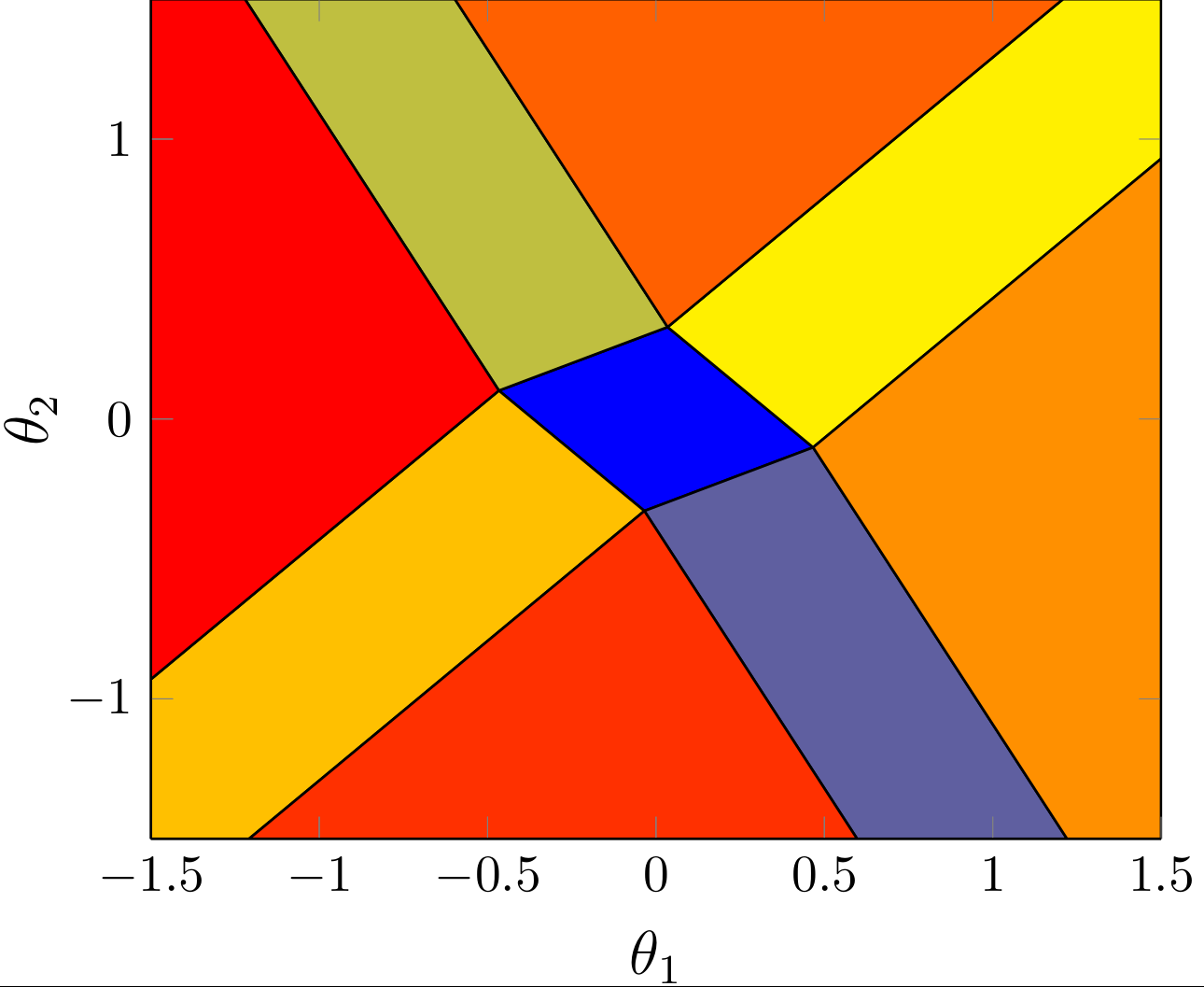
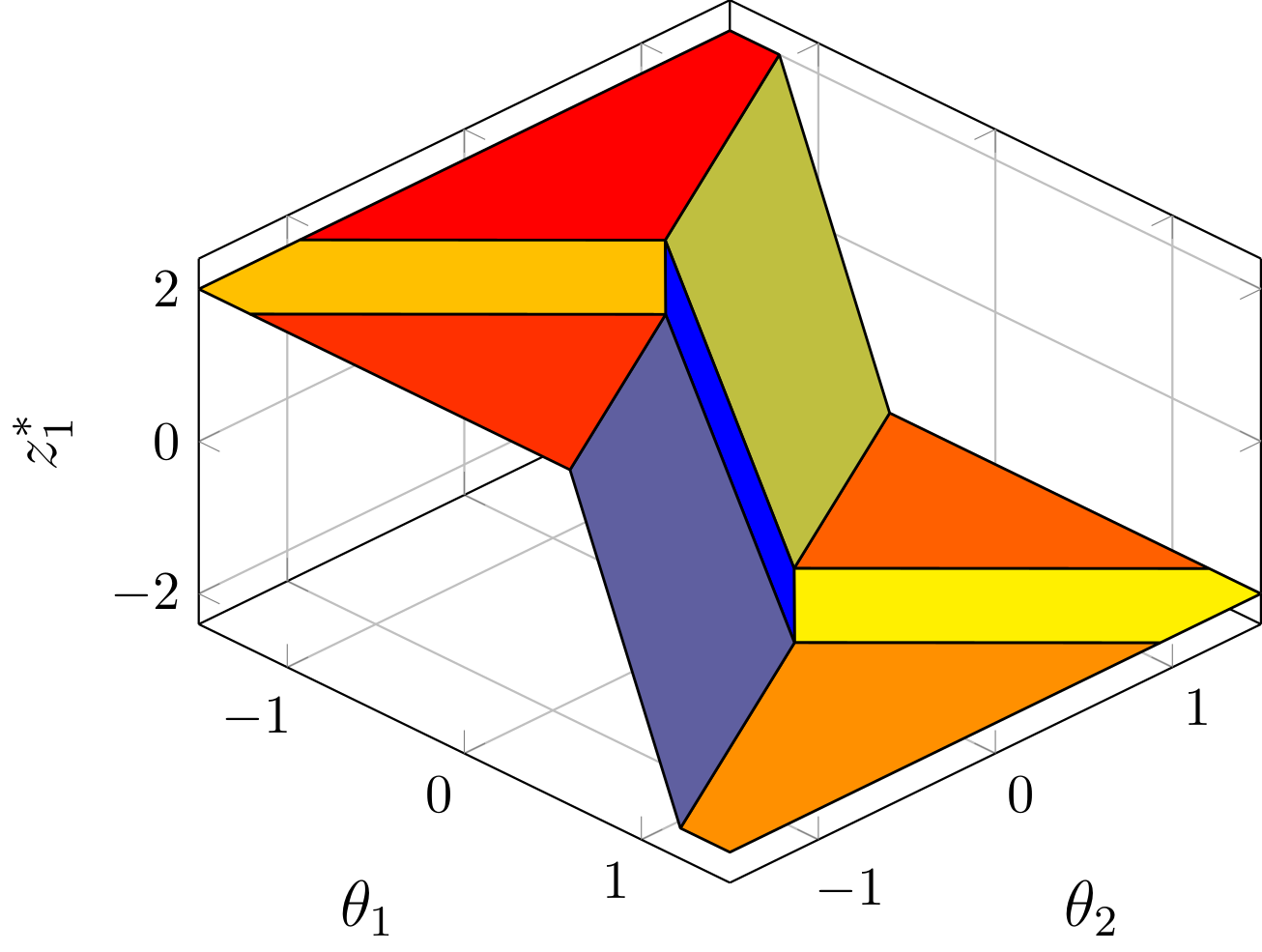
The critical regions and the optimal solution can be plotted with the commands
mpQP.plot_regions()
mpQP.plot_solution()
which create the following plots
1 maintainer

Metadata
1 maintainer
Release files for pdaqp 0.7.1
For a detailed explanation of source distributions (sdists) and built distributions (wheels), please see the package formats documentation.
Source distribution (sdist)
| File | Size | Uploaded | |
|---|---|---|---|
| pdaqp-0.7.1.tar.gz | 215.2 kB | Details |
Built distribution (wheel)
| File | Interpreter | ABI | Platform | Reset |
|---|---|---|---|---|
| pdaqp-0.7.1-py3-none-any.whl | Python 3 | none | any | Details |
Total release size: 223.0 kB
Release files / pdaqp-0.7.1.tar.gz
| Download URL | pdaqp-0.7.1.tar.gz |
|---|---|
| Size | 215.2 kB |
| Tags | Source |
|
SHA-256 checksum How to use checksums |
eacc4017f9ac6777c3f74a499635bef79f52ae2a68211ef5a96490dd9f76f6c7
|
|
BLAKE2b-256 checksum How to use checksums |
529d5a0a7481083c294ae0dbcfb7169f7608ead8974d04676f05735357bb4dc0
|
| Upload date | |
|
Uploaded using Trusted Publishing? What is trusted publishing? |
No |
| Uploaded via |
twine/6.0.1 CPython/3.10.12
|
Release files / pdaqp-0.7.1-py3-none-any.whl
| Download URL | pdaqp-0.7.1-py3-none-any.whl |
|---|---|
| Size | 7.8 kB |
| Tags | Python 3 |
|
SHA-256 checksum How to use checksums |
d1c0ac1c2484bfdfeadca01be31f97e17468743fe4f20618ad26efa79a8c961d
|
|
BLAKE2b-256 checksum How to use checksums |
cc0cbf39b587c1c5174ab65d2ca2ad903a347696591298c9d2208d0ef9688006
|
| Upload date | |
|
Uploaded using Trusted Publishing? What is trusted publishing? |
No |
| Uploaded via |
twine/6.0.1 CPython/3.10.12
|














