
PDE Emulator Architectures for Equinox.





Installation • Documentation • Quickstart • Background • Features • Boundary Conditions • Acknowledgements
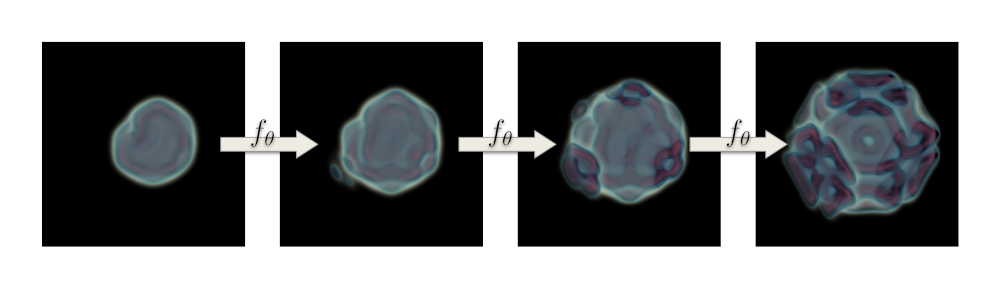
A collection of neural architectures for emulating Partial Differential Equations (PDEs) in JAX agnostic to the spatial dimension (1D, 2D, 3D) and boundary conditions (Dirichlet, Neumann, Periodic). This package is built on top of Equinox.
Installation
pip install pdequinox
Requires Python 3.10+ and JAX 0.4.13+. 👉 JAX install guide.
Documentation
The documentation is available at fkoehler.site/pdequinox.
Quickstart
Train a UNet to become an emulator for the 1D Poisson equation.
import jax
import jax.numpy as jnp
import equinox as eqx
import optax  # `pip install optax`
import pdequinox as pdeqx
from tqdm import tqdm  # `pip install tqdm`

force_fields, displacement_fields = pdeqx.sample_data.poisson_1d_dirichlet(
    key=jax.random.PRNGKey(0)
)

force_fields_train = force_fields[:800]
force_fields_test = force_fields[800:]
displacement_fields_train = displacement_fields[:800]
displacement_fields_test = displacement_fields[800:]

unet = pdeqx.arch.ClassicUNet(1, 1, 1, key=jax.random.PRNGKey(1))

def loss_fn(model, x, y):
    y_pref = jax.vmap(model)(x)
    return jnp.mean((y_pref - y) ** 2)

opt = optax.adam(3e-4)
opt_state = opt.init(eqx.filter(unet, eqx.is_array))

@eqx.filter_jit
def update_fn(model, state, x, y):
    loss, grad = eqx.filter_value_and_grad(loss_fn)(model, x, y)
    updates, new_state = opt.update(grad, state, model)
    new_model = eqx.apply_updates(model, updates)
    return new_model, new_state, loss

loss_history = []
shuffle_key = jax.random.PRNGKey(151)
for epoch in tqdm(range(100)):
    shuffle_key, subkey = jax.random.split(shuffle_key)

    for batch in pdeqx.dataloader(
        (force_fields_train, displacement_fields_train),
        batch_size=32,
        key=subkey
    ):
        unet, opt_state, loss = update_fn(
            unet,
            opt_state,
            *batch,
        )
        loss_history.append(loss)
Background
Neural Emulators are networks learned to efficienty predict physical phenomena, often associated with PDEs. In the simplest case this can be a linear advection equation, all the way to more complicated Navier-Stokes cases. If we work on Uniform Cartesian grids* (which this package assumes), one can borrow plenty of architectures from image-to-image tasks in computer vision (e.g., for segmentation). This includes:
- Standard Feedforward ConvNets
- Convolutional ResNets (He et al.)
- U-Nets (Ronneberger et al.)
- Dilated ResNets (Yu et al., Stachenfeld et al.)
- Fourier Neural Operators (Li et al.)
It is interesting to note that most of these architectures resemble classical numerical methods or at least share similarities with them. For example, ConvNets (or convolutions in general) are related to finite differences, while U-Nets resemble multigrid methods. Fourier Neural Operators are related to spectral methods. The difference is that the emulators' free parameters are found based on a (data-driven) numerical optimization not a symbolic manipulation of the differential equations.
(*) This means that we essentially have a pixel or voxel grid on which space is discretized. Hence, the space can only be the scaled unit cube $\Omega = (0, L)^D$
Features
- Based on JAX:
- One of the best Automatic Differentiation engines (forward & reverse)
- Automatic vectorization
- Backend-agnostic code (run on CPU, GPU, and TPU)
- Based on Equinox:
- Single-Batch by design
- Integration into the Equinox SciML ecosystem
- Agnostic to the spatial dimension (works for 1D, 2D, and 3D)
- Agnostic to the boundary condition (works for Dirichlet, Neumann, and periodic BCs)
- Composability
- Tools to count parameters and assess receptive fields
Boundary Conditions
This package assumes that the boundary condition is baked into the neural
emulator. Hence, most components allow setting boundary_mode which can be
"dirichlet", "neumann", or "periodic". This affects what is considered a
degree of freedom in the grid.

Dirichlet boundaries fully eliminate degrees of freedom on the boundary. Periodic boundaries only keep one end of the domain as a degree of freedom (This package follows the convention that the left boundary is the degree of freedom). Neumann boundaries keep both ends as degrees of freedom.
Acknowledgements
Related Work
Similar packages that provide a collection of emulator architectures are PDEBench and PDEArena. With focus on Phyiscs-informed Neural Networks and Neural Operators, there are also DeepXDE and NVIDIA Modulus.
Citation
This package was developed as part of the APEBench paper (accepted at Neurips 2024), we will soon add the citation here.
Funding
The main author (Felix Koehler) is a PhD student in the group of Prof. Thuerey at TUM and his research is funded by the Munich Center for Machine Learning.
License
MIT, see here
fkoehler.site · GitHub @ceyron · X @felix_m_koehler · LinkedIn Felix Köhler
1 maintainer

Metadata
1 maintainer
Release files for pdequinox 0.1.2
For a detailed explanation of source distributions (sdists) and built distributions (wheels), please see the package formats documentation.
Source distribution (sdist)
| File | Size | Uploaded | |
|---|---|---|---|
| pdequinox-0.1.2.tar.gz | 37.8 kB | Details |
Built distribution (wheel)
| File | Interpreter | ABI | Platform | Reset |
|---|---|---|---|---|
| pdequinox-0.1.2-py3-none-any.whl | Python 3 | none | any | Details |
Total release size: 87.4 kB
Release files / pdequinox-0.1.2.tar.gz
| Download URL | pdequinox-0.1.2.tar.gz |
|---|---|
| Size | 37.8 kB |
| Tags | Source |
|
SHA-256 checksum How to use checksums |
7ee9dcbf277cbb94cda508034c0955600a03bc4c664bede5eb61b4a4b99b54c5
|
|
BLAKE2b-256 checksum How to use checksums |
249cff9718b174e1b98d113d6d62fceeeb15fc01b6cdbace1c9939b9f2bc4464
|
| Upload date | |
|
Uploaded using Trusted Publishing? What is trusted publishing? |
Yes |
| Uploaded via |
twine/5.1.1 CPython/3.12.7
|
Release files / pdequinox-0.1.2-py3-none-any.whl
| Download URL | pdequinox-0.1.2-py3-none-any.whl |
|---|---|
| Size | 49.6 kB |
| Tags | Python 3 |
|
SHA-256 checksum How to use checksums |
b022b38eb03fa7ce4d20622cb9dd2b36f1b80730f082cd2b757279bb7d1111fa
|
|
BLAKE2b-256 checksum How to use checksums |
497ee0d36d65a5495eb71e1a3ce2e5f2027f9b9c86d0ab2f41a43c2735f83ebb
|
| Upload date | |
|
Uploaded using Trusted Publishing? What is trusted publishing? |
Yes |
| Uploaded via |
twine/5.1.1 CPython/3.12.7
|














