
Pairwise Difference Learning (pdll)
A scikit-learn meta-estimator that makes tree models more accurate on small tabular datasets by learning from pairs of points.





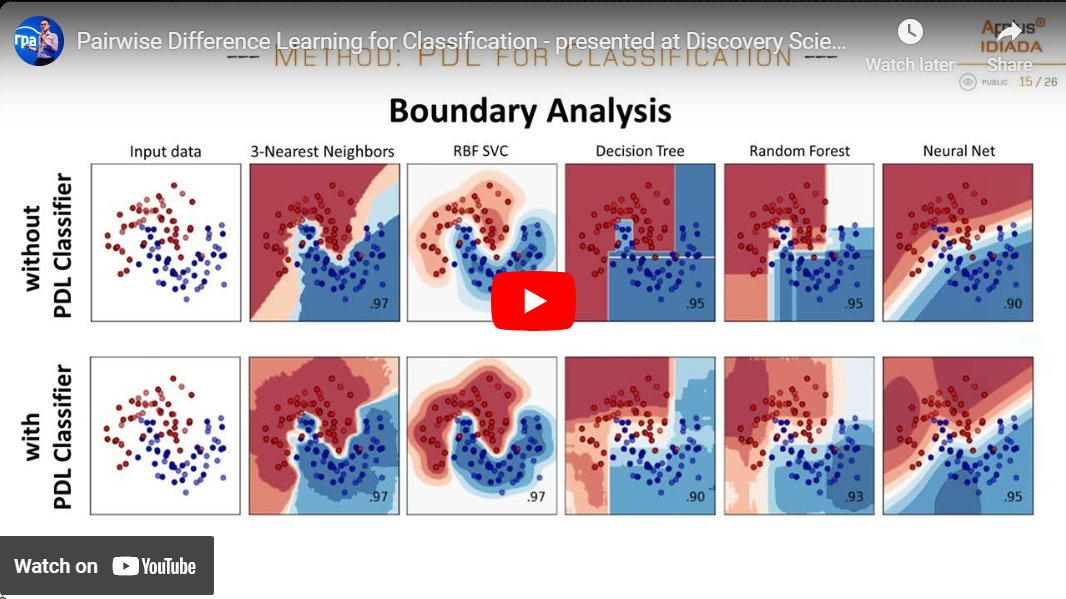
Pairwise Difference Learning (PDL) turns a multiclass problem into a binary one. Instead of asking "what class is this point?", the base model learns "are these two points of the same class?" from every pair of training points. A new point is then compared with the training points (the anchors), whose labels are known. With n training rows the model sees n² examples, which helps most when data is scarce.
pdll wraps any scikit-learn classifier (or regressor) and keeps the usual fit / predict / predict_proba / score API. It implements Belaid, Rabus & Hüllermeier, Pairwise Difference Learning for Classification, Discovery Science 2024 (arXiv).
✨ Highlights
- 🔌 Drop-in: works in
Pipeline,GridSearchCVandcross_val_score, passes scikit-learn's own estimator checks, and never modifies the estimator you pass in. - 🧾 Raw DataFrames welcome (pandas, polars or pyarrow): string, category, bool and nullable columns are encoded for you; missing values go straight to base learners that support them (e.g. HistGradientBoosting).
- 📈 More accurate tree models: in the paper, PDL improves tree-based learners on 99 OpenML datasets (macro-F1). In the end-to-end suite that CI runs on every change, it wins 18 of 30 dataset/learner pairs (11 losses) and raises mean macro-F1 from 0.873 to 0.894.
- 🧪 Validated on 131 real datasets (results): raw Kaggle, OpenML, scikit-learn and Zindi data, with no crashes and at most 2.6 GB of memory.
- 🛡️ Tested: Python 3.9–3.14, numpy ≥ 1.23, pandas ≥ 1.5, scikit-learn ≥ 1.2 (Kaggle and Colab stacks included), Linux, Windows and macOS.
📖 Contents
Installation · Usage · When to use it · How does it work? · Evaluation · Citation
Installation
pip install -U pdll
Usage
from sklearn.datasets import load_wine
from sklearn.ensemble import RandomForestClassifier
from sklearn.model_selection import cross_val_score

from pdll import PairwiseDifferenceClassifier

X, y = load_wine(return_X_y=True)

rf = RandomForestClassifier(class_weight="balanced", random_state=0)
pdc = PairwiseDifferenceClassifier(estimator=rf)

print("RandomForest     :", cross_val_score(rf, X, y, cv=5).mean())
print("PDC(RandomForest):", cross_val_score(pdc, X, y, cv=5).mean())

pdc.fit(X, y)
pdc.predict(X[:3])            # array of labels, like any scikit-learn classifier
pdc.predict_proba(X[:3])      # ndarray (n_samples, n_classes), columns follow pdc.classes_
Raw DataFrames (strings, categories, missing values) work directly:
from sklearn.datasets import fetch_openml
from sklearn.ensemble import HistGradientBoostingClassifier

X, y = fetch_openml("titanic", version=1, as_frame=True, return_X_y=True)
X = X[["pclass", "sex", "age", "sibsp", "parch", "fare", "embarked"]]   # drop identifiers such as name or ticket

pdc = PairwiseDifferenceClassifier(HistGradientBoostingClassifier(class_weight="balanced"))
pdc.fit(X[:600], y[:600]).score(X[600:900], y[600:900])
Regression uses the same idea: the base model learns the target difference between two points.
from pdll import PairwiseDifferenceRegressor
from sklearn.tree import DecisionTreeRegressor

pdr = PairwiseDifferenceRegressor(DecisionTreeRegressor()).fit(X_train, y_train)
pdr.learn_anchor_weights(X_val, y_val, method="L2")   # optional: learn a weight per anchor
More in examples/: uncertainty from the per-anchor posteriors (predict_proba_samples), weighted regression, and more.
Main parameters
| Parameter | Default | Meaning |
|---|---|---|
estimator |
ExtraTreesClassifier(class_weight="balanced") |
Base model trained on pairs. Prefer tree ensembles with class_weight="balanced". It is cloned, never modified. |
max_pairs |
"auto" |
Training uses all n² pairs up to 100,000 (every pair up to 316 rows, exactly as in the paper), then a uniform random subset; fewer for very wide data so memory stays bounded. None uses every pair. |
max_anchors |
500 |
Prediction compares each point with every anchor. Larger training sets use a class-stratified random subset. |
use_prior |
"auto" |
How similarities become probabilities: the paper's prior-based posterior (True) or the normalised mean similarity per class (False). "auto" picks the prior when a class has fewer than 5 rows and the classes are about equally frequent (on imbalanced multiclass data the prior favours large classes). |
class_weight |
None |
"balanced" (or a dict) weights the classes through sample weights. Recommended for imbalanced classes, where PDL otherwise under-predicts the minority class. |
random_state |
None |
Seeds the subsampling and the base model (if its own random_state is unset). |
fit also accepts sample_weight. A pair (i, j) is weighted w_i·w_j, which is exactly equivalent to repeating rows.
When to use it
- ✅ Small tabular data: up to about 2,000 training rows. In the real-data benchmark PDL matches its base learner on average below 1,000 rows and beats it on many datasets. Above 2,000 rows it was usually less accurate than the base learner alone, and
fitwarns you. - ✅ Tree-based base learners: DecisionTree, RandomForest, ExtraTrees, Bagging, (Hist)GradientBoosting. The weaker the learner, the larger the gain (a single decision tree gains 15 points on small digits data).
- ⚖️ Imbalanced classes: use
class_weight="balanced". PDL ranks well (its ROC AUC is on par or better) but under-predicts minority classes by default. - ⚠️ Parametric base learners (logistic regression, SVM, kNN, naive Bayes, MLP) rarely gain from PDL; pdll warns you.
- ⏱️ Cost: training sees up to
max_pairspairs with 3× the features, and prediction compares every point with up tomax_anchorsanchors. With the defaults, a typical dataset fits in seconds and stays well under 2 GB of memory, whatever its size. For more accuracy on a few thousand rows, raisemax_pairs(e.g.1_000_000), at about 10× the time and memory.
How does it work?
The PDL algorithm works by transforming the multiclass classification problem into a binary classification problem. The algorithm works as follows:
Example 1: Graphical abstract

Example 2: PDC trained on the Iris dataset
Clic to show
We provide a minimalist classification example using the Iris dataset. The dataset is balanced, so the prior probabilities of each of the 3 classes are equal: p(Setosa) = p(Versicolour) = p(Virginica) = 1/3Three Anchor Points
- Flower 1:
y1 = Setosa - Flower 2:
y2 = Versicolour - Flower 3:
y3 = Virginica
One Query Point
- Flower Q:
yq(unknown target)
Pairwise Predictions The model predicts the likelihood that both points have a similar class:
- g_sym(Flower Q, Flower 1) = 0.6
- g_sym(Flower Q, Flower 2) = 0.3
- g_sym(Flower Q, Flower 3) = 0.0
Given the above data, the first step is to update the priors.
Posterior using Flower 1:
- p_post,1(Setosa) = 0.6
- p_post,1(Versicolour) = (1/3 * (1 - 0.6)) / (1 - 1/3) = 0.2
- p_post,1(Virginica) = (1/3 * (1 - 0.6)) / (1 - 1/3) = 0.2
Similarly, we calculate for anchors 2 and 3:
-
p_post,2(Setosa) = 0.35
-
p_post,2(Versicolour) = 0.30
-
p_post,2(Virginica) = 0.35
-
p_post,3(Setosa) = 0.5
-
p_post,3(Versicolour) = 0.5
-
p_post,3(Virginica) = 0.0
Averaging over the three predictions:
Finally, the predicted class is the most likely prediction:
ŷ_q = arg max_{y ∈ Y} p_post(y) = Setosa
Evaluation
Real-world validation (131 datasets)
Before release, pdll ran with default settings on 131 raw real datasets: OpenML-CC18 and CTR23 (official task splits), Kaggle datasets, scikit-learn datasets and a Zindi dataset. 129 ran, and 2 were refused with an actionable message (sparse text, multi-target). There were no crashes, out-of-memory errors or timeouts, and peak memory stayed at or below 2.6 GB. Protocol and findings, full table.
| Training rows | Classification: macro-F1, PDL minus base learner (wins / ties / losses) |
|---|---|
| up to 1,000 | -0.001 (10 / 10 / 10) |
| 1,000 to 2,000 | -0.012 (3 / 5 / 10) |
| more than 2,000 | -0.061 (5 / 3 / 35) |
The base learner here is a strong default, ExtraTrees with balanced class weights. PDL holds its own on small data and is not meant for large data; fit warns from 2,000 rows on.
Continuous benchmark (CI)
Every change to pdll runs tests/e2e: 10 offline datasets (iris, wine, breast cancer, digits, 2D toy problems, synthetic, a Titanic-like mixed-type table and a dataset with a tiny class). Each is scored with 5-fold stratified CV and macro-F1, comparing ExtraTrees, RandomForest and DecisionTree alone versus wrapped in PDC. The build fails if accuracy or speed regresses against the committed baseline.
| Base learner alone | PDC(base learner) | |
|---|---|---|
| Mean macro-F1 (30 dataset × learner pairs) | 0.873 | 0.894 |
| Wins / losses | 18 / 11 |
The largest and most stable gains are for single decision trees (digits, 300 rows: 0.75 → 0.93; across three CV seeds a tree goes from 0.70–0.75 to 0.86–0.91). PDL does not win everywhere: it is slightly behind on the linearly separable toy problem and on breast cancer with forests.
Paper experiment
To reproduce the experiment of the paper, install the research requirements and run run_benchmark.py with a base learner and a dataset number, between 0 and 99. Example:
pip install -r requirements-benchmark.txt
python run_benchmark.py --model DecisionTreeClassifier --data 0
Scores will be stored in ./results/tmp/ directory. pdll 1.x reproduces the predictions of the original implementation (0.3.1) on the paper's inputs; tests/test_golden.py checks this on every change.
Experiment
We use 99 datasets from the OpenML repository. We compare the performance of the PDC algorithm with 7 base learners. We use the macro F1 score as a metric. The search space is inspired from TPOT a state-of-the-art library in optimizing Sklearn pipelines
Description of the search space per estimator
| Estimator | # parameters | # combinations |
|---|---|---|
| DecisionTree | 4 | 350 |
| RandomForest | 7 | 1000 |
| ExtraTree | 6 | 648 |
| HistGradientBoosting | 6 | 486 |
| Bagging | 6 | 96 |
| ExtraTrees | 7 | 1000 |
| GradientBoosting | 5 | 900 |
Search space per estimator
| Estimator | Parameter | Values |
|---|---|---|
| DecisionTreeClassifier | criterion | gini, entropy |
| max depth | None, 1, 2, 4, 6, 8, 11 | |
| min samples split | 2, 4, 8, 16, 21 | |
| min samples leaf | 1, 2, 4, 10, 21 | |
| RandomForestClassifier | criterion | gini, entropy |
| min samples split | 2, 4, 8, 16, 21 | |
| max features | sqrt, 0.05, 0.17, 0.29, 0.41, 0.52, 0.64, 0.76, 0.88, 1.0 | |
| min samples leaf | 1, 2, 4, 10, 21 | |
| bootstrap | True, False | |
| ExtraTreeClassifier | criterion | gini, entropy |
| min samples split | 2, 5, 10 | |
| min samples leaf | 1, 2, 4 | |
| max features | sqrt, log2, None | |
| max leaf nodes | None, 2, 12, 56 | |
| min impurity decrease | 0.0, 0.1, 0.5 | |
| HistGradientBoostingClassifier | max iter | 100, 10 |
| learning rate | 0.1, 0.01, 1 | |
| max leaf nodes | 31, 3, 256 | |
| min samples leaf | 20, 4, 64 | |
| l2 regularization | 0, 0.01, 0.1 | |
| max bins | 255, 2, 64 | |
| BaggingClassifier | n estimators | 10, 5, 100, 256 |
| max samples | 1.0, 0.5 | |
| max features | 0.5, 0.9, 1.0 | |
| bootstrap | True, False | |
| bootstrap features | False, True | |
| ExtraTreesClassifier | criterion | gini, entropy |
| max features | sqrt, 0.05, 0.17, 0.29, 0.41, 0.52, 0.64, 0.76, 0.88, 1.0 | |
| min samples split | 2, 4, 8, 16, 21 | |
| min samples leaf | 1, 2, 4, 10, 21 | |
| bootstrap | False, True | |
| GradientBoostingClassifier | learning rate | 0.1, 0.01, 1 |
| min samples split | 2, 4, 8, 16, 21 | |
| min samples leaf | 1, 2, 4, 10, 21 | |
| subsample | 1.0, 0.05, 0.37, 0.68 | |
| max features | None, 0.15, 0.68 |
OpenML benchmark datasets
| data_id | NumberOfClasses | NumberOfInstances | NumberOfFeatures | NumberOfSymbolicFeatures | NumberOfFeatures_post_processing | MajorityClassSize | MinorityClassSize |
|---|---|---|---|---|---|---|---|
| 43 | 2 | 306 | 4 | 2 | 3 | 225 | 81 |
| 48 | 3 | 151 | 6 | 3 | 5 | 52 | 49 |
| 59 | 2 | 351 | 35 | 1 | 34 | 225 | 126 |
| 61 | 3 | 150 | 5 | 1 | 4 | 50 | 50 |
| 164 | 2 | 106 | 58 | 58 | 57 | 53 | 53 |
| 333 | 2 | 556 | 7 | 7 | 6 | 278 | 278 |
| 377 | 6 | 600 | 61 | 1 | 60 | 100 | 100 |
| 444 | 2 | 132 | 4 | 4 | 3 | 71 | 61 |
| 464 | 2 | 250 | 3 | 1 | 2 | 125 | 125 |
| 475 | 4 | 400 | 6 | 5 | 5 | 100 | 100 |
| 714 | 2 | 125 | 5 | 3 | 4 | 76 | 49 |
| 717 | 2 | 508 | 11 | 1 | 10 | 286 | 222 |
| 721 | 2 | 200 | 11 | 1 | 10 | 103 | 97 |
| 733 | 2 | 209 | 7 | 1 | 6 | 153 | 56 |
| 736 | 2 | 111 | 4 | 1 | 3 | 58 | 53 |
| 744 | 2 | 250 | 6 | 1 | 5 | 141 | 109 |
| 750 | 2 | 500 | 8 | 1 | 7 | 254 | 246 |
| 756 | 2 | 159 | 16 | 1 | 15 | 105 | 54 |
| 766 | 2 | 500 | 51 | 1 | 50 | 262 | 238 |
| 767 | 2 | 475 | 4 | 3 | 3 | 414 | 61 |
| 768 | 2 | 100 | 26 | 1 | 25 | 55 | 45 |
| 773 | 2 | 250 | 26 | 1 | 25 | 126 | 124 |
| 779 | 2 | 500 | 26 | 1 | 25 | 267 | 233 |
| 782 | 2 | 120 | 3 | 1 | 2 | 63 | 57 |
| 784 | 2 | 140 | 4 | 2 | 3 | 70 | 70 |
| 788 | 2 | 186 | 61 | 1 | 60 | 109 | 77 |
| 792 | 2 | 500 | 6 | 1 | 5 | 298 | 202 |
| 793 | 2 | 250 | 11 | 1 | 10 | 135 | 115 |
| 811 | 2 | 264 | 3 | 2 | 2 | 163 | 101 |
| 812 | 2 | 100 | 26 | 1 | 25 | 53 | 47 |
| 814 | 2 | 468 | 3 | 1 | 2 | 256 | 212 |
| 824 | 2 | 500 | 11 | 1 | 10 | 274 | 226 |
| 850 | 2 | 100 | 51 | 1 | 50 | 51 | 49 |
| 853 | 2 | 506 | 14 | 2 | 13 | 297 | 209 |
| 860 | 2 | 380 | 3 | 1 | 2 | 195 | 185 |
| 863 | 2 | 250 | 11 | 1 | 10 | 133 | 117 |
| 870 | 2 | 500 | 6 | 1 | 5 | 267 | 233 |
| 873 | 2 | 250 | 51 | 1 | 50 | 142 | 108 |
| 877 | 2 | 250 | 51 | 1 | 50 | 137 | 113 |
| 879 | 2 | 500 | 26 | 1 | 25 | 304 | 196 |
| 880 | 2 | 284 | 11 | 1 | 10 | 142 | 142 |
| 889 | 2 | 100 | 26 | 1 | 25 | 50 | 50 |
| 895 | 2 | 222 | 3 | 1 | 2 | 134 | 88 |
| 896 | 2 | 500 | 26 | 1 | 25 | 280 | 220 |
| 902 | 2 | 147 | 7 | 5 | 6 | 78 | 69 |
| 906 | 2 | 400 | 8 | 1 | 7 | 207 | 193 |
| 909 | 2 | 400 | 8 | 1 | 7 | 203 | 197 |
| 911 | 2 | 250 | 6 | 1 | 5 | 140 | 110 |
| 915 | 2 | 315 | 14 | 4 | 13 | 182 | 133 |
| 918 | 2 | 250 | 51 | 1 | 50 | 135 | 115 |
| 925 | 2 | 323 | 5 | 1 | 4 | 175 | 148 |
| 932 | 2 | 100 | 51 | 1 | 50 | 56 | 44 |
| 933 | 2 | 250 | 26 | 1 | 25 | 136 | 114 |
| 935 | 2 | 250 | 11 | 1 | 10 | 140 | 110 |
| 936 | 2 | 500 | 11 | 1 | 10 | 272 | 228 |
| 937 | 2 | 500 | 51 | 1 | 50 | 282 | 218 |
| 969 | 2 | 150 | 5 | 1 | 4 | 100 | 50 |
| 973 | 2 | 178 | 14 | 1 | 13 | 107 | 71 |
| 974 | 2 | 132 | 5 | 1 | 4 | 81 | 51 |
| 1005 | 2 | 214 | 10 | 1 | 9 | 138 | 76 |
| 1011 | 2 | 336 | 8 | 1 | 7 | 193 | 143 |
| 1012 | 2 | 194 | 29 | 27 | 28 | 125 | 69 |
| 1054 | 2 | 161 | 40 | 1 | 39 | 109 | 52 |
| 1063 | 2 | 522 | 22 | 1 | 21 | 415 | 107 |
| 1065 | 2 | 458 | 40 | 1 | 39 | 415 | 43 |
| 1073 | 2 | 274 | 9 | 1 | 8 | 140 | 134 |
| 1100 | 3 | 478 | 11 | 5 | 10 | 247 | 90 |
| 1115 | 3 | 151 | 7 | 5 | 6 | 52 | 49 |
| 1413 | 3 | 150 | 5 | 1 | 4 | 50 | 50 |
| 1467 | 2 | 540 | 21 | 1 | 20 | 494 | 46 |
| 1480 | 2 | 583 | 11 | 2 | 10 | 416 | 167 |
| 1488 | 2 | 195 | 23 | 1 | 22 | 147 | 48 |
| 1490 | 2 | 182 | 13 | 1 | 12 | 130 | 52 |
| 1499 | 3 | 210 | 8 | 1 | 7 | 70 | 70 |
| 1510 | 2 | 569 | 31 | 1 | 30 | 357 | 212 |
| 1511 | 2 | 440 | 9 | 2 | 8 | 298 | 142 |
| 1523 | 3 | 310 | 7 | 1 | 6 | 150 | 60 |
| 1554 | 5 | 500 | 13 | 5 | 12 | 192 | 43 |
| 1556 | 2 | 120 | 7 | 6 | 6 | 61 | 59 |
| 1600 | 2 | 267 | 45 | 1 | 44 | 212 | 55 |
| 4329 | 2 | 470 | 17 | 14 | 16 | 400 | 70 |
| 40663 | 5 | 399 | 33 | 21 | 32 | 96 | 44 |
| 40681 | 2 | 128 | 7 | 7 | 6 | 64 | 64 |
| 41568 | 3 | 150 | 5 | 1 | 4 | 50 | 50 |
| 41977 | 2 | 156 | 91 | 1 | 90 | 98 | 58 |
| 41978 | 2 | 156 | 81 | 1 | 80 | 94 | 62 |
| 42011 | 3 | 150 | 5 | 1 | 4 | 50 | 50 |
| 42021 | 3 | 150 | 5 | 1 | 4 | 50 | 50 |
| 42026 | 3 | 150 | 5 | 1 | 4 | 50 | 50 |
| 42051 | 3 | 150 | 5 | 1 | 4 | 50 | 50 |
| 42066 | 3 | 150 | 5 | 1 | 4 | 50 | 50 |
| 42071 | 3 | 150 | 5 | 1 | 4 | 50 | 50 |
| 42186 | 3 | 150 | 5 | 1 | 4 | 50 | 50 |
| 42700 | 3 | 150 | 5 | 1 | 4 | 50 | 50 |
| 43859 | 3 | 150 | 5 | 1 | 4 | 50 | 50 |
| 44149 | 2 | 296 | 14 | 1 | 18 | 159 | 137 |
| 44151 | 3 | 149 | 5 | 0 | 4 | 50 | 49 |
| 44344 | 3 | 150 | 5 | 1 | 4 | 50 | 50 |
| 45711 | 2 | 530 | 14 | 3 | 13 | 354 | 176 |
Score comparison


2D datasets Examples

Citation
If pdll helps your work, please cite the paper (GitHub's "Cite this repository" button gives the same entry, and pdll.__citation__ holds it too):
@inproceedings{belaid2024pairwise,
  title     = {Pairwise Difference Learning for Classification},
  author    = {Belaid, Mohamed Karim and Rabus, Maximilian and H{\"u}llermeier, Eyke},
  booktitle = {Discovery Science},
  pages     = {284--299},
  publisher = {Springer},
  year      = {2024},
  doi       = {10.1007/978-3-031-78980-9_18},
  url       = {https://arxiv.org/abs/2406.20031}
}
Uncertainty quantification with PDL: Belaid, Rabus & Hüllermeier, Uncertainty Quantification in Pairwise Difference Learning for Classification, Machine Learning, 2025, doi:10.1007/s10994-025-06949-0.
The first commit of this repository corresponds to the original implementation of the PDC algorithm.
Contributing
Issues and pull requests are welcome. pip install -e ".[test]" then pytest runs the fast suite; pytest -m e2e runs the performance regression gate (a few minutes) and pytest -m network the OpenML integration tests.
Acknowledgments: We would like to thank Tim Wibiral, Dorra ElMekki, Viktor Bengs, Muhammad Zeeshan Anwer, Muhammad Hossein Shaker, Alireza Javanmardi, Patrick Kolpaczki, and Maximilian Muschalik for their early comments on this work.
We also acknowledge LRZ and IDIADA for computational resources.


1 maintainer

Metadata
1 maintainer
Release files for pdll 1.0.0
For a detailed explanation of source distributions (sdists) and built distributions (wheels), please see the package formats documentation.
Source distribution (sdist)
| File | Size | Uploaded | Provenance | Actions |
|---|---|---|---|---|
| pdll-1.0.0.tar.gz | 68.9 kB | With provenance | Details for pdll-1.0.0.tar.gz |
Built distribution (wheel)
| File | Interpreter | ABI | Platform | Actions Reset |
|---|---|---|---|---|
| pdll-1.0.0-py3-none-any.whl | Python 3 | none | any | Details for pdll-1.0.0-py3-none-any.whl |
Total release size: 106.2 kB
Release files / pdll-1.0.0.tar.gz
| Download URL | pdll-1.0.0.tar.gz |
|---|---|
| Size | 68.9 kB |
| Tags | Source |
|
SHA-256 checksum How to use checksums |
573d90a335406385e6ecd67114b84e6c0b8d7378b79c409d078d4665236fcff8
|
|
BLAKE2b-256 checksum How to use checksums |
cc3ec65f6396264cb7d33d602e77076215d4e40313c40cf472bdefd1e383a51c
|
| Upload date | |
|
Uploaded using Trusted Publishing? What is trusted publishing? |
Yes |
| Uploaded via |
twine/7.0.0 CPython/3.13.16
|
Provenance
Provenance describes where a file came from. On PyPI, provenance is shared via attestations, which provide a verifiable record of the build or publishing details. View details, limitations and caveats.


PyPI Publish Attestation
PyPI verified that this artifact, at this checksum, originated from the publisher listed below.
Signed by GitHub Actions, verified by PyPI on Oct 21, 2026.
Transparency logRelease files / pdll-1.0.0-py3-none-any.whl
| Download URL | pdll-1.0.0-py3-none-any.whl |
|---|---|
| Size | 37.3 kB |
| Tags | Python 3 |
|
SHA-256 checksum How to use checksums |
96f9761ccb4e35b5faddf8a33a4f00d9f1b7d4298307e5b26853c06fc0b6b621
|
|
BLAKE2b-256 checksum How to use checksums |
6b1309a6e2d6a235aa897196c7858561ba72f2d06bbf418fcfd392bfc47aa57e
|
| Upload date | |
|
Uploaded using Trusted Publishing? What is trusted publishing? |
Yes |
| Uploaded via |
twine/7.0.0 CPython/3.13.16
|
Provenance
Provenance describes where a file came from. On PyPI, provenance is shared via attestations, which provide a verifiable record of the build or publishing details. View details, limitations and caveats.
PyPI Publish Attestation
PyPI verified that this artifact, at this checksum, originated from the publisher listed below.
Signed by GitHub Actions, verified by PyPI on Oct 21, 2026.
Transparency logSecurity for pdll 1.0.0
Provenance
Provenance describes where a file came from. On PyPI, provenance is shared via attestations, which provide a verifiable record of the build or publishing details. View details, limitations and caveats.
Full provenance
Both files in this release have been uploaded with provenance metadata.
Attestation for pdll-1.0.0.tar.gz
PyPI Publish Attestation
PyPI verified that this artifact, at this checksum, originated from the publisher listed below.
Signed by GitHub Actions, verified by PyPI on Oct 21, 2026.
Transparency logA note on package security
PyPI is a repository for distributing packages, not a service for auditing them. While third-party security researchers and our staff do their best to detect and remove malicious packages, PyPI cannot guarantee the quality, security or suitability of any given package.
To learn more about protecting yourself from malicious actors, visit our package security documentation.














