
pea-audit




Audit French PEA (Plan d'Épargne en Actions) eligibility of ETFs by reading their KID (Key Information Document) with a vision LLM. Tells you whether a fund is actually eligible for a French PEA account — with verbatim citations from the document.
What is a PEA? France's tax-sheltered stock account (€150k cap, gains tax-free after 5 years). It only accepts EU-domiciled equities, or UCITS funds that synthetically replicate non-EU indexes (S&P 500, MSCI World, Nasdaq, …) via a swap on an EU-equity basket. Physical-replication funds of non-EU indexes — most iShares Core / Vanguard ETFs — don't qualify. This library tells you which side of that line your fund is on.
What's in this repo? Two things:
pea-audit— the library youpip install(lives inpea_audit/) — and ETFTracker — a reference app that consumes it (Streamlit dashboard + CLI + FastAPI at the repo root, plusetftracker/helper code). Most of this README is about the library; see ETFTracker.md for the app side (French).
Latest: v0.2.0 — async API, typed Enums, prompt-version cache key, SSRF guard, 51 unit tests. Full history in CHANGELOG.md.
$ python audit_cli.py samples/amundi_pea_monde_kid.pdf
📄 Audit de : samples/amundi_pea_monde_kid.pdf

  ✅ ÉLIGIBLE PEA    (confiance : high)

  Émetteur     : Amundi
  ISIN         : FR001400U5Q4
  Indice       : MSCI World Index EUR
  Réplication  : synthetic_swap

  Le fonds est éligible au PEA car il utilise une réplication synthétique
  via swap (IFT) avec un panier d'actions européennes ≥75%.

  Preuves :
    p.1 — « Le Fonds est éligible au Plan d'Épargne en Actions français (PEA) ... »
    p.1 — « La performance sera échangée contre celle de l'Indice de Référence ... »
Why
PEA eligibility is opaque and changes silently — issuers re-domicile, swap counterparties, switch to ESG-screened variants, and rename funds (e.g. Amundi PEA Nasdaq-100 silently became "Amundi PEA US Tech Screened" under the same ticker). Brokers don't always flag this. pea-audit reads each fund's KID directly and tells you what the document actually says, with quotes you can verify.
Install
pip install pea-audit
Optional extras:
pip install 'pea-audit[observability]'  # adds Langfuse for LLM tracing
pip install 'pea-audit[evals]'           # adds pyyaml for the eval suite
pip install 'pea-audit[dev]'             # everything above + python-dotenv
Quickstart
Get an Ollama Cloud key at https://ollama.com/settings/keys, then:
from pathlib import Path
from pea_audit import audit_pdf, VerdictCache
from pea_audit.llm import OllamaCloudClient

# Ollama Cloud keys look like "<32-hex-char id>.<24-char secret>"
# (not "sk-..." — that's the OpenAI format)
llm = OllamaCloudClient(api_key="abcdef0123456789abcdef0123456789.EXAMPLE-KEY-DO-NOT-USE")

# Cache is opt-in. Library never writes to disk unless you supply one.
cache = VerdictCache(Path("./cache"))

verdict = audit_pdf("path/to/kid.pdf", llm=llm, cache=cache)

print(verdict.eligible)        # Eligible.YES | NO | UNCERTAIN  (also == "yes" / "no" / "uncertain")
print(verdict.replication)     # Replication.PHYSICAL | SYNTHETIC_SWAP | UNKNOWN
print(verdict.isin)            # deterministic — extracted from PDF text + Luhn-validated
for c in verdict.evidence:
    print(f"  p.{c.page}: « {c.quote} »")
Don't have a KID PDF handy? The repo ships samples/amundi_pea_monde_kid.pdf — clone or download it to try the example end-to-end on a real (PEA-eligible) Amundi fund.
More examples? See examples/ — 5 runnable demos (basic audit, audit-by-ticker, custom VisionLLM, custom KIDSource, async batch with asyncio.gather).
Audit by ticker (built-in URL registry)
from pea_audit import audit_ticker, VerdictCache
from pea_audit.llm import OllamaCloudClient

llm = OllamaCloudClient(api_key="<your-ollama-cloud-key>")
cache = VerdictCache(Path("./cache"))

result = audit_ticker("EWLD.PA", llm=llm, kid_dir=Path("./kids"), cache=cache)
print(result.verdict.eligible)  # Eligible.YES
Built-ins ship for the most common French ETFs (Amundi PEA range, BNP Paribas Easy). Add more:
from pea_audit.sources import register_source, KIDSource

register_source(KIDSource(
    ticker="LYX.PA",
    isin="FR0010411884",
    url="https://www.lyxoretf.fr/.../kid.pdf",
    issuer="Lyxor",
))
Async usage
Use aaudit_pdf + AsyncOllamaCloudClient from asyncio code — FastAPI handlers, webhook receivers, parallel batches:
import asyncio
from pea_audit import aaudit_ticker, VerdictCache
from pea_audit.llm import AsyncOllamaCloudClient

async def main():
    llm = AsyncOllamaCloudClient(api_key="...")
    cache = VerdictCache(Path("./cache"))
    # 4 audits in parallel, ~one HTTP round-trip total instead of four
    return await asyncio.gather(*[
        aaudit_ticker(t, llm=llm, kid_dir=Path("./kids"), cache=cache)
        for t in ["EWLD.PA", "PAEEM.PA", "ESE.PA", "PANX.PA"]
    ])

asyncio.run(main())
AsyncVisionLLM is the protocol sibling of VisionLLM — bring your own async provider (Claude vision via anthropic, OpenAI, …).
Architecture
flowchart LR
    A[KID PDF] --> B[pypdfium2<br/>rasterize pages]
    A --> C[pypdfium2<br/>text layer]
    C --> D[ISIN regex<br/>+ Luhn check]
    B --> E[VisionLLM<br/>analyze_images]
    D -.-> E
    E --> F[PeaVerdict<br/>eligible / replication<br/>isin / evidence]
    F --> G[VerdictCache<br/>sha256-keyed]
    G --> H[Your app:<br/>CLI / Streamlit / FastAPI / …]

    style E fill:#dbeafe,stroke:#1e40af
    style D fill:#dcfce7,stroke:#166534
    style F fill:#fef3c7,stroke:#854d0e
The LLM judges what the document says; deterministic regex + Luhn reconciles the ISIN string (vision is fuzzy on alphanumerics). The cache is opt-in — pass cache=None for a stateless library.
Two protocols make it extensible without forking:
VisionLLM — swap the model
from typing import Any, Protocol

class VisionLLM(Protocol):
    def analyze_images(
        self,
        images: list[bytes],
        prompt: str,
        schema: dict[str, Any],
        system: str | None = None,
    ) -> dict[str, Any]: ...
The default OllamaCloudClient wraps Gemma 4 via Ollama Cloud with tenacity retries on transient errors and optional Langfuse tracing. Anyone can implement this protocol to plug in Claude vision, GPT-4o, Gemini, a local Ollama instance, etc. An AsyncVisionLLM sibling exists for async backends.
KIDSource — add issuers
from pea_audit.sources import register_source, KIDSource, get_source, all_sources
A registry of ticker → KID URL mappings. Ships builtins for Amundi (URL pattern), BNP Paribas (per-fund UUIDs); URL helpers for BlackRock/iShares + Vanguard are importable but don't auto-register (most of their funds are PEA-ineligible — they're for testing the negative path).
Eval baseline
The repo ships 13 regression cases under evals/cases/*.yaml — 7 PEA-eligible synthetic-swap, 6 ineligible physical non-EEA — covering Amundi, BNP, BlackRock/iShares, Vanguard. Current baseline on Gemma 4 31b-cloud: 13/13 (100%). Run before any prompt or model change:
python evals/run.py                  # compares against evals/baseline.json
python evals/run.py --save-baseline  # snapshot the current pass-set
Exit code 2 on regression (a previously-passing case now fails) — wire into CI to gate prompt/model changes.
What does it cost?
Default backend is Gemma 4 31b-cloud via Ollama Cloud:
| Operation | Approx. cost | Notes |
|---|---|---|
| One audit (cold cache) | ~$0.02 | 1 PDF, ~3 pages, vision model |
| One audit (cache hit) | $0 | sha256 lookup, no LLM call |
| Full eval suite (13 cases, cold) | ~$0.25 | Once per prompt/model change |
| Monthly portfolio re-audit (4 funds, force-refresh) | ~$0.10 | One scheduled run per month |
Bring your own LLM via VisionLLM and the cost equation becomes your provider's per-image price × ~3 pages per KID. The library doesn't add overhead beyond one model call per audit.
Production niceties
- Retries on transient errors —
tenacitywith exponential backoff (1s → 4s → 16s), only on network/timeout/5xx (not on 4xx or schema errors that won't self-resolve) - SSRF guard on downloads —
_download_kidrejects non-http(s)schemes, enforces a 20 MB streaming cap, verifiesContent-Typelooks like PDF before writing to disk (matters becauseKIDSource.urlis user-registrable) - Optional observability — Langfuse traces per LLM call (model, input/output, tokens, latency). Activates when
LANGFUSE_PUBLIC_KEY/LANGFUSE_SECRET_KEYare set, silent no-op otherwise - Deterministic ISINs — vision misreads of the 12-char ISIN string are corrected by regex-extracting candidates from the PDF text layer and validating with the Luhn check digit
- Versioned prompts —
pea_audit/prompts/audit_v{N}.mdfiles, selected viaprompt_version=parameter; rollback is a config change, not a code edit. The version is part of the cache key, so upgrading a prompt automatically invalidates stale verdicts - Hard vs soft fields in diffs —
compare_verdicts()defaults to comparing only categorical fields (eligible,replication,isin) so monthly re-audit doesn't false-fire on LLM rephrasing of free-text issuer/index names
Known limitations
- LLM variance — across repeated runs with the same prompt + model + PDFs, the eval pass rate oscillates between 11/13 and 13/13. The two flaky cases (iShares Core S&P 500 + iShares Nasdaq 100) sometimes return
replication: unknowninstead ofphysical; the LLM'ssummary_frstill reasons correctly, only the structured field wavers. Eligibility verdict is stable in all observed runs. Candidate v0.3 fix: multi-sample voting (run N=3, take majority). - Vision-only ISIN reads can drift — mitigated by the Luhn-validated text-layer extractor, but scanned PDFs without a text layer fall back to the LLM's vision read and can be wrong on alphanumeric ISINs (e.g.
FR001400U5Q4→FR00140056U4). The verdict & replication fields are reliable; the ISIN field on scanned PDFs is best-effort. - The audit verdict is LLM-judged, not regulatory advice. The library cites the actual KID text so you can verify — always do, especially before buying.
Reference app: ETFTracker
The repo also ships a personal-tool app that consumes the library: a French ETF portfolio tracker with a Streamlit dashboard, monthly re-audit cron, FastAPI service, and Docker compose deployment. See ETFTracker.md (French) for that side.
To run it:
cp positions.csv.example positions.csv   # edit with your own holdings
cp .env.example .env                     # add your OLLAMA_API_KEY
docker compose up -d web                 # → http://localhost:8502
# or:  streamlit run dashboard.py
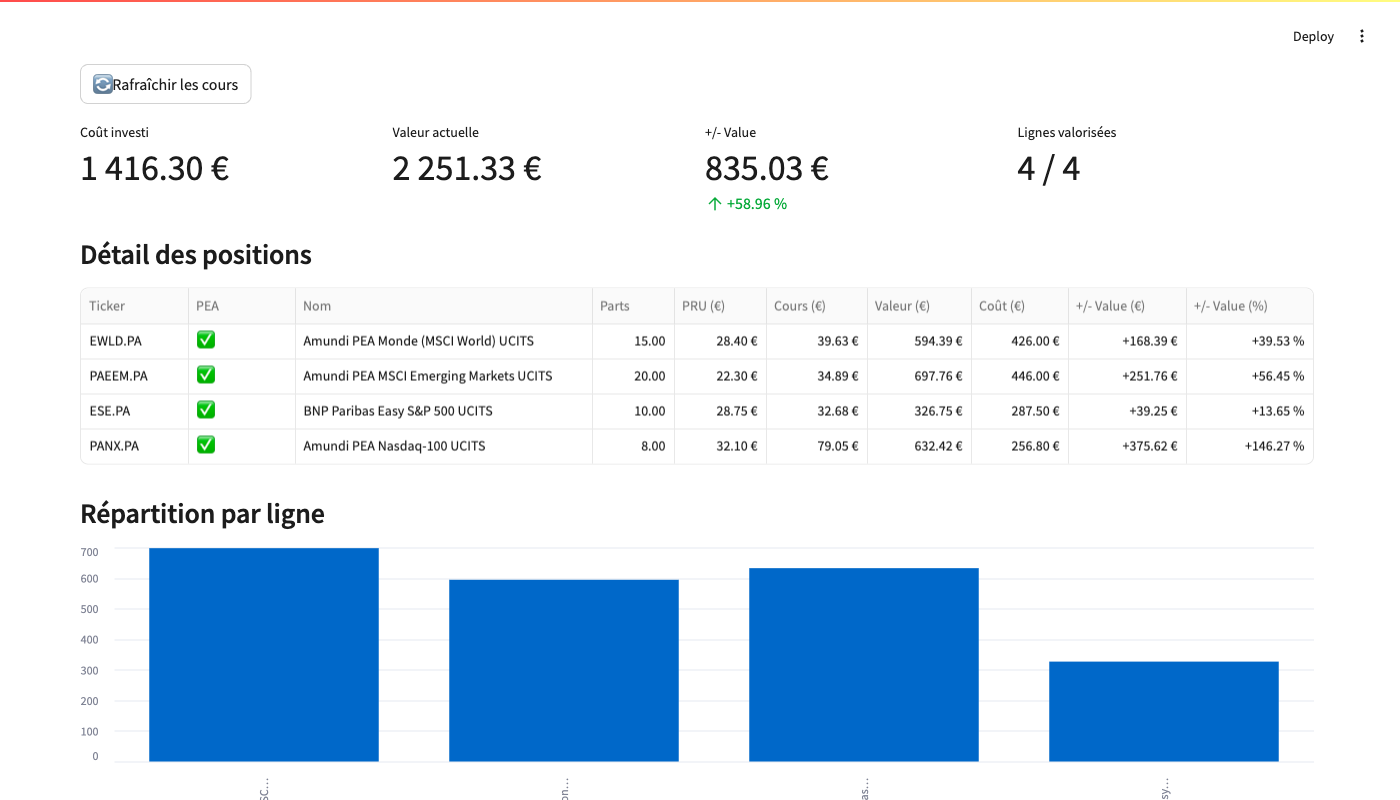
Streamlit "Portefeuille" tab — 4 holdings with live yfinance prices and PEA-eligibility badges (✅ from the audit cache).
Not a developer?
Three options if you don't write Python but want to check your PEA:
- Run the dashboard locally with the 3 commands above. No code edits required after
positions.csvis filled. - Upload via the HTTP API —
docker compose up -d apithenPOST /audit/uploadwith a PDF (Swagger docs at http://localhost:8080/docs). - Hire a developer — realistically the best option for non-technical PEA holders. The library exists so a hosted version of this is buildable in a weekend.
Contributing
See CONTRIBUTING.md. Maintainer? See PUBLISHING.md. Release history: CHANGELOG.md.
License
MIT.
1 maintainer

Metadata
1 maintainer
Release files for pea-audit 0.2.1
For a detailed explanation of source distributions (sdists) and built distributions (wheels), please see the package formats documentation.
Source distribution (sdist)
| File | Size | Uploaded | |
|---|---|---|---|
| pea_audit-0.2.1.tar.gz | 21.8 kB | Details |
Built distribution (wheel)
| File | Interpreter | ABI | Platform | Reset |
|---|---|---|---|---|
| pea_audit-0.2.1-py3-none-any.whl | Python 3 | none | any | Details |
Total release size: 55.0 kB
Release files / pea_audit-0.2.1.tar.gz
| Download URL | pea_audit-0.2.1.tar.gz |
|---|---|
| Size | 21.8 kB |
| Tags | Source |
|
SHA-256 checksum How to use checksums |
51038508275f12b5ba26af6090d6b7205deaa5076c147f1c6b75b23b72d62643
|
|
BLAKE2b-256 checksum How to use checksums |
502fea677a181fa20c48171d1670bb6b918771575c5d48156d356629182db84e
|
| Upload date | |
|
Uploaded using Trusted Publishing? What is trusted publishing? |
Yes |
| Uploaded via |
twine/6.1.0 CPython/3.13.12
|
Provenance
Provenance describes where a file came from. On PyPI, provenance is shared via attestations, which provide a verifiable record of the build or publishing details. View details, limitations and caveats.


PyPI Publish Attestation
PyPI verified that this artifact, at this checksum, originated from the publisher listed below.
Signed by GitHub Actions, verified by PyPI on May 24, 2026.
Transparency logRelease files / pea_audit-0.2.1-py3-none-any.whl
| Download URL | pea_audit-0.2.1-py3-none-any.whl |
|---|---|
| Size | 33.2 kB |
| Tags | Python 3 |
|
SHA-256 checksum How to use checksums |
da95da39a81e8c33fe1c004db721b3a5a47c1a3e59dc28d9afd3d672dd4a1269
|
|
BLAKE2b-256 checksum How to use checksums |
0da26e351512b1ca634257f89bba979577aabf5147154f0cd31a019ea584c7ea
|
| Upload date | |
|
Uploaded using Trusted Publishing? What is trusted publishing? |
Yes |
| Uploaded via |
twine/6.1.0 CPython/3.13.12
|
Provenance
Provenance describes where a file came from. On PyPI, provenance is shared via attestations, which provide a verifiable record of the build or publishing details. View details, limitations and caveats.
PyPI Publish Attestation
PyPI verified that this artifact, at this checksum, originated from the publisher listed below.
Signed by GitHub Actions, verified by PyPI on May 24, 2026.
Transparency log













