
UI tool to help you generate art (and experiment) with multimodal (text, image) AI models (stable diffusion)

Project description
Peacasso

Peacasso [Beta] is a UI tool to help you generate art (and experiment) with multimodal (text, image) AI models (stable diffusion). This project is still in development (see roadmap below).
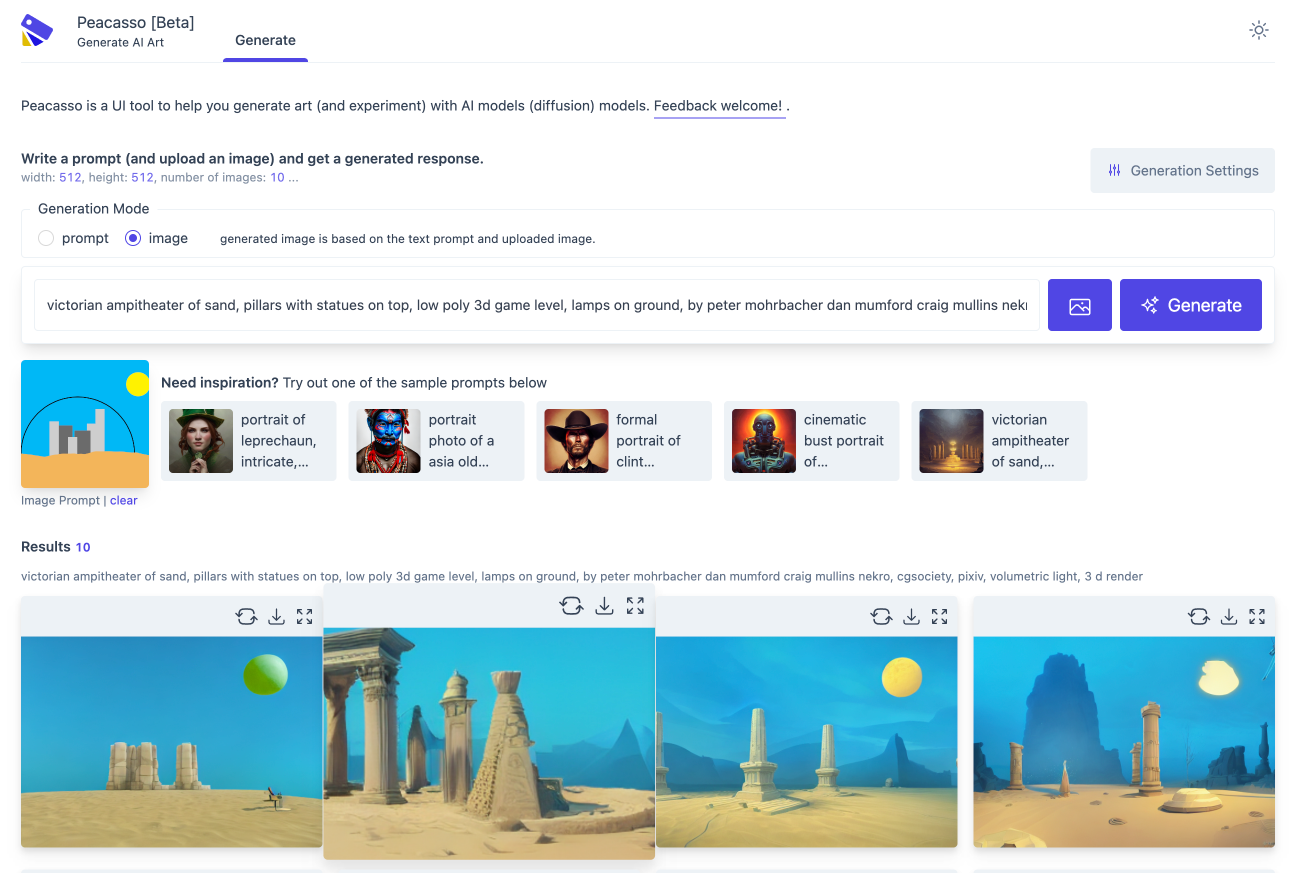
Why Use Peacasso?
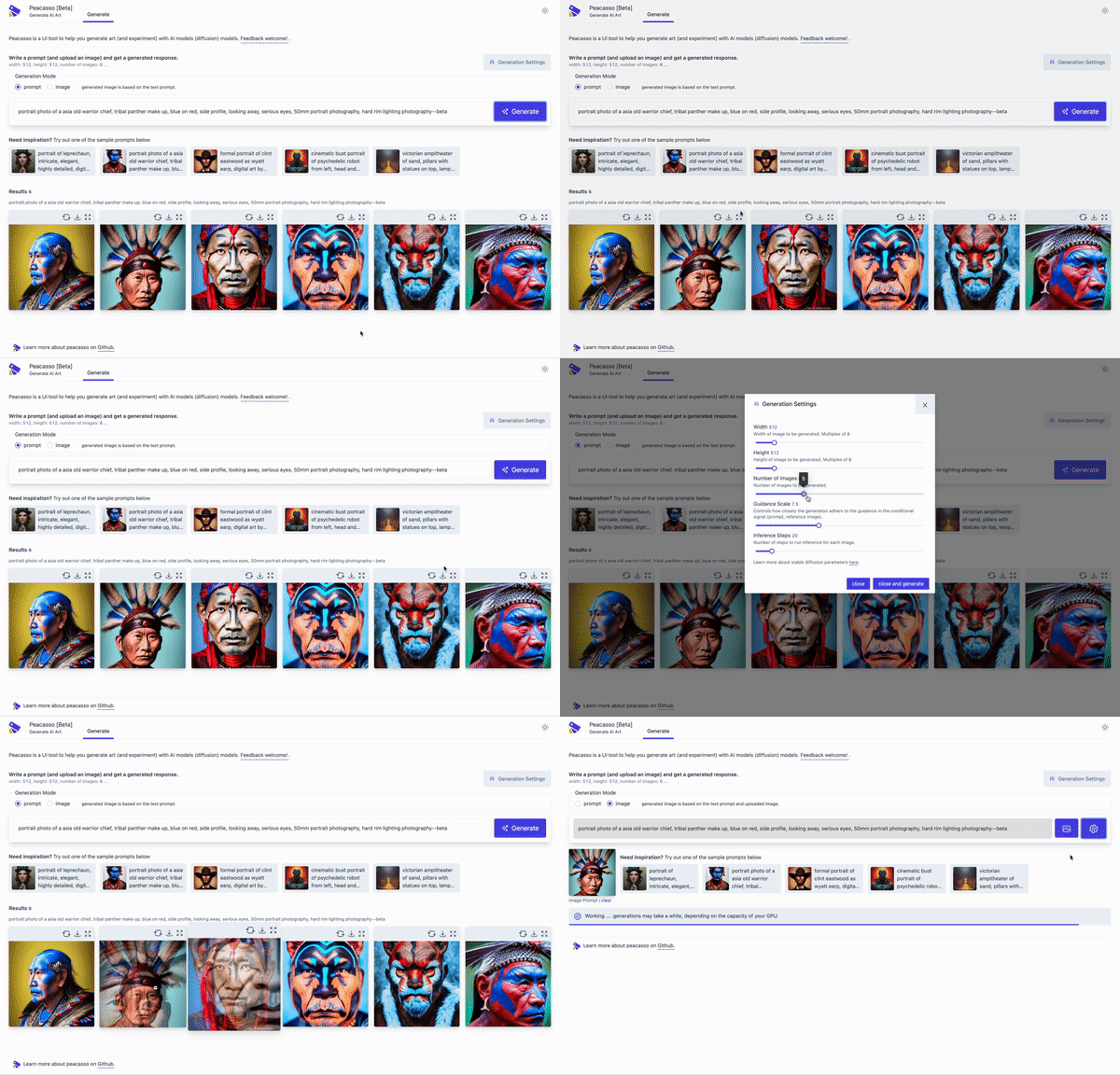
Because you deserve a nice UI and great workflow that makes exploring stable diffusion models fun! But seriously, here are a few things that make Peacasson interesting:
- Easy installation. Instead of cobbling together command line scripts, Peacasso provides a
pip installflow and a UI that supports a set of curated default operations. - UI with good defaults. The current implementation of Peacasso provides a UI for basic operations - text and image based prompting (+ inpainting), remixing generated images as prompts, model parameter selection, image download. Also covers the little things .. like light and dark mode.
- Python API. While the UI is the focus here, there is an underlying python api which will bake in experimentation features (e.g. saving intermediate images in the sampling loop, exploring model explanations etc. . see roadmap below).
Clearly, Peacasso (UI) might not be for those interested in low level code.
Requirements and Installation
- Step 1: Verify Environment - Pythong 3.7+ and CUDA
Setup and verify that your python environment is
python 3.7or higher (preferably, use Conda). Also verify that you have CUDA installed correctly (torch.cuda.is_available()is true) and your GPU has about 7GB of VRAM memory.
Once requirements are met, run the following command to install the library:
pip install peacasso
Want to stay on the bleeding edge of updates (which might be buggy)? Install directly from the repo:
git clone https://github.com/victordibia/peacasso.git
cd  peacasso
pip install -e .
Don't have a GPU, you can still use the python api and UI in a colab notebook. See this colab notebook for more details.
Usage - UI and Python API
You can use the library from the ui by running the following command:
peacasso ui --port=8080
Then navigate to http://localhost:8080/ in your browser.
You can also use the python api by running the following command:
from peacasso.generator import ImageGenerator
from peacasso.datamodel import GeneratorConfig, ModelConfig

# model configuration
model_config: ModelConfig = ModelConfig(
    device="cuda:0" , # device ..cpu, cuda, cuda:0
    model="nitrosocke/mo-di-diffusion",
    revision="main", # HF model branch
    token=None, # HF_TOKEN here if needed
)

prompt = "victorian ampitheater of sand, pillars with statues on top, lamps on ground, by peter mohrbacher dan mumford craig mullins nekro, cgsociety, pixiv, volumetric light, 3 d render"
prompt_config = GeneratorConfig(
    prompt=prompt,
    num_images=3,
    width=512,
    height=512,
    guidance_scale=7.5,
    num_inference_steps=20,
    return_intermediates=True, # return intermediate images during diffusion sampling
    seed=6010691039
)
result = gen.generate(prompt_config)
result = gen.generate(prompt_config)
for i, image in enumerate(result["images"]):
    image.save(f"image_{i}.png")

# result["intermediates"] contains the intermediate images

visualizing intermediate images during the diffusion loop.

Design Philosophy
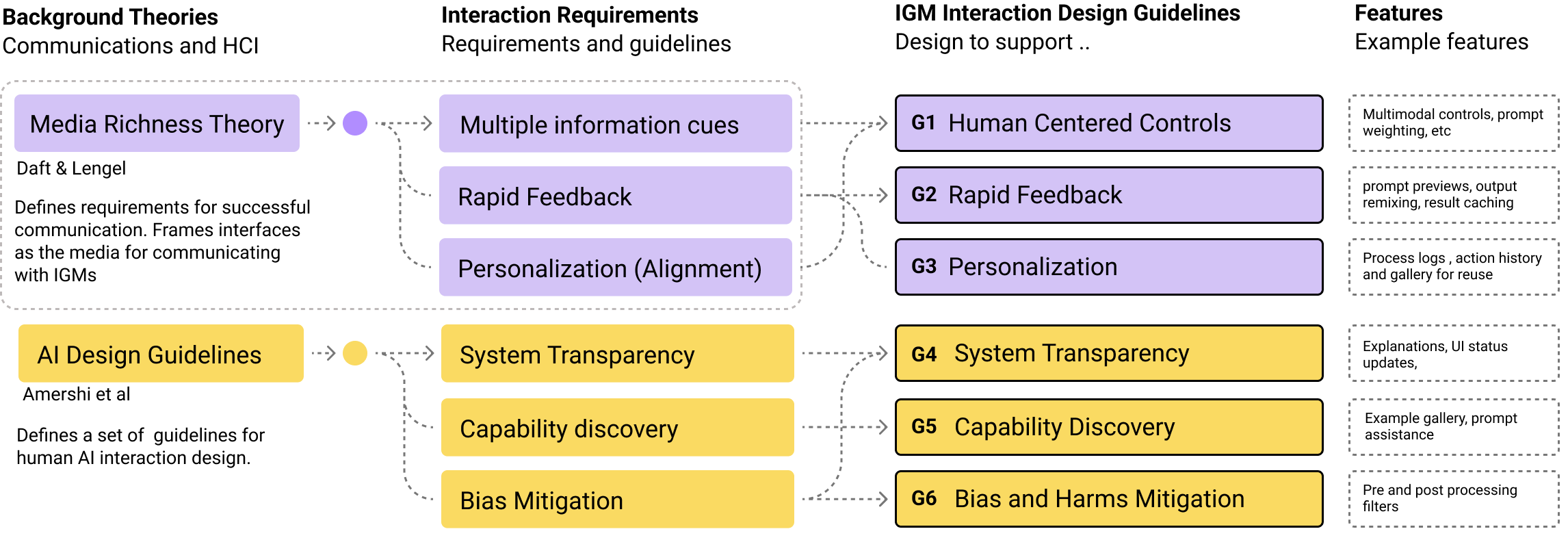
Features in Peacasso are being designed based on insights from communication theory [^1] and also research on Human-AI interaction design [^2]. Learn more about the design and components in peacasso in the paper here.
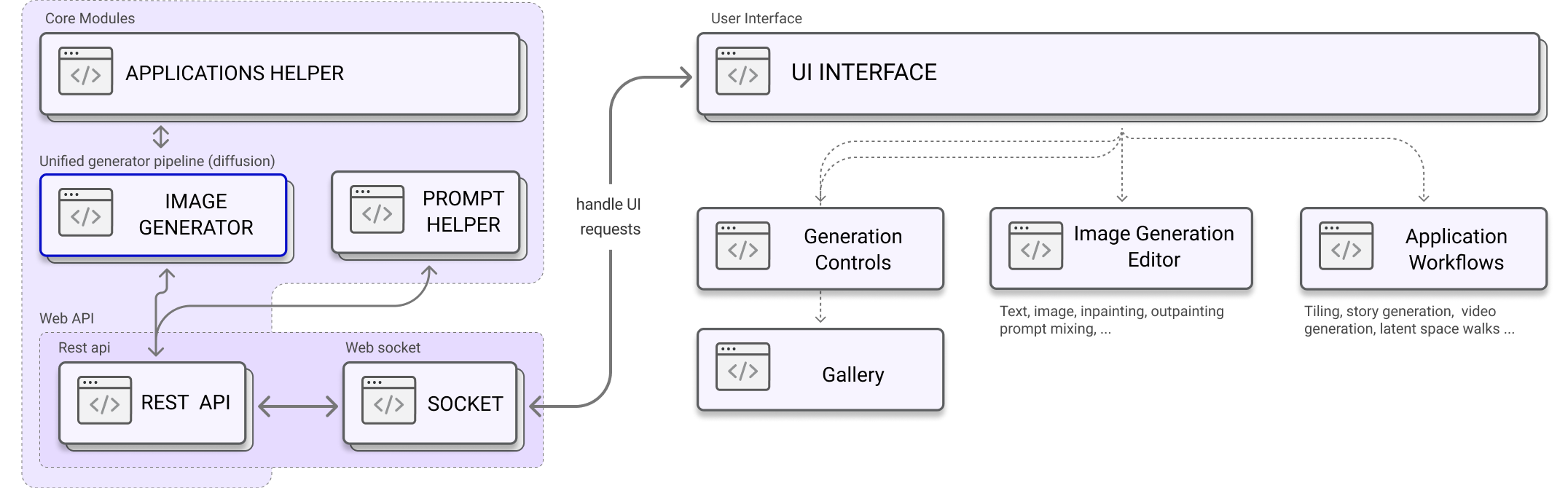
A general vision for the Peacasso architecture is shown below (parts of this are still being implemented):
Features and Road Map
- Command line interface
- UI Features. Query models with multiple parametrs
- Prompting: Text prompting (text2img), Image based prompting (img2img), Inpainting (img2img)
- Editor (for outpainting)
- Latent space exploration
- Experimentation tools
- Save intermediate images in the sampling loop
- Weighted prompt mixing
- Prompt recommendation
- Curation/sharing experiment results
- Defined Workflows (e.g., tiles, composition etc.)
- Model explanations
Acknowledgement
This work builds on the stable diffusion model and code is adapted from the HuggingFace implementation. Please note the - CreativeML Open RAIL-M license associated with the stable diffusion model.
Citation
If you use peacasso for in your research or adopt the design guidelines used to build peacasso, please consider citing as follows:
@misc{dibia2022peacasso,
      title={Interaction Design for Systems that Integrate Image Generation Models: A Case Study with Peacasso},
      author={Victor Dibia},
      year={2022},
      publisher={GitHub},
      journal={GitHub repository},
      year={2021},
      primaryClass={cs.CV}
}
References
[^1]: Richard L Daft and Robert H Lengel. 1986. Organizational information require- ments, media richness and structural design. Management science
[^2]: Saleema Amershi, Dan Weld, Mihaela Vorvoreanu, Adam Fourney, Besmira Nushi, Penny Collisson, Jina Suh, Shamsi Iqbal, Paul N Bennett, Kori Inkpen, et al. 2019. Guidelines for human-AI interaction. In Proceedings of the 2019 chi conference on human factors in computing systems.
Release history Release notifications | RSS feed


Download files
Download the file for your platform. If you're not sure which to choose, learn more about installing packages.
Source Distribution
Built Distribution
Filter files by name, interpreter, ABI, and platform.
If you're not sure about the file name format, learn more about wheel file names.
Copy a direct link to the current filters
File details
Details for the file Peacasso-0.0.16a0.tar.gz.
File metadata
- Download URL: Peacasso-0.0.16a0.tar.gz
- Upload date:
- Size: 4.2 MB
- Tags: Source
- Uploaded using Trusted Publishing? No
- Uploaded via: twine/4.0.1 CPython/3.9.12
File hashes
| Algorithm | Hash digest | |
|---|---|---|
| SHA256 |
d9e55289dd38a494dcbb484ec23396bdaf263028ef59ef8ae5421f450d676b95
|
|
| MD5 |
d4c8ef3191fd50eb3f551e3217528c6c
|
|
| BLAKE2b-256 |
a52ac01b4cdd27df0212946d74aa5495edb8dc111397e352a9a1bd23f1eed637
|
File details
Details for the file Peacasso-0.0.16a0-py3-none-any.whl.
File metadata
- Download URL: Peacasso-0.0.16a0-py3-none-any.whl
- Upload date:
- Size: 4.2 MB
- Tags: Python 3
- Uploaded using Trusted Publishing? No
- Uploaded via: twine/4.0.1 CPython/3.9.12
File hashes
| Algorithm | Hash digest | |
|---|---|---|
| SHA256 |
e1840c66d57d90a8ce429ab0434a365e7b79e567eb174c84232ba74d0d76377a
|
|
| MD5 |
ded399e5da73a60df53f0e151ababd8c
|
|
| BLAKE2b-256 |
0d59fab00dbcc1bbb5af2c5f711f0a620adba34a425e500af92a0469aa0b0924
|






