
A reinforcement learning model selection library using explainability

Project description
Pearl RL

A reinforcement learning model selection library using explainability
📖 Overview
Pearl RL is a cutting-edge library that revolutionizes reinforcement learning evaluation by using explainability techniques to compare agents based on their internal decision-making logic rather than just reward signals. This approach addresses a critical limitation in traditional RL evaluation where two agents may receive similar rewards but behave fundamentally differently.
🎯 Motivation
Traditional reinforcement learning evaluation relies heavily on scalar reward signals, which may not always reflect the true quality, stability, or safety of learned policies. Pearl RL addresses this by:
- Beyond Rewards: Evaluating agents based on their internal decision-making processes
- Explainability-Driven: Using interpretability techniques as core evaluation metrics
- Multi-Method Approach: Integrating SHAP, LIME, LMUT, stability analysis, and visual saliency
- Practical Applications: Designed for critical systems where explainability and reliability matter
🚀 Key Features
- Multiple Explainability Methods: SHAP, LIME, LMUT, Stability Analysis, Visual Saliency
- Agent Comparison Framework: Compare agents with similar rewards but different behaviors
- Environment Support: Atari games, Lunar Lander, and custom environments
- Flexible Architecture: Easy integration with existing RL agents and environments
- Visualization Tools: Tree structures, heatmaps, and decision explanations
- Production Ready: Designed for real-world applications in autonomous systems
📦 Installation
pip install pearl-rl
🏗️ Architecture
Pearl RL is built around four core components:
- Agents: RL agents with explainable decision-making
- Environments: Wrapped environments for Pearl compatibility
- Explainability Methods: Multiple techniques for agent evaluation
- Evaluation Framework: Tools for comparing and selecting agents
🎮 Quick Start
Basic Usage
from pearl import Pearl
from pearl.agents import SimpleDQN
from pearl.enviroments import GymRLEnv
from pearl.methods import ShapExplainability, LimeExplainability

# Create environment
env = GymRLEnv("LunarLander-v2")

# Create agents
agent_1 = SimpleDQN(env.observation_space, env.action_space)
agent_2 = SimpleDQN(env.observation_space, env.action_space)

# Initialize explainability methods
shap_explainer = ShapExplainability(device, mask)
lime_explainer = LimeExplainability(device, mask)

# Create Pearl instance
pearl = Pearl([agent_1, agent_2], env)

# Evaluate agents using explainability
scores = pearl.evaluate_with_explainability([shap_explainer, lime_explainer])
Advanced Example: Atari Game Evaluation
import torch
import torch.nn as nn
from pearl.agents.TourchDQN import TorchDQN
from pearl.enviroments.GymRLEnv import GymRLEnv
from pearl.methods import ShapExplainability, LimeExplainability, LMUTExplainability
from pearl.provided.AssaultEnv import AssaultEnvShapMask

# Define DQN architecture
class DQN(nn.Module):
    def __init__(self, n_actions: int):
        super().__init__()
        self.net = nn.Sequential(
            nn.Conv2d(4, 32, kernel_size=8, stride=4), nn.ReLU(),
            nn.Conv2d(32, 64, kernel_size=4, stride=2), nn.ReLU(),
            nn.Conv2d(64, 64, kernel_size=3, stride=1), nn.ReLU(),
            nn.Flatten(),
            nn.Linear(7 * 7 * 64, 512), nn.ReLU(),
            nn.Linear(512, n_actions)
        )

    def forward(self, x: torch.Tensor) -> torch.Tensor:
        return self.net(x)

# Setup
device = torch.device("cuda" if torch.cuda.is_available() else "cpu")
mask = AssaultEnvShapMask()

# Initialize explainers
shap_explainer = ShapExplainability(device, mask)
lime_explainer = LimeExplainability(device, mask)
lmut_explainer = LMUTExplainability(device, mask)

# Environment setup
env = GymRLEnv(
    env_name='ALE/Assault-v5',
    stack_size=4,
    frame_skip=4,
    render_mode='rgb_array'
)

n_actions = env.action_space.n

# Load trained agents
policy_net_good = DQN(n_actions)
agent_good = TorchDQN('models/dqn_assault_5m.pth', policy_net_good, device)

policy_net_bad = DQN(n_actions)
agent_bad = TorchDQN('models/dqn_assault_1k.pth', policy_net_bad, device)

agents = [agent_good, agent_bad]

# Prepare explainers
env.reset()
shap_explainer.set(env)
shap_explainer.prepare(agents)

lime_explainer.set(env)
lime_explainer.prepare(agents)

lmut_explainer.set(env)
lmut_explainer.prepare(agents)
lmut_explainer.collect_training_data(10000)
lmut_explainer.fit_models()

# Evaluation loop
scores_shap = [0, 0]
scores_lime = [0, 0]
scores_lmut = [0, 0]

for i in range(100):
    obs = env.get_observations()

    # Get explainability scores
    new_scores_shap = shap_explainer.value(obs)
    new_scores_lime = lime_explainer.value(obs)
    new_scores_lmut = lmut_explainer.value(obs)

    # Update cumulative scores
    scores_shap = [s + ns for s, ns in zip(scores_shap, new_scores_shap)]
    scores_lime = [s + ns for s, ns in zip(scores_lime, new_scores_lime)]
    scores_lmut = [s + ns for s, ns in zip(scores_lmut, new_scores_lmut)]

    # Select best agent based on explainability
    sum_scores = np.array(scores_shap) + np.array(scores_lime)
    best_agent = np.argmax(sum_scores)
    agent = agents[best_agent]

    # Take action
    action = agent.predict(obs)
    _, _, terminated, truncated, _ = env.step(action)

    if terminated:
        break

print(f"SHAP Scores: Good={scores_shap[0]:.2f}, Bad={scores_shap[1]:.2f}")
print(f"LIME Scores: Good={scores_lime[0]:.2f}, Bad={scores_lime[1]:.2f}")
print(f"LMUT Scores: Good={scores_lmut[0]:.2f}, Bad={scores_lmut[1]:.2f}")
Lunar Lander Example
import gymnasium as gym
import torch.nn as nn
from pearl.agents.TorchPolicy import TorchPolicyAgent
from pearl.methods import TabularLimeExplainability, LMUTExplainability
from pearl.provided.LunarLander import LunarLanderTabularMask

# Define REINFORCE network
class REINFORCE_Net(nn.Module):
    def __init__(self, input_dim: int, n_actions: int):
        super().__init__()
        self.fc1 = nn.Linear(input_dim, 256)
        self.fc2 = nn.Linear(256, 256)
        self.pi = nn.Linear(256, n_actions)

    def forward(self, x):
        x = torch.relu(self.fc1(x))
        x = torch.relu(self.fc2(x))
        return self.pi(x)

# Setup
device = torch.device("cuda" if torch.cuda.is_available() else "cpu")
env = gym.make("LunarLander-v3")
n_actions = env.action_space.n
input_dim = env.observation_space.shape[0]

# Load agents
agent_good = TorchPolicyAgent('models/lunar_lander_reinforce_500.pth',
                             REINFORCE_Net(input_dim, n_actions), device)
agent_bad = TorchPolicyAgent('models/lunar_lander_reinforce_10.pth',
                            REINFORCE_Net(input_dim, n_actions), device)
agents = [agent_good, agent_bad]

# Prepare explainers
training_data = np.array([env.reset()[0] for _ in range(500)])
feature_names = ["x_pos", "y_pos", "x_vel", "y_vel", "angle", "angular_vel", "leg1", "leg2"]

lime_mask = LunarLanderTabularMask(action_space=n_actions)
lime_explainer = TabularLimeExplainability(
    device=device,
    mask=lime_mask,
    feature_names=feature_names,
    training_data=training_data
)

lmut_mask = LunarLanderTabularMask(action_space=n_actions)
lmut_explainer = LMUTExplainability(device, lmut_mask)

# Setup and train
obs, _ = env.reset()
lime_explainer.set(env)
lime_explainer.prepare(agents)

lmut_explainer.set(env)
lmut_explainer.prepare(agents)
lmut_explainer.collect_training_data(5000)
lmut_explainer.fit_models()

# Evaluation
scores_lime = [0, 0]
scores_lmut = [0, 0]

for _ in range(500):
    obs_tensor = torch.tensor(obs, dtype=torch.float32, device=device).unsqueeze(0)

    lime_vals = lime_explainer.value(obs_tensor.cpu().numpy())
    lmut_vals = lmut_explainer.value(obs_tensor.cpu().numpy())

    scores_lime = [s + v for s, v in zip(scores_lime, lime_vals)]
    scores_lmut = [s + v for s, v in zip(scores_lmut, lmut_vals)]

    best_agent = np.argmax(scores_lime)
    action = agents[best_agent].predict(obs_tensor)

    obs, _, terminated, truncated, _ = env.step(action)
    if terminated or truncated:
        obs, _ = env.reset()

print(f"LIME Scores: Good={scores_lime[0]:.2f}, Bad={scores_lime[1]:.2f}")
print(f"LMUT Scores: Good={scores_lmut[0]:.2f}, Bad={scores_lmut[1]:.2f}")

# Generate visualizations
lmut_explainer.visualize_tree_structure(
    agent_idx=0,
    save_path="lmut_tree_visualizations/agent_0_tree_structure.png",
    feature_names=feature_names
)
📊 Results
LMUT Tree Visualization
Pearl RL provides powerful visualization tools to understand agent decision-making processes. Below is an example of LMUT (Linear Model U-Tree) analysis on Lunar Lander agents:
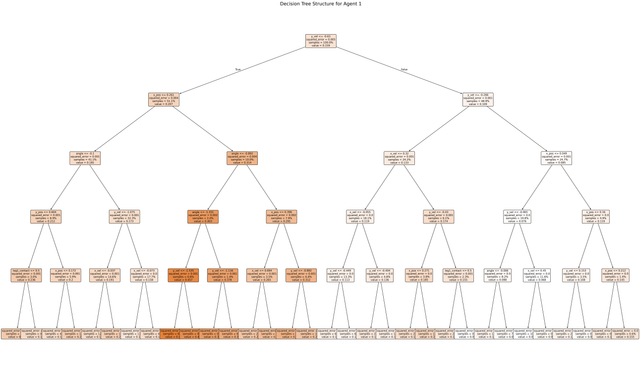
LMUT Tree Structure Analysis for Lunar Lander Agent 1
This visualization shows:
- Decision Tree Structure: How the agent partitions the state space
- Feature Importance: Which state variables (x_pos, y_pos, x_vel, y_vel, angle, angular_vel, leg1_contact, leg2_contact) are most critical for decision-making
- Policy Regions: Different decision regions based on state conditions
- Agent Behavior Patterns: Understanding of how the agent responds to different situations
The tree structure reveals that the agent primarily considers:
- Position and Velocity: Critical for landing trajectory planning
- Angular State: Important for orientation control
- Leg Contact: Essential for landing detection
This level of interpretability goes far beyond simple reward signals, providing deep insights into the agent's internal decision-making logic.
LIME Heatmaps
Pearl RL also provides LIME (Local Interpretable Model-agnostic Explanations) heatmaps that show which parts of the input are most important for agent decisions at different time steps:
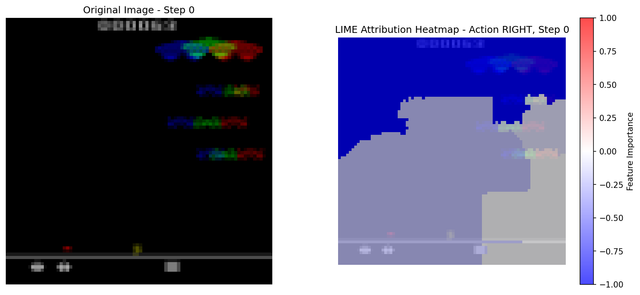
Step 0, Agent 0 |
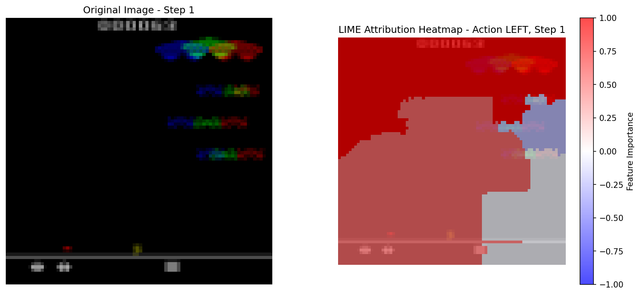
Step 1, Agent 1 |
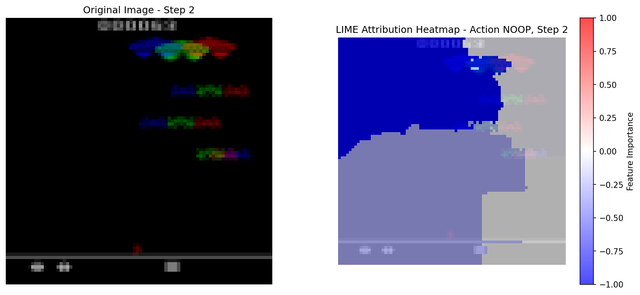
Step 2, Agent 0 |
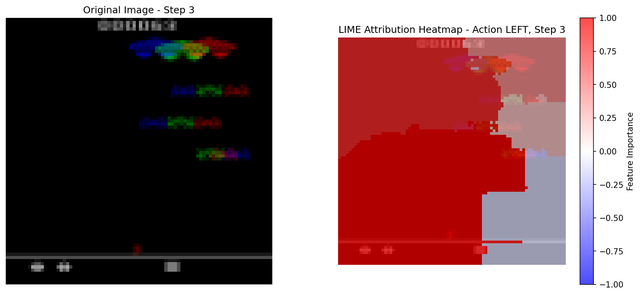
Step 3, Agent 1 |
LIME Heatmaps showing feature importance across different time steps and agents
These heatmaps demonstrate:
- Temporal Evolution: How agent focus changes over time
- Agent Differences: Different agents may focus on different input regions
- Feature Saliency: Which parts of the observation are most critical for decisions
- Decision Rationale: Understanding why agents make specific choices at each step
The heatmaps reveal that agents dynamically adjust their attention based on the current situation, providing valuable insights into their adaptive decision-making processes.
🔧 Core Components
Agents
Pearl RL supports various RL agent types:
- TorchDQN: Deep Q-Network agents
- TorchPolicy: Policy gradient agents (REINFORCE, A2C, etc.)
- SimpleDQN: Basic DQN implementation
- Custom Agents: Extend base classes for custom implementations
Environments
- GymRLEnv: Gymnasium environment wrapper
- ObservationWrapper: Custom observation preprocessing
- Provided Environments: Pre-configured Atari and Lunar Lander environments
Explainability Methods
SHAP (SHapley Additive exPlanations)
from pearl.methods.ShapExplainability import ShapExplainability

shap_explainer = ShapExplainability(device, mask)
shap_explainer.set(env)
shap_explainer.prepare(agents)
scores = shap_explainer.value(observation)
LIME (Local Interpretable Model-agnostic Explanations)
from pearl.methods.LimeExplainability import LimeExplainability

lime_explainer = LimeExplainability(device, mask)
lime_explainer.set(env)
lime_explainer.prepare(agents)
scores = lime_explainer.value(observation)
LMUT (Linear Model U-Tree)
from pearl.methods.LMUTExplainability import LMUTExplainability

lmut_explainer = LMUTExplainability(device, mask)
lmut_explainer.set(env)
lmut_explainer.prepare(agents)
lmut_explainer.collect_training_data(10000)
lmut_explainer.fit_models()
scores = lmut_explainer.value(observation)

# Visualize tree structure
lmut_explainer.visualize_tree_structure(
    agent_idx=0,
    save_path="tree_structure.png",
    feature_names=["feature1", "feature2", ...]
)
Stability Analysis
from pearl.methods.Stability import StabilityExplainability

stability_explainer = StabilityExplainability(
    device,
    noise_type='gaussian',
    noise_std=0.01,
    num_samples=5
)
stability_explainer.set(env)
stability_explainer.prepare(agents)
scores = stability_explainer.value(observation)
Tabular LIME
from pearl.methods.TabularLimeExplainability import TabularLimeExplainability

tabular_lime = TabularLimeExplainability(
    device=device,
    mask=mask,
    feature_names=["x_pos", "y_pos", "x_vel", "y_vel"],
    training_data=training_data
)
🎯 Use Cases
1. Agent Comparison
Compare agents with similar reward performance but different decision-making strategies.
2. Model Selection
Select the best agent based on explainability scores rather than just rewards.
3. Debugging
Understand why agents make specific decisions in critical situations.
4. Safety Analysis
Evaluate agent stability and robustness in noisy environments.
5. Research
Study the relationship between agent architecture and decision-making patterns.
📊 Evaluation Metrics
Pearl RL provides multiple evaluation perspectives:
- SHAP Scores: Feature importance-based evaluation
- LIME Scores: Local linear approximation scores
- LMUT Scores: Tree-based decision structure evaluation
- Stability Scores: Robustness to input perturbations
- Combined Scores: Weighted combination of multiple methods
🔬 Research Applications
Pearl RL is particularly valuable for:
- Autonomous Systems: Where explainability is critical for safety
- Network Optimization: Understanding routing and control decisions
- Game AI: Analyzing strategic decision-making
- Robotics: Evaluating control policies in real-world scenarios
- Healthcare: Understanding medical decision support systems
📚 Documentation
For detailed documentation and examples, visit our documentation page.
🤝 Contributing
We welcome contributions! Please see our contributing guidelines for details.
📄 License
This project is licensed under the MIT License - see the LICENSE file for details.
📖 Citation
If you use Pearl RL in your research, please cite:
@software{pearl_rl,
  title={Pearl RL: A Reinforcement Learning Model Selection Library Using Explainability},
  author={Youssef Rabie and Abdelrahman Mohamed Mahmoud Sobhy and Youssef Hagag},
  year={2025},
  url={https://github.com/P-E-A-R-L/Pearl}
}
🙏 Acknowledgments
Pearl RL builds upon the work of the reinforcement learning and explainable AI communities. We thank the contributors to PyTorch, Gymnasium, SHAP, LIME, and other open-source projects that make this work possible.
Release history Release notifications | RSS feed


Download files
Download the file for your platform. If you're not sure which to choose, learn more about installing packages.
Source Distribution
Built Distribution
Filter files by name, interpreter, ABI, and platform.
If you're not sure about the file name format, learn more about wheel file names.
Copy a direct link to the current filters
File details
Details for the file pearl_rl-0.1.2.tar.gz.
File metadata
- Download URL: pearl_rl-0.1.2.tar.gz
- Upload date:
- Size: 56.6 kB
- Tags: Source
- Uploaded using Trusted Publishing? No
- Uploaded via: twine/6.1.0 CPython/3.12.6
File hashes
| Algorithm | Hash digest | |
|---|---|---|
| SHA256 |
5fa0150e034c6f922d7aa8e419d662c2fa6d8226450cd9b04be20a2bce6ea2ae
|
|
| MD5 |
84ef8647cc156f8dcaf7c0402f5f29b0
|
|
| BLAKE2b-256 |
2c1baac8da044cdc75737d2423b8630cf9e4adf9e5fceea28bbf1bf6a319a82a
|
File details
Details for the file pearl_rl-0.1.2-py3-none-any.whl.
File metadata
- Download URL: pearl_rl-0.1.2-py3-none-any.whl
- Upload date:
- Size: 36.2 kB
- Tags: Python 3
- Uploaded using Trusted Publishing? No
- Uploaded via: twine/6.1.0 CPython/3.12.6
File hashes
| Algorithm | Hash digest | |
|---|---|---|
| SHA256 |
5ff44a34bc97820328165e593e21cb2782dfa6afc93bb37e3d8e485fcc7d8a66
|
|
| MD5 |
31cb8c95a73cf17c645908adbca7ddd7
|
|
| BLAKE2b-256 |
616d934f64a67e946b54f5e6ac86f70df3421e876f12bbad7db4d9ad0691dea4
|






