
Pearlarr




Pearlarr automatically grabs the releases SeaDex recommends for the anime in your Sonarr and Radarr libraries.
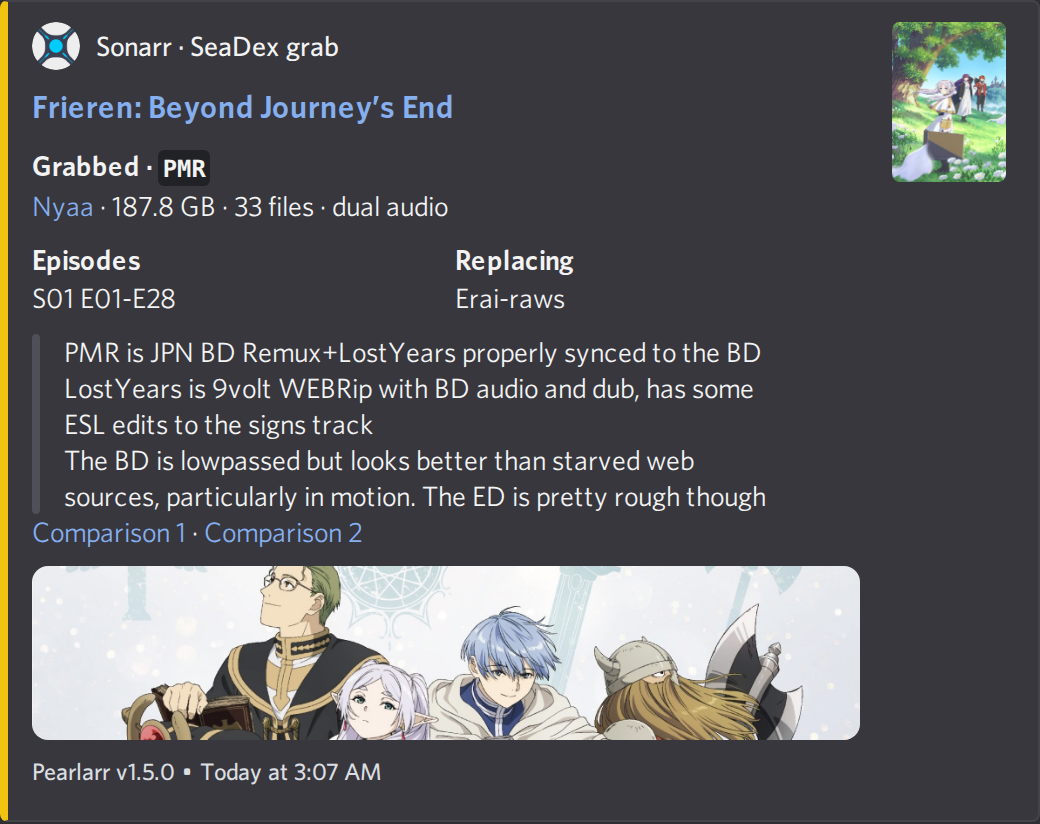
SeaDex is a community index of the best available release for each anime. On a schedule, Pearlarr maps your library to SeaDex's entries and grabs anything missing or outdated through qBittorrent. Each download can then flow into Sonarr and arrive as a notification on Discord:
How it works
Each run walks your library title by title:
- Map - Sonarr series and Radarr movies are resolved to AniList IDs (the key SeaDex indexes by) through three public ID-mapping sources.
- Check - the title's SeaDex entry is fetched, unless the cache shows nothing relevant changed since the last run.
- Select - the entry's torrents are cut down to the preferred release: your tag and tracker filters, SeaDex's "best" marks, your audio preference.
- Compare - the picks are matched against what the arr already has (release groups, episodes, file sizes), so only missing or outdated releases go further.
- Grab - the release is added to qBittorrent with your category and tags, a Discord notification goes out, and the result is cached.
- Import (optional, Sonarr) - Pearlarr waits for the downloads to finish and shepherds them into Sonarr, stepping in with a manual import when Sonarr can't place the files itself.
Here is that walk on a three-title library - one title already has SeaDex's pick, two get grabbed, and the wait pass drives both imports home:

Runs are incremental and safe to repeat: results live in a SQLite cache, a title is re-checked only when SeaDex or your arr changed something, and an interrupted run never corrupts state.
Install
Coming from upstream SeaDexArr? The config format and data locations changed - see migrating from upstream first.
uv / pipx / pip
Pearlarr needs Python 3.13 or newer. uv or pipx give it its own environment (and uv fetches a matching Python if your system's is too old):
$ uv tool install pearlarr # or: pipx install pearlarr
Plain pip install pearlarr works too, as does pip install -e . from a clone for the cutting edge.
Docker Compose
Copy docker-compose.example.yml to docker-compose.yml (or fold the pearlarr service into an existing stack), create the config directory yourself, and bring it up:
$ mkdir -p ./config
$ docker compose up -d pearlarr
On first boot the container writes a starter config.yml into ./config and restarts. Each run fails with a one-line error until the file is filled in.
Fill it in, then:
$ docker compose restart pearlarr
$ docker compose logs -f pearlarr
The container schedules its own runs. Set PEARLARR_CRON to change the cadence.
One-off commands run through the same service:
$ docker compose run --rm pearlarr run single --sonarr
$ docker compose run --rm pearlarr cache stats
Everything operational lives in docs/deployment.md: permissions and PUID/PGID, timezones, custom CAs, image tags, stopping safely, backups, upgrades.
First run
The step-by-step version of this section, with expected output, is docs/getting-started.md.
$ pearlarr config init
$ pearlarr paths          # shows where config.yml landed
Fill in just your Sonarr and/or Radarr connection first, then run one pass:
$ pearlarr run single
Without qBittorrent credentials, every run is a preview: Pearlarr evaluates your whole library and reports everything it would grab, but grabs nothing and records nothing.
That is the recommended way to check a new setup - read the preview's summary, adjust the config, repeat.
When the preview picks what you'd pick, add qbittorrent.host, username, and password, and the same command grabs for real.
(run single --dry-run simulates a run with no side effects even after credentials are set.)
Bare pearlarr runs the scheduled loop, one cycle every schedule.interval_hours. Under Docker the container's cron owns the cadence instead.
Configuration
config.yml is nested YAML in nine groups:
sonarr/radarr- connection details and per-arr behavior (unmonitored handling, torrent category).qbittorrent- WebUI credentials (blank = preview mode), tags, extra client options.seadex- how a release is chosen: tracker and tag filters, best/dual-audio preference, the private-release policy.imports- the wait-for-completion and Sonarr manual-import pass.notifications- the Discord webhook and a generic JSON webhook.schedule- the bare-metal loop's cadence.mappings- override or disable the ID-mapping sources.advanced- request pacing, cache lifetime, arr-activity detection, log level and format.
Every key, with its default, allowed values, and description, is in docs/configuration.md - generated from the source, so it is always current.
The starter config carries the same documentation as comments, and a $schema line gives editors completion and validation.
The config is validated on load: an unknown or misspelled key fails with an error naming it rather than being silently ignored.
pearlarr config validate checks the file and reports what a run would use. pearlarr config show prints the effective configuration with secrets redacted - safe to paste into a bug report.
Scope and limitations
- Downloads come from public trackers only, currently Nyaa, AnimeTosho, and RuTracker. A winning release on another public tracker is skipped with a warning and re-considered once support lands.
- Private releases are never grabbed - SeaDex carries no download link for them, and no private-tracker auth is supported.
seadex.private_releasesdecides what happens when a title's preferred release is private-only. - qBittorrent is the only download client. Usenet is out of scope. More clients and trackers are on the roadmap.
- The supported interfaces are the CLI, the config schema, the JSON event stream, and the notification payloads. Every Python import path is internal and may change without notice.
- Support is best-effort by a single maintainer.
SECURITY.md states what is promised - notably that logs and
config showoutput never contain secrets, so they are safe to paste.
Compatibility
| Supported | |
|---|---|
| Sonarr | 4.x (the v3 API) |
| Radarr | 5.x (the v3 API) |
| qBittorrent | 4.1 or newer, WebUI enabled |
| Python | 3.13+ (the Docker image ships its own 3.14) |
| OS | Linux, macOS, Windows (CI covers Linux and Windows). Docker images for amd64 and arm64 |
Documentation
- docs/getting-started.md - the first-sync walkthrough, install to verified grab.
- docs/configuration.md - every setting: defaults, allowed values, semantics.
- docs/cli.md - every command and option, with the exit codes.
- docs/deployment.md - Docker in depth, scheduling, backups, upgrades, uninstalling.
- docs/output.md - console, logs, the JSON event stream, and webhook payloads.
- docs/troubleshooting.md - symptoms, the messages behind them, and the fixes.
- docs/architecture.md - how Pearlarr is put together, and every external host it talks to.
- CHANGELOG.md - user-observable changes, with upgrade notes.
- CONTRIBUTING.md - dev setup, the quality gate, task playbooks.
- SECURITY.md - threat model, the redaction guarantee, reporting.
Acknowledgements
Pearlarr began as a fork of SeaDexArr by bbtufty. Release data comes from the SeaDex project, which Pearlarr is not affiliated with. ID mappings come from AniBridge Mappings, Kometa Anime-IDs, and Anime-Lists.
Pearlarr is licensed under GPL-3.0-or-later.
1 maintainer

Release files for pearlarr 1.5.0
For a detailed explanation of source distributions (sdists) and built distributions (wheels), please see the package formats documentation.
Source distribution (sdist)
| File | Size | Uploaded | |
|---|---|---|---|
| pearlarr-1.5.0.tar.gz | 377.3 kB | Details |
Built distribution (wheel)
| File | Interpreter | ABI | Platform | Reset |
|---|---|---|---|---|
| pearlarr-1.5.0-py3-none-any.whl | Python 3 | none | any | Details |
Total release size: 782.7 kB
Release files / pearlarr-1.5.0.tar.gz
| Download URL | pearlarr-1.5.0.tar.gz |
|---|---|
| Size | 377.3 kB |
| Tags | Source |
|
SHA-256 checksum How to use checksums |
c29040b3c1a9fcf5e515dc624fda6cc2c20cf79c8cec5f14833017716cd9a2fe
|
|
BLAKE2b-256 checksum How to use checksums |
753afdb8377502dd206140502ec810273cc707a087e9cf58dae1b363e85fba40
|
| Upload date | |
|
Uploaded using Trusted Publishing? What is trusted publishing? |
Yes |
| Uploaded via |
twine/7.0.0 CPython/3.13.14
|
Provenance
Provenance describes where a file came from. On PyPI, provenance is shared via attestations, which provide a verifiable record of the build or publishing details. View details, limitations and caveats.


PyPI Publish Attestation
PyPI verified that this artifact, at this checksum, originated from the publisher listed below.
Signed by GitHub Actions, verified by PyPI on Sep 24, 2026.
Transparency logRelease files / pearlarr-1.5.0-py3-none-any.whl
| Download URL | pearlarr-1.5.0-py3-none-any.whl |
|---|---|
| Size | 405.4 kB |
| Tags | Python 3 |
|
SHA-256 checksum How to use checksums |
cf86bb369b2a74a1b6db38bb76fe2ab5a1fb830c4102e41ed9924f48dd120e3b
|
|
BLAKE2b-256 checksum How to use checksums |
0e174916620ad6f27986e421531ea4805b2fb39f97b201eddbeeaa60136f7f1e
|
| Upload date | |
|
Uploaded using Trusted Publishing? What is trusted publishing? |
Yes |
| Uploaded via |
twine/7.0.0 CPython/3.13.14
|
Provenance
Provenance describes where a file came from. On PyPI, provenance is shared via attestations, which provide a verifiable record of the build or publishing details. View details, limitations and caveats.
PyPI Publish Attestation
PyPI verified that this artifact, at this checksum, originated from the publisher listed below.
Signed by GitHub Actions, verified by PyPI on Sep 24, 2026.
Transparency log













