
peer-consult




Let your coding agents ask each other for a second opinion, safely.
peer-consult connects Claude Code, OpenAI Codex CLI and Google Antigravity CLI (agy). From
any one of them you can:
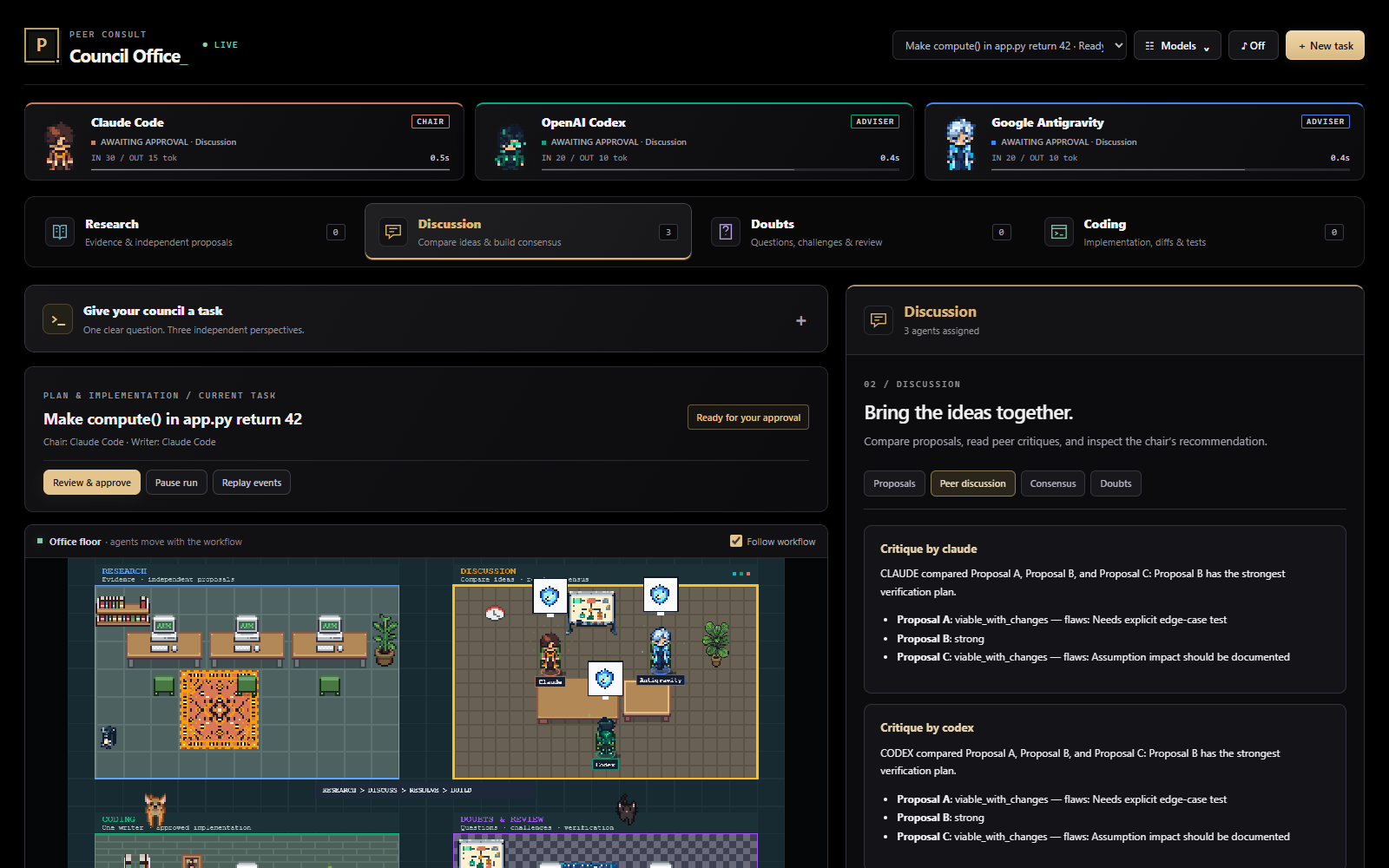
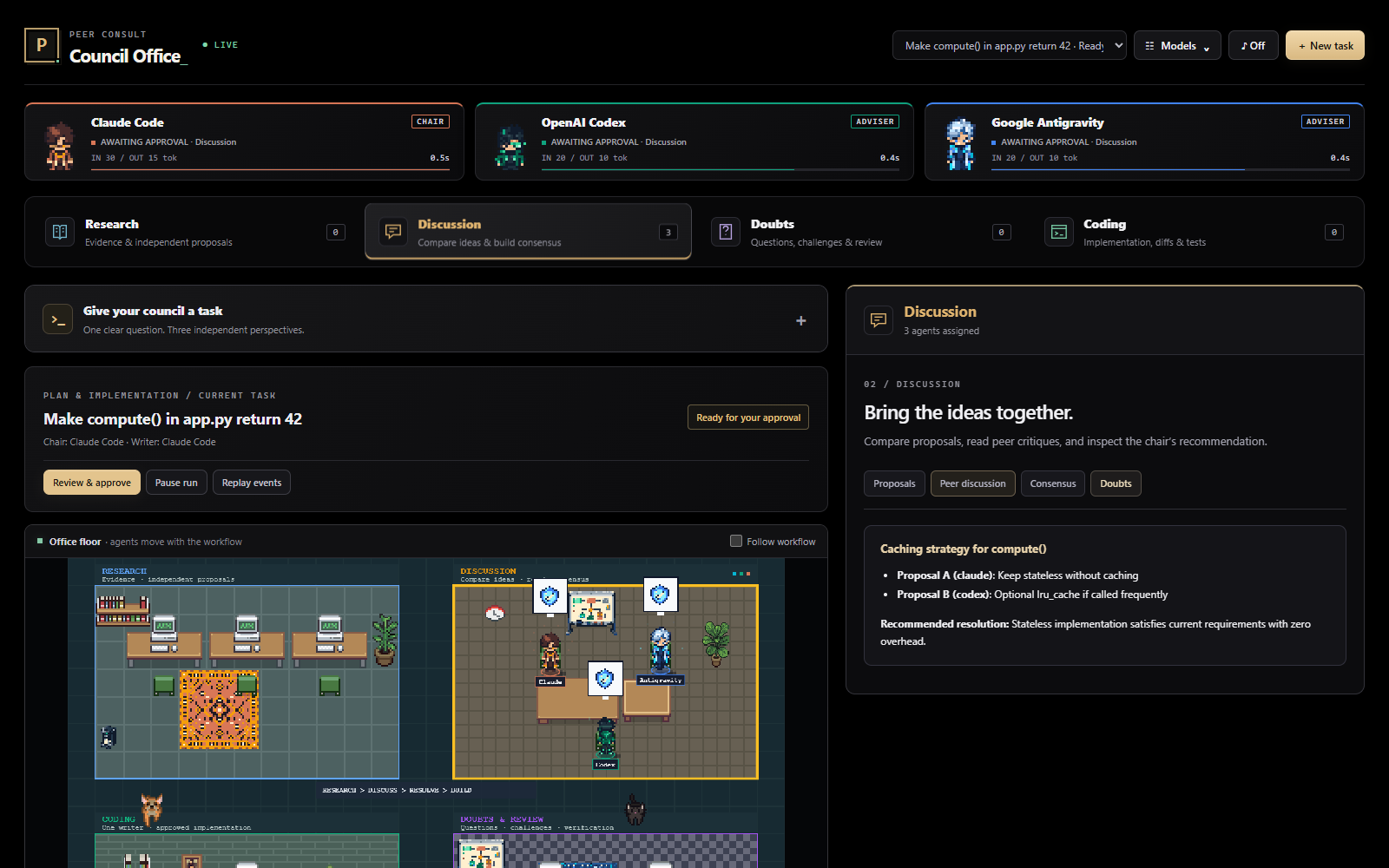
ask-*: consult one of the others as a bounded, read-only adviser. The adviser sees only the packet you send, runs with every tool disabled, and returns structured advice (assessment, recommendation, alternatives, risks, verification steps, confidence) as one JSON document.council: convene all three. They write independent proposals, critique each other anonymously (Proposal A/B/C), and a chair synthesizes a plan with an evidence ledger and the disagreements that remain. After you approve, one agent implements the plan in an isolated Git worktree. Tests then run, and the other two review the diff.- Pixel Office: watch the council work in a local real-time pixel-art office, inspect each agent, approve plans, and replay past runs.
Contents
- Requirements
- Install
- Using it from your agent
- Command line
- Configuration
- Security model
- Upgrading and uninstalling
- Known limitations
- Development
Requirements
-
Python 3.11+ on Windows, macOS or Linux.
-
At least two of these CLIs, installed and logged in:
Agent CLI Check Claude Code claudeclaude auth statusOpenAI Codex codexcodex login statusGoogle Antigravity agyagy modelsThe council needs all three.
-
gitforcouncil execute, which works in Git worktrees.
Install
# recommended: an isolated tool install
pipx install peer-consult            # or: uv tool install peer-consult

# install the skills into Claude Code, Codex and agy, and create a default config
peer-consult setup

# check executables, logins, models, sandbox flags and skills
peer-consult doctor            # add --live for one tiny real consultation against each installed CLI
To install the latest code from GitHub, use
pipx install git+https://github.com/arjunthilak05/peer-consult.
setup writes these skills (each one calls the exact interpreter peer-consult is installed in, so
they work no matter what is on PATH):
| Agent | Skills | Location |
|---|---|---|
| Claude Code | ask-codex, ask-agy, council |
~/.claude/skills/ (or $CLAUDE_CONFIG_DIR/skills/) |
| Codex | ask-claude, ask-agy, council |
~/.codex/skills/ (or $CODEX_HOME/skills/) |
| agy | ask-claude, ask-codex, council |
~/.gemini/config/skills/ |
It also creates ~/.peer-consult/config.toml the first time. After that it never overwrites the
config. If you edited a skill, setup leaves it alone and writes the new version next to it as
SKILL.md.peer-consult-new. Use --force to back up and replace, and --dry-run to preview.
Using it from your agent
Ask in plain language. The skill handles the packet and the call:
"Ask Codex to review this migration plan before we run it."
"Get Gemini's opinion on why this test is flaky; include the failing log."
"Convene the council on whether we should split the auth service."
The skills also tell agents to consult on their own when a second opinion is likely to change the outcome: repeated failed attempts, consequential design decisions, conflicting evidence, or a complex change before it is finalized. The calling agent stays responsible. It weighs the advice, verifies claims, and tells you which recommendations it adopted or rejected and why.
Command line
ask: one adviser
peer-consult ask --caller claude --target codex --request-file req.json [--delete-request-file]
peer-consult ask --caller codex  --target agy   < req.json
#   [--model ID] [--effort LEVEL] [--timeout SECONDS] [--output-file out.json] [--dry-run] [--base-dir DIR]
A minimal request is {"question": "..."}. The full packet also accepts task_id, help_type
(diagnosis | design_critique | experiment_review | code_review | other), goal, constraints,
tried, observations, hypothesis, snippets, files (explicit path + line range, read by the
helper), diff, revision, experiment_results, previous_advice and follow_up.
stdout is a single JSON document. Progress goes to stderr.
{"status": "ok", "request_id": "...", "task_id": "...", "caller": "claude", "target": "codex",
 "model": {"requested": "...", "reported": null, "fallback_detected": null},
 "effort": {"requested": "max", "observed": null},
 "elapsed_seconds": 41.2, "budget": {"used": 1, "max": 2},
 "context": {"chars": 5120, "approx_tokens_estimate": 1280, "packet_sha256": "...", "files": [], "redactions": {}},
 "advice": {"assessment": "...", "recommendation": "...", "alternatives": [{"option": "...", "tradeoffs": "..."}],
            "risks": [], "verification_steps": [], "missing_context": [], "proposed_code": "", "confidence": "medium"},
 "error": null, "warnings": []}
| Exit code | Meaning |
|---|---|
0 |
ok |
2 |
usage or config error |
3 |
refused: recursion, budget exhausted, packet too large, credential-like file |
4 |
provider error: auth, billing, model unavailable, malformed output, isolation breach |
5 |
timeout |
130 |
cancelled |
council: three agents
peer-consult council discuss -q "Should we migrate session caching from Redis to DragonFly?"
peer-consult council plan    -q "Add WebAuthn to the login flow" --file src/auth/login.py --chair claude
peer-consult council execute --run-id <run_id> --approve [--writer codex] [--test-cmd "pytest -q"]
peer-consult council status  [--run-id <run_id>]
peer-consult council resume  --run-id <run_id>      # skips stages that already completed
peer-consult council cancel  --run-id <run_id>
peer-consult council report  --run-id <run_id> [--format markdown|json]
peer-consult council doctor
peer-consult council office  [--host 127.0.0.1] [--port 4173] [--no-browser]
          ┌──────────── 1. independent proposals (parallel, read-only) ────────────┐
          │        claude                    codex                    agy          │
          └────────────────────────────────────┬───────────────────────────────────┘
                         2. anonymized cross-critique (Proposal A/B/C)
                                               │
                         3. chair synthesis: plan, evidence & assumption ledgers,
                            unresolved disagreements, authorized_files
                                               │
                         4. HUMAN APPROVAL  (plan mode stops here)
                                               │
                         5. single writer in a dedicated git worktree + lock
                            (changes outside authorized_files are reverted)
                                               │
                         6. deterministic tests  →  7. two read-only peer reviews
                                               │
                         at most 2 repair rounds → draft branch + report (never merged)
The office (council office) serves the same runs in the browser at http://127.0.0.1:4173/?token=….
The bearer token is printed on start.
Configuration
~/.peer-consult/config.toml:
[codex]
model = "gpt-6-astra"
effort = "max"          # "ultra" is rejected: it delegates to subagents
command = []            # optional explicit argv prefix, e.g. ["/usr/bin/node", "/path/to/codex.js"]

[claude]
model = "claude-fable-5-1"
effort = "max"
auth = "inherit"        # "subscription" removes ANTHROPIC_API_KEY from the adviser env so your claude.ai login is used

[agy]
model = "gemini-4-argon"
effort = "high"         # the agy CLI rejects "max" for this model

[limits]
timeout_seconds = 1200
max_request_chars = 200000   # oversized packets are refused, never truncated

[budget]
max_consultations_per_task = 2   # one consultation + one follow-up per task_id

[council]
chair = "claude"
quorum = 3

[execute]
default_writer = "claude"
max_repairs = 2
require_approval = true

[office]
host = "127.0.0.1"
port = 4173
The generated file documents every key. There is no fallback chain: if a model or effort is
unavailable, the call fails loudly and never silently downgrades. Per-call overrides:
--model, --effort, --timeout.
| Environment variable | Effect |
|---|---|
PEER_CONSULT_HOME |
state and config directory (default ~/.peer-consult) |
PEER_CONSULT_CONFIG |
explicit config file path |
CLAUDE_CONFIG_DIR, CODEX_HOME |
honoured when installing and disabling skills |
PEER_CONSULT_DEPTH |
set inside advisers. When it is present, peer-consult refuses to consult (recursion guard) |
Security model
Advisers are read-only by construction, not just by instruction:
Claude (claude -p):
--tools ""removes every built-in tool.--strict-mcp-configwithout--mcp-configremoves every MCP server.--safe-modeloads no CLAUDE.md, skills, plugins or hooks.--disable-slash-commandsand--no-session-persistence.--permission-mode dontAsk, a custom system prompt and--json-schema.- Runs in an empty temporary directory.
Codex (codex exec):
--sandbox read-only,approval_policy="never"and--ignore-user-config --ignore-rules --ephemeral.- Web search and subagents are off.
- Disabled features: shell, unified exec, multi-agent, code-mode host, hooks, plugins, apps, memories, browser and computer use, goals, image generation.
- Its own
ask-*skills are hidden. - Runs in an empty temporary directory.
agy:
- agy has no flag that removes tools. Instead, the empty workspace gets a
PreToolUsehook that denies every tool exceptfinish(how agy returns schema output). The hook fails closed. - After the run, the parser rejects any non-
finishtool step that did not end inERROR(isolation_breach) and discards that advice.
All advisers:
PEER_CONSULT_DEPTH=1is set, so an adviser cannot consult further.- Every session is fresh and stateless. Follow-ups resend the earlier advice explicitly.
- Credential-like files (
.env, keys,auth.json,~/.ssh, …) are refused. - Secret-looking strings are redacted as a second line of defence.
Council execution:
- Nothing is written without explicit approval:
--approve, or the HMAC approval token issued byplan. - The generated
councilskill tells agents that only the human user may approve. - Writes happen only in a dedicated worktree, under a single-writer lock.
- Edits outside
authorized_filesare detected and reverted. - Nothing is merged, pushed or deployed.
Pixel Office:
- Binds to
127.0.0.1by default and requires a bearer token. - Binding to another interface prints a warning.
Report vulnerabilities privately; see SECURITY.md.
Upgrading and uninstalling
pipx upgrade peer-consult && peer-consult setup     # re-render skills for the new version
peer-consult uninstall                              # removes the skill files setup wrote, if unmodified
pipx uninstall peer-consult                         # then remove the package
uninstall keeps ~/.peer-consult (config, run history, budget state). Delete it by hand if you
want a clean slate.
If you used the pre-package install.py, its old peer-consult launcher may block the new
command. Install with --force (pipx install --force peer-consult or
uv tool install --force peer-consult), then run peer-consult setup once. Setup removes the old
~/.peer-consult/runtime copy and launchers, but only files it wrote that you have not modified.
It warns if the old launcher is still first on PATH.
Known limitations
- Model identity is only partly observable. Codex and agy do not report the serving model or the
applied effort, so those fields are
null. Claude's serving model comes from its usage metadata, and peer-consult flags any mismatch asfallback_detected. - Process-tree containment on Windows. The adviser is assigned to a Job Object just after
Popen. A grandchild spawned in that sub-millisecond window is caught only bytaskkill /T. - Codex or agy as the calling agent need approval. The helper launches other CLIs, which need
network access and write their own state under your profile. A sandboxed Codex session must
request escalation. Headless
agy -pauto-denies the command, so use agy interactively and approve it. - agy keeps its conversations. agy has no ephemeral mode, so adviser conversations are stored
under
~/.gemini/antigravity-cli/like any other. agy also loads your global skills and rules, but it cannot act on them because every tool is denied.
The design record behind the council is in docs/architecture.md.
Development
git clone https://github.com/arjunthilak05/peer-consult && cd peer-consult
python -m venv .venv && . .venv/bin/activate        # Windows: .venv\Scripts\activate
pip install -e ".[dev]"

pytest                    # Python suite; provider CLIs are replaced by tests/fake_cli.py
ruff check .

cd office-ui && npm ci
npm test                  # Vitest
npm run build             # rebuilds peer_consult/office_dist (commit the result)
npx playwright install chromium && npx playwright test   # browser end-to-end (UPDATE_DOCS_SCREENSHOTS=1 refreshes docs/screenshots)
See CONTRIBUTING.md.
License
MIT. The Pixel Office adapts the engine and sprites of Pixel Agents (MIT); see THIRD_PARTY_NOTICES.md. peer-consult is an independent project, not affiliated with Anthropic, OpenAI or Google.
1 maintainer

Metadata
1 maintainer
Release files for peer-consult 1.0.0
For a detailed explanation of source distributions (sdists) and built distributions (wheels), please see the package formats documentation.
Source distribution (sdist)
| File | Size | Uploaded | Provenance | Actions |
|---|---|---|---|---|
| peer_consult-1.0.0.tar.gz | 496.8 kB | With provenance | Details for peer_consult-1.0.0.tar.gz |
Built distribution (wheel)
| File | Interpreter | ABI | Platform | Actions Reset |
|---|---|---|---|---|
| peer_consult-1.0.0-py3-none-any.whl | Python 3 | none | any | Details for peer_consult-1.0.0-py3-none-any.whl |
Total release size: 878.3 kB
Release files / peer_consult-1.0.0.tar.gz
| Download URL | peer_consult-1.0.0.tar.gz |
|---|---|
| Size | 496.8 kB |
| Tags | Source |
|
SHA-256 checksum How to use checksums |
758943cbe326a7190ae421dae58efa35ba9ff1b9f90f43ced2c3059424292684
|
|
BLAKE2b-256 checksum How to use checksums |
d2b0def8301bd311995cbf94a2b35b38c4b714023b0f25d6cb10dfe01e66bb66
|
| Upload date | |
|
Uploaded using Trusted Publishing? What is trusted publishing? |
Yes |
| Uploaded via |
twine/7.0.0 CPython/3.13.16
|
Provenance
Provenance describes where a file came from. On PyPI, provenance is shared via attestations, which provide a verifiable record of the build or publishing details. View details, limitations and caveats.


PyPI Publish Attestation
PyPI verified that this artifact, at this checksum, originated from the publisher listed below.
Signed by GitHub Actions, verified by PyPI on Nov 12, 2026.
Transparency logRelease files / peer_consult-1.0.0-py3-none-any.whl
| Download URL | peer_consult-1.0.0-py3-none-any.whl |
|---|---|
| Size | 381.5 kB |
| Tags | Python 3 |
|
SHA-256 checksum How to use checksums |
656e7dcf3a076b2d8efe778fa77fbcfb63c3268741f9be9b7e679f616a304ef6
|
|
BLAKE2b-256 checksum How to use checksums |
13ac2a268fb3f533f7c2c00cae4bc2f3e33fd2e0b7401090e3e490a10b547fa2
|
| Upload date | |
|
Uploaded using Trusted Publishing? What is trusted publishing? |
Yes |
| Uploaded via |
twine/7.0.0 CPython/3.13.16
|
Provenance
Provenance describes where a file came from. On PyPI, provenance is shared via attestations, which provide a verifiable record of the build or publishing details. View details, limitations and caveats.
PyPI Publish Attestation
PyPI verified that this artifact, at this checksum, originated from the publisher listed below.
Signed by GitHub Actions, verified by PyPI on Nov 12, 2026.
Transparency logSecurity for peer-consult 1.0.0
Provenance
Provenance describes where a file came from. On PyPI, provenance is shared via attestations, which provide a verifiable record of the build or publishing details. View details, limitations and caveats.
Full provenance
Both files in this release have been uploaded with provenance metadata.
Attestation for peer_consult-1.0.0.tar.gz
PyPI Publish Attestation
PyPI verified that this artifact, at this checksum, originated from the publisher listed below.
Signed by GitHub Actions, verified by PyPI on Nov 12, 2026.
Transparency logA note on package security
PyPI is a repository for distributing packages, not a service for auditing them. While third-party security researchers and our staff do their best to detect and remove malicious packages, PyPI cannot guarantee the quality, security or suitability of any given package.
To learn more about protecting yourself from malicious actors, visit our package security documentation.













