
peering-mcp




An MCP server that lets an AI agent look up how the internet is actually wired together — which networks connect to each other, at which internet exchanges and facilities, under what peering policy, and who a given address range is registered to.
Five read-only tools over two public sources: PeeringDB for interconnection, and the regional internet registries over RDAP for registration. Upstream responses are validated and shaped, free text is stripped of structure before it reaches a model, requests are rate limited to what PeeringDB asks for, and answers are cached on disk between runs. Every response is held to a byte budget.
Install it with uvx peering-mcp. A personal project, MIT licensed.
Why this exists
The internet is roughly eighty thousand independent networks that agree to carry each other's traffic. Which networks connect to which, where they meet, and on what terms is public, free and well structured — published through stable APIs by PeeringDB and the regional internet registries.
None of it is reachable by an AI agent. Ask a coding assistant which internet exchanges a given carrier is present at and it will answer from memory: fluent, confident, and often wrong. It has no way to check, so it does not check.
This server is that way to check.
What it does
| Tool | Question it answers |
|---|---|
lookup_network |
Who is this network, and what is their peering policy? |
list_presence |
Which internet exchanges and facilities are they present at? |
find_at_exchange |
Who else is at this exchange, and would they peer? |
find_common_presence |
Where can these networks meet each other? |
lookup_registration |
Who is this IP range or AS number registered to? |
find_common_presence is the tool that motivated the project. Working out where two or more networks could interconnect means looking each one up, listing everywhere it is present, and intersecting the results by hand. That is about an hour and a dozen browser tabs. It should be one question.
It takes two to five AS numbers and answers in four requests, whatever the number of networks. Shared exchanges come back widest bottleneck first — ordered by the smallest capacity any one network has there, because that is what a connection between them would be limited by.
It also returns how many locations each network has on its own, so an empty answer is explainable: either the networks genuinely do not overlap, or one of them has no records at all, which is a very different thing.
find_at_exchange asks it the other way round: who is already at DE-CIX Frankfurt, and which of them will peer with anyone. It takes an exchange name or its PeeringDB id, optionally keeps only the networks stating one peering policy, and returns them largest capacity first. A name matching several exchanges — ten of them are called LINX, on four continents — comes back as candidates to choose between, never a guess at which one was meant.
lookup_registration is the one tool here that does not read PeeringDB. It asks the registry that made the allocation — RIPE NCC, ARIN, APNIC, LACNIC or AFRINIC — and answers with the holder, the allocation date, the range the registration actually covers, and where to report abuse. Which registry to ask is itself a lookup, resolved from IANA's own bootstrap files rather than through a third-party redirector, so the answer can say who it came from.
Ask about one address and you get the block it sits in: 8.8.8.8 is answered with 8.8.8.0 - 8.8.8.255, registered to Google LLC. A range no registry is responsible for, such as 240.0.0.0/8, is answered without a request leaving the machine.
What a result looks like
Asking lookup_network for AS3320 returns this — the whole response, 854 bytes on the wire, against a 42-field upstream record:
{
  "status": "ok",
  "data": {
    "network": {
      "asn": 3320,
      "name": "Deutsche Telekom",
      "long_name": "Deutsche Telekom AG",
      "website": "https://wholesale.telekom.com",
      "network_type": "NSP",
      "traffic_estimate": "50-100Tbps",
      "scope": "Global",
      "traffic_ratio": "Mostly Inbound",
      "ipv4_prefixes": 150000,
      "ipv6_prefixes": 40000,
      "exchange_count": 7,
      "facility_count": 53,
      "policy": {
        "general": "Restrictive",
        "locations": "Required - International",
        "ratio_required": true,
        "contract_required": "Required",
        "url": null
      },
      "irr_as_set": "AS3320:AS-DTAG AS3320:AS-DTAG-V6",
      "looking_glass": "https://lg.telekom.com"
    },
    "candidates": []
  },
  "note": "PeeringDB records are maintained by the networks themselves. Treat a missing field as unrecorded, not as evidence it is untrue.",
  "provenance": {
    "source": "peeringdb",
    "fetched_at": "2026-09-14T16:44:53.916085Z",
    "record_updated": "2026-08-31T13:30:19Z",
    "from_cache": false
  }
}
The status field is the first thing to read, and ok means one thing only: the answer is in data. A name matching several networks returns ambiguous with the candidates to choose between, never a guess at which one was meant. An AS number that is not listed returns not_found, with a note saying a network can route traffic without being registered.
Three questions, three answers
Real responses, trimmed where marked. Nothing here is illustrative: each one is what the tool returned on 2026-09-19.
"Where could Deutsche Telekom and Hurricane Electric peer with each other?" — one call to find_common_presence with [3320, 6939], four upstream requests:
{
  "status": "ok",
  "data": {
    "networks": [
      { "asn": 3320, "name": "Deutsche Telekom", "exchanges": 7, "facilities": 53 },
      { "asn": 6939, "name": "Hurricane Electric", "exchanges": 335, "facilities": 342 }
    ],
    "exchanges": {
      "items": [
        {
          "name": "NL-ix",
          "city": "Amsterdam, Rotterdam, Brussels, Luxembourg, Frankfurt,…",
          "country": "NL",
          "networks": [
            { "asn": 3320, "speed_mbps": 220000, "ports": 2, "route_server": false },
            { "asn": 6939, "speed_mbps": 400000, "ports": 1, "route_server": true }
          ]
        },
        {
          "name": "DE-CIX Frankfurt",
          "city": "Frankfurt",
          "country": "DE",
          "networks": [
            { "asn": 3320, "speed_mbps": 110000, "ports": 1, "route_server": false },
            { "asn": 6939, "speed_mbps": 800000, "ports": 1, "route_server": true }
          ]
        }
      ],
      "total": 6,
      "truncated": false
    }
  }
}
Six shared exchanges, widest bottleneck first: NL-ix leads because the narrower of the two networks has 220 Gbps there, not because anyone has more in total. The per-network totals underneath are what make an empty answer readable — Deutsche Telekom records 7 exchanges in all, so "no overlap" would mean something different from Hurricane Electric's 335.
"Who is already at DE-CIX Frankfurt, and would they peer with anyone?" — find_at_exchange with policy: "Open":
{
  "status": "ok",
  "data": {
    "exchange": { "exchange_id": 31, "name": "DE-CIX Frankfurt", "city": "Frankfurt", "country": "DE", "networks_recorded": 1020 },
    "networks": {
      "items": [
        { "asn": 24940, "name": "Hetzner Online", "speed_mbps": 2800000, "ports": 3, "route_server": true, "policy": "Open" },
        { "asn": 20940, "name": "Akamai Technologies", "speed_mbps": 2100000, "ports": 4, "route_server": true, "policy": "Open" }
      ],
      "total": 649,
      "truncated": true
    }
  },
  "note": "Participation is self-reported by each network in PeeringDB; a network missing here is unrecorded, not absent. Showing the 2 largest of the 649 networks (of 1020 here) stating policy Open; raise limit for more, at most 200."
}
649 of the 1,020 networks there state an open policy. The filter applies to the exchange rather than to the page, so that is a count of the exchange — not "the open ones among the largest fifty".
"Who is 8.8.8.8 registered to, and where do I report abuse?" — lookup_registration, which reads the registry rather than PeeringDB:
{
  "status": "ok",
  "data": {
    "target": "8.8.8.8",
    "kind": "address",
    "registry": "ARIN",
    "handle": "NET-8-8-8-0-2",
    "holder": "Google LLC",
    "covers": "8.8.8.0 - 8.8.8.255",
    "allocation_type": "DIRECT ALLOCATION",
    "registered": "2023-12-28T17:24:33-05:00",
    "abuse": { "name": "Abuse", "email": "network-abuse@google.com" }
  },
  "note": "Registry data: it says who an allocation was made to, which is not always who operates the resource today.",
  "provenance": { "source": "rdap", "record_updated": "2023-12-28T17:24:56-05:00", "from_cache": true }
}
The question was about one address and the answer covers the block it sits in, which is what covers is for.
How it works
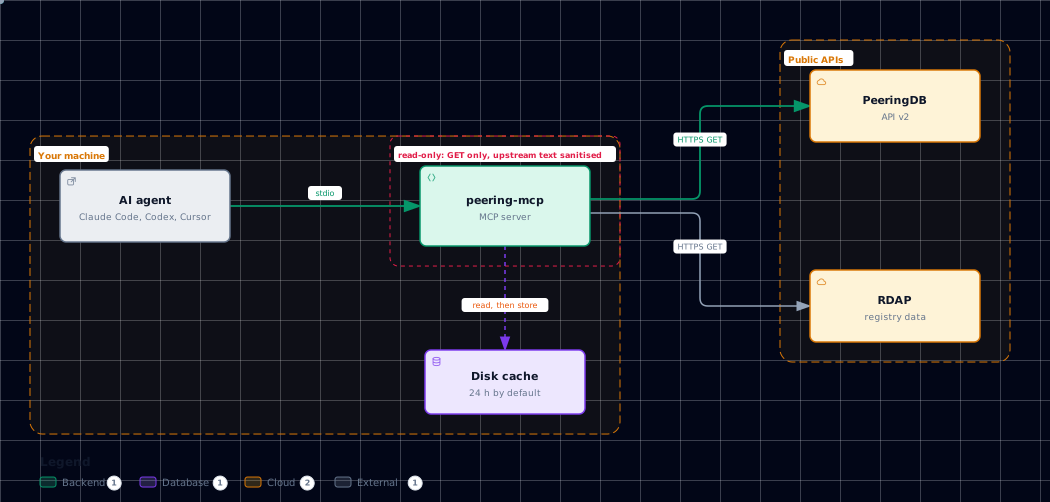
The agent never reaches the internet itself. Everything goes through the server, which is the only place rate limiting, caching, validation and sanitisation can actually be enforced.
A request takes one of two paths:
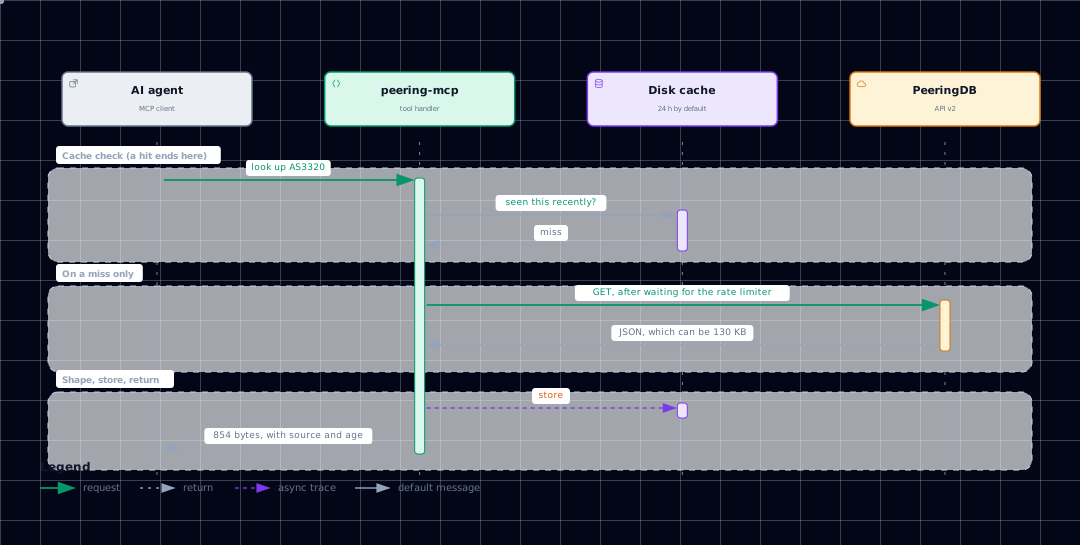
That shaping step is not cosmetic. One network's raw presence records can exceed 130 KB, and returning that would flood the agent's context window and make it measurably worse at the actual task. list_presence turns Hurricane Electric's 336 exchange ports into a page of exchanges that fits 6 KB, largest capacity first, and says how many it left out — the page is cut to the budget rather than to a count, so the limit is a ceiling and the bytes are the guarantee. find_common_presence reads 225 KB across three networks and answers in under 4 KB.
Design principles
These are load-bearing rather than aspirational, and pull requests are reviewed against them.
- Read-only, permanently. Only
GETis ever sent, enforced at the transport rather than by convention. There is no write path and there will not be one. - It says when it does not know. PeeringDB is self-reported, so a missing record is common and is not evidence that something is untrue. The server distinguishes "this network does not exist" from "nobody filled this in", and never fills a gap with a plausible guess.
- Every answer carries its source and age. Including when the upstream record was last edited, because a record untouched since 2019 deserves less weight than one edited last month.
- Responses are small on purpose, and the limit is enforced. Every tool returns a shaped, compact result rather than passing upstream JSON through, and each one has a byte budget that a test holds it to against the worst case its own caps allow — not just against today's data. A list is cut to fit the budget, and says how many it left out.
- Upstream text is untrusted. Free-text fields — PeeringDB's, written by the networks themselves, and a registry record's holder names and contacts — end up in a language model's context. They are allowlisted, length-capped and sanitised before they leave the server.
- Polite to upstream. PeeringDB permits one request per second; the server holds itself to that, caches aggressively, and identifies itself in every request.
Data sources
All public, all free, no scraping.
| Source | Used for | Auth | Cost |
|---|---|---|---|
| PeeringDB API v2 | Networks, exchanges, facilities, presence, peering policy | API key recommended, not required | Free |
| RDAP | Registration data for IPs, prefixes and AS numbers, via the IANA bootstrap files | None | Free |
Observed routing from RIPEstat and topology from CAIDA AS Rank are deliberately out of scope: they answer what the internet is doing, where this answers who is connected to whom and on what terms.
Requirements
- Python 3.12 or newer
- uv
- A free PeeringDB API key is recommended but not required — see below
Use it with an agent
Nothing to install first: uvx fetches the package and runs it.
Claude Code:
claude mcp add peering-mcp -- uvx peering-mcp
Anything that reads a JSON MCP config:
{
  "mcpServers": {
    "peering-mcp": {
      "command": "uvx",
      "args": ["peering-mcp"]
    }
  }
}
To run a local checkout instead — for development, or to try a change — swap the command for uv run --directory /path/to/peering-mcp peering-mcp.
Then ask it something an agent normally gets wrong: "Where could Deutsche Telekom and Hurricane Electric peer with each other?"
A PeeringDB API key
Recommended, and not required. Every tool works without one, nothing is gated, and the server starts with no configuration at all.
The reason to add one is that PeeringDB limits anonymous callers more tightly than authenticated ones, and its own throttle response says so: "Authenticate for less restrictions." The limit is easiest to reach on /netixlan, which is both the largest endpoint and the one every presence question needs — a network's raw port records run past 130 KB. Anonymous callers who cross the line get a throttle notice with a wait measured in tens of minutes. The server handles it honestly, returning rate_limited rather than a wrong or empty answer, but it cannot answer until the wait is over.
A key is free and takes about a minute: docs.peeringdb.com/howto/api_keys/. Use your own — it identifies your calls to PeeringDB and is tied to your account.
Pass it as the PEERINGDB_API_KEY environment variable on the server process. Keeping it in the MCP client's own config scopes the secret to the one process that needs it:
claude mcp add peering-mcp -e PEERINGDB_API_KEY=your-key-here -- \
  uv run --directory /path/to/peering-mcp peering-mcp
{
  "mcpServers": {
    "peering-mcp": {
      "command": "uv",
      "args": ["run", "--directory", "/path/to/peering-mcp", "peering-mcp"],
      "env": { "PEERINGDB_API_KEY": "your-key-here" }
    }
  }
}
The server reads the key from the environment only. It does not read a .env file, so a key placed in one is ignored without warning.
Development
git clone https://github.com/LeonardMichalas/peering-mcp.git
cd peering-mcp
uv sync --all-groups

uv run pytest              # tests
uv run ruff check .        # lint
uv run ruff format .       # format
uv run mypy src            # types
uv run handles the environment. There is no virtualenv to activate.
Install the git hooks once, and lint, format and types run before every commit:
uv run pre-commit install
Diagrams
The two diagrams above are generated, not drawn. docs/diagrams/*.json are the sources, and the animated SVGs in docs/images/ are what the README shows.
docs/diagrams/animate.mjs turns a rendered diagram into the pair of SVGs. It needs a Chromium-family browser on PATH:
node docs/diagrams/animate.mjs <rendered.html> docs/images/<name>
It emits one file per theme, because an SVG loaded as an image cannot see the theme of the page it lands in, and the motion is SMIL so that it survives GitHub rendering it as a bare image.
Configuration
Everything has a working default. The server starts and answers questions with nothing set.
| Variable | Default | Purpose |
|---|---|---|
PEERINGDB_API_KEY |
unset | Raises the PeeringDB rate limit. Recommended, not required |
PEERING_MCP_CACHE_TTL |
86400 |
Cache lifetime in seconds |
PEERING_MCP_CACHE_DIR |
$XDG_CACHE_HOME/peering-mcp, else ~/.cache/peering-mcp |
Where the on-disk cache lives |
PEERING_MCP_NO_CACHE |
unset | Set to 1 to disable caching, for testing |
PEERING_MCP_TIMEOUT |
10 |
Per-request timeout in seconds |
PEERING_MCP_MAX_RETRIES |
3 |
Attempts before an upstream failure is reported |
Tests
Four levels, each proving something the others cannot:
| Directory | What it proves |
|---|---|
tests/unit/ |
The pure logic: shaping, sanitising, bootstrap matching, rate limiting, and every response-size budget against the worst case its caps allow |
tests/contract/ |
The server handles what upstream actually sends, including malformed, truncated and hostile responses |
tests/integration/ |
It behaves as an MCP server: schemas, envelope and every status, through the SDK |
tests/eval/ |
A model picks the right tool from the description alone |
The evaluation is opt-in and separate from the suite: it asks a real model twenty natural-language questions with the real tool schemas, records which tool it reaches for, and costs about $0.50 a run. It scores 20 of 20 on Claude Opus 5 at low effort.
export ANTHROPIC_API_KEY=...
uv run --group eval python tests/eval/run_eval.py
No test reaches the real API. Upstream is mocked at the transport, so the suite runs offline and gives the same answer everywhere. The live marker is reserved for opt-in tests that do hit PeeringDB; CI excludes it with -m "not live".
Contributing
Issues and pull requests are welcome. Before opening a PR:
uv run pytest,uv run ruff check .anduv run mypy srcall pass.- New behaviour has a test at the appropriate level.
- The change respects the design principles above. In particular, a tool that returns a large or unshaped response, or that could pass raw upstream free text to a model, will be sent back.
Licence
MIT. See LICENSE.
1 maintainer

Release files for peering-mcp 0.1.1
For a detailed explanation of source distributions (sdists) and built distributions (wheels), please see the package formats documentation.
Source distribution (sdist)
| File | Size | Uploaded | |
|---|---|---|---|
| peering_mcp-0.1.1.tar.gz | 615.7 kB | Details |
Built distribution (wheel)
| File | Interpreter | ABI | Platform | Reset |
|---|---|---|---|---|
| peering_mcp-0.1.1-py3-none-any.whl | Python 3 | none | any | Details |
Total release size: 687.4 kB
Release files / peering_mcp-0.1.1.tar.gz
| Download URL | peering_mcp-0.1.1.tar.gz |
|---|---|
| Size | 615.7 kB |
| Tags | Source |
|
SHA-256 checksum How to use checksums |
3516449192e1f1ecce10e2438a6e9b59a557b2cf9ee95046eeb10d877ca2ace9
|
|
BLAKE2b-256 checksum How to use checksums |
c5b1908b5eb9e5c25abfea17048aec4360c0b26ef5bb85751035d0d0fa3a2721
|
| Upload date | |
|
Uploaded using Trusted Publishing? What is trusted publishing? |
No |
| Uploaded via |
uv/0.12.13 {"installer":{"name":"uv","version":"0.12.13","subcommand":["publish"]},"python":null,"implementation":{"name":null,"version":null},"distro":{"name":"Omarchy","version":"4.0.2","id":null,"libc":null},"system":{"name":null,"release":null},"cpu":null,"openssl_version":null,"setuptools_version":null,"rustc_version":null,"ci":null}
|
Release files / peering_mcp-0.1.1-py3-none-any.whl
| Download URL | peering_mcp-0.1.1-py3-none-any.whl |
|---|---|
| Size | 71.8 kB |
| Tags | Python 3 |
|
SHA-256 checksum How to use checksums |
a21571672d8d70ca8fdec9b5558536e4c725634ee1bc5269427bbb37b3798da7
|
|
BLAKE2b-256 checksum How to use checksums |
a832776d67d29301cf0a42b2914c3108e21c413caabed78ca2c61cfaf299b6d1
|
| Upload date | |
|
Uploaded using Trusted Publishing? What is trusted publishing? |
No |
| Uploaded via |
uv/0.12.13 {"installer":{"name":"uv","version":"0.12.13","subcommand":["publish"]},"python":null,"implementation":{"name":null,"version":null},"distro":{"name":"Omarchy","version":"4.0.2","id":null,"libc":null},"system":{"name":null,"release":null},"cpu":null,"openssl_version":null,"setuptools_version":null,"rustc_version":null,"ci":null}
|














