

AI browser agents click things that aren't actually clickable.





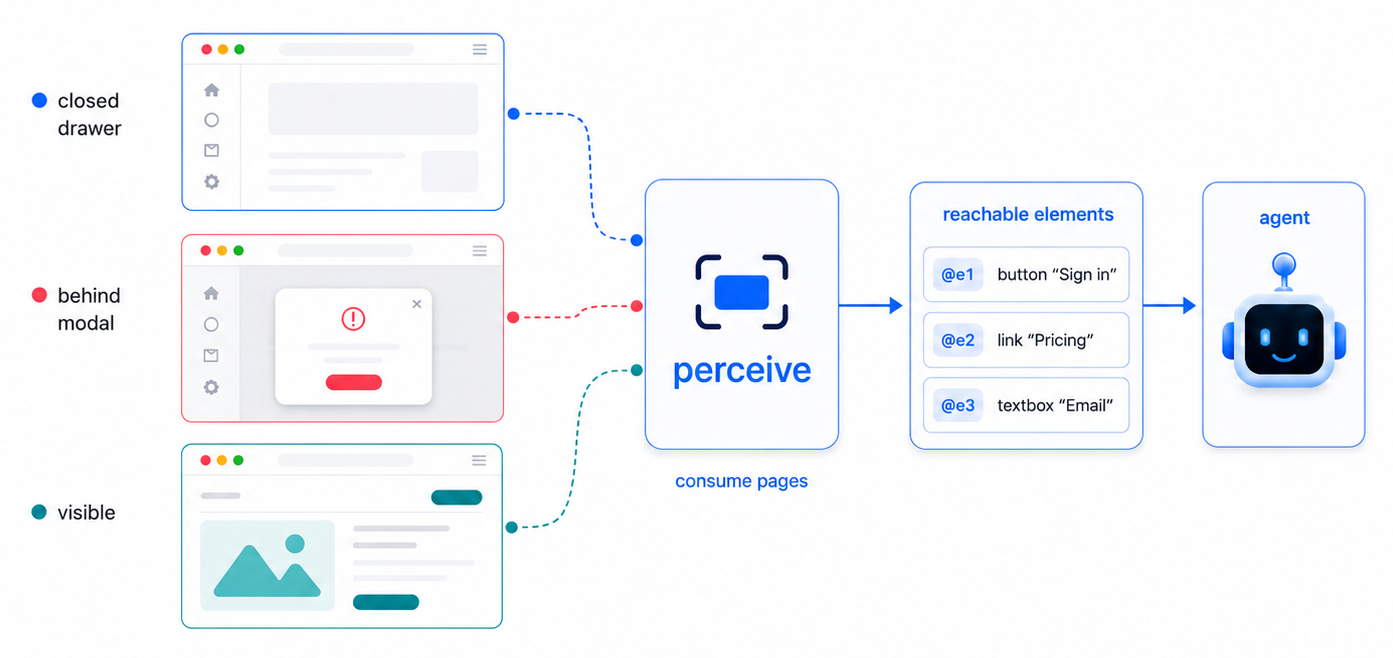
perceive is a Python library that gives browser agents a reachability-filtered action space. Closed drawers, modal-occluded buttons, inert subtrees, off-screen transforms: gone before the model sees the snapshot. The result is compact and ref-stable, with state.diff() to confirm what changed after each action.
- Fewer wrong actions. The model only sees elements a user could actually reach, so it stops trying to click controls behind modals or inside closed drawers.
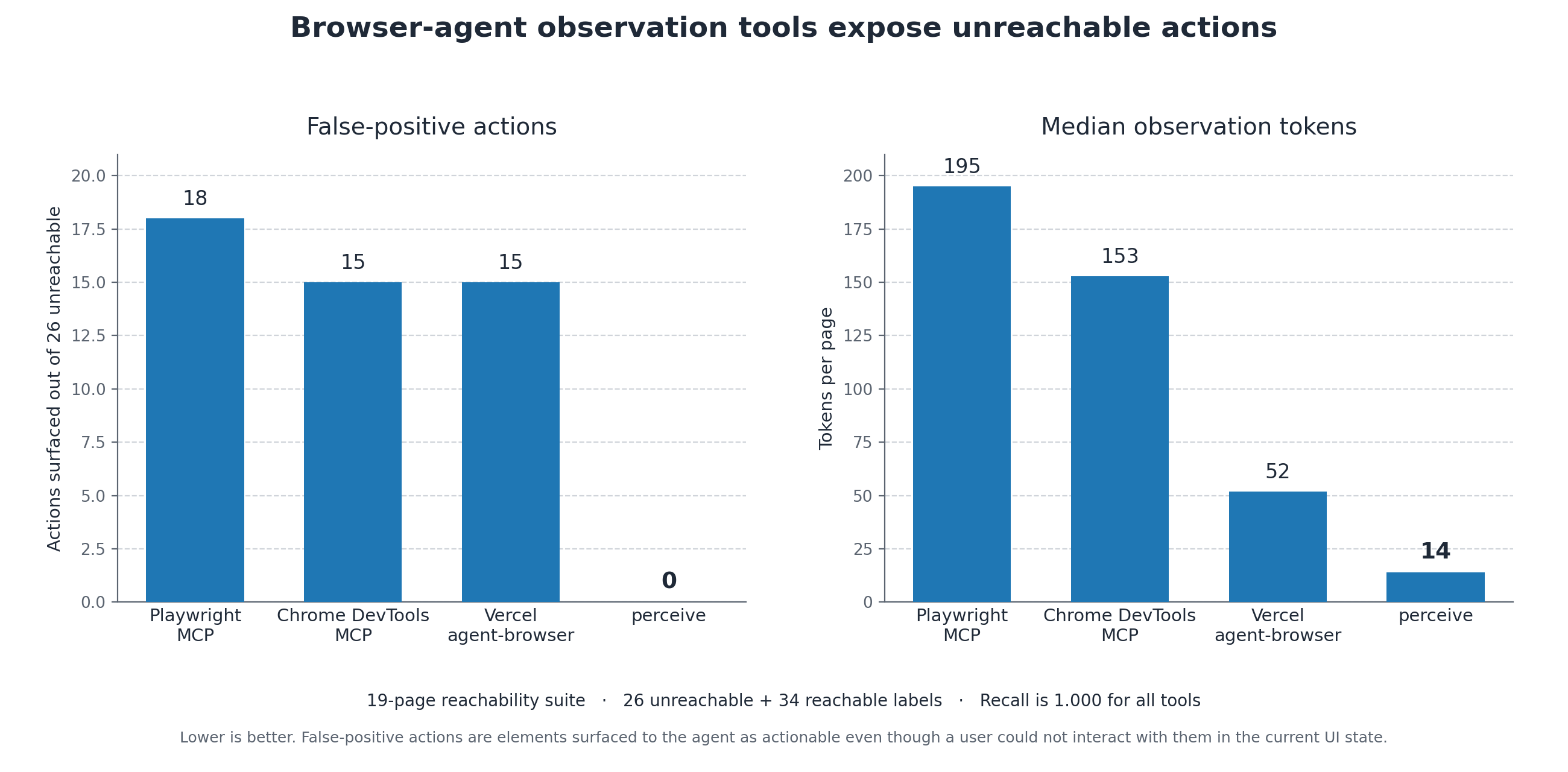
perceivesurfaces 0 of 26 unreachable elements; other browser-agent tools surface 15 to 18. - Fewer tokens. The snapshot is just the reachable action space, nothing else: 14 tokens per page, against 52 to 195 for other browser-agent tools.
Use it as a Python library, or run it as an MCP server so clients like Claude Code, Claude Desktop, and Cursor can drive a browser with no code.
Quickstart
pip install perceive
playwright install chromium    # ~100 MB Chromium binary
import perceive

with perceive.browser(url="https://example.com") as t:
    state = t.perceive()
    print(state.to_prompt())
    # @e1 link "More information..."

    t.act("click", state.find(name="More information").ref)
Benchmark results
Measured on a 19-page hand-labeled reachability conformance suite (bench/): 14 synthetic patterns plus 5 real-world component-library cases (Radix Dialog, MUI Modal, Ant Design Drawer, Headless UI Combobox, scrollable list with repeated actions). Same machine, same conformance pages, same 60 ground-truth labels (34 reachable, 26 unreachable); each tool drives the browser it ships with:
Three browser-agent observation tools each surface 15 to 18 of 26 unreachable elements as valid agent actions; perceive surfaces 0.
| Adapter | Precision | F1 | False-positive actions | Median observation tokens / page | Median cold-call latency |
|---|---|---|---|---|---|
| Raw a11y baseline (no reachability filtering) | 0.567 | 0.723 | 26 / 26 | 26 | 1363 ms |
Playwright MCP (@playwright/mcp) |
0.654 | 0.791 | 18 / 26 | 195 | 3938 ms |
Chrome DevTools MCP (chrome-devtools-mcp) |
0.694 | 0.819 | 15 / 26 | 153 | 6937 ms |
Vercel agent-browser (agent-browser) |
0.694 | 0.819 | 15 / 26 | 52 | 2287 ms |
perceive |
1.000 | 1.000 | 0 / 26 | 14 | 1605 ms |
The three browser-agent tools miss the same geometry the accessibility tree doesn't encode: modal occlusion, sticky-header overlap, off-screen transforms, parent-overflow clipping. The gap is reachability, not snapshot size. perceive runs an explicit reachability pass and resolves all of them, deterministically: 1.000 exact match across 19 pages × 5 runs.
Recall is 1.000 for all five adapters, so the gap is precision, not coverage. Tokens count the agent-facing snapshot only (each tool's native snapshot call), prompt context excluded. Latency is per-call wall time including a fresh browser launch, which a long-lived server would mostly amortize away.
Scope of claim. This is a reachability conformance benchmark, not a general claim about Playwright. Playwright remains the execution layer perceive's browser backend builds on; this measures the observation layer.
Three things perceive does that a raw accessibility tree does not
1. Filter unreachable elements
import perceive

# A closed drawer is still in the DOM, just translated off-screen.
# A raw a11y tree includes its buttons. perceive does not.
with perceive.browser(url="https://your-app.com") as t:
    state = t.perceive()
    print(len(state.elements))                                    # 4 visible buttons
    state_full = t.perceive(include_unreachable=True)
    print(len(state_full.elements))                                # 7 (visible + drawer contents)
    for el in state_full.elements:
        if not el.reachable:
            print(f"  filtered: {el.role} {el.name!r} ({el.unreachable_reason})")
    # filtered: button 'Close Drawer' (offscreen)
    # filtered: button 'Submit Form' (offscreen)
2. Filter modal-occluded elements
# Buttons behind an open modal are present in the DOM and the a11y tree,
# but a real user cannot click them. perceive returns only the modal's buttons.
with perceive.browser(url="https://your-app.com") as t:
    state = t.perceive()
    for el in state:
        print(el.ref, el.role, repr(el.name))
    # e1 button 'OK'        (in the modal)
    # e2 button 'Cancel'    (in the modal)
    # the two background buttons are filtered out
3. Stable refs across reflows, including for repeated elements
with perceive.browser(url="https://your-app.com/users") as t:
    state = t.perceive()

    # Repeated buttons with the same label get distinct refs, disambiguated
    # by surrounding context (parent landmark, siblings, stable attributes):
    edits = state.find_all(name="Edit")
    print([e.ref for e in edits])
    # ['e3', 'e5', 'e7']

    # An element's ref is preserved across re-perceives, including after
    # scrolling and other reflows that keep the element in the document:
    sign_in_before = state.find(name="Sign in").ref
    t.act("scroll", direction="down", amount=400)
    sign_in_after = t.perceive().find(name="Sign in").ref
    assert sign_in_before == sign_in_after
Why not just use Playwright locators?
Playwright locators are the right tool when you already know what to interact with. You write page.get_by_role("button", name="Sign in") because you, the human author, decided that button is what you want.
perceive is for the part of an agent loop where the model needs to decide what's available. The flow is observe → plan → act → verify, and step 1 is "give the model a compact, reachable, ref-stable action space." perceive does that step; it doesn't replace deterministic Playwright tests for code you've already written.
Integration: feeding perceive output to an LLM
import perceive

with perceive.browser(url="https://app.example.com/login") as target:
    state = target.perceive()

    prompt = f"""You are operating a browser. Available actions:
- click(ref)
- type(ref, text)
- scroll(direction)

Current UI:
{state.to_prompt()}

Task: sign in as alice@example.com with password hunter2.
Respond with one action per line."""

    # Send `prompt` to any LLM (Claude, GPT, Gemini, local model).
    # Parse the response into actions, then call:
    target.act("type", "e2", "alice@example.com")
    target.act("type", "e3", "hunter2")

    # Use observe_change to see the result of the click in compact form.
    with target.observe_change() as obs:
        target.act("click", state.find(name="Sign in").ref)
    print(obs.diff.to_prompt())
    # +@e7 dialog "Welcome back, Alice"
    # -@e3 textbox "Password"
    # … 5 unchanged
MCP server
perceive ships an MCP server, so any MCP client (Claude Code, Claude Desktop, Cursor) can drive a browser through the same reachability-filtered action space without writing any Python.
pip install 'perceive[mcp]'
playwright install chromium
Register it with your MCP client (stdio transport):
{
  "mcpServers": {
    "perceive": {
      "command": "perceive-mcp"
    }
  }
}
That assumes perceive-mcp is on your PATH. If it isn't, or you would rather not install it globally, run it with uvx instead:
{
  "mcpServers": {
    "perceive": {
      "command": "uvx",
      "args": ["--from", "perceive[mcp]", "perceive-mcp"]
    }
  }
}
The server exposes six tools:
| Tool | What it does |
|---|---|
navigate(url) |
Open a URL; returns the reachability-filtered snapshot |
perceive() |
Re-observe the current page |
click(ref) |
Click an element by ref |
type(ref, text) |
Type text into an element by ref |
scroll(direction, amount) |
Scroll the page |
press(key) |
Press a key (Enter, Tab, ...) |
navigate and perceive return the full compact snapshot; the four action tools return a diff of what changed, so the model sees only the delta after each step.
Benchmarked through the MCP transport, perceive's server scores the same 0 / 26 false positives and 14 median tokens as the library (bench/adapters/perceive_mcp.py). The reachability result is unchanged by MCP, and because the server keeps the browser warm across tool calls, the browser-launch cost is paid once per session rather than per call.
API
target = perceive.browser(url=None, *, headless=True, viewport=(1280, 800))

# Navigation and lifecycle
target.goto(url)
target.close()                                  # or use as a context manager

# Perception
state = target.perceive(
    region=None,                # CSS selector or (x, y, w, h) bbox to scope
    role=None,                  # filter to a single role (e.g. "button")
    include_text=False,         # reserved; not yet implemented
    include_unreachable=False,  # default: filter unreachable
)

# State
state.elements                  # list[Element]
state.find(ref=..., role=..., name=..., reachable=...)
state.find_all(role=..., name=..., reachable=...)
state.to_prompt(only_reachable=True)
state.diff(previous)            # DiffResult

# Action (shares ref space with the most recent perceive())
target.act("click", ref)
target.act("type", ref, text)
target.act("set_value", ref, text)            # programmatic, for tricky inputs
target.act("scroll", direction="down", amount=400)
target.act("press", key)                       # e.g. "Enter", "Tab"
target.act("goto", url)
target.act("wait", seconds)

# Self-verifying loop
with target.observe_change(settle_ms=200) as obs:
    target.act("click", "e1")
obs.before, obs.after, obs.diff
Limitations
This is a deliberately narrow early release. Things perceive does not do yet:
- Browser only. A macOS backend (
perceive.macos()) is planned but not yet implemented. - Chromium only. Firefox and WebKit are untested against the benchmark suite.
- No vision fallback. Canvas-heavy UIs, custom widgets without ARIA, and image-only elements return as fewer (or zero) elements. A small-VLM fallback is planned.
- Cross-origin iframes and closed Shadow DOM are opaque (browser security, and
{ mode: 'closed' }by design). Same-origin iframes and open shadow roots work. - Ref stability is exact-fingerprint based. A button whose accessible name changes mid-session ("Save" → "Saving…") gets a new ref. Scored-similarity matching is planned.
- Benchmark is 19 pages and three external tools. It covers CSS hiding, positioning, occlusion, traversal (Shadow DOM + iframe), and real component libraries (Radix, MUI, Ant Design, Headless UI); it does not yet cover virtualized lists, portals, nested modals, or cookie banners. Expanding before any "production-ready" claim.
Reproducing the benchmarks
The repo includes a bench package. To run it yourself:
git clone https://github.com/gauthierpiarrette/perceive.git
cd perceive
pip install -e ".[bench,dev]"
playwright install chromium

perceive-bench list pages
perceive-bench list adapters

# Run the head-to-head against the other tools yourself.
# Requires Node.js + npx; the first invocation downloads each package.
# chrome_devtools_mcp and agent_browser also need a local Chrome to drive
# (agent-browser: `npm i -g agent-browser && agent-browser install`).
perceive-bench run --adapter playwright_mcp --suite reachability
perceive-bench run --adapter playwright_mcp --suite tokens
perceive-bench run --adapter chrome_devtools_mcp --suite reachability
perceive-bench run --adapter chrome_devtools_mcp --suite tokens
perceive-bench run --adapter agent_browser --suite reachability
perceive-bench run --adapter agent_browser --suite tokens

# Same against perceive.
perceive-bench run --adapter perceive --suite reachability
perceive-bench run --adapter perceive --suite tokens
perceive-bench run --adapter perceive --suite determinism --runs 5
All results are written to results/ as JSON.
Contributing
Issues and pull requests are welcome. See CONTRIBUTING.md for development setup and guidelines.
License
Apache-2.0. See LICENSE and NOTICE.
1 maintainer

Release files for perceive 0.4.2
For a detailed explanation of source distributions (sdists) and built distributions (wheels), please see the package formats documentation.
Source distribution (sdist)
| File | Size | Uploaded | |
|---|---|---|---|
| perceive-0.4.2.tar.gz | 64.6 kB | Details |
Built distribution (wheel)
| File | Interpreter | ABI | Platform | Reset |
|---|---|---|---|---|
| perceive-0.4.2-py3-none-any.whl | Python 3 | none | any | Details |
Total release size: 148.4 kB
Release files / perceive-0.4.2.tar.gz
| Download URL | perceive-0.4.2.tar.gz |
|---|---|
| Size | 64.6 kB |
| Tags | Source |
|
SHA-256 checksum How to use checksums |
768266eb766e48c17204d39b2d858c843c40bd2883b074f8d1efeb111bcc61b3
|
|
BLAKE2b-256 checksum How to use checksums |
15d6480eb56963562e0ec2552a81054d0316fe703a9deae3312034beb537a83c
|
| Upload date | |
|
Uploaded using Trusted Publishing? What is trusted publishing? |
Yes |
| Uploaded via |
twine/7.0.0 CPython/3.13.14
|
Provenance
Provenance describes where a file came from. On PyPI, provenance is shared via attestations, which provide a verifiable record of the build or publishing details. View details, limitations and caveats.


PyPI Publish Attestation
PyPI verified that this artifact, at this checksum, originated from the publisher listed below.
Signed by GitHub Actions, verified by PyPI on Aug 5, 2026.
Transparency logRelease files / perceive-0.4.2-py3-none-any.whl
| Download URL | perceive-0.4.2-py3-none-any.whl |
|---|---|
| Size | 83.8 kB |
| Tags | Python 3 |
|
SHA-256 checksum How to use checksums |
539dc7bafcf735cd8a21a10c2eca84f816fc54fd534293ec507674a9f3963200
|
|
BLAKE2b-256 checksum How to use checksums |
c82020f07778e8c0b6bdb56dcbb2951fa066eb149982c69e7153734ef7d73eaf
|
| Upload date | |
|
Uploaded using Trusted Publishing? What is trusted publishing? |
Yes |
| Uploaded via |
twine/7.0.0 CPython/3.13.14
|
Provenance
Provenance describes where a file came from. On PyPI, provenance is shared via attestations, which provide a verifiable record of the build or publishing details. View details, limitations and caveats.
PyPI Publish Attestation
PyPI verified that this artifact, at this checksum, originated from the publisher listed below.
Signed by GitHub Actions, verified by PyPI on Aug 5, 2026.
Transparency log













