

Multimodal long-term memory for robots, smart glasses and agents.
Video, images and conversations in — memory about people, with names, out.





English · 简体中文
The film · Why identity · Highlights · Benchmarks · Quickstart · How it works · Install · Roadmap
The film
https://github.com/user-attachments/assets/7252ab1e-9fe8-4c83-b2b1-d3da03b83504
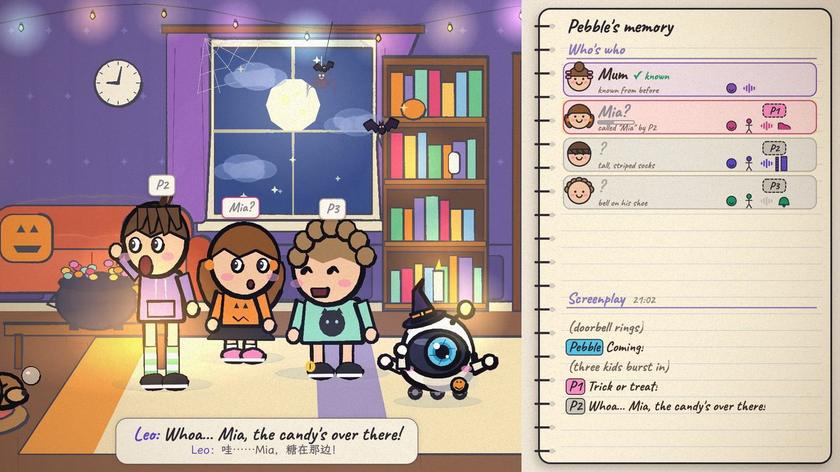
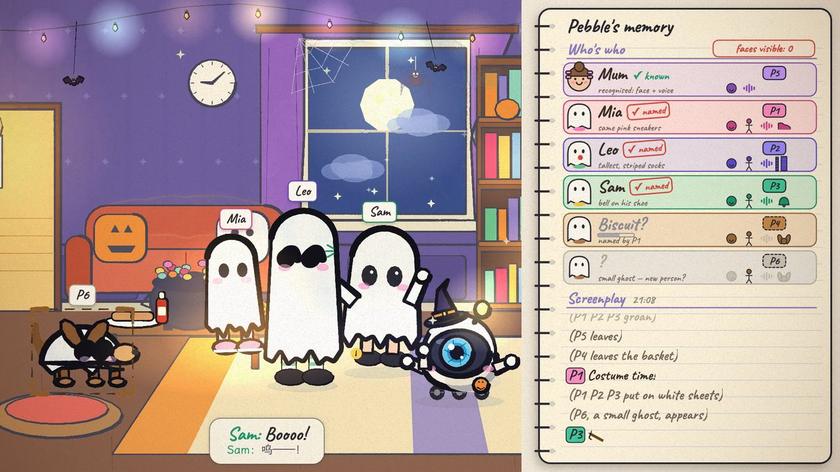
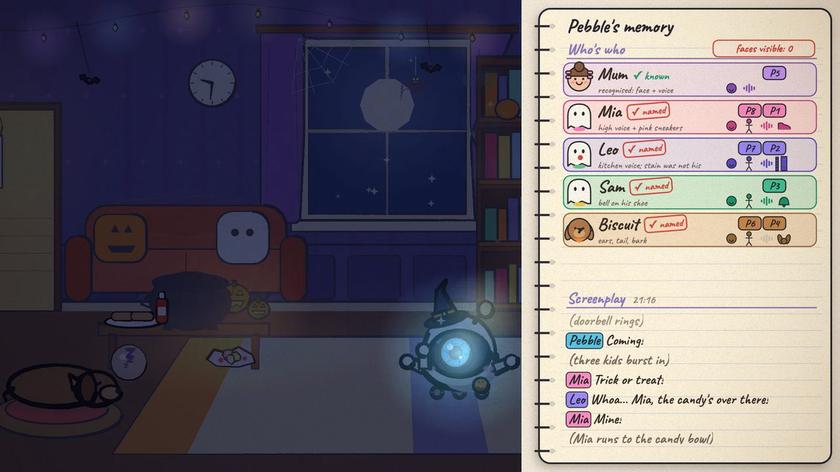
Who ate the Halloween candy? Pebble, a little home robot, watches a party through its one big lens. Three kids arrive as strangers, earn their names from what they call each other, vanish under identical white sheets — and in the middle of a blackout, one of them puts on someone else's sheet to frame him.
The notebook on the right is Pebble's memory, and it works the way PersonOS
works: the screenplay is written the moment things happen, with neutral
codes (P1, P2…); who's who is kept separately, revised as evidence comes
in, and only applied to the screenplay when the night's memory is saved. Next
morning everyone blames the boy whose sheet it was. Pebble doesn't.
 |
 |
 |
Names are earned. "Whoa… Mia, the candy's over there!" turns stranger P1 into a guess, Mia? — confirmed only when it happens again. |
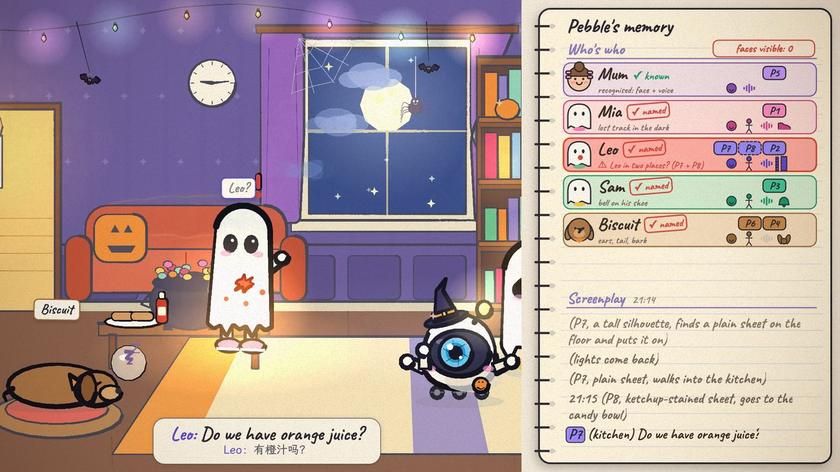
No faces, still known. Under the sheets, shoes, height, a bell on a shoelace and voices keep every ghost attached to the right kid. | Contradictions are caught. The ketchup sheet says Leo; Leo's voice comes from the kitchen. One person can't be in two places. |
 |
 |
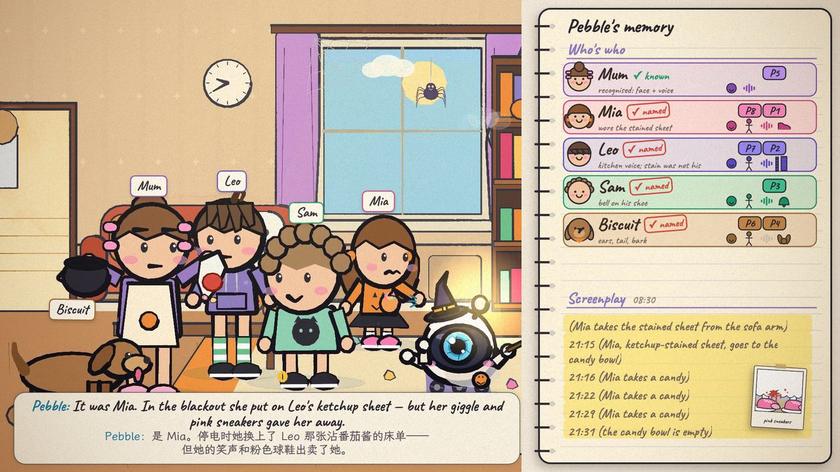 |
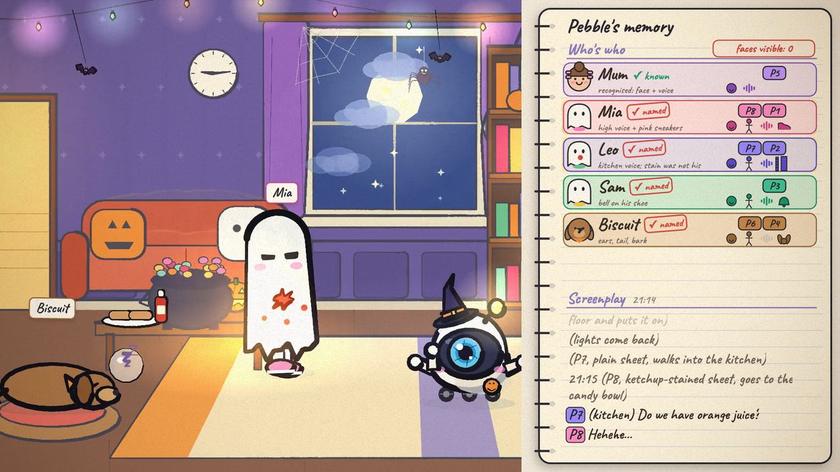
| …and repaired. A high giggle and pink sneakers move the ghost to Mia's card. What was recorded is never edited — only who it refers to. | Identity lands last. When the night is saved, codes resolve to names across the whole screenplay: one complete record, every person correct. | Answers cite evidence. "Who was it?" — Mia, with the exact lines and a snapshot of the sneakers that gave her away. |
An original, code-drawn short (p5.js + p5.brush); voices and sound by ElevenLabs. The story is staged, the mechanics are the real ones — see How it works.
Why identity
A memory system that understands video but not people writes this down:
- [21:15] A ghost in a ketchup-stained sheet went to the candy bowl.
- [21:16] A ghost took a candy.  [21:22] A ghost took a candy.  [21:29] A ghost took a candy.
Which ghost? Ask "who ate the candy?" and the best it can do is follow the sheet — straight to the wrong kid. PersonOS writes this instead:
+ [21:15] Mia — wearing Leo's ketchup-stained sheet — went to the candy bowl.
+ [21:16] Mia took a candy.  [21:22] Mia took a candy.  [21:29] Mia took a candy.
Every line points at a stable character that persists across clips and sessions. Names are earned, not enrolled — someone becomes "Mia" because people call her Mia; until then she is a stable handle you can still ask about. And the device itself is a character too, because "who did this?" sometimes has the answer "you did".
Highlights
People, not pixelsFaces, body shots and voiceprints accumulate into a per-character identity cloud. Someone seen in clip 12 is the same person three sessions later — no enrollment step, no face database to maintain. |
It catches its own mistakesMultimodal models hallucinate identities. PersonOS checks every screenplay for physically impossible contradictions in code, asks the model to repair them, and degrades by subtraction — it would rather forget a name than learn a wrong one. |
Facts now, identity when it's sureWhat happened is recorded the moment it is seen; who it was is settled once the evidence is in. Correcting an identity changes who a record refers to — never what was observed. |
Memory that never overwrites the pastAn append-only record — evidence → episode → atom → chain. "15 fish → 13 → 11" stays as linked history; the answer layer decides what is current. |
Answers show their workEvery answer cites the episode, clip and timestamp it came from, with the full retrieval and adjudication trace one attribute away. |
Built for devices that live in the worldClips stream in asynchronously through an ordered per-session queue with backpressure; nothing blocks the device loop. Text, images and video land in one store. |
Benchmarks
M3-Bench-robot — long-video memory from a robot's point of view: 100 videos, 1,276 questions. This is the benchmark identity is built for.
| Overall | Person understanding | Multi-hop | Multi-evidence | Cross-modal | General knowledge | |
|---|---|---|---|---|---|---|
| PersonOS | 61.5 | 73.5 | 63.5 | 62.8 | 59.0 | 48.0 |
| M3-Agent, same models¹ | 37.4 | 50.9 | 42.4 | 37.1 | 37.0 | 28.4 |
| M3-Agent, as published | 30.7 | 43.3 | 29.4 | 32.8 | 31.2 | 19.1 |
Video-MME, long videos, no subtitles — answered from memory alone: the video is ingested into PersonOS and the answering model never sees it.
| Overall | Synopsis | Object recog. | Spatial reas. | Object reas. | Temporal reas. | Action recog. | Action reas. | Temporal perc. | Attribute perc. | OCR | Counting | Spatial perc. |
|---|---|---|---|---|---|---|---|---|---|---|---|---|
| 87.0 | 93.3 | 92.6 | 90.9 | 87.9 | 87.9 | 84.1 | 85.0 | 83.3 | 85.2 | 78.6 | 70.8 | 33.3 |
Text memory, no compromise — the same store on conversational benchmarks:
| Benchmark | Overall | Breakdown |
|---|---|---|
| LoCoMo-10 · 1,536 q, adversarial excluded | 83.3 | single-hop 89.3 · temporal 79.8 · multi-hop 77.3 · open-domain 58.7 |
| LongMemEval-S · 500 q, official judge prompts | 80.6 | knowledge-update 91.7 · single-session-assistant 98.2 · single-session-user 89.1 · multi-session 76.9 · temporal 76.4 · preference 43.3 · abstention 73.3 |
Accuracy in %. Video memory built with Qwen3.5-Omni-Plus, questions answered from memory by GPT-5.5. ¹ Same dataset, memory model and answer model as PersonOS; prompt templates and retrieval budgets are not guaranteed identical. Text benchmarks reproduce from scripts/bench; video evaluation code ships with the accompanying paper.
Quickstart
pip install personos
export PERSONOS_LLM_API_KEY=sk-...
export PERSONOS_LLM_BASE_URL=https://api.openai.com/v1   # any OpenAI-compatible gateway
from personos import Memory

m = Memory()   # SQLite under ~/.personos — nothing to provision

m.add("I moved from Hangzhou to Shanghai in June", user_id="alice", session_id="s1")
m.end_session(user_id="alice", session_id="s1", sync=True)

print(m.search("where do I live?", user_id="alice").ans.answer)
# -> Shanghai
Give it eyes. Same three calls, now with video and person identity:
pip install 'personos[identity]'
export PERSONOS_VIDEO_BACKEND=real
export PERSONOS_MLLM_API_KEY=sk-...  PERSONOS_MLLM_MODEL=...   # any model that accepts video
for clip in ["clip000.mp4", "clip001.mp4", "clip002.mp4"]:          # consecutive clips
    m.add([{"role": "user", "content": "", "video": clip}],
          user_id="robot", session_id="living-room")

m.end_session(user_id="robot", session_id="living-room", sync=True)  # identities are committed here

out = m.search("What's the name of the girl at the table, and what does she study?", user_id="robot")
print(out.ans.answer)       # Alice ... math
print(out.ans.cited_cells)  # the episodes (and clips) the answer came from
Not sure what your setup can do? Run personos doctor. More in
examples/: a week of conversation · a photo · video with
person identity.
How it works
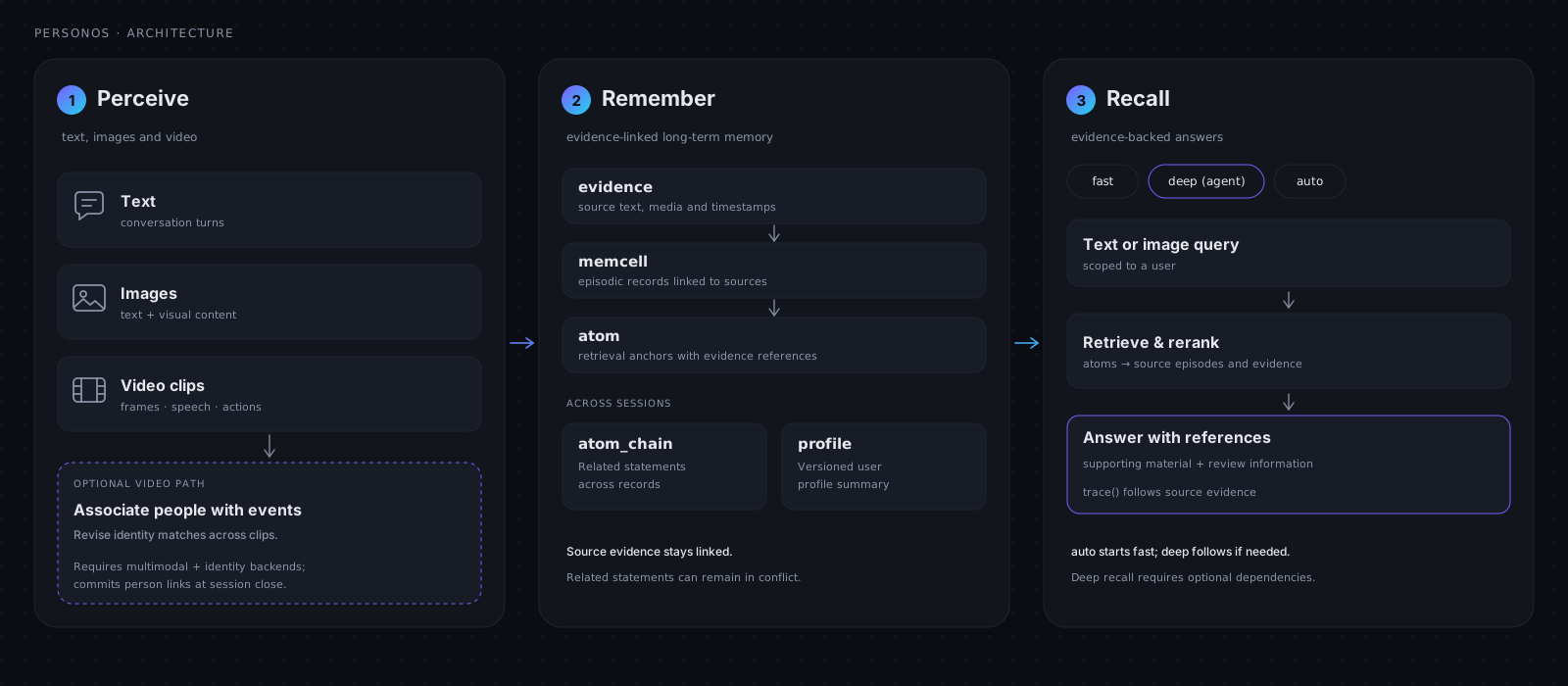
① Perceive. A multimodal model watches each clip and writes a screenplay: who is on screen — as clip-local codes, not names — who says what, what happens, when.
② Resolve identity. Codes are matched against known characters through a face / body / voiceprint cloud. Code-level checks look for physical contradictions (one person in two places, two people sharing one identity) and send them back to the model for repair. Within a session, character chains collect evidence — a first sighting, a better face, a clearer voice, a name said out loud — and are adjudicated into persistent characters when the session closes.
③ Remember. The screenplay is resolved through those identities and written into a layered, append-only store:
evidence  ──►  memcell (episode)  ──►  atom  ──►  atom_chain
raw input      the narrative unit      the          the same fact over time,
never edited   used for answering      retrieval    grouped, never collapsed
                                       anchor
Atoms are short propositions that embed well — the retrieval index. Episodes are what the model actually reads.
④ Recall. search() rewrites the question, resolves who it is about,
retrieves, reranks, adjudicates a draft and escalates to a multi-step agent
when needed — and returns how it got there:
out = m.search("who ate the candy?", user_id="pebble")
out.ans.answer   # the answer
out.rw.subject   # who the question was resolved to be about
out.hits         # atoms retrieved, in fusion order
out.reviews      # what the adjudicator said about the draft
out.to_public()  # ...or a plain dict
Built for
| Home & service robots | Remember household members, guests and what each of them asked for — across days, without enrollment. |
| Smart glasses & wearables | "Who was the person I met at the booth on Tuesday, and what did we talk about?" |
| Desktop & companion agents | One memory across chat, screenshots and calls, every answer traceable to its source. |
Installation
The core has 7 dependencies — no torch, no LangChain, no web framework. Everything heavier is opt-in:
| Install | Unlocks |
|---|---|
pip install personos |
Text memory: layered write path, fast + deep recall, profiles |
personos[deep] |
Multi-step deep-recall agent (recommended) |
personos[image] |
Image ingest and recall over photos |
personos[identity] |
Video with face / body / voiceprint identity (~2 GB) |
personos[mysql] personos[redis] |
Multi-process deployments |
personos[oss] |
Object storage instead of local media files |
personos[all] |
Everything |
Model weights
Optional capabilities download their own weights on first use:
| Capability | Weights | Where they land |
|---|---|---|
| Face recognition | InsightFace buffalo_l (~300 MB) |
~/.insightface (auto-download) |
| Voiceprints | SpeechBrain spkrec-ecapa-voxceleb |
HuggingFace cache; override with PERSONOS_ECAPA_MODEL / PERSONOS_ECAPA_DIR |
| Multimodal understanding | none — remote API | PERSONOS_MLLM_* points at any MLLM endpoint |
Offline or behind a firewall: set HF_ENDPOINT=https://hf-mirror.com, or
pre-download and point the *_DIR variables at local copies.
Configuration
Everything except the model endpoint is optional. Unset means a capability is off or degraded — never that the text path breaks.
| Default | Unset means | |
|---|---|---|
| Chat + embeddings | — | required |
| Database | SQLite at ~/.personos |
set PERSONOS_DB_URL for MySQL — needed only for several workers |
| Multimodal model | off | images are stored but not understood; video is refused with instructions |
| Media storage | local files | set PERSONOS_MEDIA_BACKEND=oss for object storage |
| Reranker | off | retrieval keeps its fusion order |
| Deep recall | off | pip install personos[deep] |
| Redis | off | single process; session state in memory |
| Tracing | off | every tracing call is a no-op |
The model service fetches video clips by URL, so with local media storage
set PERSONOS_MEDIA_BASE_URL to a publicly reachable prefix (or use OSS).
See .env.example for every option.
Ask for something unconfigured and you get a sentence, not silence:
MissingCapability: video understanding is unavailable: no multimodal model is configured
  To enable it: set PERSONOS_MLLM_API_KEY and PERSONOS_MLLM_MODEL
Cannot do it at all → raise; did it partially → return and say so in
result.warnings. A missing optional capability never fails a write.
API
m.add(messages, user_id=..., session_id=...)   # text, a dict with an image, or video clips
m.end_session(user_id=..., session_id=...)     # close the segment; build memories and commit identities
m.search(query, user_id=..., mode="auto")      # "auto" | "fast" | "deep"
m.profile(user_id=...)                         # distilled user profile
m.trace(node_id, user_id=...)                  # provenance, both directions
m.capabilities()                               # what this configuration can do
m.reset(user_id=...)                           # delete one user's data
Writes are asynchronous by default: add() / end_session() enqueue onto
a per-session ordered queue (FIFO per session, fair across sessions,
backpressure when overloaded) and return an AddReceipt at once. Pass
sync=True, or call m.flush(...), when you need to read your own writes. A
full queue raises QueueBusy — the HTTP API's 503 + Retry-After.
Reads (search, profile, trace) are synchronous; from async code use
await asyncio.to_thread(m.search, q).
Running it as a service
server/ is a FastAPI deployment — ordered ingestion across
processes, backpressure, token-scoped multi-tenancy. It is not part of the pip
package; if you are embedding memory in an application, you do not need it.
Roadmap
- Layered append-only memory with fast + deep recall
- Image ingest and recall
- Video memory with face / body / voiceprint identity, self-repair and cross-session recognition
- Async ordered ingestion, HTTP server
- Memory inspector UI — timeline, character gallery, answer traces
- MCP server for Claude Code, Cursor and other MCP clients
- Integrations: LangGraph, OpenAI Agents SDK, ROS 2
-
AsyncMemory - Streaming ingestion for live camera feeds
- Lighter identity install (faces without torch)
- Paper + full video evaluation code
Status
0.1.x — the memory pipeline runs in production; the packaging around it is
new, and the public API may still move before 1.0. Releases follow
RELEASE.md.
Contributing
Issues and PRs are welcome — see CONTRIBUTING.md. The test
suite runs with pytest and needs no external services.
Acknowledgements
- The film is original work, drawn in code with p5.js and p5.brush; voices and sound effects by ElevenLabs.
- The M3-Bench-robot benchmark and the video samples used in the examples come from M3-Agent / M3-Bench (ByteDance-Seed, CC BY-NC-SA 4.0). Samples are downloaded on demand and are not redistributed in this repository.
License
Apache-2.0. See LICENSE.
1 maintainer

Metadata
1 maintainer
Release files for personos 0.1.3
For a detailed explanation of source distributions (sdists) and built distributions (wheels), please see the package formats documentation.
Source distribution (sdist)
| File | Size | Uploaded | |
|---|---|---|---|
| personos-0.1.3.tar.gz | 6.5 MB | Details |
Built distribution (wheel)
| File | Interpreter | ABI | Platform | Reset |
|---|---|---|---|---|
| personos-0.1.3-py3-none-any.whl | Python 3 | none | any | Details |
Total release size: 6.8 MB
Release files / personos-0.1.3.tar.gz
| Download URL | personos-0.1.3.tar.gz |
|---|---|
| Size | 6.5 MB |
| Tags | Source |
|
SHA-256 checksum How to use checksums |
62cf931ede5a9925f31f9b48c312dd19d80ef8909e29cb24d6de727883461cf4
|
|
BLAKE2b-256 checksum How to use checksums |
8667cd80ef680ffb78f968f8becbd6baa0090958db81d4c49e61ea2218c6f7b6
|
| Upload date | |
|
Uploaded using Trusted Publishing? What is trusted publishing? |
No |
| Uploaded via |
twine/7.0.0 CPython/3.11.15
|
Release files / personos-0.1.3-py3-none-any.whl
| Download URL | personos-0.1.3-py3-none-any.whl |
|---|---|
| Size | 327.6 kB |
| Tags | Python 3 |
|
SHA-256 checksum How to use checksums |
48e20c5d44c7ee403180f6c7365205a28a6a49d046681dc6cf1ec98413700b64
|
|
BLAKE2b-256 checksum How to use checksums |
9ee68dca852c97e832e0315186a5dc2ade2d6a5c51cc22a124ffd15de8e9013e
|
| Upload date | |
|
Uploaded using Trusted Publishing? What is trusted publishing? |
No |
| Uploaded via |
twine/7.0.0 CPython/3.11.15
|














