
Easy way to efficiently run 100B+ language models without high-end GPUs


Project description
Run large language models at home, BitTorrent-style.
Fine-tuning and inference up to 10x faster than offloading



Generate text with distributed Llama 2 (70B), Stable Beluga 2, Falcon, Guanaco-65B or BLOOM-176B and fine‑tune them for your own tasks — right from your desktop computer or Google Colab:
from transformers import AutoTokenizer
from petals import AutoDistributedModelForCausalLM

# Choose any model available at https://health.petals.dev
model_name = "petals-team/StableBeluga2"

# Connect to a distributed network hosting model layers
tokenizer = AutoTokenizer.from_pretrained(model_name)
model = AutoDistributedModelForCausalLM.from_pretrained(model_name)

# Run the model as if it were on your computer
inputs = tokenizer("A cat sat", return_tensors="pt")["input_ids"]
outputs = model.generate(inputs, max_new_tokens=5)
print(tokenizer.decode(outputs[0]))  # A cat sat on a mat...
🦙 Want to run Llama 2? Request access to its weights at the ♾️ Meta AI website and 🤗 Model Hub, then run huggingface-cli login in the terminal before loading the model. Or just try it in our chatbot app.
🔏 Privacy. Your data will be processed by other people in the public swarm. Learn more about privacy here. For sensitive data, you can set up a private swarm among people you trust.
💬 Any questions? Ping us in our Discord!
Connect your GPU and increase Petals capacity
Petals is a community-run system — we rely on people sharing their GPUs. You can check out available models and help serving one of them! As an example, here is how to host a part of Stable Beluga 2 on your GPU:
🐧 Linux + Anaconda. Run these commands for NVIDIA GPUs (or follow this for AMD):
conda install pytorch pytorch-cuda=11.7 -c pytorch -c nvidia
pip install git+https://github.com/bigscience-workshop/petals
python -m petals.cli.run_server petals-team/StableBeluga2
🪟 Windows + WSL. Follow this guide on our Wiki.
🐋 Docker. Run our Docker image for NVIDIA GPUs (or follow this for AMD):
sudo docker run -p 31330:31330 --ipc host --gpus all --volume petals-cache:/cache --rm \
    learningathome/petals:main \
    python -m petals.cli.run_server --port 31330 petals-team/StableBeluga2
🍏 macOS + Apple M1/M2 GPU. Install Homebrew, then run these commands:
brew install python
python3 -m pip install git+https://github.com/bigscience-workshop/petals
python3 -m petals.cli.run_server petals-team/StableBeluga2
📚 Learn more (how to use multiple GPUs, start the server on boot, etc.)
💬 Any questions? Ping us in our Discord!
🦙 Want to host Llama 2? Request access to its weights at the ♾️ Meta AI website and 🤗 Model Hub, generate an 🔑 access token, then add --token YOUR_TOKEN_HERE to the python -m petals.cli.run_server command.
🔒 Security. Hosting a server does not allow others to run custom code on your computer. Learn more here.
🏆 Thank you! Once you load and host 10+ blocks, we can show your name or link on the swarm monitor as a way to say thanks. You can specify them with --public_name YOUR_NAME.
How does it work?
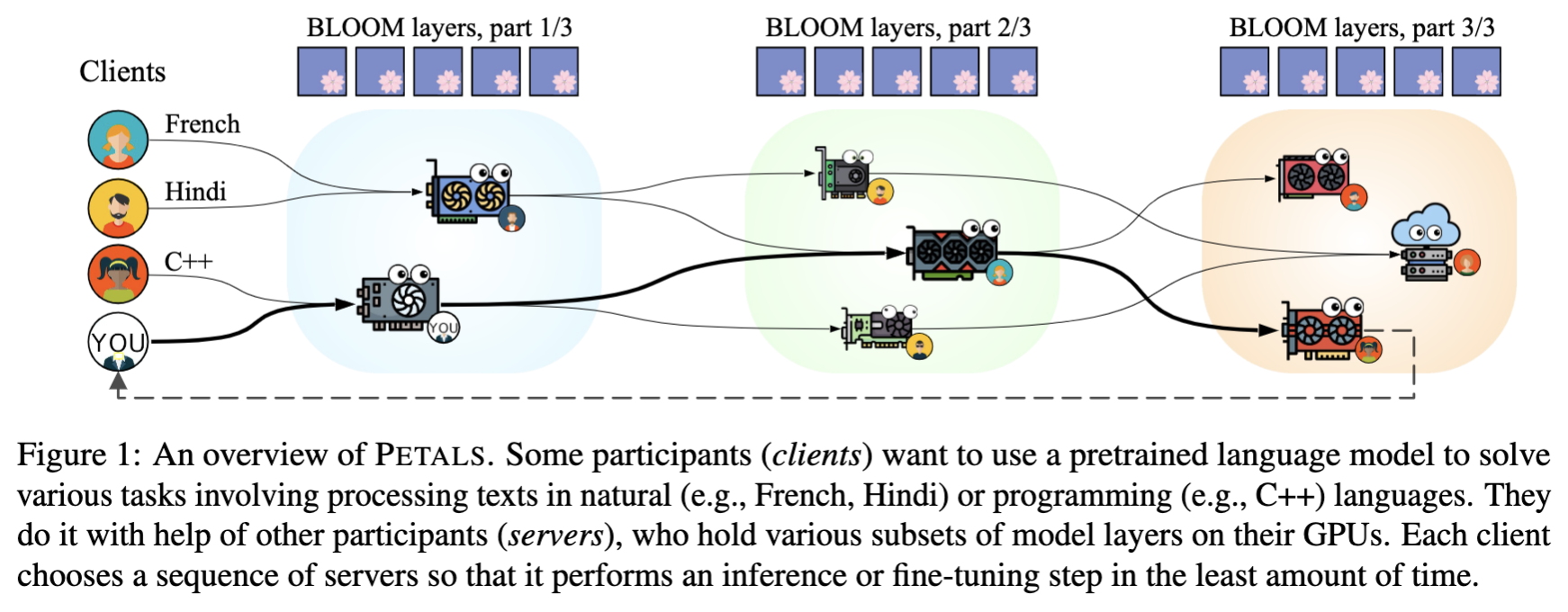
- Petals runs large language models like Llama and BLOOM collaboratively — you load a small part of the model, then join people serving the other parts to run inference or fine-tuning.
- Single-batch inference runs at up to 6 steps/sec for Llama 2 (70B) and ≈ 1 step/sec for BLOOM-176B. This is up to 10x faster than offloading, enough to build chatbots and other interactive apps. Parallel inference reaches hundreds of tokens/sec.
- Beyond classic language model APIs — you can employ any fine-tuning and sampling methods, execute custom paths through the model, or see its hidden states. You get the comforts of an API with the flexibility of PyTorch.
📜 Read paper 📚 See FAQ
📚 Tutorials, examples, and more
Basic tutorials:
- Getting started: tutorial
- Prompt-tune Llama-65B for text semantic classification: tutorial
- Prompt-tune BLOOM to create a personified chatbot: tutorial
Useful tools:
- Chatbot web app (connects to Petals via an HTTP/WebSocket endpoint): source code
- Monitor for the public swarm: source code
Advanced guides:
Benchmarks
The benchmarks below are for BLOOM-176B:
| Network | Single-batch inference (steps/s) |
Parallel forward (tokens/s) |
|||
|---|---|---|---|---|---|
| Bandwidth | Round-trip latency |
Sequence length | Batch size | ||
| 128 | 2048 | 1 | 64 | ||
| Offloading, max. possible speed on 1x A100 1 | |||||
| 256 Gbit/s | 0.18 | 0.18 | 2.7 | 170.3 | |
| 128 Gbit/s | 0.09 | 0.09 | 2.4 | 152.8 | |
| Petals on 14 heterogeneous servers across Europe and North America 2 | |||||
| Real world | 0.83 | 0.79 | 32.6 | 179.4 | |
| Petals on 3 servers, with one A100 each 3 | |||||
| 1 Gbit/s | < 5 ms | 1.71 | 1.54 | 70.0 | 253.6 |
| 100 Mbit/s | < 5 ms | 1.66 | 1.49 | 56.4 | 182.0 |
| 100 Mbit/s | 100 ms | 1.23 | 1.11 | 19.7 | 112.2 |
1 An upper bound for offloading performance. We base our offloading numbers on the best possible hardware setup for offloading: CPU RAM offloading via PCIe 4.0 with 16 PCIe lanes per GPU and PCIe switches for pairs of GPUs. We assume zero latency for the upper bound estimation. In 8-bit, the model uses 1 GB of memory per billion parameters. PCIe 4.0 with 16 lanes has a throughput of 256 Gbit/s, so offloading 176B parameters takes 5.5 seconds. The throughput is twice as slow (128 Gbit/s) if we have two GPUs behind the same PCIe switch.
2 A real-world distributed setting with 14 servers holding 2× RTX 3060, 4× 2080Ti, 2× 3090, 2× A4000, and 4× A5000 GPUs. These are personal servers and servers from university labs, spread across Europe and North America and connected to the Internet at speeds of 100–1000 Mbit/s. 4 servers operate from under firewalls.
3 An optimistic setup that requires least communication. The client nodes have 8 CPU cores and no GPU.
We provide more evaluations and discuss these results in more detail in Section 3.3 of our paper.
🛠️ Contributing
Please see our FAQ on contributing.
📜 Citation
Alexander Borzunov, Dmitry Baranchuk, Tim Dettmers, Max Ryabinin, Younes Belkada, Artem Chumachenko, Pavel Samygin, and Colin Raffel. Petals: Collaborative Inference and Fine-tuning of Large Models. arXiv preprint arXiv:2209.01188, 2022.
@article{borzunov2022petals,
  title = {Petals: Collaborative Inference and Fine-tuning of Large Models},
  author = {Borzunov, Alexander and Baranchuk, Dmitry and Dettmers, Tim and Ryabinin, Max and Belkada, Younes and Chumachenko, Artem and Samygin, Pavel and Raffel, Colin},
  journal = {arXiv preprint arXiv:2209.01188},
  year = {2022},
  url = {https://arxiv.org/abs/2209.01188}
}
This project is a part of the BigScience research workshop.

Release history Release notifications | RSS feed


Download files
Download the file for your platform. If you're not sure which to choose, learn more about installing packages.
Source Distribution
Built Distribution
Filter files by name, interpreter, ABI, and platform.
If you're not sure about the file name format, learn more about wheel file names.
Copy a direct link to the current filters
File details
Details for the file petals-2.2.0.tar.gz.
File metadata
- Download URL: petals-2.2.0.tar.gz
- Upload date:
- Size: 107.5 kB
- Tags: Source
- Uploaded using Trusted Publishing? No
- Uploaded via: twine/4.0.2 CPython/3.8.15
File hashes
| Algorithm | Hash digest | |
|---|---|---|
| SHA256 |
c24dac8d6b35cfabc5f72bc8d9699cbfb9c483e4595a30298b038c03b7083a2e
|
|
| MD5 |
92cc5aa6ffd88890eed980458f85ccf0
|
|
| BLAKE2b-256 |
395ec00f22dc2a57d283f3a3499ed263c208143174f9e262f6b2681a836028fd
|
File details
Details for the file petals-2.2.0-py3-none-any.whl.
File metadata
- Download URL: petals-2.2.0-py3-none-any.whl
- Upload date:
- Size: 115.4 kB
- Tags: Python 3
- Uploaded using Trusted Publishing? No
- Uploaded via: twine/4.0.2 CPython/3.8.15
File hashes
| Algorithm | Hash digest | |
|---|---|---|
| SHA256 |
16f91e82f88556c54ffd1c64c684922b4278b0c1471ca3a5e86fb2cdd18efa3d
|
|
| MD5 |
95c039004f20ce4f170462fdcdf18d65
|
|
| BLAKE2b-256 |
c22753a7a475664a5cd69bf466f2df98480bfaabb083a188208fb858e9291d77
|






