
petls-pytorch





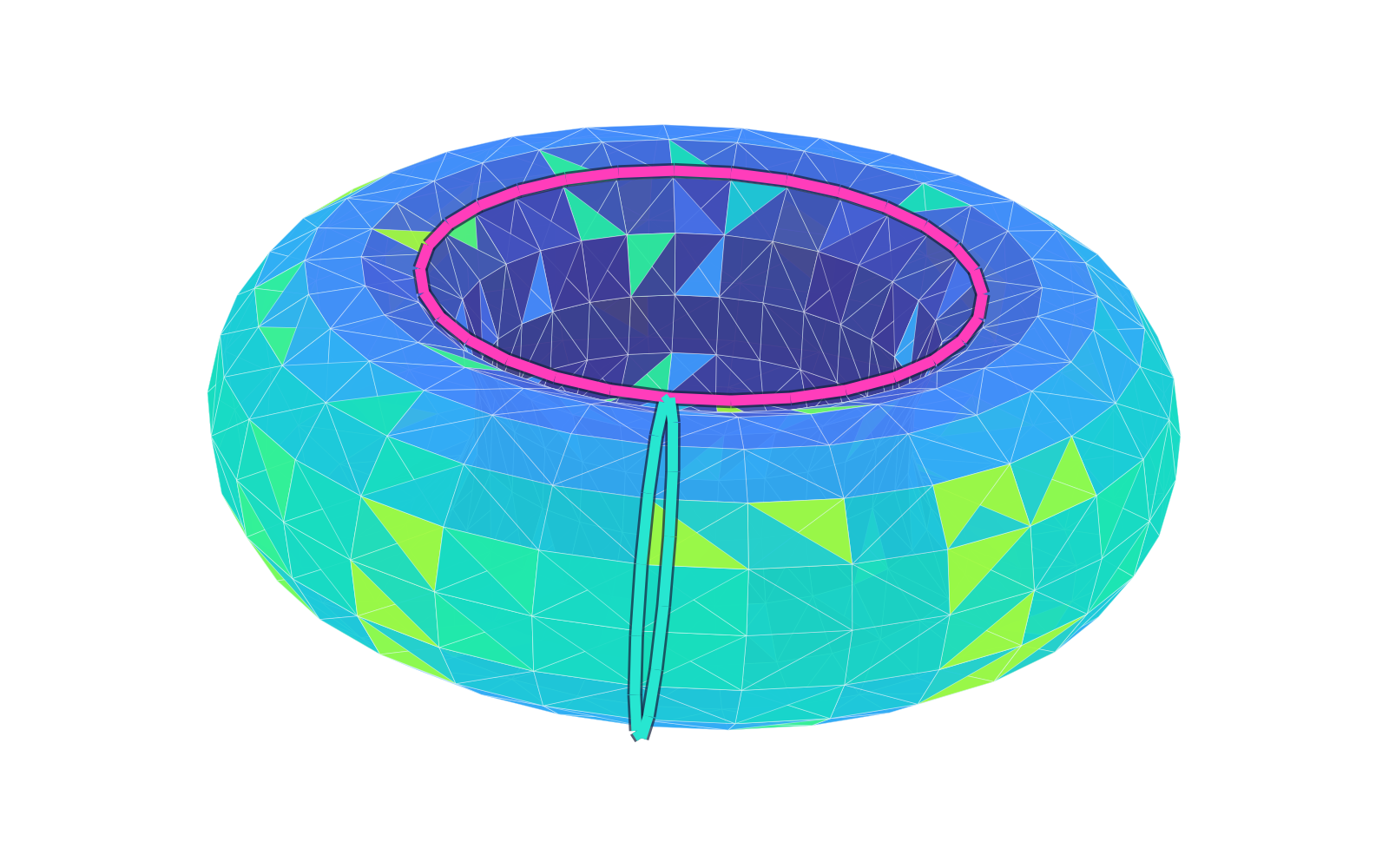
One component, two independent tunnels, one enclosed surface: β = (1, 2, 1).
PETLS-PyTorch turns point clouds, graphs, and molecular trajectories into multiscale topological signatures, with PyTorch-native CPU and CUDA eigensolvers. It answers three complementary questions:
- What persists? Betti numbers and persistence intervals track components, tunnels, and voids across scale.
- How is it organized? Persistent-Laplacian spectra distinguish structures that have the same hole counts but different geometry or connectivity.
- Where is it? Harmonic representatives and basis-invariant participation scores map topological structure back to supporting points, simplices, or molecules.
The hero is an actual Alpha complex at α² = 0.30; the magenta and cyan paths
represent its two independent one-dimensional classes. The
figure source is fully reproducible.
Performance
Measured October 7, 2026 on an Intel Core i7-13700K and RTX 4070 Ti (WSL2, PyTorch 2.13.0, CUDA 13.0). Both devices use float64, the same seeded inputs, and four CPU threads. Times are medians of three measured runs after one warmup per solver/device.
| Workload | Solver | CPU pipeline | CUDA pipeline |
|---|---|---|---|
| Standard: 78 queries, up to 2,399 rows | Default: up to 8 positive modes | 3.02 s | 2.38 s |
| Standard: 78 queries, up to 2,399 rows | Full spectrum | 2.61 s | 1.99 s |
| Larger matrices: 48 queries, up to 5,990 rows | Default: up to 8 positive modes | 5.11 s | 6.03 s |
| Larger matrices: 48 queries, up to 5,990 rows | Full spectrum | 9.76 s | 6.39 s |
Pipeline time includes dataset/complex construction once plus all query work: operator construction, eigensolving, homology, and result processing. Warmup, validation, and file writes are excluded. All 1,512 measured requests across both workloads completed without failures or skips; every requested positive mode passed comparison with the matching full CPU spectrum.
The default solver uses complete device solves for small matrices and range iteration for larger ones. Full spectra are faster on the standard workload; the default reduces CPU pipeline time by about 48% on the larger-matrix workload. CUDA full-spectrum timings include the existing CPU eigensolver route for matrices of 2–512 rows; the default solver stays on the selected device.
Reproduce the comparison from a checkout with uv:
OMP_NUM_THREADS=4 MKL_NUM_THREADS=4 OPENBLAS_NUM_THREADS=4 \
  uv run --extra benchmark python -m benchmark.compare --preset standard \
  --threads 4 --warmups 1 --repeats 3 \
  --output-dir benchmark-results/standard-comparison
Use --preset quick for the larger-matrix workload above. Results include raw
requests, repeat ranges, solver quality, and hardware/source provenance under
benchmark-results/. See the measurement notes
for the workload breakdown and optimization results, or
technical notes for other benchmark commands.
Install
Install the published release from PyPI:
pip install --upgrade petls-pytorch
This README documents 1.2.0. For development, or to run the included examples and benchmarks, install a repository checkout:
git clone https://github.com/Sylverity/petls-pytorch.git
cd petls-pytorch
python -m pip install -e .
CPython 3.10–3.14 is supported. For GPU execution, install the CUDA-enabled PyTorch build appropriate for your system using the official PyTorch installer.
Optional extras add benchmark datasets (petls-pytorch[benchmark]) or the CIF
and plotting dependencies used by the crystal demo
(petls-pytorch[analysis]).
Quick start
import torch
import petls_pytorch

alpha = petls_pytorch.Alpha(
    points=[[0, 0], [1, 0], [1, 1], [0, 1]],
    weights=[0.20, 0.18, 0.20, 0.18],
    max_dim=2,
    max_alpha_square=1.0,
    device="cuda" if torch.cuda.is_available() else "cpu",
    dtype=torch.float64,
)

scale = 0.10  # The square's edges have entered; its interior is still unfilled.
summary = alpha.topology_summary(dimensions=(0, 1), a=scale, b=scale)
modes = alpha.positive_spectrum(dim=1, a=scale, positive_modes=8)
# Explicit full spectrum, when needed:
# spectrum = alpha.spectra(dim=1, a=scale, b=scale)
intervals = alpha.persistence_intervals(dim=1)
features = alpha.harmonic_features(dim=1, a=scale)
participation = alpha.harmonic_participation(dim=1, a=scale)

print(summary["betti"])  # {0: 1, 1: 1}
if participation["participation_complete"]:
    point_scores = participation["point_participation"]
Here a == b describes topology at one scale; a < b requests a persistent
Laplacian between scales. Alpha scales are squared-radius/power filtration
values. Up to eight positive modes are requested; this example has only three,
with eigenvalues approximately 2, 2, 4.
Supported constructions:
| Construction | Class | Typical input |
|---|---|---|
| Weighted or ordinary Alpha | Alpha |
Point coordinates and optional power weights |
| Vietoris–Rips | Rips |
Point coordinates or a distance matrix |
| Directed flag | dFlag |
Weighted directed graphs in .flag format |
| Cellular sheaf | PersistentSheafLaplacian |
Filtered complexes with restriction maps |
All constructions provide get_L(), spectra(), eigenpairs(),
topology_summary(), and estimate_laplacian(). persistence_intervals() and
positive_spectrum() require a retained Gudhi simplex tree, as in Alpha,
Rips, or Complex(simplex_tree=...). Directed-flag and sheaf summaries use the
existing spectral path and infer Betti counts from numerical Laplacian nullity.
Harmonic localization requires simplex mappings: these are retained by Alpha,
Rips, and dFlag, but not by PersistentSheafLaplacian.
From a crystal to an interpretable signature
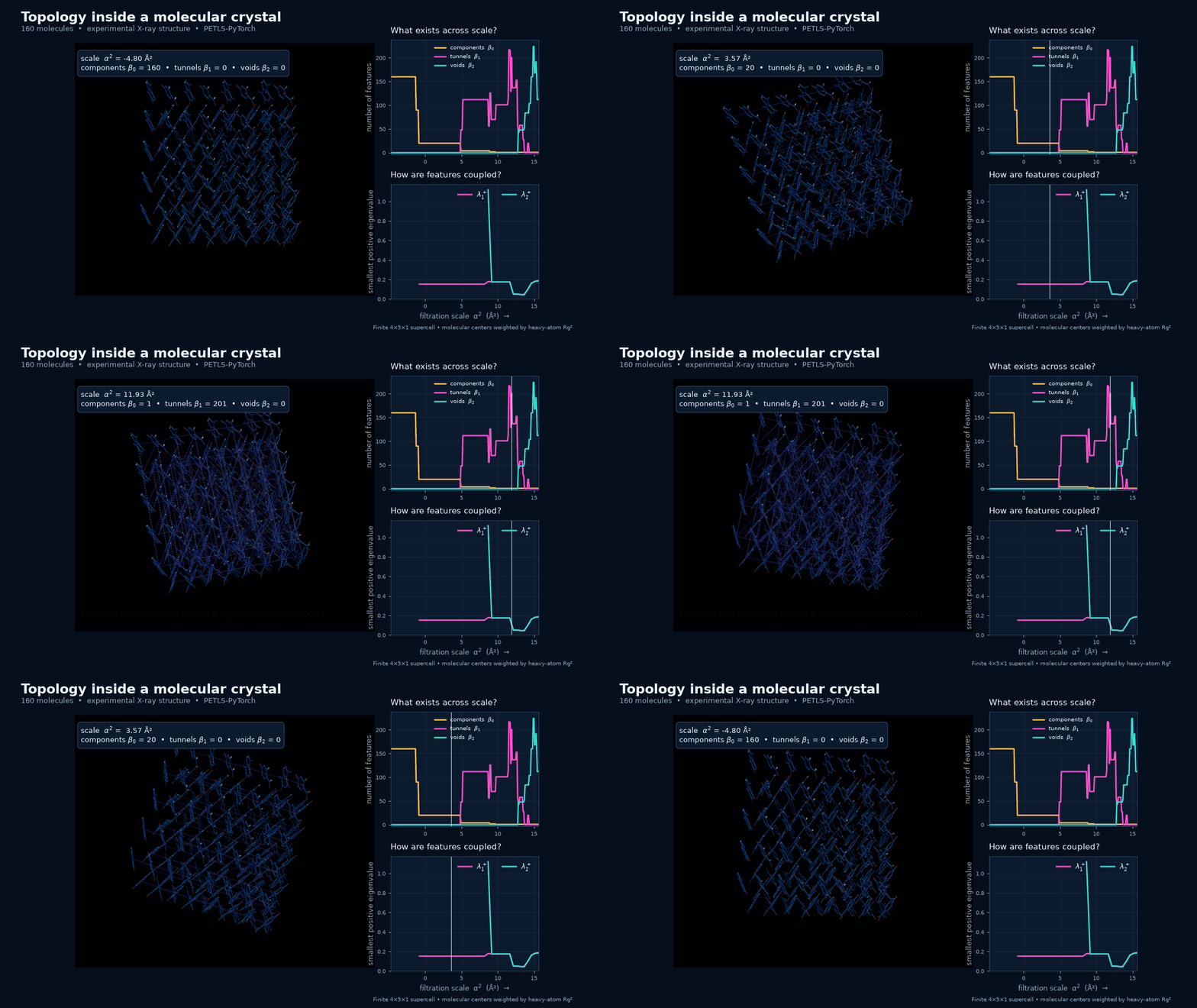
This example reduces a public experimental 160-molecule, 1,920-heavy-atom crystal to a scale-dependent signature:
- Left: the violet Alpha scaffold grows through the crystal; the magenta cage localizes one selected harmonic 2-cycle to the molecules supporting it.
- Top right:
β₀,β₁, andβ₂count connected regions, tunnels, and enclosed voids. The white cursor marks the scale rendered on the left. - Bottom right: the smallest positive 1- and 2-Laplacian eigenvalues reveal organization that Betti numbers alone cannot distinguish.
Applied frame-by-frame, the same workflow creates interpretable time series for assembly transitions, packing changes, persistent scale ranges, and the molecules driving each change.
The complete demo, reproduction guide, and public experimental CIF are included. This is a finite-supercell demonstration, not periodic homology or a binding energetics calculation.
Numerical behavior
- CPU is the default; select
"cuda"explicitly or use"auto". float32andfloat64are supported;Alphadefaults tofloat64with or without weights. The partial positive-mode solver always computes infloat64.- Gudhi persistence is the authoritative homology source for Gudhi-backed complexes, while numerical nullity and spectral diagnostics are reported separately.
- Gudhi homology uses coefficients modulo 11; the Laplacian uses real coefficients. Modular Betti counts never select or discard real positive modes. Results expose both fields and report their agreement separately from solver quality.
harmonic_participation()localizes the harmonic space using projector-diagonal scores, invariant to rotations of a complete harmonic basis. Each simplex's score is shared equally among its vertices; the total equals the number of recovered harmonic directions. Labels are retained when available. These scores localize the harmonic space collectively; individual basis vectors are not canonical persistence-interval representatives. For truncated results, checkparticipation_completebefore comparing whole-space scores.- Gudhi-backed
topology_summary()defaults to requesting eight leading positive modes.positive_spectrum()exposes the same solver directly; small problems use a complete device eigensolve internally. - In the partial solver, sparse operator applications, projected eigensolves, and residual checks stay on the selected device in float64, with no CPU eigensolver fallback. Geometry and boundary indexing can still use CPU.
- Large partial persistent solves apply a Schur correction without materializing the full dense Laplacian. The active eliminated block is dense and factored on the device; numerically singular blocks use a pseudoinverse. Allocation guards still apply.
- Large partial solves work in
range(L)with a block independent of Betti multiplicity. They stop when the requested positive modes meet the configured relative residual tolerance, or reach the iteration limit; they do not rediscover the harmonic kernel. - Each partial-solver mode reports its residual and
certified,approximate, orunavailablequality. Range reconstruction and orthogonality are audited. These labels describe numerical checks, not formal eigenvalue enclosures. Numerical nullity isNonefor range solves; authoritative homology remains available. Small complete solves still compare numerical nullity to homology. spectra()andeigenpairs()retain their configured solver behavior; the defaulteigvalshroute computes a complete spectrum. Usespectral_mode="full"for the previous summary path; boundary-only complexes also use that path. Its legacy sparse ordinary solver uses SciPy on CPU.- Harmonic localization uses a complete solve within the dense limits by default. Oversized ordinary localization can use a sparse solve with truncated output; persistent localization still requires a dense Laplacian and observes the allocation guards.
See technical notes for filtration semantics, solver
selection, localization behavior, allocation controls, the .flag format, and
the full benchmark command set.
Project
PETLS-PyTorch is a clean-room, PyTorch-native implementation built on the foundational persistent-Laplacian work of Ben Jones, Guo-Wei Wei, and the PETLS project. The reference documentation and paper define the shared mathematical context; parity tests cover common workflows without incorporating original source code.
Issues and pull requests are welcome. See CONTRIBUTING.md for development setup and checks. Licensed under Apache-2.0.
Citation
If you use petls-pytorch in research, cite this software and the original
PETLS paper.
@software{marston2026petlspytorch,
  title     = {petls-pytorch: A PyTorch-native implementation of persistent topological Laplacians},
  author    = {Marston, Sumner K.},
  year      = {2026},
  publisher = {Sylverity Research},
  url       = {https://github.com/Sylverity/petls-pytorch}
}

@misc{jones2025petlspersistenttopologicallaplacian,
  title         = {PETLS: PErsistent Topological Laplacian Software},
  author        = {Benjamin Jones and Guo-Wei Wei},
  year          = {2025},
  eprint        = {2508.11560},
  archivePrefix = {arXiv},
  primaryClass  = {math.AT},
  url           = {https://arxiv.org/abs/2508.11560}
}
1 maintainer

Metadata
1 maintainer
Release files for petls-pytorch 1.2.0
For a detailed explanation of source distributions (sdists) and built distributions (wheels), please see the package formats documentation.
Source distribution (sdist)
| File | Size | Uploaded | |
|---|---|---|---|
| petls_pytorch-1.2.0.tar.gz | 5.7 MB | Details |
Built distribution (wheel)
| File | Interpreter | ABI | Platform | Reset |
|---|---|---|---|---|
| petls_pytorch-1.2.0-py3-none-any.whl | Python 3 | none | any | Details |
Total release size: 5.8 MB
Release files / petls_pytorch-1.2.0.tar.gz
| Download URL | petls_pytorch-1.2.0.tar.gz |
|---|---|
| Size | 5.7 MB |
| Tags | Source |
|
SHA-256 checksum How to use checksums |
c93040b1a829c1b6d6b626a9499e8914ffbde86dd04e338e796bb93887510bf9
|
|
BLAKE2b-256 checksum How to use checksums |
12a13037917061646a9a88cde99da50d9b9b1f0ccdc5b6c83695aaa6e0b67d8e
|
| Upload date | |
|
Uploaded using Trusted Publishing? What is trusted publishing? |
Yes |
| Uploaded via |
twine/7.0.0 CPython/3.13.14
|
Provenance
Provenance describes where a file came from. On PyPI, provenance is shared via attestations, which provide a verifiable record of the build or publishing details. View details, limitations and caveats.


PyPI Publish Attestation
PyPI verified that this artifact, at this checksum, originated from the publisher listed below.
Signed by GitHub Actions, verified by PyPI on Oct 9, 2026.
Transparency logRelease files / petls_pytorch-1.2.0-py3-none-any.whl
| Download URL | petls_pytorch-1.2.0-py3-none-any.whl |
|---|---|
| Size | 59.3 kB |
| Tags | Python 3 |
|
SHA-256 checksum How to use checksums |
556a58a7967b9db6bcff925bef1f755a3f41a781c9928569a1bcfe362576a9f7
|
|
BLAKE2b-256 checksum How to use checksums |
9b0c0c00e077accff79cda37c17f9ee23fee796bfd0cfe2380827198edfbd7b3
|
| Upload date | |
|
Uploaded using Trusted Publishing? What is trusted publishing? |
Yes |
| Uploaded via |
twine/7.0.0 CPython/3.13.14
|
Provenance
Provenance describes where a file came from. On PyPI, provenance is shared via attestations, which provide a verifiable record of the build or publishing details. View details, limitations and caveats.
PyPI Publish Attestation
PyPI verified that this artifact, at this checksum, originated from the publisher listed below.
Signed by GitHub Actions, verified by PyPI on Oct 9, 2026.
Transparency log













