
PGN Tokenizer
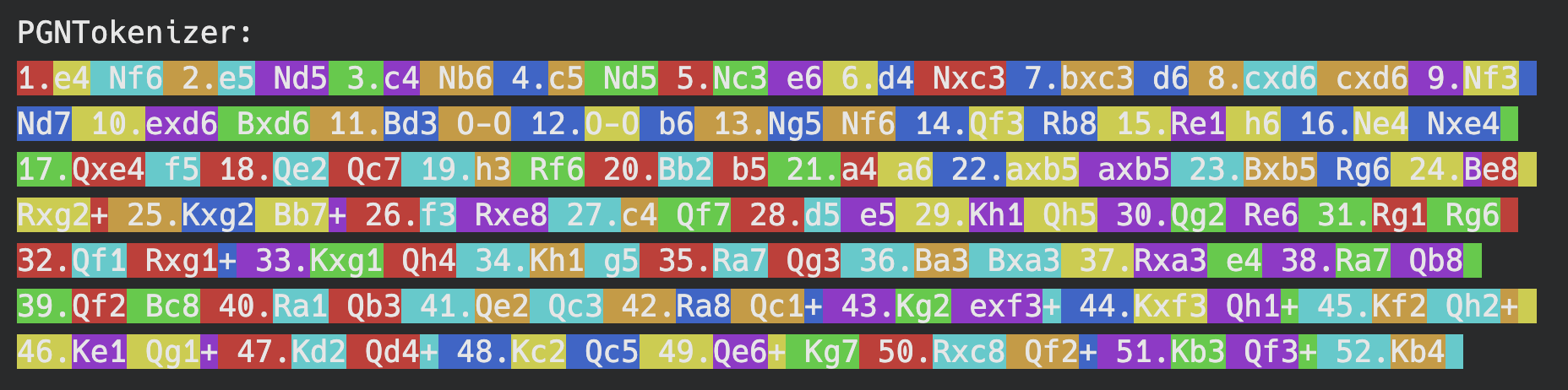
This is a Byte Pair Encoding (BPE) tokenizer for Chess Portable Game Notation (PGN).
Supported Languages
Note: This is part of a work-in-progress project to investigate how language models might understand chess without an engine or any chess-specific knowledge.
Installation
You can install it with your package manager of choice:
Python Package
uv
uv add pgn-tokenizer
pip
pip install pgn-tokenizer
TypeScript Package
npm
npm install @dvdagames/pgn-tokenizer
bun
bun add @dvdagames/pgn-tokenizer
Getting Started
Here's a brief overview of getting started with the Python and TypeScript versions of the PGN Tokenizer.
Python
The Python package uses the
tokenizers library for training the tokenizer and the transformers library to create a PreTrainedTokenizerFast interface from the PGN Tokenizer configuration, and provides minimal interface with .encode() and .decode() methods, and a .vocab_size property, but you can also access the underlying tokenizer class via the .tokenizer property.
from pgn_tokenizer import PGNTokenizer

# Initialize the tokenizer
tokenizer = PGNTokenizer()

# Tokenize a PGN string into a List of Token IDs
tokens = tokenizer.encode("1.e4 e5 2.Nf6 Nc3 3.Bc4")

# Decode a List of Token IDs into a String
decoded = tokenizer.decode(tokens)

# print the vocab size
print(f"Tokenizer vocabulary: {tokenzier.vocabSize}")
TypeScript
The TypeScript package uses the same underlying PGN Tokenizer configuration as the Python package, which is the output of the tokenizers training, but the @huggingface/transformers package does not fully support all of the same tokenizer options that the PGN Tokenizer relies on, so the encoding and decoding logic has been implemented manually following the same Byte Pair Encoding (BPE) algorithm.
The most basic use case is to import the encode or decode methods and use them directly:
import { encode, decode } from "@dvdagames/pgn-tokenizer";

// convert a string into an Array of token IDs
tokens = encode("1.e4 e5 2.Nf6 Nc3 3.Bc4");

// decode an encoded Array of token IDs into a String
decoded = decode(tokens);
But you can also import the underlying pgnTokenizer class to have access to the vocab_size property, too:
import pgnTokenizer from "@dvdagames/pgn-tokenizer";

// convert a string into an Array of token IDs
tokens = pgnTokenizer.encode("1.e4 e5 2.Nf6 Nc3 3.Bc4");

// decode an encoded Array of token IDs into a String
decoded = pgnTokenizer.decode(tokens);

// print the vocab size
console.log(`Tokenizer vocabulary: ${pgnTokenizer.vocab_size}`);
Tokenizer Comparison
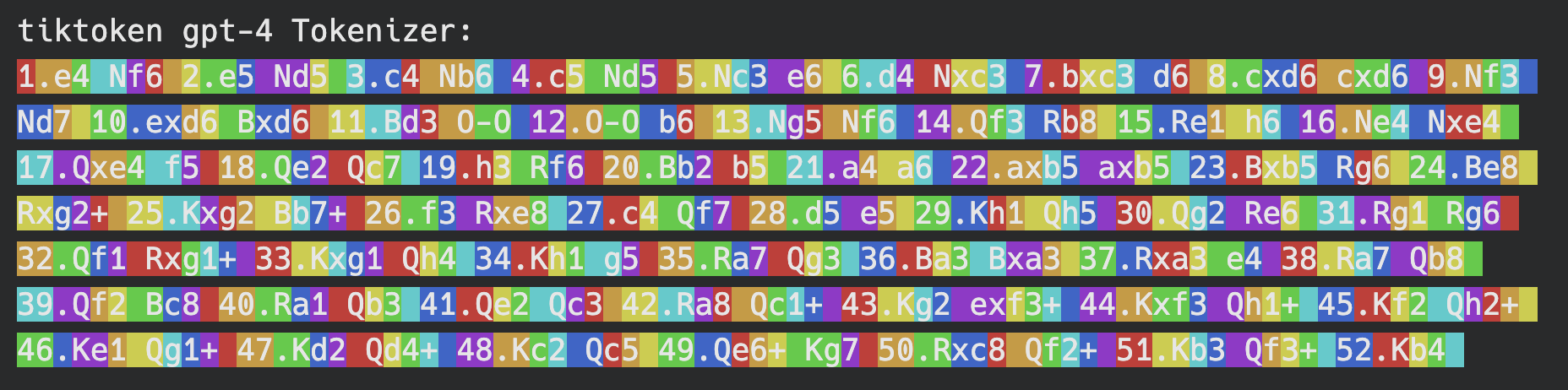
More traditional, language-focused BPE tokenizer implementations are not suited for PGN strings because they are more likely to break the actual moves apart.
For example 1.e4 e5 would likely be tokenized as 1, .e, 4, e, 5 (or 1, ., e, 4, e, 5 depending on the tokenizer), but using this specialized PGN Tokenizer it will be tokenized as 1., e4, e5. This allows models to be trained with more accurate connections between tokens in PGN strings and more accurate inference when completing PGN strings.
Visualization
Here is a visualization of the vocabulary of this specialized PGN tokenizer compared to the BPE tokenizer vocabularies of the cl100k_base (the vocabulary for the gpt-3.5-turbo and gpt-4 models' tokenizer) and the o200k_base (the vocabulary for the gpt-4o model's tokenizer):
PGN Tokenizer
Note: The tokenizer was trained with ~2.8 Million chess games in PGN notation with a target vocabulary size of 4096.
GPT-3.5-turbo and GPT-4 Tokenizers
GPT-4o Tokenizer
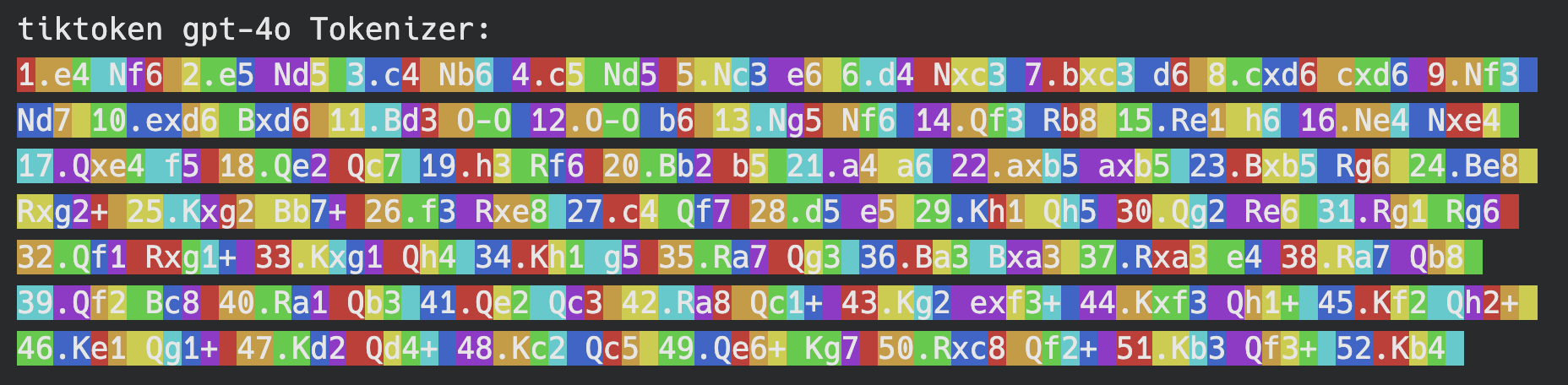
Note: These visualizations were generated with a function adapted from an educational Jupyter Notebook in the tiktoken repository.
Acknowledgements
- @karpathy for the Let's build the GPT Tokenizer tutorial
- Hugging Face for the
tokenizersandtransformerslibraries. - Kaggle user MilesH14, whoever you are, for the (now-unpublished) dataset of 3.5 million chess games cleaned from the Chess Research Project
1 maintainer

Metadata
1 maintainer
Release files for pgn-tokenizer 1.0.0
For a detailed explanation of source distributions (sdists) and built distributions (wheels), please see the package formats documentation.
Source distribution (sdist)
| File | Size | Uploaded | |
|---|---|---|---|
| pgn_tokenizer-1.0.0.tar.gz | 1.2 MB | Details |
Built distribution (wheel)
| File | Interpreter | ABI | Platform | Reset |
|---|---|---|---|---|
| pgn_tokenizer-1.0.0-py3-none-any.whl | Python 3 | none | any | Details |
Total release size: 1.3 MB
Release files / pgn_tokenizer-1.0.0.tar.gz
| Download URL | pgn_tokenizer-1.0.0.tar.gz |
|---|---|
| Size | 1.2 MB |
| Tags | Source |
|
SHA-256 checksum How to use checksums |
2b7b3f7d257132efa227468e4694e61d00fc339c97452fc59cc3667a64fd1c0e
|
|
BLAKE2b-256 checksum How to use checksums |
9760a20de108b736eb2ef7eb4d8f273ea347920cead298a1833842abf334392e
|
| Upload date | |
|
Uploaded using Trusted Publishing? What is trusted publishing? |
Yes |
| Uploaded via |
uv/0.11.2 {"installer":{"name":"uv","version":"0.11.2","subcommand":["publish"]},"python":null,"implementation":{"name":null,"version":null},"distro":{"name":"Ubuntu","version":"24.04","id":"noble","libc":null},"system":{"name":null,"release":null},"cpu":null,"openssl_version":null,"setuptools_version":null,"rustc_version":null,"ci":true}
|
Release files / pgn_tokenizer-1.0.0-py3-none-any.whl
| Download URL | pgn_tokenizer-1.0.0-py3-none-any.whl |
|---|---|
| Size | 72.2 kB |
| Tags | Python 3 |
|
SHA-256 checksum How to use checksums |
2b6698ae046866c060b795371263d5a03d227fe63aa971b96878a01d55d1c252
|
|
BLAKE2b-256 checksum How to use checksums |
eb97e549afef4726fa0e23430cbc06336c48dc9fa0d995fa1479a04080774205
|
| Upload date | |
|
Uploaded using Trusted Publishing? What is trusted publishing? |
Yes |
| Uploaded via |
uv/0.11.2 {"installer":{"name":"uv","version":"0.11.2","subcommand":["publish"]},"python":null,"implementation":{"name":null,"version":null},"distro":{"name":"Ubuntu","version":"24.04","id":"noble","libc":null},"system":{"name":null,"release":null},"cpu":null,"openssl_version":null,"setuptools_version":null,"rustc_version":null,"ci":true}
|














