
PgRelay
PostgreSQL-backed transactional outbox and reliable background jobs for Python services.








CI runs Ruff, mypy, pytest with an 85% coverage gate across Python 3.12/3.13 and PostgreSQL 15/16/17, plus a Docker Compose smoke test. The test suite covers enqueue, claim, leases, heartbeat, idempotency, purge, replay/cancel, retry/DLQ, HTTP workers, process recovery, API jobs, and runner behavior.
PgRelay is for the awkward space between "just call the webhook in the request" and "we need a separate queueing
platform". It stores jobs in the same PostgreSQL database your application already commits to, then runs them from a
small asyncio worker. The SDK writes into your existing SQLAlchemy AsyncSession, so a domain row and the job that
publishes it can commit or roll back together.
PgRelay 0.1.2 is not a LISTEN/NOTIFY queue. Workers poll PostgreSQL, claim ready rows with FOR UPDATE SKIP LOCKED,
and use durable leases for recovery after worker crashes.
It is intentionally not an exactly-once system. PgRelay gives you at-least-once delivery, retries, leases, dead-letter jobs, replay, and enough operator API to see what happened. Any external side effect still needs an idempotency key on the receiving side.
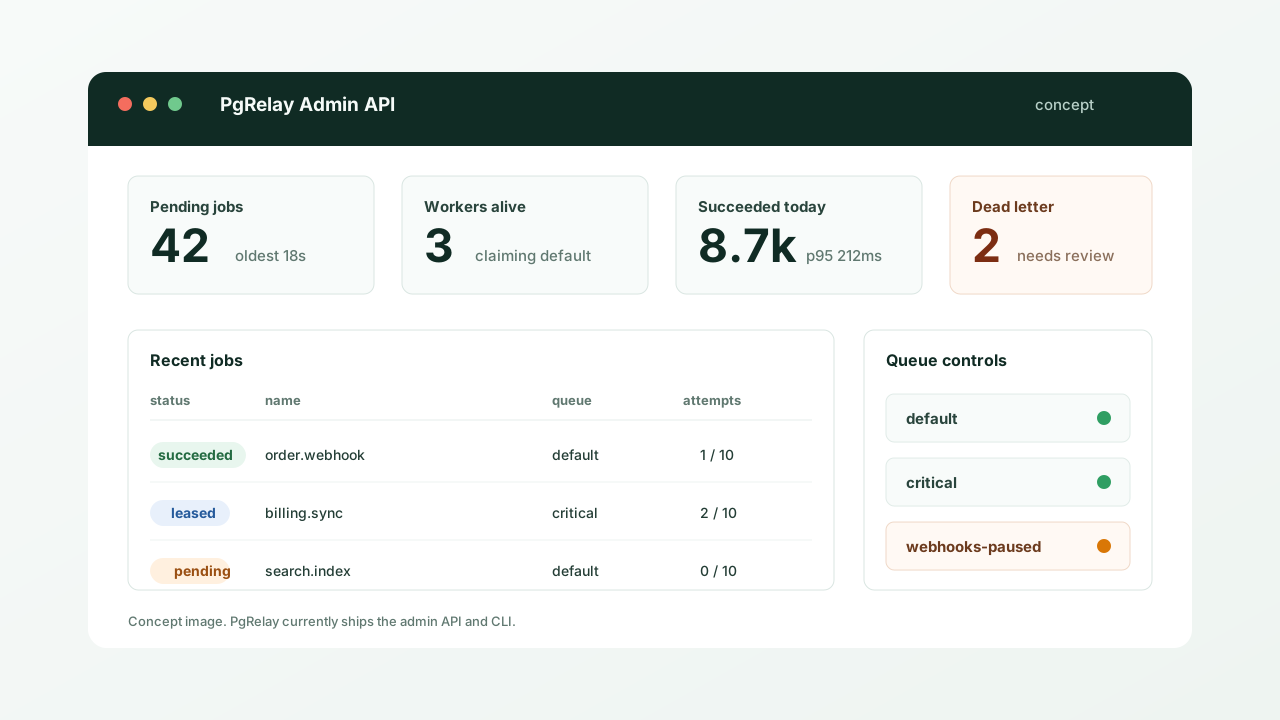
The image is a concept for a possible browser admin console. PgRelay currently ships the admin API and CLI; a separate browser console is not part of this release.
What You Get
- Transactional enqueue from a caller-owned
sqlalchemy.ext.asyncio.AsyncSession - HTTP jobs and Python handler jobs
- PostgreSQL queues with pause/resume and per-queue concurrency limits
- Worker leases, lease heartbeats, expired lease recovery, retries, and dead-letter state
- Idempotency keys and dedupe keys
- Replay and cancel operations for job recovery
- FastAPI admin API with health, readiness, jobs, attempts, queues, stats, and worker heartbeats
- Typer CLI for migrations, workers, replay, drain, purge, and environment checks
- Worker counters and histograms built with
prometheus-client
When It Fits
PgRelay is a good fit when your service already uses PostgreSQL and SQLAlchemy async, and the job is part of the same business fact you are committing. Typical examples are webhook delivery, search indexing, billing sync, email requests, or a small internal handler that should run after a transaction is durable.
It is not trying to replace Kafka, Temporal, Celery, SQS, or a workflow engine. If you need fan-out streams, long-running durable workflows, cross-language workers, hosted scheduling, or exactly-once effects in another system, use the tool built for that job.
For trade-offs against nearby alternatives, see Comparison with Celery, Taskiq, Procrastinate, and PgQueuer.
For operational limits, sizing notes, polling cost, retention, vacuum, and production checks, see Production Readiness and Limits.
Quick Start
Requirements:
- Python 3.12 or 3.13
- PostgreSQL 15+
- Poetry 2.x for local development
- Docker Compose if you want the one-command local stack
Run the local stack:
poetry install --with dev
docker compose up --build
The compose file starts PostgreSQL, runs migrations, then launches the admin API and one worker. The API listens on
http://localhost:8090.
Check it:
curl http://localhost:8090/healthz
curl http://localhost:8090/readyz
curl -H "Authorization: Bearer dev-token-change-me" http://localhost:8090/v1/jobs
FastAPI's OpenAPI UI is available at:
http://localhost:8090/docs
The default token is for local development only. Set PGRELAY_API_AUTH_TOKENS before running anything that is reachable
outside your machine. Use PGRELAY_API_READ_ONLY_AUTH_TOKENS for monitoring clients that should only read admin API
state.
Enqueue Inside Your Transaction
The important detail is ownership: PgRelay does not call commit() and does not close your session. Your application
keeps the transaction boundary.
from pgrelay.sdk.client import PgRelayClient

client = PgRelayClient.from_env()

async with session_factory() as session:
    async with session.begin():
        session.add(order)

        await client.enqueue_http(
            session=session,
            name="order.webhook",
            url="https://example.com/webhooks/orders",
            json_body={"order_id": str(order.id)},
            idempotency_key=f"order-webhook:{order.id}",
            trace_id=request_id,
        )
If the transaction rolls back, the job rolls back with it. If the transaction commits, a worker can claim the job after commit.
Python handler jobs use the same pattern:
await client.enqueue_handler(
    session=session,
    name="orders.recalculate_totals",
    payload={"order_id": str(order.id)},
    queue_name="default",
    idempotency_key=f"recalculate:{order.id}",
)
Python handler jobs use an explicit process-local handler registry: each worker process must register the same handler names in its application code. HTTP jobs do not use that registry; job state, attempts, leases, and queue state live in PostgreSQL.
Run a custom worker for Python handler jobs:
PGRELAY_DATABASE_URL=postgresql+asyncpg://postgres:postgres@localhost:5432/postgres \
  python examples/handler_worker.py
See examples/handler_worker.py for the matching orders.recalculate_totals handler.
CLI
pgrelay migrate upgrade
pgrelay migrate downgrade REVISION
pgrelay api
pgrelay worker
pgrelay replay JOB_ID
pgrelay replay JOB_ID --force
pgrelay drain default --timeout-seconds 300
pgrelay purge
pgrelay doctor
The CLI reads PGRELAY_* settings from the environment or .env.
Admin API
Unauthenticated endpoints:
| Method | Path | Purpose |
|---|---|---|
GET |
/healthz |
Process liveness |
GET |
/readyz |
Database readiness |
Authenticated endpoints require Authorization: Bearer <token>:
| Method | Path | Purpose |
|---|---|---|
POST |
/v1/jobs |
Enqueue a job through the admin API |
GET |
/v1/jobs |
List jobs without payload fields |
GET |
/v1/jobs/{job_id} |
Read one job with sensitive fields redacted |
GET |
/v1/jobs/{job_id}/attempts |
Read attempt history |
POST |
/v1/jobs/{job_id}/replay |
Create a fresh pending job from an existing one |
POST |
/v1/jobs/{job_id}/cancel |
Cancel a pending job |
GET |
/v1/queues |
List queues |
PUT |
/v1/queues/{queue_name} |
Create or update a queue |
POST |
/v1/queues/{queue_name}/pause |
Pause a queue |
POST |
/v1/queues/{queue_name}/resume |
Resume a queue |
GET |
/v1/stats |
Read queue and job stats |
GET |
/v1/workers |
Read worker heartbeat rows |
Example:
curl -H "Authorization: Bearer dev-token-change-me" \
  "http://localhost:8090/v1/jobs?status=pending&limit=25"
Configuration
PgRelay uses pydantic-settings with the PGRELAY_ prefix. The sample file is
.env.example.
The settings you will usually touch first:
| Setting | Why it matters |
|---|---|
PGRELAY_DATABASE_URL |
Runtime database URL. It must use postgresql+asyncpg://. |
PGRELAY_API_AUTH_TOKENS |
Comma-separated bearer tokens with read/write admin API access. Required in production. |
PGRELAY_API_READ_ONLY_AUTH_TOKENS |
Comma-separated bearer tokens for read-only admin API access. |
PGRELAY_WORKER_QUEUES |
Comma-separated queue names a worker should claim from. |
PGRELAY_WORKER_CONCURRENCY |
Maximum in-flight jobs per worker process. |
PGRELAY_WORKER_LEASE_SECONDS |
Lease duration before another worker may recover a stuck job. |
PGRELAY_HTTP_ALLOWED_HOSTS |
Allowlist for HTTP job targets. Required in production. |
PGRELAY_BLOCK_PRIVATE_NETWORK_TARGETS |
Blocks HTTP jobs from reaching private network targets by default. |
PGRELAY_RETENTION_SUCCEEDED_DAYS |
How long succeeded jobs are kept before purge. |
PGRELAY_RETENTION_DEAD_LETTER_DAYS |
How long dead-letter jobs are kept before purge. |
In production, do not use the development token from docker-compose.yml. PgRelay refuses to start with that token when
PGRELAY_ENV=prod.
Job Lifecycle
pending -> leased -> succeeded
                  -> pending      (retryable failure before max_attempts)
                  -> dead_letter  (max attempts reached or permanent failure)
pending -> cancelled
dead_letter/cancelled -> pending  (replay creates a new job id)
Workers poll PostgreSQL, claim pending jobs with row locks and SKIP LOCKED, then heartbeat the lease while the job
runs. If a worker dies, lease recovery returns the job to pending or moves it to dead_letter when attempts are
exhausted.
Operational Notes
- Design receivers to handle duplicate delivery. At-least-once is the contract.
- Use stable
idempotency_keyvalues for effects that should not be queued twice. - Keep HTTP job hosts allowlisted. The worker follows no redirects and blocks private network targets by default.
- Admin API job details redact payloads, headers, metadata, and response body previews.
- Watch dead-letter jobs. They are usually either a receiver problem, a bad payload, or a missing idempotency rule.
- Run more worker processes for throughput, but size the database pool so each worker has room to claim, heartbeat, and finish jobs.
- Treat payloads as operational data. Job list endpoints omit payloads, and detail endpoints redact payloads before returning jobs.
For state transitions, guarantees, and failure modes, see Architecture. For operational sizing, polling cost, retention, vacuum, and scaling limits, see Production Readiness and Limits.
Project Status
This repository is currently at 0.1.2. The core API, worker, SDK, migrations, and local Docker stack are present, but
the project should still be treated as young. Pin versions, test against your own failure modes, and expect the edges to
be sharper than a mature hosted queue.
Planned next steps are intentionally modest: optional PostgreSQL LISTEN/NOTIFY wakeups on top of polling, batch
enqueue, and OpenTelemetry integration.
License
MIT. See LICENSE.
Development
This project was developed with AI assistance and is maintained by the author.
1 maintainer

Release files for pgrelay 0.1.2
For a detailed explanation of source distributions (sdists) and built distributions (wheels), please see the package formats documentation.
Source distribution (sdist)
| File | Size | Uploaded | |
|---|---|---|---|
| pgrelay-0.1.2.tar.gz | 44.8 kB | Details |
Built distribution (wheel)
| File | Interpreter | ABI | Platform | Reset |
|---|---|---|---|---|
| pgrelay-0.1.2-py3-none-any.whl | Python 3 | none | any | Details |
Total release size: 111.9 kB
Release files / pgrelay-0.1.2.tar.gz
| Download URL | pgrelay-0.1.2.tar.gz |
|---|---|
| Size | 44.8 kB |
| Tags | Source |
|
SHA-256 checksum How to use checksums |
04c0f03cd330f9fcd85f089be77a99ee22c74b7f13c04fef7da118129bff1aa4
|
|
BLAKE2b-256 checksum How to use checksums |
3a5307562e38f5c396208c7e085fb6acc5cbfaf73506b5de9526f4319e36484f
|
| Upload date | |
|
Uploaded using Trusted Publishing? What is trusted publishing? |
Yes |
| Uploaded via |
twine/6.1.0 CPython/3.13.12
|
Provenance
Provenance describes where a file came from. On PyPI, provenance is shared via attestations, which provide a verifiable record of the build or publishing details. View details, limitations and caveats.


PyPI Publish Attestation
PyPI verified that this artifact, at this checksum, originated from the publisher listed below.
Signed by GitHub Actions, verified by PyPI on Jul 12, 2026.
Transparency logRelease files / pgrelay-0.1.2-py3-none-any.whl
| Download URL | pgrelay-0.1.2-py3-none-any.whl |
|---|---|
| Size | 67.0 kB |
| Tags | Python 3 |
|
SHA-256 checksum How to use checksums |
2f03672e0d640e8276768c88f09cc804c01797264cb6e810f363878274ea5265
|
|
BLAKE2b-256 checksum How to use checksums |
a2313f96a2b8268609310fd189070a35657821211261b2f9047e53f6c7df648a
|
| Upload date | |
|
Uploaded using Trusted Publishing? What is trusted publishing? |
Yes |
| Uploaded via |
twine/6.1.0 CPython/3.13.12
|
Provenance
Provenance describes where a file came from. On PyPI, provenance is shared via attestations, which provide a verifiable record of the build or publishing details. View details, limitations and caveats.
PyPI Publish Attestation
PyPI verified that this artifact, at this checksum, originated from the publisher listed below.
Signed by GitHub Actions, verified by PyPI on Jul 12, 2026.
Transparency log













