
Static analyzer for Postgres Row-Level Security — 47 lint rules covering tenant and per-user row-scoping bugs, performance traps, and hygiene; 16 mechanically auto-fixable; semantic policy-diff command for CI gating; pytest plugin for RLS isolation tests.
Verified details
These details have been verified by PyPIProject links
GitHub Statistics
Maintainers

Project description
pgrls





▶ 23-second demo · Quickstart · Rule reference · Docs site · CHANGELOG · PyPI
Static analyzer for Postgres Row-Level Security. Catches the policy bugs eyeball-review misses — broken row scoping (across tenants and between users in the same tenant), inverted auth checks, write-side holes; 16 of 47 rules mechanically auto-fixable.
pgrls diffclassifies every migration SAFE / BREAKING / REQUIRES_REVIEW / DANGEROUS so CI gates on real regressions, not safe schema changes. MIT, framework-agnostic (Supabase, PostgREST, Hasura, Django, raw SQL), CI-native (text / JSON / SARIF / Markdown / GitHub-PR-comment / GitHub annotations / JUnit XML).
Beta — actively maintained. 47 lint rules, 16 mechanically auto-fixable, semantic policy-diff command, pytest plugin for RLS isolation tests. Tested on PostgreSQL 15, 16, 17. Stable JSON / SARIF schema for CI integrations. The CHANGELOG records every release; current build is shown by the PyPI badge above.
- Lint & fix —
pgrls lintchecks a live database against all forty-seven rules and reports findings as text, JSON, SARIF, Markdown, GitHub-PR-comment (--format pr-comment), GitHub Actions annotations (--format github), or JUnit XML (--format junit) for CI.pgrls fixauto-remediates the mechanically-fixable rules (SEC001, SEC002, SEC006, SEC011, SEC015, SEC017, SEC019, SEC020, SEC031, SEC032, PERF001, PERF003, PERF004, HYG003, VIEW001, VIEW002) — to stdout or a migration-ready.sqlfile (--output).pgrls lint --baselinerecords existing findings so CI fails only on new ones, letting a team adopt pgrls on a legacy database without clearing the whole backlog first.- Test — the
pgrls.testingpytest plugin for writing RLS tests: role switching, per-test transactions, and tenant-isolation assertions.- Snapshot & diff —
pgrls snapshot/pgrls diffis a semantic RLS-policy diff that classifies every change SAFE / BREAKING / REQUIRES_REVIEW / DANGEROUS. Optional Z3-based predicate analysis (pip install pgrls[diff-z3]), plus migration-as-input — apply a migration to an ephemeral Postgres and diff the result (pip install pgrls[diff-apply]), withCREATE EXTENSIONauto-detection and a cached-baseline Docker image for fast re-runs.- TypeScript port —
pgrls-teston npm implements the same RLS-testing contract for JS/TS — bothpgandpostgres.jsdriver adapters, vitest-friendly. Seets/in this repo.- VS Code extension —
pgrls/pgrls-vscodewraps the CLI;pgrls: Lint databasesurfaces findings as diagnostics in the Problems panel, with hover documentation per rule.
Install
pip install pgrls
Requires Python 3.11+ and Postgres 15+. pgrls is tested in CI against PostgreSQL 15–17 (see .github/workflows/test.yml for the matrix).
Real-world bugs pgrls catches
The kind of mistake that ships to prod despite policy review:
CREATE POLICY tenant_read ON public.documents
    FOR SELECT TO authenticated
    USING (auth.uid() IS NULL OR owner = auth.uid());
Looks fine — and is structured the way many RLS tutorials show it. But auth.uid() returns NULL for any connection without a session JWT. For those connections the IS NULL branch is true, the OR short-circuits, and the policy admits every row of public.documents. It's a recurring pattern in multi-tenant Supabase / PostgREST projects — the kind of thing a public CVE write-up names by hindsight.
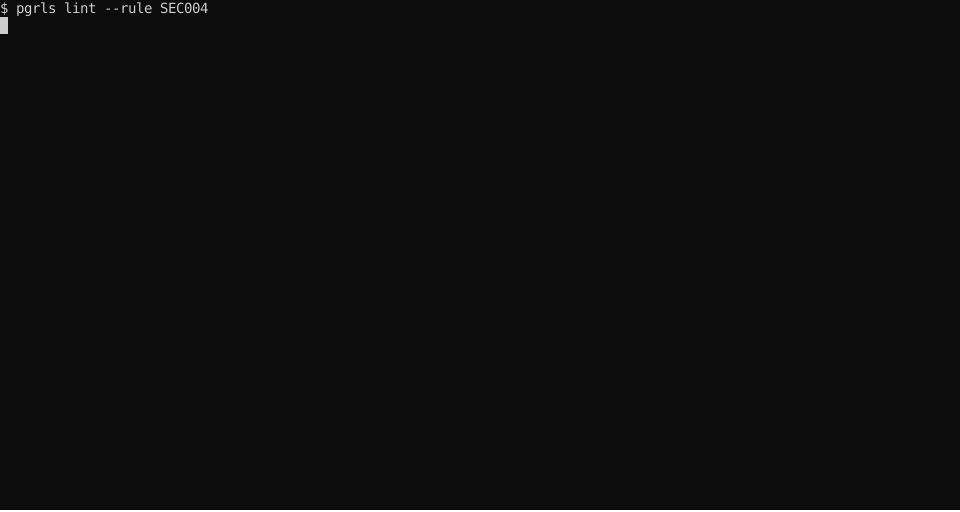
pgrls flags it as SEC004 (severity error) in milliseconds. With --explain, the rule's reference paragraph is appended underneath the finding (lines hard-wrapped here for the README; the real output is one long line per paragraph):
$ pgrls lint --rule SEC004 --explain
  ERROR  SEC004  public.documents.tenant_read
         Policy 'tenant_read' on public.documents contains a top-level
         `auth_func() IS NULL` disjunct in its USING clause. For anonymous
         connections that disjunct evaluates to true, satisfying the policy
         and exposing every row. Remove the IS NULL disjunct or replace with
         an explicit deny.

         The pattern: a policy with USING (auth_func() IS NULL OR <real check>).
         auth_func() returns NULL for anonymous connections, so the IS NULL
         disjunct is true and the OR is satisfied without ever evaluating the
         real check. Anonymous clients see all rows.

pgrls: 1 error.
RLS isn't only about keeping tenants apart. The same bug class bites within a single tenant, when rows are meant to be per-user:
CREATE TABLE documents (id uuid, tenant_id int, owner_id uuid, body text);
ALTER TABLE documents ENABLE ROW LEVEL SECURITY;
CREATE POLICY tenant_scope ON documents
    USING (tenant_id = current_setting('app.tenant')::int);
Cross-tenant reads are blocked, so this passes a tenant-isolation review. But there's an owner_id column and nothing keys on it, so every user in a tenant reads every other user's documents. If that table holds drafts, DMs, or private uploads, it's a leak. SEC027 (info) flags the table so you decide: add a per-user predicate, or confirm it's intentionally tenant-shared and allowlist it.
Browse the full rule catalogue in AGENTS.md for the other 41 — missing WITH CHECK, BYPASSRLS roles, per-row auth-function evaluation, search-path attacks, view-mediated RLS bypasses, and more.
Usage
Scaffold a config (optional — pgrls runs with zero config):
pgrls init # writes a commented pgrls.toml; --force to overwrite
Point pgrls at any Postgres database:
export DATABASE_URL="postgres://user:pass@host:5432/db"
pgrls lint
Or pass the URL directly:
pgrls lint --database-url "postgres://user:pass@host:5432/db"
Limit the scan to specific schemas:
pgrls lint --schemas public,tenant
Point at a non-default config file, or pick an output format:
pgrls lint --config ./config/pgrls.toml --format text     # human-readable (default)
pgrls lint --config ./config/pgrls.toml --format json     # machine-readable for CI
pgrls lint --config ./config/pgrls.toml --format sarif    # GitHub Code Scanning
pgrls lint --config ./config/pgrls.toml --format markdown   # rendered CI reports / runbooks
pgrls lint --config ./config/pgrls.toml --format pr-comment # collapsible per-rule GitHub PR comment
pgrls lint --config ./config/pgrls.toml --format github     # GitHub Actions run annotations
pgrls lint --config ./config/pgrls.toml --format junit    # JUnit XML for CI test reports
Or run only specific rules — handy when scoping a SARIF report in CI, or
investigating one rule in isolation. --rule is case-insensitive,
repeatable, and overrides [lint] disable in the config so you can pull a
disabled rule back in for one run without editing the config:
pgrls lint --rule SEC001 --rule SEC003
Or run everything except certain rules with --exclude-rule (the
complement of --rule; case-insensitive, repeatable):
pgrls lint --exclude-rule SEC022 --exclude-rule PERF002
Trim the printed report to the findings you care about with
--min-severity (display-only — the exit code still reflects every finding
per --fail-on, so hiding info noise can't flip CI green), and write the
report to a file instead of stdout with --output/-o:
pgrls lint --min-severity warning            # hide info-level nudges from output
pgrls lint --format sarif --output pgrls.sarif
Pass --explain to append each rule's reference paragraph beneath its
finding in the text output, so a CI log carries the why next to the
where without a separate pgrls explain <RULE> lookup. Text format
only — JSON / SARIF / Markdown / GitHub / JUnit keep their schemas stable.
Example output
Text (default):
  ERROR  SEC001  public.users
         Table public.users does not have row-level security enabled.
         Add ENABLE ROW LEVEL SECURITY or include the table in
         [lint.rules.SEC001].allowlist if it is a public reference table.

pgrls: 1 error.
JSON (--format json):
{
  "violations": [
    {
      "rule_id": "SEC001",
      "severity": "error",
      "title": "RLS not enabled on table",
      "message": "Table public.users does not have row-level security enabled. Add ENABLE ROW LEVEL SECURITY or include the table in [lint.rules.SEC001].allowlist if it is a public reference table.",
      "location": "public.users"
    }
  ],
  "summary": { "errors": 1, "warnings": 0, "infos": 0, "total": 1 }
}
The JSON shape is the public CI contract — top-level keys, per-violation keys, and summary keys are stable across releases. Pipe through jq to filter, count, or transform; ship to a dashboard; upload as a build artifact.
SARIF (--format sarif) emits a SARIF v2.1.0 document. GitHub Code Scanning, Azure DevOps, and other static-analysis aggregators consume it directly — see the GitHub Actions recipe below for the upload step that puts findings inline on PRs.
Exit codes follow the standard linter convention:
0— clean (or findings belowfail_on)1— findings met or exceededfail_on(defaultwarning); your schema has an RLS issue2—pgrlsitself failed to run (bad config, DB unreachable, fixer SQL rolled back, etc.). Distinct from1so CI alerts can route "schema bug" differently from "tool error."
Baseline — adopt pgrls on a legacy database
Running pgrls against an existing database for the first time often surfaces a backlog of pre-existing findings. --baseline lets you ratchet: record today's findings and have CI fail only on new ones.
# First run (file absent): records every current finding, exits 0.
pgrls lint --database-url "$DATABASE_URL" --baseline pgrls-baseline.json

# Later runs: report and fail only on findings NOT in the baseline.
pgrls lint --database-url "$DATABASE_URL" --baseline pgrls-baseline.json
The first run writes the baseline file and exits 0. Every later run suppresses findings already recorded and exits nonzero only when a new finding appears — so a team can adopt pgrls without fixing the whole backlog up front, then chip away at the baseline over time. Commit the baseline file to the repo.
To re-baseline after deliberately accepting new findings, pass --update-baseline alongside --baseline FILE; the baseline is refreshed in place with the current findings (replace, not merge — stale entries for findings that no longer fire are dropped). No need to delete the file first.
Auto-remediation: pgrls fix
pgrls fix generates SQL for the rules whose remediation is mechanical. Default mode is dry-run — it prints the SQL but does not modify the database. Pass --apply to execute, or --output <file> to write a migration-ready .sql script (a header plus one -- [rule] description comment per statement) instead of printing to stdout.
# Dry-run: print what would change.
pgrls fix --database-url "$DATABASE_URL"

# Apply for real.
pgrls fix --database-url "$DATABASE_URL" --apply

# Only fix one rule.
pgrls fix --database-url "$DATABASE_URL" --rule SEC002 --apply

# Write the SQL to a migration-ready file instead of stdout.
pgrls fix --database-url "$DATABASE_URL" --output migration.sql

# CI gate: exit 1 if any auto-fixable violations exist (no SQL emitted).
pgrls fix --database-url "$DATABASE_URL" --check
Currently fixable: SEC001 (emits ALTER TABLE … ENABLE ROW LEVEL SECURITY;), SEC002 (emits ALTER TABLE … FORCE ROW LEVEL SECURITY;), SEC006 (emits ALTER POLICY … WITH CHECK (…) mirroring the policy's USING), SEC011 (emits ALTER POLICY … USING (…) / WITH CHECK (…) stripping an OR true debug bypass), SEC019 (emits ALTER POLICY … USING (…) / WITH CHECK (…) adding the missing_ok = true second argument to one-argument current_setting() calls), SEC020 (emits ALTER POLICY … WITH CHECK (…) replacing a constant-true WITH CHECK with the policy's USING), SEC031 (emits DROP POLICY … ON …; for a no-op restrictive USING (true) floor — it AND-combines to nothing, so dropping it leaves access unchanged), PERF001 (rewrites unwrapped auth calls as (SELECT auth.uid()) and emits ALTER POLICY … USING (…);), PERF003 (emits CREATE INDEX ON … (…); for a policy-predicate column with no leading-column index), HYG003 (emits DROP POLICY … ON …; for a policy that exactly duplicates another on the same table), VIEW001 (emits ALTER VIEW … SET (security_invoker = true);), and VIEW002 (emits ALTER VIEW … SET (security_barrier = true);). Other rules need human intent (which role? which column? which policy?) and are not auto-fixed.
RLS posture — pgrls report
pgrls lint answers "what's wrong?"; pgrls report answers "what's the posture overall?" — a factual, rule-free snapshot of every table's row-level-security state, for audits and onboarding.
pgrls report --database-url "$DATABASE_URL"                                  # text table + summary
pgrls report --database-url "$DATABASE_URL" --format json                    # machine-readable
pgrls report --database-url "$DATABASE_URL" --format markdown -o posture.md  # write an audit doc
pgrls report --database-url "$DATABASE_URL" --format html -o posture.html    # standalone HTML page, print/PDF-ready
Each table gets a coarse status — protected (RLS on, FORCE'd, ≥1 permissive policy), not-forced (RLS on with a permissive policy, but owner bypasses), no-policies (RLS on but no permissive policy → default-deny; covers zero policies and restrictive-only tables), covered-by-parent (a partition child whose RLS-enabled parent covers queries routed through it — credited when that parent is among the scanned schemas), or rls-off — plus an aggregate summary. It runs no rules and emits no findings; use pgrls lint for that.
Tracking trends — pgrls history
Pair a daily cron with pgrls lint --format json -o snapshots/$(date -u +%FT%H%M%SZ).json and ask pgrls history snapshots/ weekly — "are we gaining ground over time, or is the findings count creeping up?"
pgrls history snapshots/                       # terminal table
pgrls history snapshots/ --format markdown     # paste-ready GFM (for a weekly update / PR comment)
pgrls history snapshots/ --format json -o trend.json   # machine-readable for plotting
Each row is one snapshot plus the NEW / FIXED delta vs. the prior snapshot in chronological order (findings keyed by (rule_id, location) so a schema-wide finding stays PERSISTENT rather than NEW+FIXED on every comparison). A trailing summary line names the net change over the full series.
Configuration
Drop a pgrls.toml next to your project. See pgrls.example.toml in the repo for a fully commented version.
[database]
url = "$DATABASE_URL"
schemas = ["public"]

[lint]
disable = []
fail_on = "warning"

[lint.rules.SEC001]
allowlist = ["countries", "currencies"]

# `severity` re-tiers a rule's findings without disabling it —
# "error" | "warning" | "info". SEC019 is an info rule; promoting
# it to error makes a one-arg current_setting() call fail CI.
[lint.rules.SEC019]
severity = "error"
Sharing config across projects — extends
A config can layer on top of a shared base with a top-level extends
(a path, or a list of paths resolved relative to the file that declares
it) — handy for a monorepo or an org-wide ruleset:
extends = "../pgrls.base.toml"   # or ["../base.toml", "./team.toml"]

[lint]
fail_on = "error"                # override one key; inherit the rest
Tables deep-merge key-by-key (a child can set [lint.rules.SEC001].severity
while inheriting the base's allowlist); scalars and arrays are replaced,
not appended (a child disable list wins wholesale). For a list, later
entries override earlier ones, and the declaring file overrides every base.
A cycle in the extends chain is an error.
Editor support — JSON Schema
pgrls ships a JSON Schema for pgrls.toml (pgrls.schema.json) so editors autocomplete keys and flag typos and invalid values (a misspelled [lint.rles], a bad fail_on). pgrls init writes a #:schema directive on the first line, which the Even Better TOML VS Code extension applies automatically:
#:schema https://raw.githubusercontent.com/pgrls/pgrls/main/pgrls.schema.json
Point any JSON-Schema-aware TOML tooling at that URL for the same validation.
Testing your RLS — pgrls.testing
Install with pip install pgrls[testing] to pull in pytest alongside pgrls.
pgrls.testing is a pytest plugin that lets you write RLS tests with idiomatic pytest ergonomics. The pgrls_db fixture opens a connection, starts a per-test transaction, lets you switch roles + claims for each scenario, and rolls back at end so nothing persists between tests.
def test_user_a_cannot_see_user_bs_invoices(pgrls_db):
    pgrls_db.seed("public.invoices", [
        {"id": "1", "tenant_id": "tenant-a", "amount": 100},
        {"id": "2", "tenant_id": "tenant-b", "amount": 200},
    ])
    with pgrls_db.as_role(
        "authenticated",
        claims={"sub": "user-a", "tenant_id": "tenant-a"},
    ):
        pgrls_db.assert_rows("SELECT id FROM invoices", count=1)
        pgrls_db.assert_invisible(
            "SELECT id FROM invoices WHERE tenant_id = 'tenant-b'"
        )
        pgrls_db.assert_rejected(
            "INSERT INTO invoices (tenant_id, amount) VALUES ('tenant-b', 999)"
        )
The plugin assumes the standard PostgREST conventions (SET LOCAL ROLE + request.jwt.claims GUC). Configure the connection string via one of the following — the first one defined wins:
- A
pgrls_test_database_urlfixture in yourconftest.py. This replaces the plugin's default fixture (pytest fixture shadowing); when you supply one, the env-var fallback below is not consulted. Useful for per-session testcontainers. - The
PGRLS_TEST_DATABASE_URLenvironment variable. - The
DATABASE_URLenvironment variable (fallback).
Setting none of the three causes pgrls_db to raise PgrlsTestConfigError.
The cross-language contract is documented at docs/pgrls-test-protocol.md. The TypeScript port ships as pgrls-test on npm — same Layer 1 protocol, same wire-level behaviour, idiomatic JS/TS surface (camelCase API, pg and postgres.js adapters). Source under ts/ in this repo. The Go port is shipping in stages at go/ (module github.com/pgrls/pgrls/go, versioned independently as go/v0.7.x); step 1 (scaffold + ProtocolVersion constant + error types) shipped in go/v0.7.0, with steps 2–7 (Driver interface, pgx + lib/pq adapters, Client API, assertion helpers, conformance suite, release tag) tracked in go/CHANGELOG.md.
Diff — pgrls snapshot + pgrls diff
pgrls diff is the semantic policy diff command. Point it at any two
Postgres sources — two snapshot files, a snapshot and a live DB, or two
live DBs — and it classifies every RLS change as SAFE, BREAKING,
REQUIRES_REVIEW, or DANGEROUS. Use it in CI to gate deployments on
actual security regressions without blocking safe migrations.
# Capture a baseline from the current branch (filter to a schema list
# to keep snapshots small and stable).
pgrls snapshot --database-url "$DATABASE_URL" --schemas app -o base.json

# After applying a migration, compare live DB to the baseline. The
# --schemas filter applies to the URL side only (the snapshot file
# already carries the filter from capture time).
pgrls diff base.json --database-url "$DATABASE_URL" --schemas app
The default --fail-on dangerous threshold means CI only fails when a
genuinely dangerous change is detected (RLS toggled off, a permissive
policy added, a predicate widened, etc.). Pass --fail-on requires-review
for a stricter gate, or set [diff].fail_on in pgrls.toml to make
the choice persistent (CLI flag → [diff].fail_on → built-in
dangerous). Output is git-diff-style by default (--format text);
use --format json or --format sarif for CI integrations that
already parse pgrls lint output — the same Violation shape is
reused.
Pass --explain to append a one-paragraph rationale beneath each
classified Change in the text output — why a dropped PERMISSIVE
policy is BREAKING rather than DANGEROUS, why a column drop is
REQUIRES_REVIEW, etc. Text format only; JSON / SARIF already carry
the classification tag.
| Change category | Default classification |
|---|---|
| RLS toggled off | DANGEROUS |
| Table dropped | BREAKING |
| Permissive policy added | DANGEROUS |
| Restrictive policy dropped | DANGEROUS |
| USING predicate widened (OR added) | DANGEROUS |
| USING predicate tightened (AND added) | SAFE |
| Roles widened (PUBLIC or new role) | DANGEROUS |
| Column dropped (still referenced) | REQUIRES_REVIEW |
| GRANT added on non-RLS table to PUBLIC | DANGEROUS |
See AGENTS.md for the full classification table and AST pattern documentation.
Rules
pgrls lint ships these rules:
| ID | Severity | Catches |
|---|---|---|
| SEC001 | error | Tables in scanned schemas with RLS disabled and no policies (a table with policies but RLS off is SEC032) |
| SEC002 | error | Tables with RLS enabled but FORCE ROW LEVEL SECURITY off |
| SEC003 | error | Permissive policies granted to PUBLIC |
| SEC004 | error | Inverted auth check (Lovable CVE pattern) in USING |
| SEC005 | warning | Policy expression has no own-column reference |
| SEC006 | error | INSERT/UPDATE/ALL policies with no WITH CHECK |
| SEC007 | info | All policies on a table are permissive (no RESTRICTIVE floor) |
| SEC008 | warning | Permissive policy USING clause is constant true (admits every row) |
| SEC009 | warning | RLS enabled but no policies defined (silent deny-all) |
| SEC010 | warning | Policy USING/WITH CHECK clause is constant false (deny-all anti-pattern) |
| SEC011 | warning | Policy expression has an OR true branch (debug bypass left in) |
| SEC012 | warning | Table has only RESTRICTIVE policies (silent deny-all — needs at least one PERMISSIVE) |
| SEC013 | warning | Trigger on RLS-protected table can bypass policies (triggers fire as table owner) |
| SEC014 | warning | SECURITY DEFINER function bypasses caller's RLS (audit every SECDEF function) |
| SEC015 | warning | SECURITY DEFINER function exposed to pg_temp search-path shadowing |
| SEC016 | warning | Role with the BYPASSRLS attribute bypasses every RLS policy |
| SEC017 | warning | Function with the LEAKPROOF attribute is evaluated below the RLS barrier |
| SEC018 | warning | Policy compares a column against current_user / session_user (no isolation under a shared pool role) |
| SEC019 | info | Policy calls current_setting() without the missing_ok argument (raises on an unset GUC) |
| SEC020 | warning | Policy WITH CHECK is constant true while USING restricts (writes accept rows reads never would) |
| SEC021 | info | Policy compares an identity column against a hardcoded literal (e.g. tenant_id = 1) |
| SEC022 | info | RLS-enabled table whose policies are all FOR SELECT — no write-side policy, so INSERT/UPDATE/DELETE are denied |
| SEC023 | warning | Policy granted to a role carrying BYPASSRLS — the role skips the policy entirely, so its TO clause is inert |
| SEC024 | info | Policy calls current_setting() with an unqualified parameter name (a dropped prefix the application cannot SET) |
| SEC025 | warning | Policy predicate references another table whose RLS is disabled — the cross-table read is only as strong as the referenced table's isolation |
| SEC026 | warning | Policy predicate uses LIKE / ILIKE / SIMILAR TO / POSIX regex against an auth-context value (a wildcard-shape GUC matches every row) |
| SEC027 | info | RLS table has an owner / user-identity column that no policy scopes by — rows may be visible across users within the same tenant |
| SEC028 | warning | Permissive write policy (INSERT/UPDATE/ALL) whose WITH CHECK is constant true — accepts every write; the TO clause gates who, not what |
| SEC029 | warning | Role can SET ROLE to a BYPASSRLS role through membership — escalation path that silently disables every policy (BYPASSRLS is not inherited, but reachable) |
| SEC030 | info | Policy scopes by a nullable discriminator column (tenant_id = current_setting(…) where the column allows NULL) — NULL rows escape scoping today and leak the moment a NULL-tolerant predicate appears |
| SEC031 | warning | RESTRICTIVE policy whose USING is constant true — AND-combines to a no-op, so it looks like a security floor but enforces none |
| SEC032 | error | Table has policies but RLS is not enabled — the policies are dormant (Postgres ignores them) and the table is wide open despite looking RLS-managed |
| SEC033 | error | Policy scopes by a user-modifiable JWT claim (user_metadata / raw_user_meta_data) — the authenticated user can rewrite the value via the auth API, bypassing the check; use app_metadata (service-role-only) instead |
| SEC034 | warning | Policy gates rows on auth.email() — silent denial-of-service-to-self when the user changes email, when SQL = is case-sensitive but emails aren't, or when plus-addressing means x+y@host ≠ x@host; scope by auth.uid() instead |
| SEC036 | error | Policy EXISTS (SELECT FROM auth.users WHERE …) sub-select with no caller binding — checks "is there any admin at all" instead of "is THIS user an admin", so every authenticated user passes once any matching row exists |
| SEC037 | warning | Policy compares auth.role() to a value outside the known role set (anon / authenticated / service_role) — comparison never matches and silently denies every row, masking the broken policy |
| PERF001 | warning | Auth function called per-row in policy USING (unwrapped) |
| PERF002 | warning | Policy expression uses a VOLATILE function (random(), clock_timestamp(), …) |
| PERF003 | warning | Policy predicate column without a leading-column index (sequential scan on every query) |
| PERF004 | warning | Policy predicate wraps an indexed column in a function (e.g. lower(email)) so the plain index can't serve it — Postgres seq-scans; needs an expression index |
| HYG001 | error | Policies referencing columns that don't exist on the table |
| HYG002 | warning | Policy named like a placeholder (todo, fixme, tmp, …) |
| HYG003 | info | Policy is an exact duplicate of another policy on the same table |
| VIEW001 | error | View over RLS-protected table without WITH (security_invoker = true) |
| VIEW002 | warning | View over RLS-protected table without WITH (security_barrier = true) |
| VIEW003 | warning | Materialized view over RLS-protected table (RLS not honored at query time) |
| VIEW004 | warning | View calls SECURITY DEFINER function that reads an RLS-protected table |
Run pgrls explain <RULE> (for example pgrls explain SEC023) to print any
rule's full rationale — what it flags, why it matters, how detection works,
and how to allowlist a false positive — on the command line. Bare
pgrls explain (no argument) lists the catalog: one line per rule with its
severity and title. Pass --format markdown to either form (pgrls explain SEC023 --format markdown, pgrls explain --format markdown) for a
paste-ready Markdown document — an ## SEC023 — … heading + the body, or a
Markdown table of the catalog. --format json emits machine-readable rule
metadata (id, severity, title, a fixable flag, and — for a single rule —
the full reference body) for IDE / tooling integrations. All forms read only
pgrls's built-in rule catalog, so they need no database connection.
For canonical SQL fixes per rule, see AGENTS.md. For per-rule
configuration options (allowlists, etc.), see pgrls.example.toml.
For per-release changes, see CHANGELOG.md.
CI integration
pgrls is designed to live in your CI alongside any other linter. It
needs a Postgres database with your schema applied; it then connects,
introspects, and exits non-zero if any rule at or above
fail_on (default warning) fires.
pre-commit
# .pre-commit-config.yaml
repos:
  - repo: https://github.com/pgrls/pgrls
    rev: v0.5.7
    hooks:
      - id: pgrls-lint
        # pgrls hits a real database, so most teams scope this to
        # `pre-push` rather than every commit.
        stages: [pre-push]
        args:
          - --database-url=$DATABASE_URL
          - --config=pgrls.toml
GitHub Actions
The quickest path is the published Action (pgrls/pgrls-action on the GitHub Marketplace) — it installs pgrls from PyPI and runs pgrls lint against a reachable database:
- uses: pgrls/pgrls-action@v1
  with:
    database-url: ${{ secrets.PGRLS_DATABASE_URL }}
    schemas: public
    fail-on: error
It exposes every flag pgrls lint does (--format, --rule, --exclude-rule, --baseline, --output, --min-severity, …); see the Marketplace listing for the full input table.
Or run pgrls directly — useful when you want to spin up an ephemeral Postgres as a job service:
# .github/workflows/pgrls.yml
name: pgrls
on: [push, pull_request]
jobs:
  lint:
    runs-on: ubuntu-latest
    services:
      postgres:
        image: postgres:16-alpine
        env:
          POSTGRES_USER: ci
          POSTGRES_PASSWORD: ci
          POSTGRES_DB: ci
        ports: ["5432:5432"]
        options: >-
          --health-cmd pg_isready
          --health-interval 10s
          --health-retries 5
    env:
      DATABASE_URL: postgres://ci:ci@localhost:5432/ci
    steps:
      - uses: actions/checkout@v4
      - uses: actions/setup-python@v5
        with:
          python-version: "3.11"
      - run: pip install pgrls
      - name: Apply schema
        run: psql "$DATABASE_URL" -v ON_ERROR_STOP=1 -f migrations/all.sql
      - name: Lint RLS
        run: pgrls lint --format sarif > pgrls.sarif
      - name: Upload SARIF for code scanning
        uses: github/codeql-action/upload-sarif@v3
        if: always()
        with:
          sarif_file: pgrls.sarif
The SARIF upload puts findings inline on the PR as code-scanning
alerts — no extra dashboard plumbing. Use --format json instead
of --format sarif if you want to pipe to jq, build your own
dashboard, or keep the report as a build artifact.
Roadmap
- More lint rules. Continued expansion of the SEC / PERF / HYG / VIEW catalog. Polished error messages.
TypeScript port of— shipped as thepgrls.testingpgrls-testnpm package, versioned independently of the Python package (taggedts-v0.6.0). Source:ts/.- Go port of
pgrls.testingfollowing the same Layer 1 protocol — versioned independently of the Python package as thego/v0.7.xsequence (Go module tag prefixgo/, distinct from the Python package's tags). Step 1 (scaffold + protocol-version constant + error types) landed ingo/v0.7.0; subsequent steps (Driver interface, pgx + lib/pq adapters, Client API, assertion helpers, conformance suite) tracked ingo/CHANGELOG.md. SAT-based predicate implication checking.Z3-driven semantic predicate analysis landed in v0.4.x.Migration-as-input.pgrls diff --apply migration.sqlshipped in v0.5.0; baseline cache + extension auto-detect in v0.5.1–v0.5.2.
License
MIT — see LICENSE.
Project details
Verified details
These details have been verified by PyPIProject links
GitHub Statistics
Maintainers
Release history Release notifications | RSS feed


Download files
Download the file for your platform. If you're not sure which to choose, learn more about installing packages.
Source Distribution
Built Distribution
Filter files by name, interpreter, ABI, and platform.
If you're not sure about the file name format, learn more about wheel file names.
Copy a direct link to the current filters
File details
Details for the file pgrls-0.6.14.tar.gz.
File metadata
- Download URL: pgrls-0.6.14.tar.gz
- Upload date:
- Size: 883.7 kB
- Tags: Source
- Uploaded using Trusted Publishing? Yes
- Uploaded via: twine/6.1.0 CPython/3.13.12
File hashes
| Algorithm | Hash digest | |
|---|---|---|
| SHA256 |
1fa529fcbdf5a69c6c3686a7497403cbd9968bfd172345a59797654141a2be8c
|
|
| MD5 |
4cc6b947b1b1364b3c60c9594dea55e5
|
|
| BLAKE2b-256 |
83d775abb9fcec661bd023ebd6f782c73f5d8f50823010a02f5430dc4a5e3ce6
|
Provenance
The following attestation bundles were made for pgrls-0.6.14.tar.gz:
Publisher:
publish.yml on pgrls/pgrls
-
Statement:
-
Statement type:
https://in-toto.io/Statement/v1 -
Predicate type:
https://docs.pypi.org/attestations/publish/v1 -
Subject name:
pgrls-0.6.14.tar.gz -
Subject digest:
1fa529fcbdf5a69c6c3686a7497403cbd9968bfd172345a59797654141a2be8c - Sigstore transparency entry: 1638418007
- Sigstore integration time:
-
Permalink:
pgrls/pgrls@973d6a75ca80650e494dc6d69ff892592a820994 -
Branch / Tag:
refs/tags/v0.6.14 - Owner: https://github.com/pgrls
-
Access:
public
-
Token Issuer:
https://token.actions.githubusercontent.com -
Runner Environment:
github-hosted -
Publication workflow:
publish.yml@973d6a75ca80650e494dc6d69ff892592a820994 -
Trigger Event:
release
-
Statement type:
File details
Details for the file pgrls-0.6.14-py3-none-any.whl.
File metadata
- Download URL: pgrls-0.6.14-py3-none-any.whl
- Upload date:
- Size: 327.3 kB
- Tags: Python 3
- Uploaded using Trusted Publishing? Yes
- Uploaded via: twine/6.1.0 CPython/3.13.12
File hashes
| Algorithm | Hash digest | |
|---|---|---|
| SHA256 |
c410aeefb96b6c26ddd84ab6313d4d6ca4e84b14b9b3066f9786722fc8a5535f
|
|
| MD5 |
b006ab9c54e6c9d6deab1284d74ae84c
|
|
| BLAKE2b-256 |
2bd434830b769770085e29d9a78204ce83577bbced192d860638699bee3d21b2
|
Provenance
The following attestation bundles were made for pgrls-0.6.14-py3-none-any.whl:
Publisher:
publish.yml on pgrls/pgrls
-
Statement:
-
Statement type:
https://in-toto.io/Statement/v1 -
Predicate type:
https://docs.pypi.org/attestations/publish/v1 -
Subject name:
pgrls-0.6.14-py3-none-any.whl -
Subject digest:
c410aeefb96b6c26ddd84ab6313d4d6ca4e84b14b9b3066f9786722fc8a5535f - Sigstore transparency entry: 1638418072
- Sigstore integration time:
-
Permalink:
pgrls/pgrls@973d6a75ca80650e494dc6d69ff892592a820994 -
Branch / Tag:
refs/tags/v0.6.14 - Owner: https://github.com/pgrls
-
Access:
public
-
Token Issuer:
https://token.actions.githubusercontent.com -
Runner Environment:
github-hosted -
Publication workflow:
publish.yml@973d6a75ca80650e494dc6d69ff892592a820994 -
Trigger Event:
release
-
Statement type:






