
pgtriage




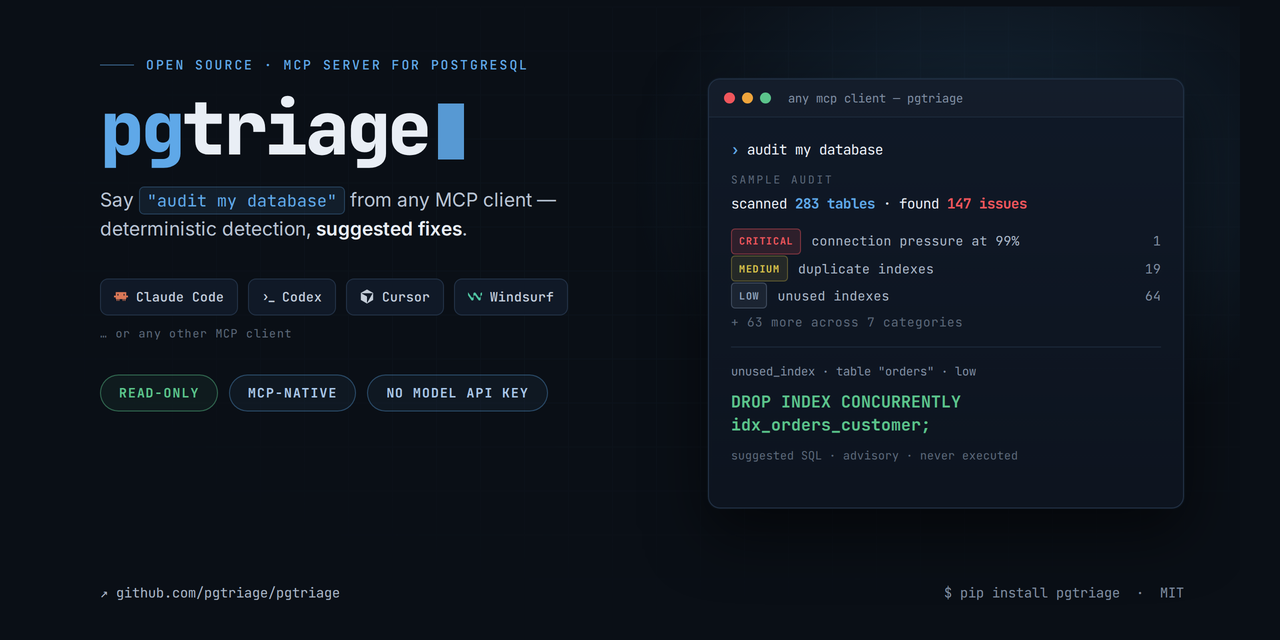
Read-only MCP server for PostgreSQL performance auditing. Connect it to Claude Code (or any MCP client) and say "audit my database" to get structured findings with evidence and suggested fixes.
Not related to the pgAudit logging extension. pgtriage does performance triage, not compliance logging.
Why I built this
Built after diagnosing implicit type casts and missing indexes on multi-million-row tables in production fintech systems. The fixes were simple (one CREATE INDEX CONCURRENTLY statement each), but finding them required reading query plans most engineers never look at. A real production audit surfaced 88 findings across 118 tables. pgtriage automates that diagnostic process and lets any AI client explain the results.
How it works
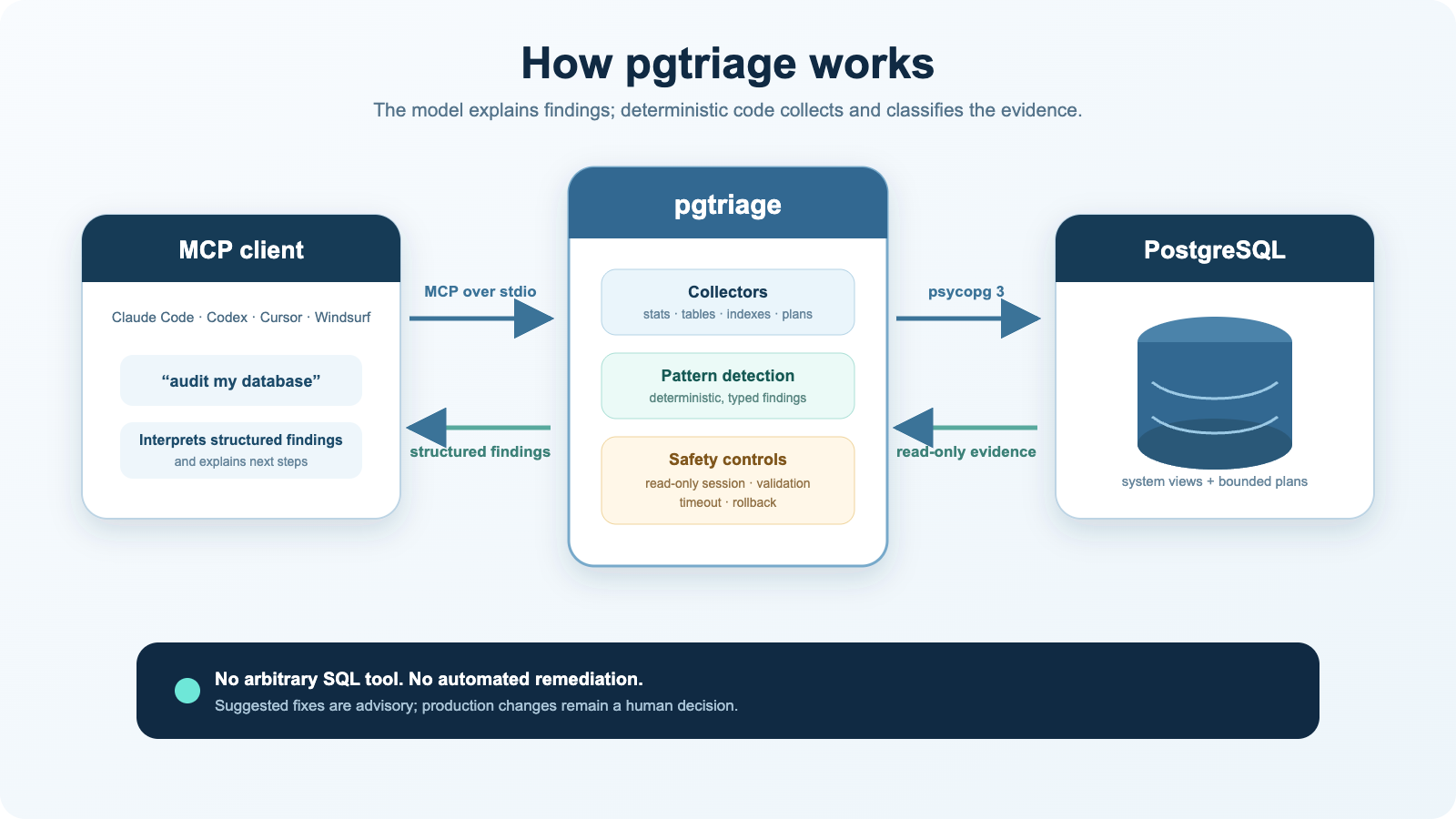
pgtriage connects to your PostgreSQL database and exposes performance auditing tools via the Model Context Protocol. It collects metrics from PostgreSQL system views, runs deterministic pattern detection, and returns structured findings. The MCP client provides the AI layer, interpreting results and explaining fixes in plain English.
No API keys required. No AI costs. No vendor lock-in. The intelligence comes from your MCP client.
Example output
Example audit: 283 tables scanned, 147 findings — 1 critical connection-pressure finding, 19 medium duplicate-index findings, 64 low unused-index findings, and 63 more across seven categories.
{
  "severity": "critical",
  "category": "connection_pressure",
  "detail": "Ordinary client connection utilization at 99% (96/97 usable slots; 100 max, 3 reserved). Ordinary connection capacity is effectively exhausted.",
  "suggested_fix": "Consider using a connection pooler (PgBouncer) or increasing max_connections if RAM allows.",
  "evidence": {
    "total_connections": 96,
    "max_connections": 100,
    "reserved_connections": 3,
    "ordinary_connection_capacity": 97,
    "ordinary_slots_available": 1,
    "utilization_pct": 99.0
  }
}
{
  "severity": "medium",
  "category": "duplicate_index",
  "table": "orders",
  "detail": "Structurally equivalent indexes on 'public.orders': 'public.idx_orders_customer' (2 GB, 18,420 scans), 'public.idx_orders_customer_copy' (2.1 GB, 12 scans). 'public.idx_orders_customer' has the uniquely highest recorded scan count; the remaining eligible indexes are drop candidates subject to workload review.",
  "suggested_fix": "Review every compared definition, current and periodic workload, and replica usage before considering:\nDROP INDEX CONCURRENTLY \"public\".\"idx_orders_customer_copy\";\nDROP INDEX CONCURRENTLY cannot run inside a transaction block.",
  "safe_to_apply": false,
  "evidence": {
    "structurally_equivalent": true,
    "statistics_reset_at": "2026-10-01T00:00:00+00:00",
    "minimum_statistics_age_days": 7,
    "keep_index": {
      "qualified_name": "public.idx_orders_customer",
      "scans": 18420,
      "size": "2 GB",
      "definition": "CREATE INDEX idx_orders_customer ON public.orders USING btree (customer_id)"
    },
    "drop_candidates": [
      {
        "qualified_name": "public.idx_orders_customer_copy",
        "scans": 12,
        "size": "2.1 GB",
        "definition": "CREATE INDEX idx_orders_customer_copy ON public.orders USING btree (customer_id)",
        "sql": "DROP INDEX CONCURRENTLY \"public\".\"idx_orders_customer_copy\";"
      }
    ]
  }
}
What it finds
- Sequential scans on large tables with missing index suggestions
- Type casts on indexed columns that suppress index usage, verified against PostgreSQL catalog metadata and the observed query plan
- Dead tuple buildup and autovacuum health issues
- Unused and duplicate indexes wasting disk and slowing writes
- N+1 query patterns from pg_stat_statements analysis
- Stale table statistics causing bad query plans
- TOAST table bloat from large JSONB/TEXT columns
- Configuration issues (shared_buffers, work_mem, autovacuum tuning)
- Connection pressure approaching max_connections
- Long-running queries holding locks
See the public roadmap for current priorities and non-goals.
Quick start
Install
pip install pgtriage
Configure Claude Code
Add to your MCP settings (.claude/settings.json or project settings):
{
  "mcpServers": {
    "pgtriage": {
      "command": "python",
      "args": ["-m", "pgtriage"],
      "env": {
        "PGTRIAGE_CONNECTION_STRING": "postgres://user:pass@localhost:5432/dbname"
      }
    }
  }
}
Recommended: Use a dedicated read-only database role:
CREATE ROLE pgtriage_reader LOGIN PASSWORD 'secure_password';
GRANT pg_read_all_stats TO pgtriage_reader;
GRANT USAGE ON SCHEMA public TO pgtriage_reader;
GRANT SELECT ON ALL TABLES IN SCHEMA public TO pgtriage_reader;
Use
> audit my database

> check table health for the users table

> are there any unused indexes?

> review my PostgreSQL configuration

> find slow queries

> audit only the accounts schema
Demo

Tools
full_audit
Run a comprehensive performance audit covering table health, slow queries, index health, and configuration. Pass the optional schema_name argument to scope table, plan, and index findings to one user schema; omit it to audit every non-system schema. Configuration findings remain database-wide. Returns all findings sorted by severity.
check_table_health
Analyze dead tuples, autovacuum stats, sequential scan ratios, and TOAST bloat. Optionally filter to a specific user schema and/or table.
analyze_slow_queries
Pull the slowest queries from pg_stat_statements, inspect their execution plans, and detect patterns like indexed-column type casts, sequential scans, stale statistics, and N+1 queries. An optional schema_name filter uses verbose execution-plan metadata rather than parsing SQL text. Literal queries use bounded EXPLAIN ANALYZE; normalized queries containing placeholders use a non-executing generic plan.
check_index_health
Find unused indexes, structurally equivalent duplicate-index groups, and tables that likely need indexes based on scan patterns. Duplicate findings preserve the compared definitions, sizes, and scan counts. pgtriage names a review candidate only when statistics are mature, one keeper has the uniquely highest scan count, and the candidate is not protected by a constraint or operational role. Optionally scope the analysis to one user schema.
check_config
Review PostgreSQL settings (shared_buffers, work_mem, autovacuum_vacuum_scale_factor, random_page_cost, etc.) and flag suboptimal values. Checks connection utilization and long-running queries.
Agent runtime integration
pgtriage Agent Lab is a runnable TypeScript reference client that demonstrates authorization, bounded retries, durable workflow state, and fail-closed review around this MCP boundary.
pgtriage publishes MCP safety annotations for every tool. All tools are marked
read-only and non-destructive; tools that can run bounded EXPLAIN ANALYZE are
deliberately not marked idempotent. Agent runtimes must still allowlist,
authorize, and validate every call because MCP annotations are descriptive
hints, not permissions. See
Agent Runtime Integration for the complete
contract, schema-scoped audit behavior, and retry guidance.
Resources
| Resource | Description |
|---|---|
pgtriage://status |
Connection status, PostgreSQL version, loaded extensions |
pgtriage://tables |
All tables with sizes and approximate row counts |
Requirements
- Python 3.11+
- PostgreSQL 12+
pg_stat_statementsextension (recommended for slow query analysis, not required for other tools)- Database user with read access to
pg_stat_*views
Safety
pgtriage is designed for read-only production use and does not issue write SQL. Three independent layers protect database state:
- Session-level read-only:
SET default_transaction_read_only = trueon every connection. PostgreSQL rejects any write attempt at the server level. - Query validation: EXPLAIN ANALYZE only runs on SELECT statements. INSERT, UPDATE, DELETE, DROP, SELECT INTO, SELECT FOR UPDATE, and stacked queries are all rejected before execution.
- Transaction rollback: Every EXPLAIN ANALYZE runs inside an explicit BEGIN/ROLLBACK block with a 10-second
statement_timeout. Transactional database changes are rolled back and long-running queries are canceled. Rollback cannot undo external side effects triggered by database extensions or functions, so the dedicated read-only role and session-level read-only enforcement remain essential.
Additionally:
- Connection strings are never exposed in tool outputs
- Suggested fixes are advisory and are never executed by pgtriage; findings default to
safe_to_apply: false - All database access is single-connection, no pooling
Development
git clone https://github.com/pgtriage/pgtriage.git
cd pgtriage
python3 -m venv .venv
source .venv/bin/activate
pip install -e ".[dev]"
pytest
License
MIT
1 maintainer

Metadata
1 maintainer
Release files for pgtriage 0.2.1
For a detailed explanation of source distributions (sdists) and built distributions (wheels), please see the package formats documentation.
Source distribution (sdist)
| File | Size | Uploaded | Provenance | |
|---|---|---|---|---|
| pgtriage-0.2.1.tar.gz | 43.7 kB | With provenance | Details |
Built distribution (wheel)
| File | Interpreter | ABI | Platform | Reset |
|---|---|---|---|---|
| pgtriage-0.2.1-py3-none-any.whl | Python 3 | none | any | Details |
Total release size: 77.1 kB
Release files / pgtriage-0.2.1.tar.gz
| Download URL | pgtriage-0.2.1.tar.gz |
|---|---|
| Size | 43.7 kB |
| Tags | Source |
|
SHA-256 checksum How to use checksums |
cc1f48e4352cf56233eb4377feed6eb0e4fe057d17cafcadb84224de0b1a1566
|
|
BLAKE2b-256 checksum How to use checksums |
c91680464a7ca9523b7e852309aecdd869412cd8cd9d229cf3dfd4397b82f2e4
|
| Upload date | |
|
Uploaded using Trusted Publishing? What is trusted publishing? |
Yes |
| Uploaded via |
twine/7.0.0 CPython/3.13.16
|
Provenance
Provenance describes where a file came from. On PyPI, provenance is shared via attestations, which provide a verifiable record of the build or publishing details. View details, limitations and caveats.


PyPI Publish Attestation
PyPI verified that this artifact, at this checksum, originated from the publisher listed below.
Signed by GitHub Actions, verified by PyPI on Oct 23, 2026.
Transparency logRelease files / pgtriage-0.2.1-py3-none-any.whl
| Download URL | pgtriage-0.2.1-py3-none-any.whl |
|---|---|
| Size | 33.4 kB |
| Tags | Python 3 |
|
SHA-256 checksum How to use checksums |
945b592726af3f58c70555adcf231f7024dec3e109312bd48f58770eb33a18f7
|
|
BLAKE2b-256 checksum How to use checksums |
098433cf98ed2fc24e0d85d7ce499347d0a103fe47a367386caded7581ebd668
|
| Upload date | |
|
Uploaded using Trusted Publishing? What is trusted publishing? |
Yes |
| Uploaded via |
twine/7.0.0 CPython/3.13.16
|
Provenance
Provenance describes where a file came from. On PyPI, provenance is shared via attestations, which provide a verifiable record of the build or publishing details. View details, limitations and caveats.
PyPI Publish Attestation
PyPI verified that this artifact, at this checksum, originated from the publisher listed below.
Signed by GitHub Actions, verified by PyPI on Oct 23, 2026.
Transparency logSecurity for pgtriage 0.2.1
Provenance
Provenance describes where a file came from. On PyPI, provenance is shared via attestations, which provide a verifiable record of the build or publishing details. View details, limitations and caveats.
Full provenance
All 2 files in this release have been uploaded with provenance metadata.
Attestation for pgtriage-0.2.1.tar.gz
PyPI Publish Attestation
PyPI verified that this artifact, at this checksum, originated from the publisher listed below.
Signed by GitHub Actions, verified by PyPI on Oct 23, 2026.
Transparency logA note on package security
PyPI is a repository for distributing packages, not a service for auditing them. While third-party security researchers and our staff do their best to detect and remove malicious packages, PyPI cannot guarantee the quality, security or suitability of any given package.
To learn more about protecting yourself from malicious actors, visit our package security documentation.














