




PhAST: Physics-Aware, Scalable, and Task-specific GNNs for Accelerated Catalyst Design
This repository contains implementations for 2 of the PhAST components presented in the paper:
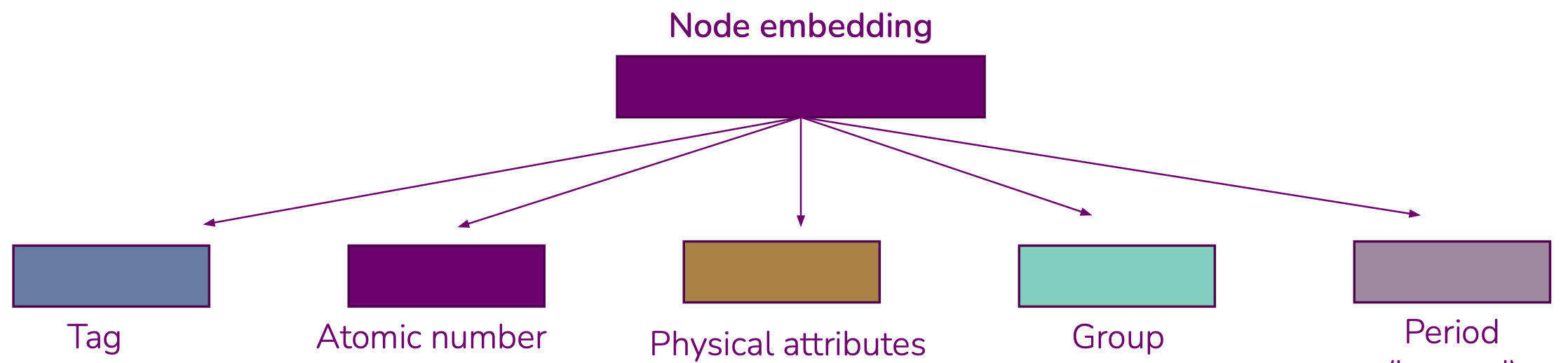
PhysEmbeddingthat allows one to create an embedding vector from atomic numbers that is the concatenation of:- A learned embedding for the atom's group
- A learned embedding for the atom's period
- A fixed or learned embedding from a set of known physical properties, as reported by
mendeleev - In the case of the OC20 dataset, a learned embedding for the atom's tag (adsorbate, catalyst surface or catalyst sub-surface)
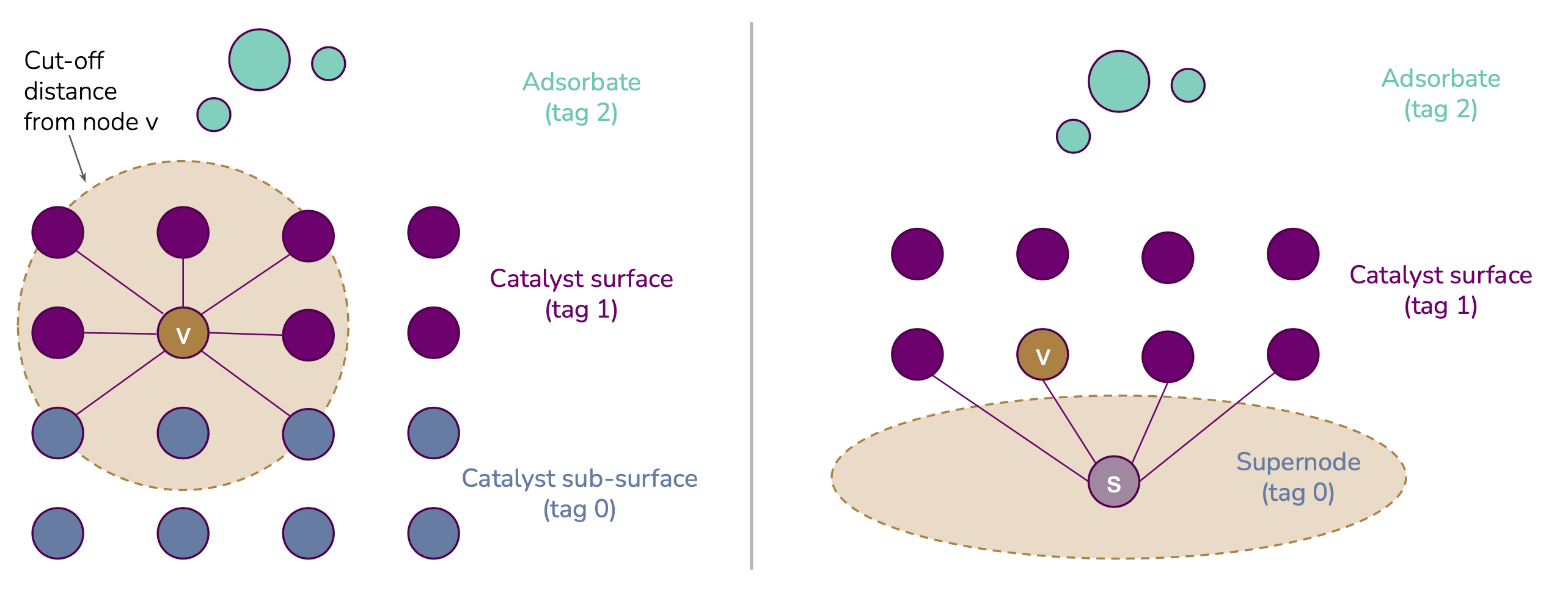
- Tag-based graph rewiring strategies for the OC20 dataset:
-
remove_tag0_nodesdeletes all nodes in the graph associated with a tag 0 and recomputes edges -
one_supernode_per_graphreplaces all tag 0 atoms with a single new atom -
one_supernode_per_atom_typereplaces all tag 0 atoms of a given element with its own super node
-
Also: https://github.com/vict0rsch/faenet
Installation
pip install phast
⚠️ The above installation does not include torch_geometric which is a complex and very variable dependency you have to install yourself if you want to use the graph re-wiring functions of phast.
☮️ Ignore torch_geometric if you only care about the PhysEmbeddings.
Getting started
Physical embeddings
import torch
from phast.embedding import PhysEmbedding

z = torch.randint(1, 85, (3, 12)) # batch of 3 graphs with 12 atoms each
phys_embedding = PhysEmbedding(
    z_emb_size=32, # default
    period_emb_size=32, # default
    group_emb_size=32, # default
    properties_proj_size=32, # default is 0 -> no learned projection
    n_elements=85, # default
)
h = phys_embedding(z) # h.shape = (3, 12, 128)

tags = torch.randint(0, 3, (3, 12))
phys_embedding = PhysEmbedding(
    tag_emb_size=32, # default is 0, this is OC20-specific
    final_proj_size=64, # default is 0, no projection, just the concat. of embeds.
)

h = phys_embedding(z, tags) # h.shape = (3, 12, 64)

# Assuming torch_geometric is installed:
data = torch.load("examples/data/is2re_bs3.pt")
h = phys_embedding(data.atomic_numbers.long(), data.tags) # h.shape = (261, 64)
Graph rewiring
from copy import deepcopy
import torch
from phast.graph_rewiring import (
    remove_tag0_nodes,
    one_supernode_per_graph,
    one_supernode_per_atom_type,
)

data = torch.load("./examples/data/is2re_bs3.pt")  # 3 batched OC20 IS2RE data samples
print(
    "Data initially contains {} graphs, a total of {} atoms and {} edges".format(
        len(data.natoms), data.ptr[-1], len(data.cell_offsets)
    )
)
rewired_data = remove_tag0_nodes(deepcopy(data))
print(
    "Data without tag-0 nodes contains {} graphs, a total of {} atoms and {} edges".format(
        len(rewired_data.natoms), rewired_data.ptr[-1], len(rewired_data.cell_offsets)
    )
)
rewired_data = one_supernode_per_graph(deepcopy(data))
print(
    "Data with one super node per graph contains a total of {} atoms and {} edges".format(
        rewired_data.ptr[-1], len(rewired_data.cell_offsets)
    )
)
rewired_data = one_supernode_per_atom_type(deepcopy(data))
print(
    "Data with one super node per atom type contains a total of {} atoms and {} edges".format(
        rewired_data.ptr[-1], len(rewired_data.cell_offsets)
    )
)
Data initially contains 3 graphs, a total of 261 atoms and 11596 edges
Data without tag-0 nodes contains 3 graphs, a total of 64 atoms and 1236 edges
Data with one super node per graph contains a total of 67 atoms and 1311 edges
Data with one super node per atom type contains a total of 71 atoms and 1421 edges
Tests
This requires poetry. Make sure to have torch and torch_geometric installed in your environment before you can run the tests. Unfortunately because of CUDA/torch compatibilities, neither torch nor torch_geometric are part of the explicit dependencies and must be installed independently.
git clone git@github.com:vict0rsch/phast.git
poetry install --with dev
pytest --cov=phast --cov-report term-missing
Testing on Macs you may encounter a Library Not Loaded Error
Requires Python <3.12 because
mendeleev (0.14.0) requires Python >=3.8.1,<3.12
1 maintainer

Metadata
1 maintainer
Release files for phast 0.1.3
For a detailed explanation of source distributions (sdists) and built distributions (wheels), please see the package formats documentation.
Source distribution (sdist)
| File | Size | Uploaded | Provenance | Actions |
|---|---|---|---|---|
| phast-0.1.3.tar.gz | 14.1 kB | Without provenance | Details for phast-0.1.3.tar.gz |
Built distribution (wheel)
| File | Interpreter | ABI | Platform | Actions Reset |
|---|---|---|---|---|
| phast-0.1.3-py3-none-any.whl | Python 3 | none | any | Details for phast-0.1.3-py3-none-any.whl |
Total release size: 28.4 kB
Release files / phast-0.1.3.tar.gz
| Download URL | phast-0.1.3.tar.gz |
|---|---|
| Size | 14.1 kB |
| Tags | Source |
|
SHA-256 checksum How to use checksums |
7ed1c42c8831920ffbe7970b5b30ef6022daccc75f80deefee5f79d47678c6e8
|
|
BLAKE2b-256 checksum How to use checksums |
7df049fb64fcf499f97194c53ac84e563e85872aa4ccb4c1c4aef7f98a50694c
|
| Upload date | |
|
Uploaded using Trusted Publishing? What is trusted publishing? |
No |
| Uploaded via |
poetry/2.1.2 CPython/3.12.7 Darwin/23.6.0
|
Release files / phast-0.1.3-py3-none-any.whl
| Download URL | phast-0.1.3-py3-none-any.whl |
|---|---|
| Size | 14.3 kB |
| Tags | Python 3 |
|
SHA-256 checksum How to use checksums |
2633dfae06b85e62f06ada859e7370b605bda64dd6195b99403cf610829f7b13
|
|
BLAKE2b-256 checksum How to use checksums |
8e816c4799de2502e181da88ed3ec187b6cc6f5f80518f2d33339fa306e63a8a
|
| Upload date | |
|
Uploaded using Trusted Publishing? What is trusted publishing? |
No |
| Uploaded via |
poetry/2.1.2 CPython/3.12.7 Darwin/23.6.0
|
Security for phast 0.1.3
Provenance
Provenance describes where a file came from. On PyPI, provenance is shared via attestations, which provide a verifiable record of the build or publishing details. View details, limitations and caveats.
No provenance found
None of the files in this release were uploaded with provenance metadata.
A note on package security
PyPI is a repository for distributing packages, not a service for auditing them. While third-party security researchers and our staff do their best to detect and remove malicious packages, PyPI cannot guarantee the quality, security or suitability of any given package.
To learn more about protecting yourself from malicious actors, visit our package security documentation.














