
phm-lite-check
Deterministic physics plausibility checking for LLM outputs and robotics / embodied-AI datasets. Zero dependencies, pure standard library, Python >= 3.8.
This package is an independent, community-provided library: it is the
offline subset of the PHM physical-judgment engine (proprietary core
methods are intentionally excluded). A companion plugin
(phm-physics-check) is listed on the Dify Marketplace.
Not affiliated with, endorsed by, or sponsored by LangChain, AutoGen, or Dify. Integration adapters are community-provided.
Approved by the PyRIT creator — microsoft/PyRIT
A scorer wrapper of this package lives in
microsoft/PyRIT PR #3507
(physics_consistency_scorer). Status as of 2026-11-10:
- Six first-round correctness issues (maintainer + automated reviewer) were fixed same-day (2026-11-08).
- The PyRIT creator (richlundeen) approved the PR ("no blocking concerns remain"), verified 356 scoped tests, Ruff and the scoped type check.
- He then pushed follow-up integration commits on this PR's branch:
an upstream-main merge to clear conflicts (eb8948e) and a hook adaptation
to the new
ScoringExpectationscorer API with documented numeric checks (8a163d9). - The PR remains open pending the maintainer's merge; nothing is left open on this side.
Claimed on MCPush
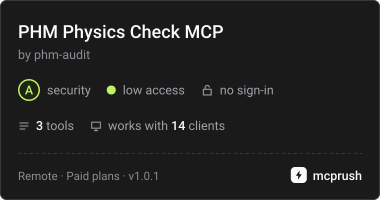
Ownership-verified listing approved on MCPush: security grade A, 3 tools, no sign-in required, local & free (v1.0.1).
What it checks
Text / quantities (check_text, full_check)
- Dimensional / unit consistency (SI + common units)
- Universal speed limit (c)
- Absolute temperature floor (0 K)
- Non-negativity of mass / length / energy
- Probability range [0, 1]
- Kinematic relations (free-fall family, tolerance-checked)
- Conservation checks (energy / momentum, tolerance-checked)
Robotics records (check_robotics_record)
- Quaternion normalization (|q| within tolerance of 1.0)
- Timestamp sanity: monotonicity, duplicates, NaN/Inf, outlier gaps (possible frame loss)
- NaN / Inf scan over numeric arrays
- Unit annotation presence for common motion fields
Design guarantees
- Deterministic: same input -> same output, always reproducible.
- Zero dependencies: pure standard library; framework adapters import their host lazily.
- Verdicts: PASS / WARN / FAIL with structured violation records.
- No network calls: everything runs offline in-process.
NOTE: this package contains only the deterministic offline subset of the PHM physical-judgment engine. Proprietary core methods are intentionally excluded. (Deployment-specific deep checks are available separately via a configurable remote engine endpoint, not included in this package.)
Install
Option A — from the GitHub repo (no package index needed):
pip install git+https://github.com/PHM-Audit/phm-lite-check
Option B — from a Release wheel (faster, no git clone):
pip install https://github.com/PHM-Audit/phm-lite-check/releases/download/v1.0.0/phm_lite_check-1.0.0-py3-none-any.whl
Optional extras (once installed):
pip install "phm-lite-check[langchain]"   # + langchain-core (adapter tests)
pip install "phm-lite-check[autogen]"     # + autogen-agentchat
PyPI listing is planned; both options above work today.
Quickstart — library
from phm_lite_check import check_text, check_robotics_record

check_text("The drone descends at 450 km/h and confidence is 1.8.")
# {"verdict": "FAIL", "violations": [...], ...}

check_robotics_record({
    "quaternion": [1.395, 0.0, 0.0, 0.0],   # |q| >> 1 -> FAIL
    "timestamps": [0.0, 0.1, 0.05],          # not monotonic -> FAIL
    "position": [1.0, 2.0],                  # no unit annotated -> WARN
})
Quickstart — LangChain
from phm_lite_check.integrations import langchain_tool

tools = langchain_tool.get_langchain_tools()   # 3 @tool callables
agent = create_react_agent(llm, tools)         # your usual wiring
Quickstart — AutoGen (v0.4+)
from autogen_agentchat.agents import AssistantAgent
from phm_lite_check.integrations import autogen_tool

assistant = AssistantAgent(
    name="checked_assistant",
    model_client=...,                    # your model client
    tools=autogen_tool.get_autogen_tools(),
)
Quickstart — MCP server (stdio)
The package ships a Model Context Protocol server entry point (phm_lite_check/mcp_server.py,
FastMCP, stdio transport). Works with Claude Desktop, Cursor, Cline or any MCP host.
Install with the MCP extra (requires mcp>=1.0,<2 — the 2.x SDK renamed the FastMCP API):
pip install "phm-lite-check[mcp]"
Run the server:
python3 -m phm_lite_check.mcp_server
Claude Desktop / generic MCP host configuration (claude_desktop_config.json):
{
  "mcpServers": {
    "phm-lite-check": {
      "command": "python3",
      "args": ["-m", "phm_lite_check.mcp_server"]
    }
  }
}
Tools exposed over MCP (all declared readOnlyHint):
| Tool | Input | Checks |
|---|---|---|
physics_text_check |
{"text": "..."} |
unit inconsistency, lightspeed violations, probabilities outside [0,1], kinematic impossibilities |
physics_quantity_check |
{"value": 5.5, "unit": "km/s"} |
per-quantity physical bounds |
robotics_data_check |
{"record_json": "{...}"} |
quaternion normalization, timestamp sanity, NaN/Inf scan, unit annotation |
Verified end-to-end on mcp 1.30.0: JSON-RPC initialize handshake, tools/list returns the three
tools above, and a tools/call round-trip on physics_quantity_check executes against the local
rule table. The server makes zero network calls.
Also packaged as an MCPB bundle and listed in the official MCP Registry
(io.github.PHM-Audit/phm-lite-check@1.0.1, stdio).
Tools exposed by both adapters
| Tool | Input | Checks |
|---|---|---|
physics_text_check |
free text with quantities | unit consistency, limits, probabilities |
physics_quantity_check |
value + unit | one quantity against physical law |
robotics_data_check |
JSON record | quaternions, timestamps, NaN/Inf, units |
Tests
pip install -e ".[dev]"
pytest tests/ -q
License
MIT
Benchmark
The judgment rules shipped here are exercised in public by DPC-Bench v0.2 — a paired clean/corrupted physical-consistency detection benchmark (7 task families incl. a real NGSIM I-80 family, three-caliber L1/L2/L3 labels).
1 maintainer

Metadata
1 maintainer
Release files for phm-lite-check 1.0.3
For a detailed explanation of source distributions (sdists) and built distributions (wheels), please see the package formats documentation.
Source distribution (sdist)
| File | Size | Uploaded | Provenance | Actions |
|---|---|---|---|---|
| phm_lite_check-1.0.3.tar.gz | 19.1 kB | Without provenance | Details for phm_lite_check-1.0.3.tar.gz |
Built distribution (wheel)
| File | Interpreter | ABI | Platform | Actions Reset |
|---|---|---|---|---|
| phm_lite_check-1.0.3-py3-none-any.whl | Python 3 | none | any | Details for phm_lite_check-1.0.3-py3-none-any.whl |
Total release size: 36.8 kB
Release files / phm_lite_check-1.0.3.tar.gz
| Download URL | phm_lite_check-1.0.3.tar.gz |
|---|---|
| Size | 19.1 kB |
| Tags | Source |
|
SHA-256 checksum How to use checksums |
bc02c59b9c36c351f38798f0ae81015444374bc8f177c3e41f9bdb567df648b9
|
|
BLAKE2b-256 checksum How to use checksums |
c9556a9d298886c0f996b8fc31a398e06584556966167b39cfd2fc816c08f6f0
|
| Upload date | |
|
Uploaded using Trusted Publishing? What is trusted publishing? |
No |
| Uploaded via |
twine/7.0.0 CPython/3.12.14
|
Release files / phm_lite_check-1.0.3-py3-none-any.whl
| Download URL | phm_lite_check-1.0.3-py3-none-any.whl |
|---|---|
| Size | 17.7 kB |
| Tags | Python 3 |
|
SHA-256 checksum How to use checksums |
33aac0d481008868300b078920d48557eee9e59ebe5244cb5b58d263c86d3669
|
|
BLAKE2b-256 checksum How to use checksums |
b99b079700b821a3f958c853c848deb83e772199cbdca9d182d9cec4679bbf10
|
| Upload date | |
|
Uploaded using Trusted Publishing? What is trusted publishing? |
No |
| Uploaded via |
twine/7.0.0 CPython/3.12.14
|
Security for phm-lite-check 1.0.3
Provenance
Provenance describes where a file came from. On PyPI, provenance is shared via attestations, which provide a verifiable record of the build or publishing details. View details, limitations and caveats.
No provenance found
None of the files in this release were uploaded with provenance metadata.
A note on package security
PyPI is a repository for distributing packages, not a service for auditing them. While third-party security researchers and our staff do their best to detect and remove malicious packages, PyPI cannot guarantee the quality, security or suitability of any given package.
To learn more about protecting yourself from malicious actors, visit our package security documentation.














