
phylim: a phylogenetic limit evaluation library built on cogent3



phylim evaluates the identifiability when estimating the phylogenetic tree using the Markov model. The identifiability is the key condition of the Markov model used in phylogenetics to fulfil consistency.
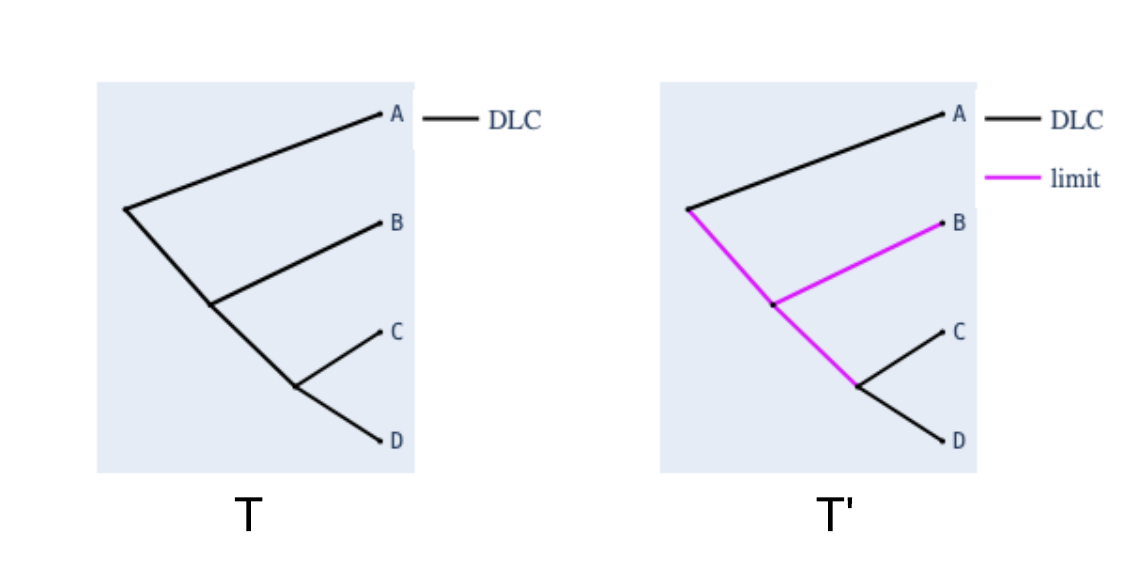
Establishing identifiability relies on the arrangement of specific types of transition probability matrices (e.g., DLC and sympathetic) while avoiding other types. A key concern arises when a tree does not meet the condition that, for each node, a path to a tip must exist where all matrices along the path are DLC. Such trees are not identifiable 🪚🎄! For instance, in the figure below, tree T' contains a node surrounded by a specific type of non-DLC matrix, rendering it non-identifiable. In contrast, compare T' with tree T.
phylim provides a quick, handy method to check the identifiability of a model fit, where we developed a main cogent3 app, phylim. phylim is compatible with piqtree, a python library that exposes features from iqtree2.
The following content will demonstrate how to set up phylim and give some tutorials on the main identifiability check app and other associated apps.
Installation
pip install phylim
Let's see if it has been done successfully. In the package directory:
pytest
Hope all tests passed! :white_check_mark: :blush:
Run the check of identifiability
If you fit a model to an alignment and get the model result:
>>> from cogent3 import get_app, make_aligned_seqs

>>> aln = make_aligned_seqs(
...    {
...        "Human": "ATGCGGCTCGCGGAGGCCGCGCTCGCGGAG",
...        "Gorilla": "ATGCGGCGCGCGGAGGCCGCGCTCGCGGAG",
...        "Mouse": "ATGCCCGGCGCCAAGGCAGCGCTGGCGGAG",
...    },
...    info={"moltype": "dna", "source": "foo"},
... )

>>> app_fit = get_app("model", "GTR")
>>> result = app_fit(aln)
You can easily check the identifiability by:
>>> checker = get_app("phylim")

>>> checked = checker(result)
>>> checked.is_identifiable

True
The phylim app wraps all information about phylogenetic limits.
>>> checked
| Source | Model Name | Identifiable | Has Boundary Values | Version |
|---|---|---|---|---|
| brca1.fasta | GTR | True | True | 2025.1.12 |
You can also use features like classifying all matrices or checking boundary values in a model fit.
Label all transition probability matrices in a model fit
You can call classify_model_psubs to give the category of all the matrices:
>>> from phylim import classify_model_psubs

>>> labelled = classify_model_psubs(result)
>>> labelled
| edge name | matrix category |
|---|---|
| Gorilla | DLC |
| Human | DLC |
| Mouse | DLC |
Check if all parameter fits are within the boundary
>>> from phylim import check_fit_boundary

>>> violations = check_fit_boundary(result)
>>> violations
BoundsViolation(source='foo', vio=[{'par_name': 'C/T', 'init': np.float64(1.0000000147345554e-06), 'lower': 1e-06, 'upper': 50}, {'par_name': 'A/T', 'init': np.float64(1.0000000625906854e-06), 'lower': 1e-06, 'upper': 50}])
❗For users who want to check identifiability on a model with multiple likelihood functions (e.g. split codon model), please check https://github.com/HuttleyLab/PhyLim/issues/23#issuecomment-3125670158
Check identifiability for piqtree
phylim provides an app, phylim_to_model_result, which allows you to build the likelihood function from a piqtree output tree.
>>> phylo = get_app("piq_build_tree", model="GTR")
>>> tree = phylo(aln)

>>> lf_from = get_app("phylim_to_model_result")
>>> result = lf_from(tree)

>>> checker = get_app("phylim")
>>> checked = checker(result)
>>> checked.is_identifiable

True
Colour the edges for a phylogenetic tree based on matrix categories
If you obtain a model fit, phylim can visualise the tree with labelled matrices.
phylim provides an app, phylim_style_tree, which takes an edge-matrix category map and colours the edges:
>>> from phylim import classify_model_psubs

>>> edge_to_cat = classify_model_psubs(result)
>>> tree = result.tree

>>> tree_styler = get_app("phylim_style_tree", edge_to_cat)
>>> tree_styler(tree)
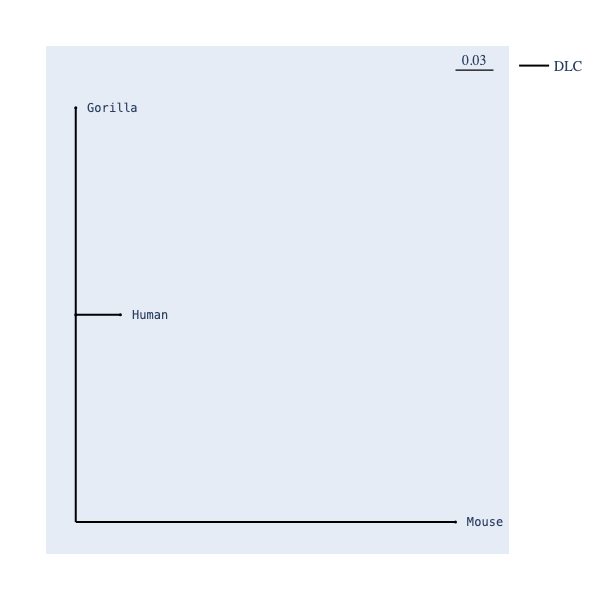
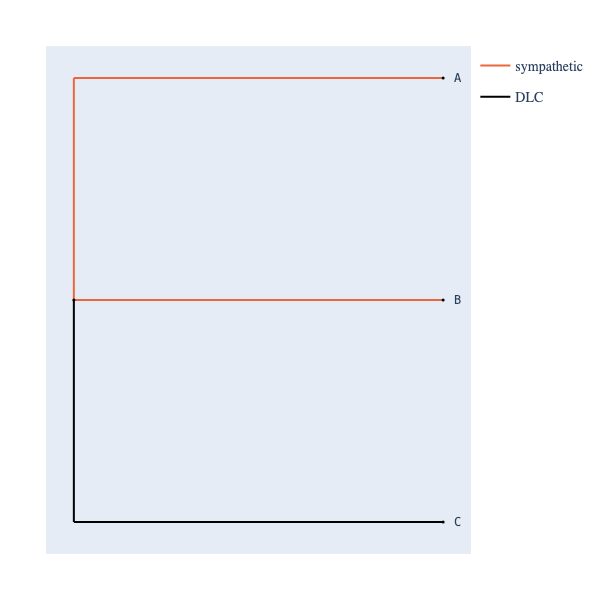
You can also colour edges using a user-defined edge-matrix category map, applicable to any tree object!
>>> from cogent3 import make_tree
>>> from phylim import SYMPATHETIC, DLC

>>> tree = make_tree("(A, B, C);")
>>> edge_to_cat = {"A":SYMPATHETIC, "B":SYMPATHETIC, "C":DLC}

>>> tree_styler = get_app("phylim_style_tree", edge_to_cat)
>>> tree_styler(tree)
2 maintainers


Metadata
2 maintainers
Release files for phylim 2025.8.27
For a detailed explanation of source distributions (sdists) and built distributions (wheels), please see the package formats documentation.
Source distribution (sdist)
| File | Size | Uploaded | |
|---|---|---|---|
| phylim-2025.8.27.tar.gz | 12.0 kB | Details |
Built distribution (wheel)
| File | Interpreter | ABI | Platform | Reset |
|---|---|---|---|---|
| phylim-2025.8.27-py3-none-any.whl | Python 3 | none | any | Details |
Total release size: 24.2 kB
Release files / phylim-2025.8.27.tar.gz
| Download URL | phylim-2025.8.27.tar.gz |
|---|---|
| Size | 12.0 kB |
| Tags | Source |
|
SHA-256 checksum How to use checksums |
e6a9d19aa8c018f397aeb82e1a7c99699248c496c61e81c78846e575388e76ae
|
|
BLAKE2b-256 checksum How to use checksums |
0b9470afe7a3ee9e3e2720edfa4cfd2b1ebc1832d77da4c0f68c491f089c6d31
|
| Upload date | |
|
Uploaded using Trusted Publishing? What is trusted publishing? |
Yes |
| Uploaded via |
twine/6.1.0 CPython/3.12.9
|
Provenance
Provenance describes where a file came from. On PyPI, provenance is shared via attestations, which provide a verifiable record of the build or publishing details. View details, limitations and caveats.


PyPI Publish Attestation
PyPI verified that this artifact, at this checksum, originated from the publisher listed below.
Signed by GitHub Actions, verified by PyPI on Aug 27, 2025.
Transparency logRelease files / phylim-2025.8.27-py3-none-any.whl
| Download URL | phylim-2025.8.27-py3-none-any.whl |
|---|---|
| Size | 12.2 kB |
| Tags | Python 3 |
|
SHA-256 checksum How to use checksums |
5b26d14f66b0221bdec0e45095a7bd75b02d1dc5e46a1d9cdc6ef189eef56ca3
|
|
BLAKE2b-256 checksum How to use checksums |
b0181d56ae9dca2a3a588bde7c208515423cfb646c892f79e17e247cee286cb9
|
| Upload date | |
|
Uploaded using Trusted Publishing? What is trusted publishing? |
Yes |
| Uploaded via |
twine/6.1.0 CPython/3.12.9
|
Provenance
Provenance describes where a file came from. On PyPI, provenance is shared via attestations, which provide a verifiable record of the build or publishing details. View details, limitations and caveats.
PyPI Publish Attestation
PyPI verified that this artifact, at this checksum, originated from the publisher listed below.
Signed by GitHub Actions, verified by PyPI on Aug 27, 2025.
Transparency log













