
phylokit-mcp
phylokit-mcp is an MCP server that lets AI agents build maximum-likelihood trees with IQ-TREE 3 and align sequences with MAFFT.




A topology without support is not a result. infer_tree always runs a
bootstrap and returns per-clade support. There is no flag to skip it.
Why the rule
A maximum-likelihood tree looks the same whether or not the data support it. Measured on alignments simulated from a known 7-taxon tree (JC, 100 replicates, seed 1):
| Sites | Informative sites | Recovered the true tree? | Lowest clade support |
|---|---|---|---|
| 300 | 51 | yes, exactly | 1.00 |
| 60 | 11 | no, RF 2 | 0.57 |
At 60 sites the tree contains a clade (C,D,G) that does not exist and omits
one that does (E,F,G). Both runs return a fully resolved Newick string of the
same shape. Only the support values tell them apart, and the false clade is the
lowest-supported one in the tree.
What it reports that a Newick string cannot
- Conflicting clades: groupings the data support at ≥0.70 that are absent from the reported tree. A support-annotated Newick string has nowhere to put them.
fraction_resolved: the share of clades clearing 0.70. The headline number, before any single grouping is repeated as fact.- Model runners-up with ΔAIC, not just a winner. On the 300-site alignment
above, simulated under JC, the AIC winner is not JC (TPM2u and TPM2
tie), and several models, JC among them at ΔAIC 0.7, sit inside the
conventional ±2 margin (
seed=1, piqtree 0.8.3). - Length versus evidence:
n_parsimony_informativealongsiden_sites. A 10,000-site alignment of near-identical sequences supports nothing.
Tools
| Tool | What it does |
|---|---|
infer_tree |
ML tree plus bootstrap support (nonparametric or UFBoot2), per clade. |
select_substitution_model |
Ranks 100+ models with ΔAIC/AICc/BIC, and says when the criteria disagree. |
compare_trees |
Robinson–Foulds distance and the clades that differ. Compares splits, not strings. |
simulate_alignment |
Generates sequences along a tree you specify: the positive control. |
align_sequences |
Aligns unaligned FASTA with MAFFT, inline or to a new file (out_path). |
map_positions |
Maps a residue to its alignment column, and that column to every other sequence. |
capabilities |
piqtree and IQ-TREE versions, 215 substitution models, MAFFT version, limits. |
Tools that take FASTA or Newick also take a file path (fasta_path, or
trees_path for two trees), read by the server; a relative path resolves
against the server's working directory.
The tests run real IQ-TREE and real MAFFT (no mocked engine), with 23 mutation checks and a real-process JSON-RPC handshake test.
Install
pip install phylokit-mcp
Requires Python 3.12+. IQ-TREE 3 comes through
piqtree 0.8, which builds it into its
wheel. align_sequences also needs the
MAFFT binary on PATH, as does
map_positions on unaligned input; the other tools work without it. Details: docs/INSTALL.md.
Configure your MCP client
{
  "mcpServers": {
    "phylokit": {
      "command": "uvx",
      "args": ["phylokit-mcp"]
    }
  }
}
If uvx picks a Python older than 3.12, use
"args": ["--python", "3.12", "phylokit-mcp"].
What the benchmark shows
Claude with the server was compared with Claude writing Python in an environment we set up with piqtree, cogent3 and MAFFT, on 38 phylogenetics questions, 3 runs each. A tie means the server matches that result without you building the environment. Questions right in every run, server against Python: Claude Haiku 5.5 34 against 37, Sonnet 5.5 37 against 35, Opus 5.5 36 against 35 (on the commit that takes file paths). None is separated (pre-registered; Holm-adjusted McNemar p = 0.75 on both Haiku and Sonnet). The server cost about the same as Python on Haiku and more on Sonnet (1.23×) and Opus (1.26×).
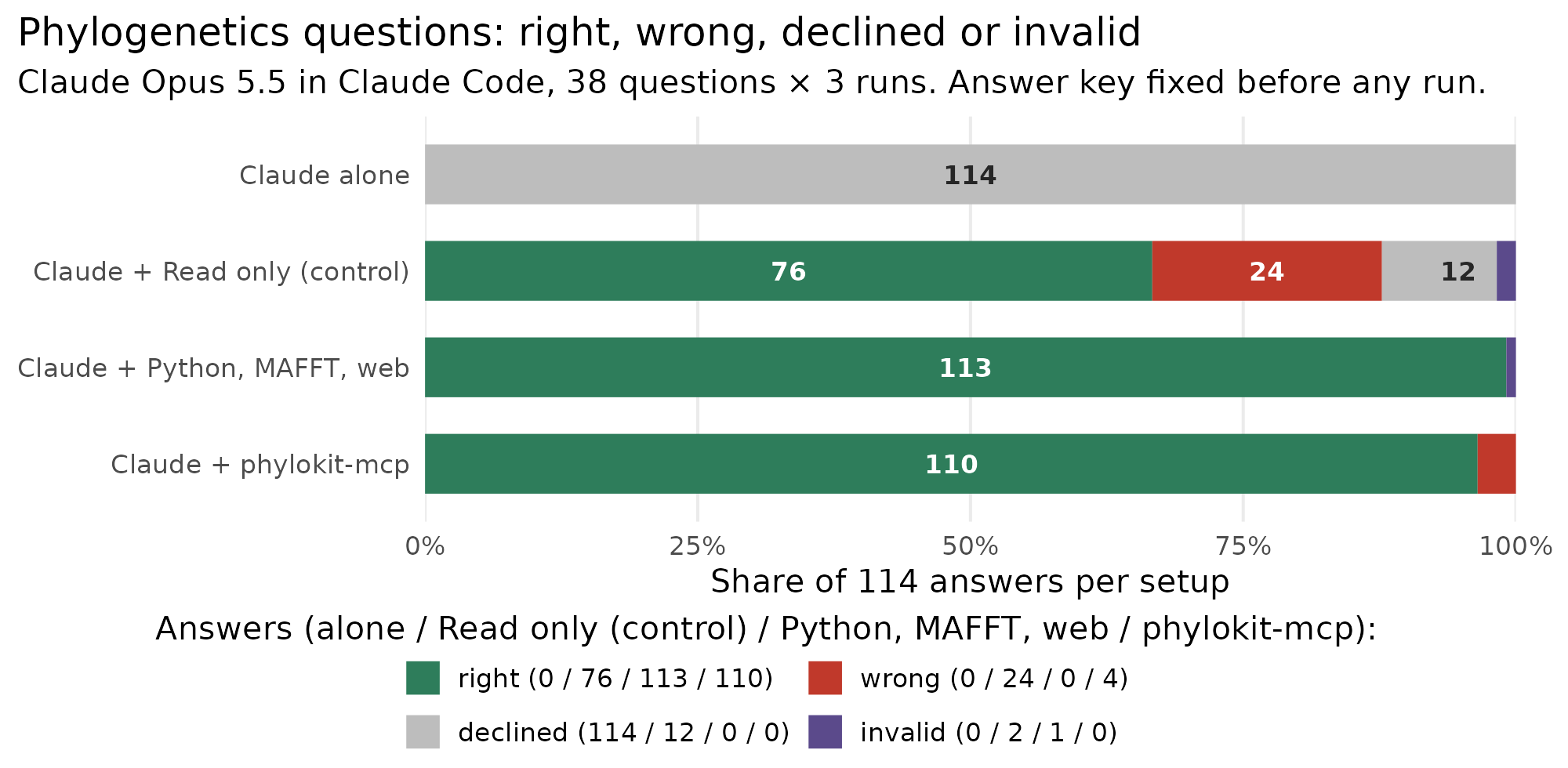
The chart is the first Opus 5.5 run, on a release that took the data as text. Counting answers, the server got 110 of 114 right and Python 113; counting questions, 36 of 38 were right in every run against 37 (sign test p = 1). Per question the server took 6.0 times as long (95% CI 4.4 to 8.3) and cost 14.4 times as much (9.9 to 20.2), each a geometric mean of per-question ratios. Most of that cost was the model pasting the data file into tool calls; taking file paths (pre-registered re-run, 2026-10-18) brought it down to 1.26 times (1.04 to 1.55).
We wrote the questions and ran the benchmark ourselves; an outside re-run is welcome. The benchmark does not score support values; method, controls and other limitations are in benchmarks/agent_qa; the Haiku and Sonnet runs: 2026-10-20 re-run.
Reproducibility
Not bit-exact, in any setting: IQ-TREE reads the wall clock during its search,
so the same request and seed can differ in the trailing digits of branch
lengths and log-likelihood, and a support value can move by a replicate
flipping. The server reports deterministic_across_processes: false. Compare
trees with compare_trees and numbers with a tolerance, never by string
equality. Measurements: docs/REPRODUCIBILITY.md.
Limitations
- Nucleotide and protein, no codon models. Pass
sequence_type="protein"and a protein model (LG,WAG, …). The molecule type is declared, never sniffed: an A/C/G/T-only alignment is also valid protein (Ala/Cys/Gly/Thr), and a wrong guess returns a wrong tree, likelihood and support with no warning. - Two bootstraps, no aLRT or approximate Bayes. The default is the
nonparametric bootstrap (Felsenstein 1985), computed here, clades supported
at 0.70; it is the only one that reports well-supported clades missing from
the ML tree.
support_method="ufboot"is IQ-TREE's UFBoot2 (Hoang et al. 2018), clades supported at 0.95. - Nonparametric cost is linear in replicates, each a full ML search: on 89 taxa x 435 sites one replicate took 25-93 s, and 1000 UFBoot2 replicates 83 s. Capped at 200 taxa, 1000 nonparametric and 10000 UFBoot2 replicates. Every tool sends a progress notification every 15 s, so a client idle timeout does not abort a long call.
- Alignment is MAFFT
--auto, single-threaded, and nothing else: no strategy choice, profile alignment or trimming; at most 200 sequences of 100,000 residues and 600 s. Gapped input is refused, not degapped. The tree tools refuse ragged input rather than align it. - Unrooted trees. No rooting, dating or ancestral reconstruction.
License
GPL-2.0-only, because piqtree is GPL-2.0-only, which is incompatible
with GPL-3.0. cogent3 is BSD.
If you publish results from this server, cite IQ-TREE 3, piqtree and (when it made the alignment) MAFFT, not this wrapper. The references are in CITATION.cff, and licensing and affiliation are in NOTICE.
1 maintainer

Metadata
1 maintainer
Release files for phylokit-mcp 0.8.0
For a detailed explanation of source distributions (sdists) and built distributions (wheels), please see the package formats documentation.
Source distribution (sdist)
| File | Size | Uploaded | Provenance | Actions |
|---|---|---|---|---|
| phylokit_mcp-0.8.0.tar.gz | 139.4 kB | Without provenance | Details for phylokit_mcp-0.8.0.tar.gz |
Built distribution (wheel)
| File | Interpreter | ABI | Platform | Actions Reset |
|---|---|---|---|---|
| phylokit_mcp-0.8.0-py3-none-any.whl | Python 3 | none | any | Details for phylokit_mcp-0.8.0-py3-none-any.whl |
Total release size: 198.9 kB
Release files / phylokit_mcp-0.8.0.tar.gz
| Download URL | phylokit_mcp-0.8.0.tar.gz |
|---|---|
| Size | 139.4 kB |
| Tags | Source |
|
SHA-256 checksum How to use checksums |
6b66f63770b04f7f932260bce2bdfc9bf91a2eaf97dda47a33e113bf6880b61d
|
|
BLAKE2b-256 checksum How to use checksums |
46a4e3f870789c9beb1a7e27385e89eca2c412b85c29a50b40be124022fc338a
|
| Upload date | |
|
Uploaded using Trusted Publishing? What is trusted publishing? |
No |
| Uploaded via |
twine/7.0.0 CPython/3.14.3
|
Release files / phylokit_mcp-0.8.0-py3-none-any.whl
| Download URL | phylokit_mcp-0.8.0-py3-none-any.whl |
|---|---|
| Size | 59.4 kB |
| Tags | Python 3 |
|
SHA-256 checksum How to use checksums |
2e82b947f956a534c20e6246788a1adb0eb30f9499678a069d5610ac5cd69956
|
|
BLAKE2b-256 checksum How to use checksums |
a538d8ff62da7cdc75a84fd562f33b525190bcac3f2ec1a0a9c3e1ea8ca4bd59
|
| Upload date | |
|
Uploaded using Trusted Publishing? What is trusted publishing? |
No |
| Uploaded via |
twine/7.0.0 CPython/3.14.3
|
Security for phylokit-mcp 0.8.0
Provenance
Provenance describes where a file came from. On PyPI, provenance is shared via attestations, which provide a verifiable record of the build or publishing details. View details, limitations and caveats.
No provenance found
None of the files in this release were uploaded with provenance metadata.
A note on package security
PyPI is a repository for distributing packages, not a service for auditing them. While third-party security researchers and our staff do their best to detect and remove malicious packages, PyPI cannot guarantee the quality, security or suitability of any given package.
To learn more about protecting yourself from malicious actors, visit our package security documentation.














