
Copyright © 2016-2018 SoftFIRE and TU Berlin. Licensed under Apache v2 License.
Physical Device Manager
The SoftFIRE Physical Device Manager provides reservation of physical resources. For the third wave, experimenters may reserve UE(s) at the Surrey test bed, and remotely control them using TeamViewer. The figure below depicts the physical resource reservation process.
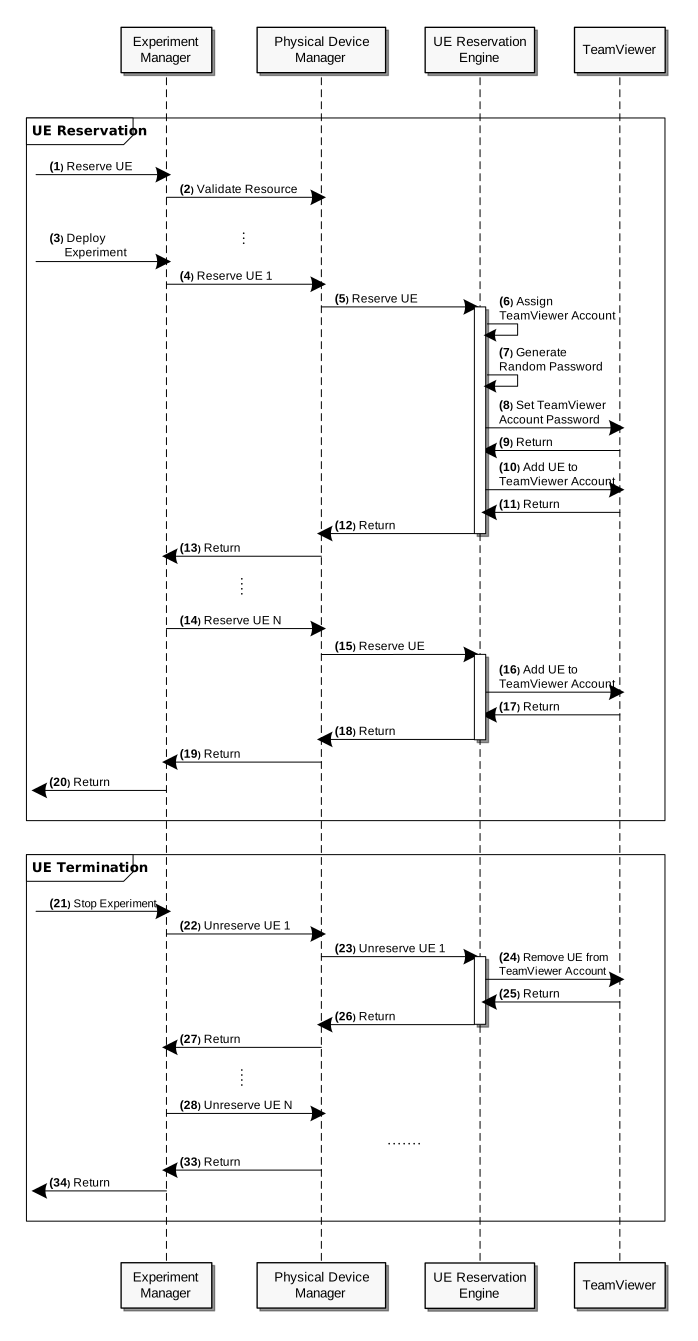
For more information on how to use the physical resources visit the documentation.
Technical Requirements
The Physical Device Manager requires Python 3.5 or higher.
Installation and configuration
You can install the Physical Device Manager using pip:
pip install physical-device-manager
and then start it with the physical-device-manager command.
Or you can run it from source code by cloning the git repository, installing the dependencies as specified in the setup.py file and executing the physical-device-manager script.
The Physical Device Manager needs a configuration file present at /etc/softfire/physical-device-manager.ini. An example of the configuration file can be found here.
Issue tracker
Issues and bug reports should be posted to the GitHub Issue Tracker of this project.
What is SoftFIRE?
SoftFIRE provides a set of technologies for building a federated experimental platform aimed at the construction and experimentation of services and functionalities built on top of NFV and SDN technologies. The platform is a loose federation of already existing testbed owned and operated by distinct organizations for purposes of research and development.
SoftFIRE has three main objectives: supporting interoperability, programming and security of the federated testbed. Supporting the programmability of the platform is then a major goal and it is the focus of the SoftFIRE’s Second Open Call.
Licensing and distribution
Copyright © [2016-2018] SoftFIRE project
Licensed under the Apache License, Version 2.0 (the “License”);
you may not use this file except in compliance with the License. You may obtain a copy of the License at
http://www.apache.org/licenses/LICENSE-2.0
Unless required by applicable law or agreed to in writing, software distributed under the License is distributed on an “AS IS” BASIS, WITHOUT WARRANTIES OR CONDITIONS OF ANY KIND, either express or implied. See the License for the specific language governing permissions and limitations under the License.
3 maintainers


Metadata
3 maintainers
Release files for physical-device-manager 1.0.6
For a detailed explanation of source distributions (sdists) and built distributions (wheels), please see the package formats documentation.
Source distribution (sdist)
| File | Size | Uploaded | Provenance | Actions |
|---|---|---|---|---|
| physical-device-manager-1.0.6.tar.gz | 5.7 kB | Without provenance | Details for physical-device-manager-1.0.6.tar.gz |
Built distribution (wheel)
| File | Interpreter | ABI | Platform | Actions Reset |
|---|---|---|---|---|
| physical_device_manager-1.0.6-py2.py3-none-any.whl | Python 3, Python 2 | none | any | Details for physical_device_manager-1.0.6-py2.py3-none-any.whl |
Total release size: 15.5 kB
Release files / physical-device-manager-1.0.6.tar.gz
| Download URL | physical-device-manager-1.0.6.tar.gz |
|---|---|
| Size | 5.7 kB |
| Tags | Source |
|
SHA-256 checksum How to use checksums |
acc5cd5282dc6e21945fa4bac7124d3274e3dcd8c1b8a2dbd62796c0e9e720aa
|
|
BLAKE2b-256 checksum How to use checksums |
ed3ce99615a3d4c078dc4e86c545f80d087776991ac1cfd04cfe7323007cd1db
|
| Upload date | |
|
Uploaded using Trusted Publishing? What is trusted publishing? |
No |
Release files / physical_device_manager-1.0.6-py2.py3-none-any.whl
| Download URL | physical_device_manager-1.0.6-py2.py3-none-any.whl |
|---|---|
| Size | 9.8 kB |
| Tags | Python 2 Python 3 |
|
SHA-256 checksum How to use checksums |
8363e78841f2bd0575dd5296114b2785d1544e70fd0a27dd2311c062023af2cc
|
|
BLAKE2b-256 checksum How to use checksums |
78ac6f8ae62b37ed5e66100970be5c45c091e69c4d8f369cdc6af519f498bab4
|
| Upload date | |
|
Uploaded using Trusted Publishing? What is trusted publishing? |
No |
Security for physical-device-manager 1.0.6
Provenance
Provenance describes where a file came from. On PyPI, provenance is shared via attestations, which provide a verifiable record of the build or publishing details. View details, limitations and caveats.
No provenance found
None of the files in this release were uploaded with provenance metadata.
A note on package security
PyPI is a repository for distributing packages, not a service for auditing them. While third-party security researchers and our staff do their best to detect and remove malicious packages, PyPI cannot guarantee the quality, security or suitability of any given package.
To learn more about protecting yourself from malicious actors, visit our package security documentation.














