
Linter for trained neural PDE surrogates

Project description
physics-lint
A CI linter for trained neural PDE surrogates. Catches residual, conservation, boundary-condition, positivity, and symmetry violations that MSE misses. Stable rule IDs, SARIF output, GitHub code scanning integration. Think ruff, for physics.
by Jane Yeung · github.com/tyy0811/physics-lint
Why physics-lint
A neural PDE surrogate can pass every MSE benchmark and still violate the physics it was trained on. MSE averages spatial error; it says nothing about whether mass is conserved, whether the solution respects the boundary condition, whether a positive initial condition stays positive, or whether a rotationally symmetric problem produces a rotationally symmetric solution. These are the failure modes that matter in production: a climate surrogate that mildly violates energy conservation compounds errors over long rollouts; a medical imaging surrogate that produces negative densities fails downstream pipelines; a structural simulator that breaks reflection symmetry misleads optimization.
physics-lint mechanically checks these properties against calibrated analytical floors, produces actionable warnings with stable rule IDs, and emits machine-readable output that your CI can act on. You add it to your GitHub Actions workflow, it runs on every model PR, and the Security tab shows you exactly which rules fired, which model artifact failed, and a doc link explaining each rule with its mathematical justification and citation.
Hero: physics-lint in CI
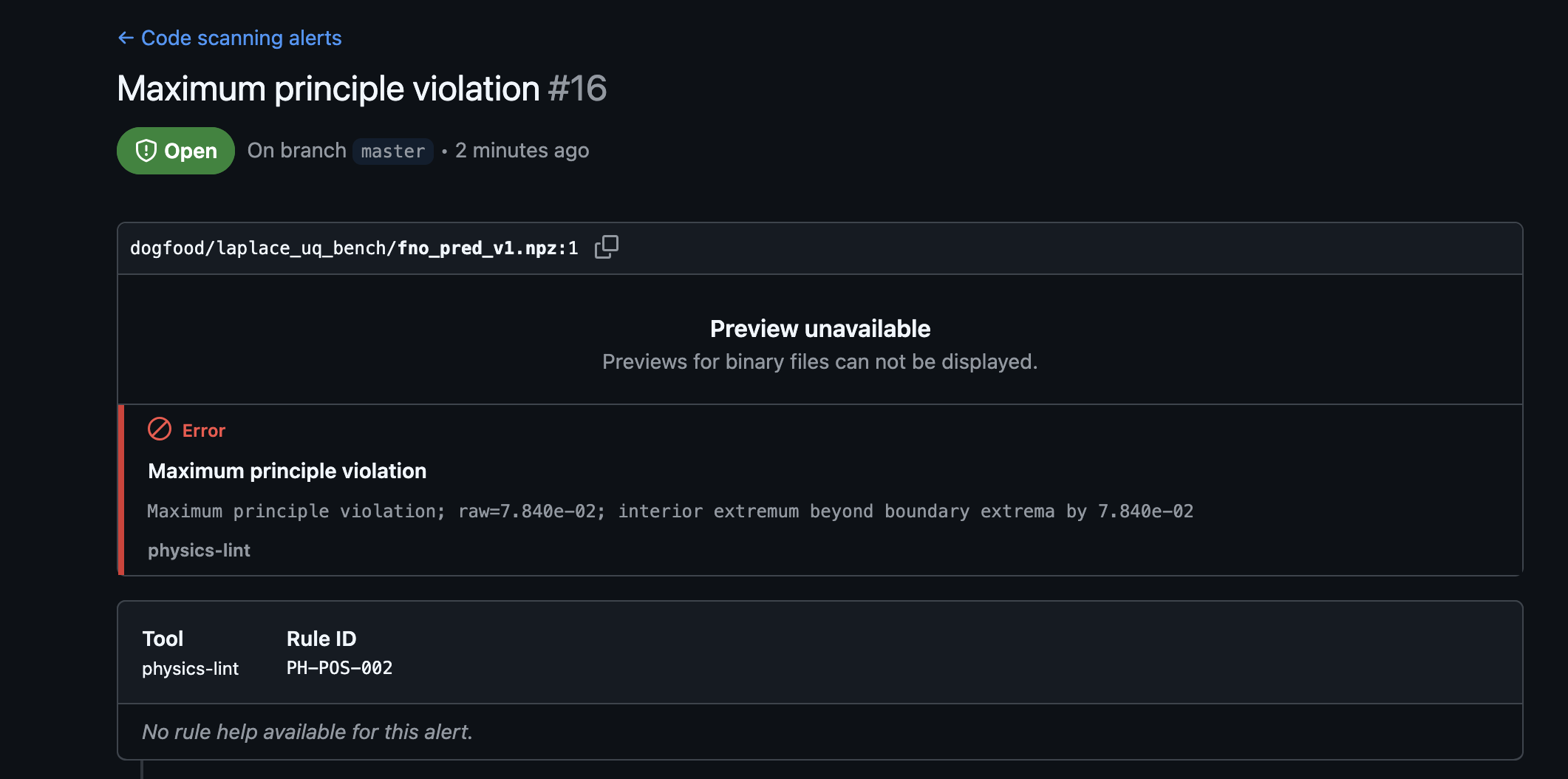
Above: the FNO PH-POS-002 alert surfaced in physics-lint's own repository Security tab. The screenshot is from running physics-lint against three trained surrogates from tyy0811/laplace-uq-bench — unet_regressor, fno, ddpm. All three failed at least one physics check on the sample; FNO is the most severely flagged because it uniquely violates the maximum principle (interior extremum exceeds boundary extrema by 0.078 in a Dirichlet-homogeneous problem), while UNet and DDPM respect the principle cleanly. PH-POS-002 catches the violation as a code-scanning alert with a physically interpretable message and rule documentation links.
# .github/workflows/physics-lint.yml
name: physics-lint
on: [push, pull_request]

permissions:
  contents: read
  security-events: write

jobs:
  lint:
    runs-on: ubuntu-latest
    strategy:
      fail-fast: false
      matrix:
        model:
          - { name: unet, path: models/unet_adapter.py }
          - { name: fno,  path: models/fno_adapter.py }
          - { name: ddpm, path: models/ddpm_pred.npz }
    steps:
      - uses: actions/checkout@v4
      - uses: actions/setup-python@v5
        with: { python-version: '3.11' }
      - run: pip install physics-lint
      - run: |
          physics-lint check ${{ matrix.model.path }} \
              --config pyproject.toml \
              --category physics-lint-${{ matrix.model.name }} \
              --format sarif \
              --output physics-lint-${{ matrix.model.name }}.sarif
      - if: always()
        uses: github/codeql-action/upload-sarif@v4
        with:
          sarif_file: physics-lint-${{ matrix.model.name }}.sarif
          category: physics-lint-${{ matrix.model.name }}
Every model PR populates the GitHub Security tab with rule violations, complete with documentation links and persistent state. if: always() on the SARIF upload step means alerts land even when the check step exits non-zero. Configure [tool.physics-lint.sarif] to surface violations in PR checks too.
Installation
pip install physics-lint
Python 3.10 or later. Optional unstructured-mesh support via pip install physics-lint[mesh].
Quick start
# Lint a .npz dump
physics-lint check pred.npz --format text

# Lint an adapter (a Python file defining load_model() and domain_spec())
physics-lint check physics_lint_adapter.py --format text

# CI-style SARIF output
physics-lint check model.py --format sarif --category physics-lint-run \
    --output physics-lint.sarif
A minimal adapter at physics_lint_adapter.py:
from physics_lint import DomainSpec, BCSpec, GridDomain, FieldSourceSpec
import torch

def load_model() -> torch.nn.Module:
    model = MyFNOLaplace()
    model.load_state_dict(torch.load("checkpoints/fno_laplace.pt"))
    model.eval()
    return model

def domain_spec() -> DomainSpec:
    return DomainSpec(
        pde="laplace",
        grid_shape=(64, 64),
        domain=GridDomain(x=(0.0, 1.0), y=(0.0, 1.0)),
        periodic=False,
        boundary_condition=BCSpec(kind="dirichlet_homogeneous"),
        field=FieldSourceSpec(type="callable", backend="auto"),
    )
Or drive physics-lint from Python:
from physics_lint.loader import load_target
from physics_lint.report import PhysicsLintReport

loaded = load_target("physics_lint_adapter.py", cli_overrides={}, toml_path=None)
# ... invoke rules, assemble a PhysicsLintReport, render to text/json/sarif
What physics-lint catches
Broken-model gallery (examples/broken_model_gallery.ipynb) walks through three cases where MSE ranking and physics-lint ranking disagree:
| Case | Model | What MSE says | What physics-lint catches |
|---|---|---|---|
| 1 | Over-smoothed prediction with boundary leak | MSE ~1e-4 — top of leaderboard | PH-BC-001 FAIL: doesn't respect Dirichlet BC |
| 2 | Under-trained prediction with localized negatives | MSE ~1e-5 — near-perfect | PH-POS-001 FAIL: u < 0 in a 5×5 region |
| 3 | Non-equivariant CNN with positional-embedding input | Comparable loss to baseline | PH-SYM-001: C4 error 12× baseline |
Cases 1-2 are constructed pathologies labelled after real failure modes on trained neural PDE surrogates. Case 3 is a real trained model. See the notebook for rationale.
Dogfood: laplace-uq-bench
physics-lint v1.0 is validated against three trained surrogates from github.com/tyy0811/laplace-uq-bench — unet_regressor, fno, and ddpm. PH-BC-001 ranks the three surrogates in full agreement with the upstream bc_err table (DDPM best, FNO worst — FNO's boundary error ≈150× DDPM's). PH-RES-001 is rank-1-consistent with upstream pde_residual under documented stencil and scope differences (fd4 vs fd2, full-grid vs interior, L² trapezoidal vs dimensionless RMS). PH-POS-002 had a magnitude-vs-count definitional gap with upstream max_viol, resolved in v1.2 via a metrics-compatibility shim.
Full results in dogfood/dogfood_real_results.md. Methodology notes and reinterpretation rationale in docs/tradeoffs.md.
v1.2 roadmap. Expanding to 6 surrogates (adding ensemble, DPS, OT-CFM, improved DDPM, flow-matching), restoring byte-identical sanity-axis comparison via a metrics-compatibility shim, and producing an out-of-distribution "MSE misses what physics catches" scatter figure are tracked in docs/backlog/v1.2.md.
External validation
The dogfood suite validates physics-lint against real trained neural surrogates. The external validation suite validates physics-lint against classical PDE theory — textbook theorems, published methodology, and reference-code implementations. Both are required; neither substitutes for the other. Dogfood catches "does the tool rank real models the way the ML ecosystem does"; external validation catches "does the tool compute the quantities its rule IDs claim."
physics-lint v1.0 ships external-validation anchors for all 18 rules. Every rule has a math justification, a CI-runnable correctness fixture, and where a published baseline existed in v1.0 scope, a reproduction (1 rule, PH-RES-001). Per-rule provenance in each rule's CITATION.md under external_validation/; the anchor index and full 18-row matrix are in external_validation/README.md.
268 rule-anchor tests plus 278 harness, rollout-anchor, and case-study tests (546 in total under external_validation/). The whole suite is CPU-only — no GPU / Modal / ImageNet / escnn / e3nn / RotMNIST dependency; the GPU-bound rollout reproductions (LagrangeBench, PhysicsNeMo — see Cross-stack rollout anchors) run separately on Modal.
Run:
source .venv/bin/activate && pytest --import-mode=importlib external_validation/ -v
v1.2 roadmap. Items deferred from v1.0 (3D tetrahedral-mesh extension for PH-CON-004, full PH-NUM-001 MMS h-refinement, PH-SYM-004 adapter-mode upgrade, live PDEBench / Hansen ProbConserv / RotMNIST / escnn / e3nn / Gruver reproductions, tighter hyperbolic norm-equivalence anchors for PH-VAR-002) are tracked in docs/backlog/v1.2.md.
Cross-stack rollout anchors
The dogfood suite checks physics-lint against trained Laplace surrogates; the external-validation suite checks it against classical PDE theory. The rollout-anchor track checks the third leg: whether the same SARIF rule schemas run unmodified across architecturally- and substrate-distinct third-party neural-physics stacks — take a trained, published model, run its rollout, lint the output through the public physics-lint API (with a thin documented harness where the public Field/rule API doesn't natively accept the data, e.g. particle clouds).
Case study 01 — LagrangeBench (TUM, NeurIPS 2023): SEGNN + GNS. The headline result: physics-lint's PH-SYM equivariance schema runs across SEGNN-TGV2D and GNS-TGV2D rollouts at single-step inference and separates the two architectures by three orders of magnitude — SEGNN's E(2)-equivariance is exact-by-construction (error ~2.3e-7, at the float32 noise floor); GNS's is approximate-by-training (bimodal ~3.6e-4 to ~3.5e-2, consistent with Helwig et al.'s data-augmentation characterization of GNS). physics-lint detects a documented architectural property cleanly, on real trained checkpoints. And the same SARIF rule machinery emitted both numbers with no rule-side branching on stack identity — that schema-uniformity holds across two architectures and two substrate classes (dissipative-isotropic TGV2D; open-driven-dissipative dam-break-2D, N = 12 trajectories), each emitting byte-identical structural rows under its substrate's verdict. On the PH-CON conservation rules the two stacks are deliberately indistinguishable — both emit byte-identical rows and the dissipative-system skip-with-reason gate fires identically on both. That is the correct outcome, not a null result: TGV2D conserves mass exactly by construction, so a linter that flagged a violation there would be the broken tool. What physics-lint declines to flag — and why — is itself a trust signal: the conservation rows show the dispatch is principled, the equivariance gap shows it captures real signal.
Case study 02 — NVIDIA PhysicsNeMo MeshGraphNet. A mesh-domain integration, complete through Phase 3 (closed at d5b0983): a published NGC MeshGraphNet checkpoint (cylinder-wake vortex shedding) linted per-timestep through the public Field/rule API. Phase 1's pre-rollout audit passed — NGC v0.1.0-format weights load into the v2.0.0 model via a documented name-remap + edge-MLP column-reorder adapter, and the model reproduces NGC's shipped sample to RMSE ≈ 3.2e-3 (≈ 1.36× the Pfaff et al. reference), clearing the pre-registered reproduction gate (so the planned FNO-on-Darcy substitute case study was not triggered). Phase 2 then fired the conservation schema on the rollout: all 7/7 pre-registered D0-24 verdicts PASS, with the MGN/GT PH-CON-001 gap at 0.41% — inside the ~5.8% harness discretization floor (N = 1: a coverage result on a real published checkpoint, not a statistical claim). Case study 02 was posed as a falsification surface for the schema-uniformity claim — does it hold beyond LagrangeBench? — and the claim survived: the same SARIF schema ran unmodified onto an unstructured-mesh stack.
Cross-stack rule coverage. Three stacks, eight rule families. Every cell is either a measured result or a named reason the rule did not run — a substrate-incompatible rule and a deferred rule are different things, and the table says which:
| Rule | LB SEGNN (TGV2D) | LB GNS (TGV2D) | MGN (cylinder vortex) |
|---|---|---|---|
PH-SYM-001/002 equivariance |
80/80 PASS, ~2.3e-7 — exact-by-construction | 0/80 PASS, bimodal ~3.6e-4–3.5e-2 — approximate-by-training | N/A — PH-SYM-* is particle-side only by scope |
PH-SYM-003 SO(2) |
SKIP — PBC-square breaks SO(2) | SKIP — same reason | N/A — particle-side only |
PH-CON-001 mass |
0.0 — TGV2D conserves mass exactly | 0.0 — identical | 5.881% (GT 5.857%); within ~5.8% harness floor, N = 1 |
PH-CON-002 energy |
SKIP — dissipative-system gate (D0-18) | SKIP — same gate | SKIP — open-driven-dissipative gate (D0-22) |
PH-CON-003 dissipation sign |
0.0 — monotone KE decay | 0.0 — identical | SKIP — open-driven-dissipative gate (D0-22) |
PH-BC-001 boundary |
N/A — TGV2D periodic substrate (no walls) | N/A — TGV2D periodic substrate (no walls) | mesh-side harness path not yet built → amendment 1 |
PH-RES-001 residual |
deferred — case study 03 scope | deferred — case study 03 scope | deferred → amendment 2 / case study 03 |
PH-NUM-002 multi-resolution |
N/A — single-resolution rollouts | N/A — single-resolution rollouts | single mesh resolution per trajectory → v1.1 backlog |
A SKIP is a principled-dispatch outcome, not a gap: the substrate-detection layer fired and declined to evaluate a rule whose assumptions don't hold on that substrate. An N/A is substrate- or scope-incompatibility. A deferred cell names the amendment that will close it.
Full methodology trail (per-round writeups, decision log, case study 02 design + phase plans) in external_validation/_rollout_anchors/methodology/.
Rule catalog (v1.0)
Each rule has a stable ID (PH-<CATEGORY>-<NNN>), a default severity, documented input-mode compatibility, and a doc page with math justification and citation. v1.0 ships 18 rules.
| Rule ID | Name | Severity | Input modes |
|---|---|---|---|
PH-RES-001 |
Residual exceeds variationally-correct norm threshold | error | adapter + dump |
PH-RES-002 |
FD-vs-AD residual cross-check discrepancy | warning | adapter only |
PH-RES-003 |
Spectral-vs-FD residual discrepancy on periodic grid | warning | adapter + dump |
PH-BC-001 |
Boundary condition violation (relative or absolute mode) | error | adapter + dump |
PH-BC-002 |
Boundary flux imbalance (divergence theorem) | warning | adapter + dump |
PH-CON-001 |
Mass conservation violation | error | adapter + dump |
PH-CON-002 |
Energy conservation violation | error | adapter + dump |
PH-CON-003 |
Energy dissipation sign violation | warning | adapter + dump |
PH-CON-004 |
Per-element conservation hotspot | warning | adapter + dump (mesh) |
PH-POS-001 |
Positivity violation | error | adapter + dump |
PH-POS-002 |
Maximum principle violation | error | adapter + dump |
PH-SYM-001 |
$C_4$ rotation equivariance violation | warning | adapter + dump |
PH-SYM-002 |
Reflection equivariance violation | warning | adapter + dump |
PH-SYM-003 |
SO(2) Lie derivative equivariance violation | warning | adapter only |
PH-SYM-004 |
Translation equivariance violation (periodic-only in v1) | warning | adapter + dump |
PH-VAR-002 |
Hyperbolic norm-equivalence conjectural | info | adapter + dump |
PH-NUM-001 |
Quadrature convergence warning (mesh) | warning | adapter + dump |
PH-NUM-002 |
Refinement convergence rate below expected | warning | adapter + dump |
physics-lint rules list shows this table (<50 ms via lazy registry). physics-lint rules show PH-RES-001 prints the full per-rule docs including derivation and citation.
Design-doc future surface (v1.2). Three additional rules — PH-VAR-001 (L² residual on second-order strong form), PH-NUM-003 (non-C² activation scan), PH-NUM-004 (configured BC vs model training BC) — are deferred to v1.2 along with the [tool.physics-lint.rules] per-rule override surface. See docs/backlog/v1.2.md.
v1.0 known limitations
PH-BC-001 and PH-RES-001 in relative mode are rank-ordering reliable but absolute-threshold unreliable on homogeneous-Dirichlet samples (where the boundary target is identically zero). Both rules divide the raw error by avg|boundary_target| (for PH-BC-001) or avg|target| (for PH-RES-001) and apply a floor at machine epsilon (~2.2e-16) when the denominator underflows. On homogeneous-Dirichlet problems the floor dominates, producing ratio values of ~1e13–1e14 that trip the relative-mode FAIL threshold for any non-zero raw error.
What this means in practice:
- The ranking across models stays correct — FNO > UNet > DDPM on
PH-BC-001raw error, matching the laplace-uq-benchbc_errtable. The dogfood ranking agreement (above) is unaffected. - The verdict (
PASS/FAIL) on such samples should not be trusted as an absolute signal. On the v1.0 CI dogfood workflow (sample 0 oftyy0811/laplace-uq-benchis homogeneous-Dirichlet), all three surrogates reportPH-BC-001andPH-RES-001FAIL; only the raw magnitudes discriminate. - Users running CI with
continue-on-error: falsewho want to block PRs on real BC violations on homogeneous-Dirichlet samples should preferPH-BC-001inmode = "absolute"(per-rule override). The per-rule override surface is v1.2 (docs/backlog/v1.2.md); until then, use the workflow to surface alerts informatively and gate on other rules.
Resolution path. v1.2 regularizes the relative-mode denominator with max(avg|ref|, absolute_floor) where absolute_floor is a calibrated per-problem-class floor (not machine epsilon), making the ratio meaningful on homogeneous-Dirichlet problems. Tracked in docs/backlog/v1.2.md.
PH-CON-002 evaluates raw_value on dissipative systems, producing FAIL on physically-correct dissipative-by-design behavior. TGV2D, RPF2D, LDC2D, DAM2D and analogous viscous-SPH systems dissipate energy as a property of the physics; PH-CON-002's relative-drift form (max|E(t) - E(0)| / |E(0)|) trips the FAIL threshold on rollouts where ~99% of initial KE has correctly dissipated to viscosity. This is the primary use case for ML PDE surrogates (most ML targets are dissipative); a writeup footnote saying "ignore those FAILs" is harder to defend than the right rule semantics.
The harness layer at external_validation/_rollout_anchors/_harness/ demonstrates a skip-with-reason mechanism that addresses this — a two-half positive-evidence gate (system_class hint AND KE-monotone-non-increasing) avoids masking buggy supposed-conservative surrogates while restoring correct semantics on dissipative-by-design rollouts. The harness layer is the prototype for v1.x graduation; the v1.0 public PH-CON-002 rule is preserved as-shipped. Full discussion in external_validation/_rollout_anchors/methodology/ and summarized in Cross-stack rollout anchors above.
PH-SYM-004 and PH-NUM-001 ship as SKIPPED-with-reason in v1.0.0. Both rule IDs are registered and stable, but each emits SKIPPED rather than a verdict. PH-SYM-004 (translation equivariance) needs an adapter-mode operator contract that the v1.0 public adapter does not carry — a coordinate-function field cannot express the operator the equivariance check requires. PH-NUM-001 (quadrature convergence) needs a non-degenerate convergence functional — integrating a finite-element field is exact for any sufficient quadrature, so a naive q-vs-2q check cannot fire. Each is scheduled for v1.1 after a design pass; their activation will be a minor-version, additive change. The other 16 rules are active.
Supported PDEs and models
v1.0 PDE coverage:
| PDE | Residual | Norm |
|---|---|---|
| Laplace | $R = -\Delta u$ | $H^{-1}$ |
| Poisson | $R = -\Delta u - f$ | $H^{-1}$ |
| Heat | $R = u_t - \kappa\Delta u$ | Bochner $L^2(0,T; H^{-1})$ |
| Wave | $R = u_{tt} - c^2\Delta u$ | Bochner $L^2(0,T; H^{-1})$ (conjectural; see PH-VAR-002) |
Domains: 2D and 3D structured Cartesian grids. Optional unstructured meshes via scikit-fem (install via pip install physics-lint[mesh]).
v1.0 model coverage: any PyTorch model loadable via a small adapter file (torch.nn.Module or any Callable[[Tensor], Tensor]). Iterative samplers and non-PyTorch frameworks use the secondary dump mode: save the model's prediction as pred.npz with metadata, and physics-lint runs against the tensor directly. JAX, TensorFlow, and NumPy users are supported this way.
Explicitly out of scope for v1.0: Navier-Stokes, MHD, compressible flow, AMR, GPU kernels, JAX backend, symbolic PDE definitions, auto-fix.
How it works
Three design invariants
1. Norm-equivalence to error, scoped to the chosen residual formulation. Every residual rule satisfies a two-sided bound
$$c_B |r_B(u^\delta)|_{Y'} \leq |u - u^\delta|W \leq C_B |r_B(u^\delta)|{Y'}$$
(Bachmayr et al. 2024 Eq. 2.13; Ernst et al. 2025 Eq. 3.2–3.3). The constants and the test-space norm $Y'$ depend on the formulation, not the PDE class alone. physics-lint implements the standard second-order residual. For hyperbolic problems, PH-VAR-002 notes that norm-equivalence is weaker and conjectural.
2. Self-calibration against numerical floor. Every rule reports
$$\text{violation_ratio} = \frac{\text{raw_violation}}{\text{analytical_floor}}$$
where the analytical floor is measured by running the same rule on a known analytical solution at the same resolution. Default thresholds: ratio < 10 → PASS; [10, 100] → WARN; > 100 → FAIL. Per-rule overridable via config. Floors live in physics_lint/data/floors.toml with per-floor multiplicative tolerance.
3. Reproduce known empirical results. The test suite demonstrates physics-lint detects:
- deliberately non-equivariant CNN with positional embeddings violates $C_4$ symmetry by $>2\times$ baseline (see
physics_lint.validation.broken_cnn); - real-model disagreement surfaces in the 3-surrogate laplace-uq-bench dogfood (
dogfood/run_dogfood_real.py); - the broken-model gallery (
examples/broken_model_gallery.ipynb) exhibits three MSE-vs-physics-lint disagreement cases; - the cross-stack rollout anchors run the same rule schemas unmodified across LagrangeBench SEGNN + GNS rollouts and (in progress) a PhysicsNeMo MeshGraphNet checkpoint (
external_validation/_rollout_anchors/).
Field abstraction
physics-lint represents a trained model's output as a Field:
GridField— regular Cartesian grid, 4th-order Fornberg FD or Fourier spectral differentiation (auto-selected from theperiodicflag).CallableField— wraps aCallable[[Tensor], Tensor], derivatives viatorch.autograd.functional.jacobianbatched withtorch.vmap.MeshField— scikit-fem-backed for unstructured meshes (optional[mesh]extra).
All rules operate against the Field abstraction and a validated DomainSpec (pydantic v2).
Hybrid loader: adapter + dump
physics-lint supports two model-loading paths, dispatched by file extension:
| Extension | Mode | What you write |
|---|---|---|
.py |
Adapter (primary) | Two functions: load_model() and domain_spec() |
.npz / .npy |
Dump (secondary) | Pre-generated prediction with metadata dict |
.pt / .pth |
Error | Use an adapter or convert to .npz |
Adapter mode runs the full rule suite including autograd-based rules. Dump mode is for iterative samplers (DDPM, DPS), JAX/TensorFlow models, or any case where running the model is expensive or nondeterministic. Rules that require a callable skip gracefully in dump mode with an explicit reason:
⊘ PH-SYM-003 SKIPPED SO(2) LEE requires callable; dump mode
Skipped rules appear in the text report, in the JSON report, and in SARIF run.invocations[].toolExecutionNotifications — never silent omission. Per-rule PASS outcomes do not emit SARIF results (SARIF results are findings; the Security tab treats every result as an alert).
GitHub code scanning (SARIF)
SARIF output populates the GitHub Security tab (Tier 1, always). Optionally, configuring [tool.physics-lint.sarif] with a source file and line region surfaces violations in PR checks (Tier 2, opt-in):
[tool.physics-lint.sarif]
source_file = "train_heat_fno.py"
pde_line = 42
bc_line = 58
Tier 3 (arbitrary inline diff comments on unrelated lines) is explicitly not in v1.0.
Configuration
Canonical config in pyproject.toml under [tool.physics-lint]; standalone physics-lint.toml supported as a fallback.
Minimal (relies on the adapter for everything):
[tool.physics-lint]
adapter = "./physics_lint_adapter.py"
Full v1.0 surface:
[tool.physics-lint]
pde = "heat"
grid_shape = [64, 64, 32]
domain = { x = [0.0, 1.0], y = [0.0, 1.0], t = [0.0, 1.0] }
periodic = false
boundary_condition = "dirichlet_homogeneous"
diffusivity = 0.01
symmetries = ["D4", "translation_x", "translation_y"]
adapter = "./physics_lint_adapter.py"

[tool.physics-lint.field]
type = "callable"
backend = "auto"

[tool.physics-lint.sarif]
source_file = "train_heat_fno.py"
pde_line = 42
bc_line = 58
physics-lint config init --pde heat emits a heat-specific commented template. physics-lint config show --config pyproject.toml validates your config and pretty-prints the resolved spec (no target required).
Design-doc future surface. [tool.physics-lint.rules] per-rule overrides (tol_pass, abs_threshold, enabled, severity) are specified in the design doc but not wired through the CLI in v1.0. Disable individual rules at run time via --disable PH-SYM-003. The full override surface lands in v1.2 per docs/backlog/v1.2.md.
CLI reference
physics-lint check <target> [--config PATH] [--format {text,json,sarif}] [--category NAME]
                             [--output PATH] [--disable RULE_ID] [--verbose]

physics-lint self-test [--verbose] [--write-report PATH]

physics-lint rules (list | show RULE_ID)

physics-lint config (init [--pde {generic|heat|wave}] | show --config PATH)
Exit codes: 0 = all error-severity rules pass; 1 = at least one error-severity rule failed; 2 = invalid config or CLI usage; 3 = model load failed.
Security
physics-lint execs adapter code — the same trust model as pytest loading conftest.py. For local use, fine. In CI contexts, physics-lint runs arbitrary Python with the same token permissions as the job itself. The canonical workflow above sets minimum permissions:
permissions:
  contents: read
  security-events: write
Do not grant contents: write or pull-requests: write unless you need them. For public-contribution workflows where PR authors and repo owners differ (e.g., model zoos accepting contributions), use pull_request_target with branch restrictions per GitHub's documented guidance.
Development
Methodology tradeoffs in docs/tradeoffs.md. v1.2 backlog in docs/backlog/v1.2.md. Cross-stack rollout-anchor methodology trail (rungs 4a–4c, case study 02 design + plans, decision log) in external_validation/_rollout_anchors/methodology/.
Stack: Python 3.10+, hatchling, pydantic 2.0+, typer, ruff, pytest + hypothesis, Sphinx + MyST + furo. Apache-2.0 license. Six-job CI matrix (Linux × Python 3.10/3.11/3.12 × NumPy 1.26/2.0 × PyTorch 2.0/2.2/2.5 + macOS arm64). 85% coverage gate.
git clone https://github.com/tyy0811/physics-lint
cd physics-lint
pip install -e ".[dev]"
pre-commit install
pytest
Contributions welcome. File issues for design questions or rule suggestions.
Citation
@software{yeung_physics_lint_2026,
  author  = {Yeung, Jane},
  title   = {physics-lint: A CI linter for trained neural PDE surrogates},
  year    = {2026},
  url     = {https://github.com/tyy0811/physics-lint},
  version = {1.0.0}
}
Acknowledgments and references
The rule catalog is grounded in:
- Bachmayr, Dahmen, Oster (2024), Variationally correct neural residual regression for parametric PDEs, arXiv:2405.20065.
- Ernst, Rekatsinas, Urban (2025), A posteriori certification for neural network approximations to PDEs, arXiv:2502.20336v3.
- Jekel et al. (2022), Using conservation laws to infer deep learning model accuracy of Richtmyer-Meshkov instabilities, arXiv:2208.11477.
- Gruver, Finzi, Goldblum, Wilson (2023), The Lie derivative for measuring learned equivariance, ICLR 2023, arXiv:2210.02984.
- Helwig et al. (2023), Group equivariant Fourier neural operators for PDEs, ICML 2023, arXiv:2306.05697.
- Qiu, Dahmen, Chen (2025), Variationally correct operator learning, arXiv:2512.21319.
- Gustafsson & McBain (2020), scikit-fem: A Python package for finite element assembly, JOSS 5(52).
- Trefethen (2000), Spectral Methods in MATLAB, SIAM.
- Fornberg (1988), Generation of finite difference formulas on arbitrarily spaced grids, Math. Comp. 51(184).
License
Apache License 2.0. Patent grant included — safe for commercial-adjacent MLOps pipelines.
Release history Release notifications | RSS feed


Download files
Download the file for your platform. If you're not sure which to choose, learn more about installing packages.
Source Distribution
Built Distribution
Filter files by name, interpreter, ABI, and platform.
If you're not sure about the file name format, learn more about wheel file names.
Copy a direct link to the current filters
File details
Details for the file physics_lint-1.0.0.tar.gz.
File metadata
- Download URL: physics_lint-1.0.0.tar.gz
- Upload date:
- Size: 1.7 MB
- Tags: Source
- Uploaded using Trusted Publishing? No
- Uploaded via: twine/6.2.0 CPython/3.11.4
File hashes
| Algorithm | Hash digest | |
|---|---|---|
| SHA256 |
f4d736323e78ed90166bc45bc7d3f057c7f0b3c269c6e57b4440b5fe01528a32
|
|
| MD5 |
2b9a10355c1ec2a14d0058f3790d1541
|
|
| BLAKE2b-256 |
ec90965be35ead54b2767080ad04890ec0c7fe8591e7bbcd300db8ef043e9c02
|
File details
Details for the file physics_lint-1.0.0-py3-none-any.whl.
File metadata
- Download URL: physics_lint-1.0.0-py3-none-any.whl
- Upload date:
- Size: 106.8 kB
- Tags: Python 3
- Uploaded using Trusted Publishing? No
- Uploaded via: twine/6.2.0 CPython/3.11.4
File hashes
| Algorithm | Hash digest | |
|---|---|---|
| SHA256 |
a6fa0e33716e27261dd9d5587577f0c89322d0a2761e1550c7076f7107593389
|
|
| MD5 |
2f6998184f83b0a7f72525df9d523b90
|
|
| BLAKE2b-256 |
37eee336a9472d0eb7169a3ba7005127fd89879eb03e0974e36599d2e47de5f5
|






